Feeds:
Posts
Comments

Posts Tagged ‘Proust’

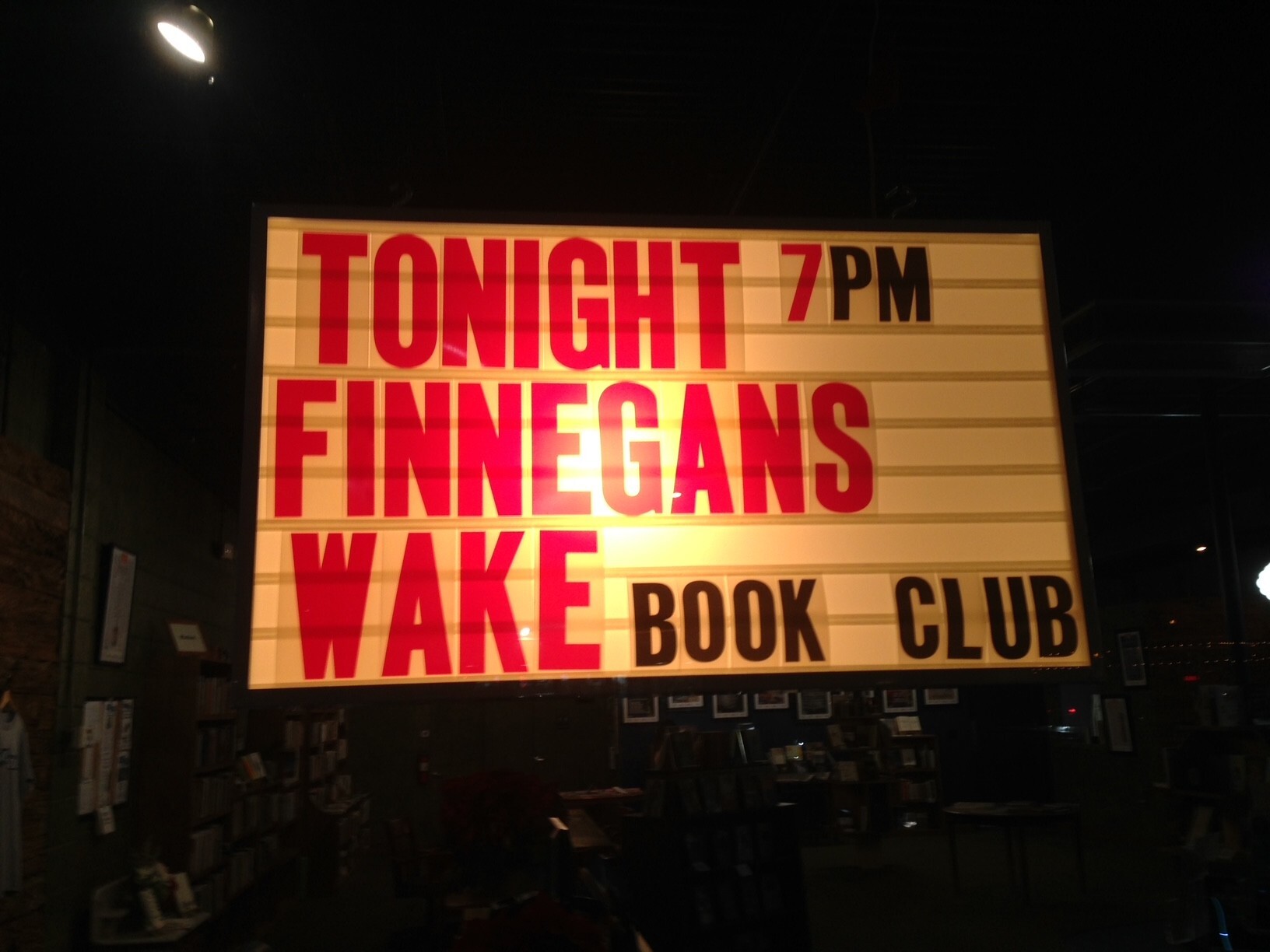
Photo: Peter Quadrino.
A Texas club has been reading
Finnegans Wake for 12 years. And making progress.

I have a bunch of reactions to today’s story about a book group reading the same James Joyce novel for 12 years and still going. One is that I would have benefited from reading Finnegans Wake with others because there was so much I didn’t understand. Another is that my stereotype about Texans needs constant correction: of course, there are people in Texas who tackle literature!

Sean Saldana wrote about this book club at Texas Standard, which I follow on Mastodon.

“In 1939, Irish author James Joyce published Finnegans Wake, a piece of literature that defies comprehension. 

“ ‘riverrun, past Eve and Adam’s,’ it begins, ‘from swerve of shore to bend of bay, brings us by a commodius vicus of recirculation back to Howth Castle and Environs.’ 

“The book starts and ends with a sentence fragment, combines multiple languages and has no clear or linear plot. It’s a work that’s so dense, one group that started in Austin has been working on it for more than a decade.

“ ‘We’re only reading one page at a time,’ said Peter Quadrino, founder and organizer of the Finnegans Wake Reading Group of Austin, TX.

“Every other week, Quadrino hosts a Zoom call where people from around the world gather and attempt to understand one of the most infamous books in English literature.

“The group spends the first 15 minutes of each meeting socializing. Then they all go around in a circle and each person reads two lines until they’re done with that week’s page.

“After that, they spend about an hour and a half researching, annotating and trying to make sense of Joyce’s experimental prose.

“ ‘We used to read two pages per meeting,’ said Quadrino. ‘Then at a certain point there was just so much going on in the pages and so much in the discussion that we had to lower it to one page per meeting.’ …

“The book’s complexity has made it a point of fascination for literary enthusiasts in the eight decades since it was first published. Houston, New York, Boston, Seattle, Dublin, Kyiv and many other cities around the world host groups dedicated to reading and analyzing Finnegans Wake. …

“ ‘I never really consider what it’s going to be like when we finish because I don’t want it to end,’ explained Quadrino, ‘and if we do finish we’ll just circle right back to the beginning and keep reading.’ ” More at Texas Standard, here.

Would you want to join a book group like that? I have heard of similar ones. Humans just don’t want to be defeated by complexity. The Athenaeum in Boston reads Proust’s Remembrance of Things Past over and over, too.

Read Full Post »

Over at the Brain Pickings blog, Maria Popova has a review of a book that features photos of famous meals in fiction.

“Food and literature have a long and arduous relationship … But nowhere does that relationship come alive more vividly and enchantingly than in Fictitious Dishes: An Album of Literature’s Most Memorable Meals  … an ingenious project by designer and writer Dinah Fried, who cooks, art-directs, and photographs meals from nearly two centuries of famous fiction. Each photograph is accompanied by the particular passage in which the recipe appeared, as well as a few quick and curious factlets about the respective author, novel, or food.

“The project began as a modest design exercise while Fried was attending the Rhode Island School of Design a couple of years ago, but the concept quickly gripped her with greater allure that transcended her original short-term deadline.

“As she continued to read and cook, a different sort of self-transcendence took place. [Although] a near-vegetarian, she found herself wrestling with pig kidney for Ulysses and cooking bananas eleven ways for Gravity’s Rainbow. …

“All of Fried’s photographs are immensely thoughtful (Ishmael’s austere dinner from Moby-Dick is not only a nautically appropriate serving of clam chowder, but also appears lit by candlelight), and some bear a distinct undertone of cultural meta-satire (representing A Confederacy of Dunces is the ultimate edible Americana, a hot dog on a classic All-American diner tablecloth).”

Check out Popova’s review here, and revel in photographs that include Sylvia Plath’s avocado and crabmeat salad, Oliver Twist’s request for “More,” Proust’s petite madeleine, Alice’s Mad Tea Party, and Heidi’s toasted cheese.

Photo: Dinah Fried
“On buffet tables, garnished with glistening hors-d’oeuvre, spiced baked hams crowded against salads of harlequin designs and pastry pigs and turkeys bewitched to a dark gold.” — The Great Gatsby, by F. Scott Fitzgerald, 1925

Read Full Post »

Here is an artist who addresses the sense of smell — and not only with lily-of-the-valley fragrance or the sea or brewing coffee.

Douglas Quenqua writes in the Science section of the NY Times that Belgian artist Peter De Cupere uses pretty much everything that has an odor.

“Peter De Cupere’s ‘Tree Virus’ sculpture wasn’t much to look at: a dead, black tree rooted in a craggy white ball suspended over a dirt pit, all of it covered by a plastic igloo. Built on a college campus in the Netherlands in 2008, the whole thing might have been leftover scenery from a Tim Burton film if it weren’t for the outrageous smell.

‘Inside the igloo, a heady mix of peppermint and black pepper saturated the air. It flooded the nose and stung the eyes. Most visitors cried; many ran away. Others seemed to enjoy it, laughing through the tears. Such is the strange power of olfactory art.

“ ‘When you walk into an installation with scent, you cannot hide. Your body starts to react,’ said Mr. De Cupere. … He is just one of several contemporary artists using odor to create art that delivers an intensely personal, emotional and sometimes physical experience. …

“Smell has an unfair advantage over the other senses when it comes to eliciting a response, researchers say. ‘There is a unique and directly intimate connection between where smell is processed in the brain and where memory is stored,” said Rachel Herz, a psychologist at Brown University and the author of The Scent of Desire: Discovering Our Enigmatic Sense of Smell. …

“Just as Proust’s madeleines opened a floodgate to childhood memories, scents can recall different feelings depending on how a person first encountered them.”

More here.

Photo: Peter De Cupere
Peter De Cupere’s “Tree Virus” sculpture, which causes many visitors to cry.

Read Full Post »