Feeds:
Posts
Comments

Posts Tagged ‘recording’

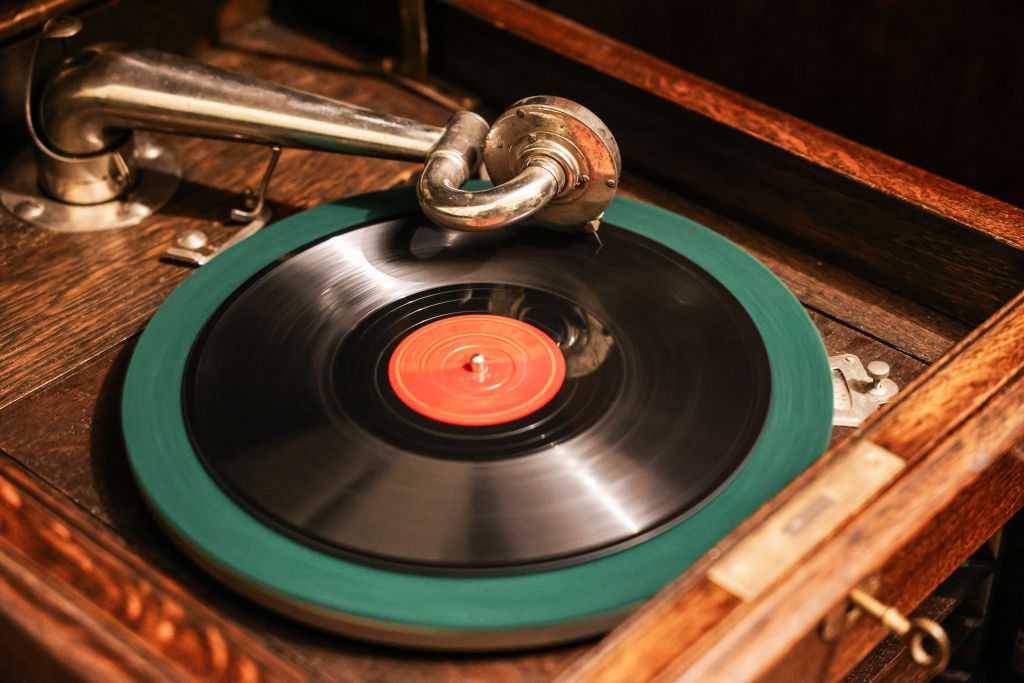
Photo: picture alliance.
An old-time record player playing a 78 rpm record. This is shellac — ie, before vinyl.

Maybe it’s because I still feel guilty about how my brother and I made a game of smashing our grandfather’s shellac records when we were children, but I can’t help taking sides in the court battle described below. Now that I’m a grownup, I believe that we should protect these oldies, and let the public get at them.

Ashley Belanger reports at Ars Technica that the Internet Archive’s battle with music publishers has ended in a settlement that will, in my view, be to the public’s benefit.

“A settlement has been reached in a lawsuit where music publishers sued the Internet Archive over the Great 78 Project, an effort to preserve early music recordings that only exist on brittle shellac records.

“No details of the settlement have so far been released, but a court filing on Monday confirmed that the Internet Archive and UMG Recordings, Capitol Records, Sony Music Entertainment, and other record labels ‘have settled this matter.’ …

“Days before the settlement was announced, record labels had indicated that everyone but the Internet Archive and its founder, Brewster Kahle, had agreed to sign a joint settlement, seemingly including the Great 78 Project’s recording engineer George Blood, who was also a target of the litigation. But in the days since, IA has gotten on board, posting a blog confirming that ‘the parties have reached a confidential resolution of all claims.’ …

“For IA — which strove to digitize 3 million recordings to help historians document recording history — the lawsuit from music publishers could have meant financial ruin. Initially, record labels alleged that damages amounted to $400 million, claiming they lost streams when IA visitors played Great 78 recordings.

“But despite IA arguing that there were comparably low downloads and streams on the Great 78 recordings — as well as a music publishing industry vet suggesting that damages were likely no more than $41,000 — the labels intensified their attacks in March. In a court filing, the labels added so many more infringing works that the estimated damages increased to $700 million. It seemed like labels were intent on doubling down on a fight that, at least one sound historian suggested, the labels might one day regret.

“Notably, the settlement comes after IA previously lost a court fight with book publishers last year, where IA could have faced substantial damages. In that fight, IA accused book publishers of being unable to prove that IA’s emergency library had hurt their sales. But book publishers, represented by the same legal team as music labels, ultimately won that fight and negotiated a judgment that similarly included an undisclosed payment.

“With both legal battles likely ending in undisclosed payments, it seems likely we’ll never know the true cost to the digital library of defending its digitization projects.

“In a court filing ahead of the settlement in the music label fight, IA had argued that labels had added an avalanche of infringing works so late into the lawsuit to create leverage to force a settlement.

“David Seubert, who relied on the Great 78 Project and manages sound collections at the University of California, Santa Barbara library, previously told Ars that he suspected that the labels’ lawsuit was ‘somehow vindictive,’ because the labels’ revenue didn’t seem to be impacted by the Great 78 Project. He suggested that perhaps labels just ‘don’t like the Internet Archive’s way of pushing the envelope on copyright and fair use.

” ‘There are people who, like the founder of the Internet Archive, want to push that envelope, and the media conglomerates want to push back in the other direction.’ “

More at ArsTechnica, here. Of related interest, at My Dad’s Records, here, my nephew once preserved the old R&B vinyl 78s of the same naughty brother who was guilty with me, but my nephew let the tumblr site go years ago. Check it out anyway.
Read Full Post »

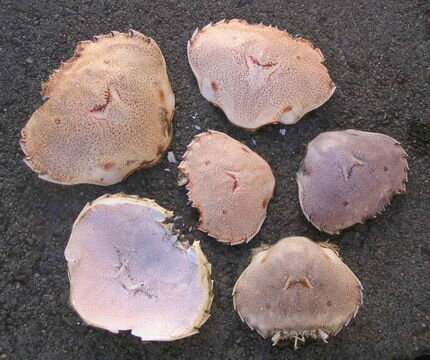
Photo: Encyclopedia of Life.
Paddle crab, endemic to New Zealand. A new study reports on “ways to monitor visually elusive but vocal species in aquatic environments.”

Technology is being used in ways that that sometimes hurt, sometimes help, the creatures of the natural world. Today’s story is about helping.

Shweta Varshney at Samachar Central introduces us to the Global Library of Underwater Biological Sounds and its wonderful acronym GLUBS. GLUBS uses audio technology to help monitor changes in marine life.

“Of the roughly 250,000 known marine species,” reports Varshney, “scientists think all ~126 marine mammals emit sounds — the ‘thwop’, ‘muah’, and ‘boop’s of a humpback whale, for example, or the ‘boing’ of a minke whale. Audible too are at least 100 invertebrates, 1,000 of the world’s 34,000 known fish species, and likely many thousands more.

“Now a team of 17 experts from nine countries has set a goal of gathering on a single platform huge collections of aquatic life’s tell-tale sounds, and expanding it using new enabling technologies — from highly sophisticated ocean hydrophones and artificial intelligence learning systems to phone apps and underwater GoPros used by citizen scientists.

“The Global Library of Underwater Biological Sounds, ‘GLUBS,’ will underpin a novel non-invasive, affordable way for scientists to listen in on life in marine, brackish and freshwaters, monitor its changing diversity, distribution and abundance, and identify new species. Using the acoustic properties of underwater soundscapes can also characterize an ecosystem’s type and condition.

“Says lead author Miles Parsons of the Australian Institute of Marine Science: ‘The world’s most extensive habitats are aquatic and they’re rich with sounds produced by a diversity of animals. With biodiversity in decline worldwide and humans relentlessly altering underwater soundscapes, there is a need to document, quantify, and understand the sources of underwater animal sounds before they potentially disappear.’

“The team’s proposed web-based, open-access platform will provide:

  • “A reference library of known and unknown biological sound sources (by integrating and expanding existing libraries around the world);
  • “A data repository portal for annotated and unannotated audio recordings of single sources and of soundscapes;
  • “A training platform for artificial intelligence algorithms for signal detection and classification;
  • “An interface for developing species distribution maps, based on sound; and
  • “A citizen science-based application so people who love the ocean can participate in this project

“The wide range of uses for PAM [passive acoustic monitoring] is expanding in step with advances in technology, providing a large volume of easily-accessible data. …

“Many fish and aquatic invertebrate species are predominantly nocturnal or hard to find, the paper notes, making visual observations difficult or impossible. As a result, ‘PAM is proving to be one of the most effective ways to monitor visually elusive but vocal species in aquatic environments, which can potentially aid in more effective conservation management,’ including zoning in marine park areas or fishery closures, the paper says.

“Besides making sounds for communication, many aquatic species produce ‘passive sounds’ while eating, swimming, and crawling — often less acoustically complex or distinct than active sounds but important contributions to an ecosystem’s tell-tale soundscape.

“ ‘Collectively there are now many millions of recording hours around the world that could potentially be assessed for a plethora of both known and, to date, unidentified biological sounds. …

“ ‘This developing library is a key way to catalog, monitor and track changes in biodiversity on reefs and other ocean habitats before they are gone but also help us define “what a healthy reef is” as we seek to rebuild reefs.’ …

“ ‘A database of unidentified sounds is, in some ways, as important as one for known sources,’ the scientists say. ‘As the field progresses, new unidentified sounds will be collected, and more unidentified sounds can be matched to species. …

“ ‘A global database could serve broader questions, like determining universal trends in underwater sound production, while individual, specialized repositories could continue to inform and detail other topics, such as documenting the presence of soniferous species in a particular region.’

“[Listening] to the sea has revealed great whales swimming in unexpected places, new species and new sounds.” Learn about what listening is doing for other species here. No firewall.

Read Full Post »

img_5840_slide-ff1c3b28ab10fe2abcf7dd215aafd3846b326aee-s700-c85

Photo: Chris Livesay for NPR
A security guard blocks off the recording area outside the Violin Museum in Cremona, Italy, for a project to preserve every note of the Stradivarius violin.

When a whole town — or almost a whole town — gets on board to support an artistic project, the results can be impressive. I imagine that the key is to tap what matters to people. In this case, violins.

Christopher Livesay reported about the unusual preservation project at National Public Radio (NPR) in February.

“Inside the concert hall of the Violin Museum in Cremona, Italy, Antonio de Lorenzi plays the prelude from Bach’s Partita No. 3 on a Stradivarius violin. Cremona is the town where master luthier Antonio Stradivari crafted his storied instruments three centuries ago.

“But there’s no guarantee that his instrument’s inimitable sound will survive for centuries more, says Fausto Cacciatori, the museum’s chief conservator.

” ‘What will these instruments sound like in 200 years? I hope they can still be played,’ he says. ‘But you never know. All it takes is one unfortunate event. An earthquake, for instance. Think about what happened to so much art during World War II.’

“Cacciatori says Stradivarius instruments need a 21st century failsafe — and someone who understands music as well as technology to pull it off. Enter deejay Leonardo Tedeschi. …

“When he’s not spinning records, Tedeschi runs Audiozone, a northern Italian sound engineering firm. And he had an idea: ‘To bring the sound of Stradivari and make it accessible around the world,’ he says.

“The idea came to him in 2014, when he wanted to mix the analog sounds of Stradivarius violins in some of his own electronic recordings, but discovered the elements he needed were lacking. That’s when he reached out to the Violin Museum in Cremona, just a 45-minute drive from his native Piacenza, with a proposal.

“First, they would need to record Stradivarius instruments, and while they were at it, those of other master luthiers. Then they would have to save the recordings in a database that future composers could use to make their own music electronically.

“The Violin Museum, which was already concerned about preserving these sounds for future generations, agreed. … They would have to painstakingly record every possible note that can be played on each instrument.

” ‘Every possible note, and even more difficult, every note transition,’ explains Tedeschi. ‘From one note to all the other ones in the same string.’ …

“In the concert hall, Lorenzi, who is with the Italian Symphony Orchestra and has performed in the world’s top concert halls, plucks the notes C, D, E, F, G, A, B and C — ‘do, re, mi, fa, sol, la, ti, do’ — on the Stradivarius violin. Then down the scale, until the engineers say they’ve got it. …

“He says, ‘It takes a lot of mental and physical concentration. It’s one of the most demanding things I’ve ever done.’

“But that meditative concentration is hard-won. Outside the museum, Tedeschi points out the thorn in his side.

“A rumble passes as a woman drags a suitcase across cobblestones. Then, the hiss of a street-sweeper machine. It’s what you’d expect in a city of 70,000 people, with a bustling open-air market and a population of typically boisterous Italians. …

” ‘Every time we hear this sound, the sound will mix with the frequency of our instruments, so we cannot use that sound in our product,’ Tedeschi laments.

“At the end of December, just before recording was set to begin, he went to the mayor of Cremona, Gianluca Galimberti, and asked for help. … The mayor asked the people of Cremona to please keep it down, and blocked traffic around the concert hall during recordings from Jan. 7 to Feb. 9.”

Did it work? Read more here.

Read Full Post »


Photo: Ginny Fordham
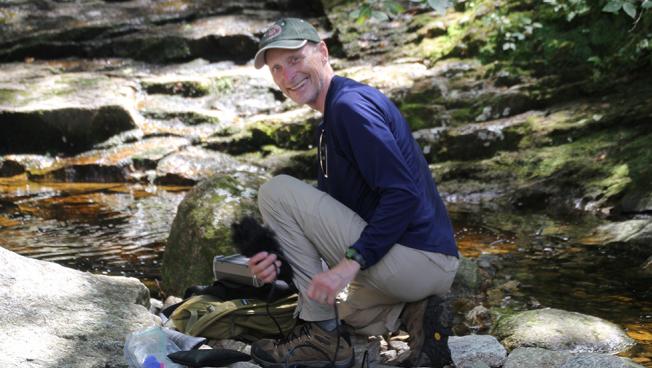
Berklee professor Steve Wilkes gathers sound at the White Mountain National Forest in New Hampshire. A recent project also captures Cape Cod.

Berklee professor Steve Wilkes and his collaborator David Masher have created some amazing soundscapes that capture the music of the natural world. Their work is described at the Hear the Forest website:

“Hear The Forest is an effort to initiate the process of building an aural-map – essentially, an audio time capsule – of New Hampshire’s White Mountain National Forest.  Supported by the National Forest Service and the Arts Alliance of Northern New Hampshire, this work will be performed by Berklee College of Music Professor, Steve Wilkes, as part of the 2017 Artist-in-residence program. …

“In addition to his field ecology and sound recording work, Wilkes will offer several public programs, including workshops that will provide residents and visitors with information on contributing to the ongoing sound file collection on the White Mountain National Forest. …

“ ‘I hope to be able to express and communicate to others this profound sense of inspiration – and to help everyone slow down a bit, and really listen,’ ” Wilkes says. More here.

You might also like hear an interesting interview with Wilkes that was broadcast at WGBH. The station provides this intro: “Nature is rich with dynamic sounds, like the roaring of waterfalls or the sweetness of birdsong.

“Berklee professor Steve Wilkes … captured the still whispers of buzzing bugs, the martian-like atmosphere at the summit of Mount Washington and the laughter of children enjoying the park — all essential sounds to create a ‘digital aural map’ of the forest, which he calls Hear The Forest. Callie Crossley speaks with Wilkes about his project.” More here.

I like the idea of encouraging others to contribute their own nature recordings to the White Mountains project. It feels like something anyone could do if they just paid attention — and paying attention is the whole idea.

Read Full Post »

The website Narratively just alerted me to something cool from StoryCorps, a feature I generally hear on National Public Radio (NPR).

According to the StoryCorps website, “The first-ever animated feature from StoryCorps, Listening Is an Act of Love, presents six stories from 10 years of StoryCorps, where everyday people sit down together to ask life’s important questions and share stories from their lives. Framing these intimate conversations is an interview between StoryCorps founder Dave Isay and his nine-year-old nephew, Benji.

Listening Is an Act of Love will be broadcast by public television stations nationwide. … on varying dates through February 2014. Can’t wait until the animated special airs on your local station? Watch on PBS Roku and Apple TV channels — available on DVD, too!” More here.

(At ny1.com, here, you can read how recording people’s stories caused Isay to take a permanent detour from his medical school ambitions.)

Do you have favorite StoryCorps stories? Have you ever created one?

I have a tape of my father reading the Kipling story “The Elephant’s Child” and poems he loved like “La Belle Dame Sans Merci,” which always choked him up. But if you do a StoryCorps story, you get it archived at the Library of Congress — probably more permanent than my old cassette tape.

Read Full Post »

Longtime readers may recall I took a playwriting class a couple years ago. One of the assignments — which I blogged about here — was to listen in on a conversation in a public place and write it down word for word. Very awkward, but a good lesson in the random way people really talk.

Now the artist/cabby Daniel J. Wilson has taken the concept to an extreme, recording customers’ conversations and using them in his art.

Matt Flegenheimer writes at the NY Times that while driving a taxi in New York, Wilson “secretly recorded the conversations of his passengers, assembled the highlights into an audio collage of the back-seat musings and installed the final product in his taxi, playing the clips for his riders …

“ ‘It’s this world where people act like you don’t exist, even though you’re three feet away,’ Mr. Wilson, 35, said from the front seat of his cab recently. ‘You get this fragment of a person.’ ” More.

Much has been done with the invisibility theme in literature: Ralph Ellison’s Invisible Man, the powerful Mammy in The Sound and the Fury, the murderer disguised as an “invisible” waiter in an Agatha Christie novel — you can probably come up with more.

The Times article discusses the invasion of privacy. I think invasion of privacy might be the penalty for treating humans as invisible.

Photo: Hiroko Masuike/The New York Times
Victoria Reis, left, called Daniel J. Wilson’s audio collage “the least pretentious and most experimental” work she had seen all week, and tipped him.

Read Full Post »

Living on Earth, a national radio program produced in Somerville, Massachusetts, has interviewed an interesting guy who makes audio recordings of nature.

He may record, for example, what a woodland sounds like before a logging company comes in and what it sounds like after clear cutting. He may record the sounds of insects in trees. He says it is nearly impossible to get away from man-made sounds when recording nature.

Listening to his recordings early this morning resulted in my listening for the birds more on the walk I took later. (And I turned to see a very jubilant cardinal.)

“Few have heard the world as Bernie Krause has. Originally trained as a musician, he spent years recording the most famous musicians of the 1960s and 70s. Then he left the studio to explore the origins of music in nature. Krause has recorded wild sounds in places few have ever been or even dreamed of. Living on Earth’s Ike Sriskandarajah listens in.” Listen here or read transcript.

Krause calls his field of study soundscape ecology. Here is his new book, The Great Animal Orchestra.

Read Full Post »