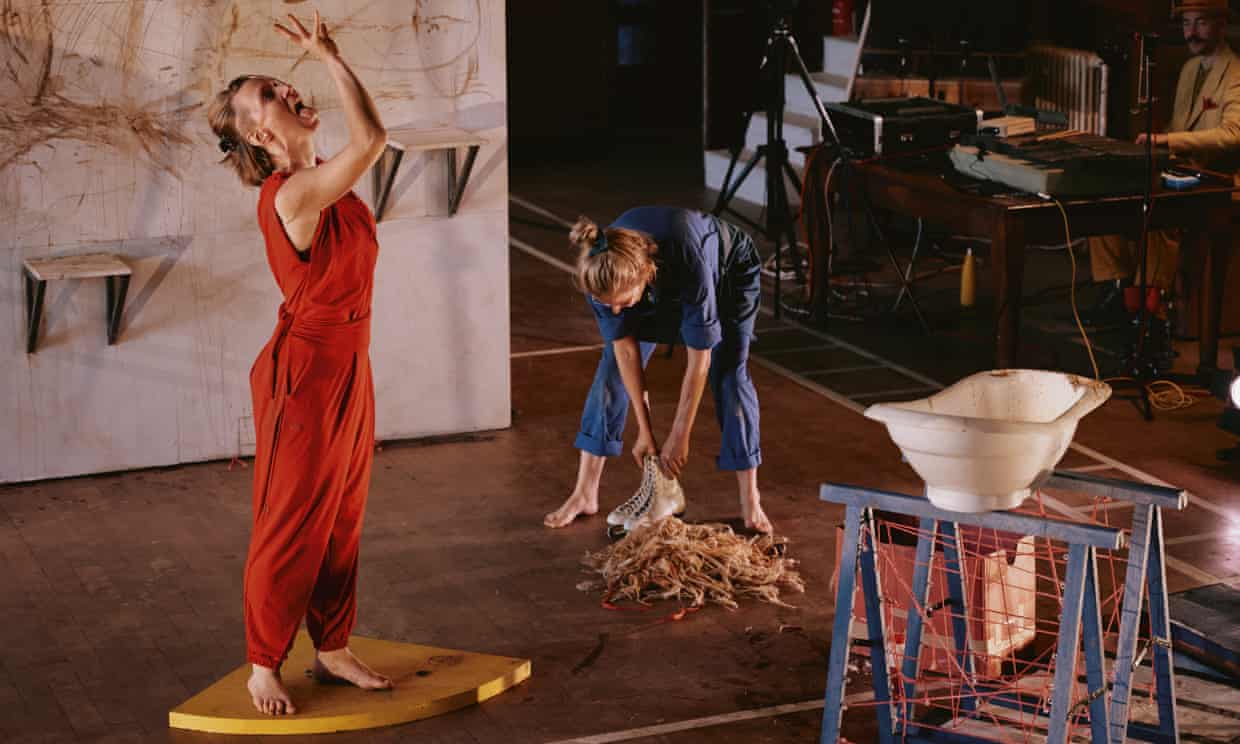
Photo: Luke Waddington.
At Cambois Miners Welfare Institute, Esther Huss’s avant garde dance group involved local residents in performing Stairwall. Another choreographer in the north of England tapped local low-income children for a production and realized that it would be practical to make costumes that the kids could keep.
When the arts engage local people, they learn fast that fantasy tied to the practical concerns of daily life works best.
Lyndsey Winship reports at the Guardian on dance groups in the UK that are serious about involving the community.
“On the beach, the sand is black-flecked with coal. The pit closed in 1968, houses condemned and residents pushed to move out. But people stayed. ‘There’s not much in the way of anything really,’ says one local resident, Becca Sproat, except for a strong sense of community.
“This isolated patch of Northumberland seems an unlikely place for the German choreographer Esther Huss to have set up shop, after 20 years in London. But her husband, the playwright Alex Oates, who grew up down the coast in Whitley Bay, brought her here. ‘I fell in love with the oddness of this place, this meeting of the industrial and nature and being slightly outside mainstream society. It’s creatively interesting,’ she says. …
“In the middle of a row of brightly painted houses stands the Cambois Miners Welfare Institute, built in 1929. It had been unused for more than a decade until Huss asked to have a look inside. … Huss and Oates took on the lease, shared with the local boxing club. So there is a boxing ring on the hall’s stage and leather punchbags along one wall. As well as Huss making her own work here, she runs a dance group, and Oates runs a writing group, shivering through the winter with no heating and scraping together funding to keep everything free. Some artists pay lip service to reaching new audiences, Huss and Oates are actually living it. Next is a two-year project Cambois Creates, to make a memorable event for the whole community.
“Huss’s choreography is inspired by dadaism, German expressionism and the Japanese dance-theatre form butoh, and in the Cambois dance group, she encourages novice dancers to create their own movement.
‘My family howl at me,’ laughs 61-year-old Alison Johnson, ‘ “Oh mam, show us your latest interpretive dance!” But it’s nice to do something different,’ she says.
“ ‘It’s become such a safe environment where we all get out of our comfort zone, because we trust each other, because of Esther. It’s special.’
“Sproat, 33, had been stuck at home for 16 months during the pandemic when she got a leaflet through the door. ‘Something about a dance group, and I just laughed and binned it, because there’s no way I was going to do that. Or so I thought!’ she says. Desperate to get out of the house, she agreed to volunteer at the Institute, ‘And somehow Esther’s enthusiasm rubbed off on me. I’m not a dancer,’ says Sproat, who has some mobility issues, ‘but I’ve learned how to express myself through movement. I’m a lot more confident than I was.’ …
“You’re a long way from the London bubble and for artists working here that can be part of the appeal. ‘Moving up here, it changed everything,’ says Huss. ‘I always felt like, does London need another dance piece?’ Liv Lorent, who moved to Newcastle 30 years ago, tells me the same: ‘London didn’t need another choreographer.’ Lorent only planned to stay a few months, but fell in love with the people, the light, the beauty, the audiences. [They’re] no-nonsense, there’s no woolliness, she says, but there’s always a sense of humor. …
“Lorent describes herself as ‘all heart and idealism’ and being in the north-east has allowed that. Like Huss, she’s long been committed to community involvement. Her company, balletLORENT, recently moved into a 1930s former school building in Newcastle’s deprived West End. Lorent frequently works with local adults and children in performances. She tells me about one project where there was a costume budget, but knowing some of those children were in need of every day clothes, she made the costumes something they could take home and wear after the show. It’s about creating fantasy, while living in the real world.
“Huss likes to take her fantasies into the real world. Her last piece, Stairwall, toured in unconventional venues including a timber merchants in North Shields. She heard that some of the male staff were expecting the dancers to arrive in heels and sexy outfits – ‘It’s quite blokey up here sometimes’ – so they must have been surprised by Huss’s multidisciplinary dance-theatre. But some of the men were game to be part of the performance, one telling Huss: ‘When I die, this is going to be one of the proudest days of my life.’ She loves seeing how people respond to her work. ‘I’m not pretending everyone liked it, but generally people were really open to it,’ says Huss.
“ ‘I was surprised how immersed I became in it,’ says Johnson. ‘I found myself becoming quite emotionally charged. The fact that she’s showcased these within Cambois, I remember feeling very privileged that something you would see on a stage in a major town or city was on in Cambois Institute!’
“ ‘I didn’t think I would actually like it,’ says Sproat, ‘But it was just so inspiring. Esther and Alex lived in London and there’s millions of opportunities down there. So for them to come here is amazing.’ ”
More at the Guardian, here.

 Suzanne's Mom's Blog