Feeds:
Posts
Comments

Posts Tagged ‘reintroduce’

Photo: BLM.
“The US California Condor Recovery Program, initiated in the 1970s, represented an enormous change in the strategy of species conservation,” writes Knowable Magazine.

They are not as appealing as, say, hummingbirds, but the California condors had a lot of environmentalists worried in the 1970s, including a young boy I knew who grew up to be a respected biologist and scientific photographer.

I remember him talking a lot about condors when we were carpooling. And I thought, “Well, condors. An odd obsession for a child.”

Thank goodness people get obsessed about the least beautiful denizens of our planet.

Iván Carrillo tells the condor story at Knowable Magazine via the Tucson Sentinel.

“The spring morning is cool and bright in the Sierra de San Pedro Mártir National Park in Baja California, Mexico, as a bird takes to the skies. Its 9.8-foot wingspan casts a looming silhouette against the sunlight; the sound of its flight is like that of a light aircraft cutting through the wind. In this forest thick with trees up to 600 years old lives the southernmost population of the California condor (Gymnogyps californianus), the only one outside the United States. Dozens of the scavenging birds have been reintroduced here, to live and breed once again in the wild.

“Their return has been captained for more than 20 years by biologist Juan Vargas Velasco and his partner María Catalina Porras Peña, a couple who long ago moved away from the comforts of the city to endure extreme winters living in a tent or small trailer, to manage the lives of the 48 condors known to fly over Mexican territory. Together — she as coordinator of the California Condor Conservation Program, and he as field manager — they are the guardians of a project whose origins go back to condor recovery efforts that began in the 1980s in the United States, when populations were decimated, mainly from eating the meat of animals shot by hunters’ lead bullets.

“In Mexico, the species disappeared even earlier, in the late 1930s. Its historic return — the first captive-bred condors were released into Mexican territory in 2002 — is the result of close binational collaboration among zoos and other institutions in the United States and Mexico.

“Beyond the number on the wing that identifies each individual, Porras Peña knows perfectly the history and behavior of the condors under her care. … She captures her knowledge in an Excel log: a database including information such as origin, ID tag, name, sex, age, date of birth, date of arrival, first release and number in the Studbook (an international registry used to track the ancestry and offspring of each individual of a species through a unique number). Also noted is wildlife status, happily marked for most birds with a single word: ‘Free.’ …

“The California condor, North America’s largest bird, has taken flight again. It’s a feat made possible by well-established collaborations between the US and Mexico, economic investment, the dedication of many people and, above all, the scientific understanding of the species — from the decoding of its genome and knowledge of its diseases and reproductive habits to the use of technologies that can closely follow each individual bird.

“But many challenges remain for the California condor, which 10,000 years ago dominated the skies over the Pacific coast of the Americas, from southern Canada to northern Mexico. Researchers need to assemble wild populations that are capable of breeding without human assistance, and with the confidence that more birds are hatched than die. It is a tough battle against extinction, waged day in and day out by teams in California, Arizona and Utah in the United States, and Mexico City and Baja California in Mexico.

“The US California Condor Recovery Program, initiated in the 1970s, represented an enormous change in the strategy of species conservation. After unsuccessful habitat preservation attempts, and as a last-ditch attempt to try to save the scavenger bird from extinction, the United States Fish and Wildlife Service and the California Fish and Game Commission advocated for a decision as bold as it was controversial: to capture the last condors alive in the wild and commit to breeding them in captivity. …

“On April 19, 1987, the last condor was captured, marking a critical moment for the species: On that day, the California condor became officially extinct in the wild.

“At the same time, a captive breeding program was launched, offering a ray of hope for a species that, beyond its own magnificence, plays an important role in the health of ecosystems — efficiently eliminating the remains of dead animals, thus preventing the proliferation of diseases and environmental pollution.

“This is what is defined as a refaunation project, says Rodolfo Dirzo, a Stanford University biologist. … Refaunation, Dirzo says, involves reintroducing individuals of a species into areas where they once lived but no longer do. He believes that both the term and the practice should be more common. …

“The California Condor Recovery Program produced its first results in a short time. In 1988, just one year after the collection of the last wild condors, researchers at the San Diego Zoo announced the first captive birth of a California condor chick.

“The technique of double or triple clutching followed, to greater success. Condors are monogamous and usually have a single brood every two years, explains Fernando Gual, who until October 2024 was director general of zoos and wildlife conservation in Mexico City. But if for some reason they lose an egg at the beginning of the breeding season — either because it breaks or falls out of the nest, which is usually on a cliff — the pair produces a second egg. If this one is also lost or damaged, they may lay a third. The researchers learned that if they removed the first egg and incubated it under carefully controlled conditions, the condor pair would lay a second egg, which was also removed for care, leaving a third egg for the pair to incubate and rear naturally.

“This innovation was followed by the development of artificial incubation techniques to increase egg survival, as well as puppet rearing, using replicas of adult condors to feed and care for the chicks born in captivity. That way, the birds would not imprint on humans, reducing the difficulties the birds might face when integrating into the wild population.

“Xewe (female) and Chocuyens (male) were the first condors to triumphantly return to the wild. The year was 1992, and the pair returned to freedom accompanied by a pair of Andean condors, natural inhabitants of the Andes Mountains in South America. Andean condors live from Venezuela to Tierra del Fuego and have a wingspan about 12 inches larger than that of California condors. Their mission here was to help to consolidate a social group and aid the birds in adapting to the habitat. The event took place at the Sespe Condor Sanctuary in the Los Padres National Forest in California. In a tiny, tentative way, the California condor had returned.

“By the end of the 1990s, there were other breeding centers, such as the Los Angeles Zoo, the Oregon Zoo, the World Center for Birds of Prey in Boise, Idaho, the San Diego Zoo and the San Diego Zoo Safari Park. Then, in 1999, the first collaboration agreements were established between the United States and Mexico for the reintroduction of the California condor in the Sierra de San Pedro Mártir National Park. The number of existing California condors increased from just over two dozen in 1983 to more than 100 in 1995, some of which had been returned to the wild in the United States. By 2000, there were 172 condors and by 2011, 396.

“By 2023, the global population of California condors reached 561 individuals, 344 of them living in the wild.” Lots more at Knowable Magazine via the Tucson Sentinel, here.

I salute the cleverness and devotion of scientists. May they live long and prosper!
Read Full Post »

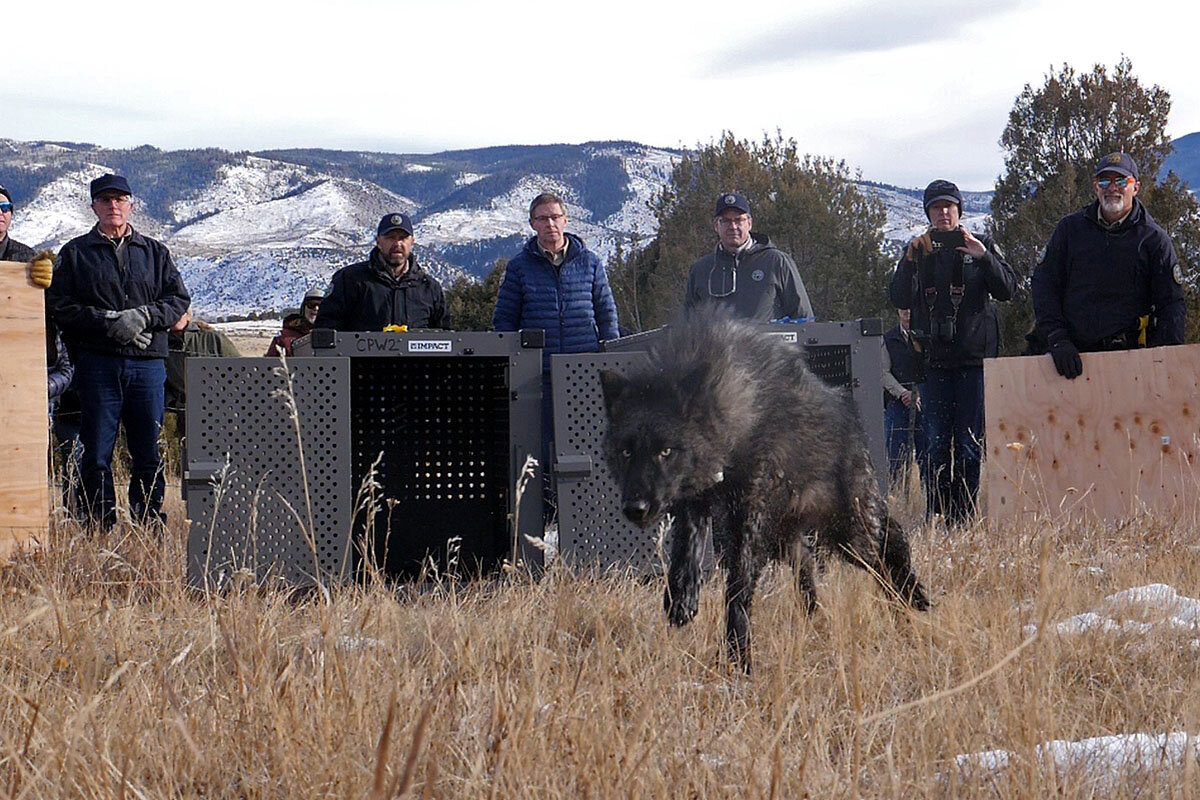
Photo: Jerry Neal/Colorado Parks and Wildlife.
Via Christian Science Monitor: “Wolf 2302-OR runs into the wilderness as Colorado Parks and Wildlife released five gray wolves onto public land in Grand County, Colorado, on Monday, Dec. 18, 2023.”

Rewilding involves trade-offs. That’s why reintroducing the gray wolf with the scary eyes to its old haunts requires taking the needs of many constituencies into account.

As Sarah Matusek reports at the Christian Science Monitor, “A new era dawned in Colorado’s Rocky Mountains [in December] with the release of five gray wolves. 

“The reintroduction of the wild canines to Colorado fulfills a voter-passed plan to begin restoring the endangered species here by the end of 2023. The first batch of furry predators, flown in from Oregon, bounded out of crates in Grand County, Colorado, across an undisclosed meadow. 

“Wolves are contentious in the western United States, with disagreement about the threats they may pose versus their ecological benefit. A judge last week denied a last-minute lawsuit from the Colorado cattle industry seeking to block the release.  

“Despite the culture-war status of wolves, their release has also spurred cooperation. Many ranchers, wolf advocates, scientists, and wildlife officials have engaged in knowledge-sharing and strategizing around conflict reduction. …

“Gray wolves, wildlife experts say, are native to the Centennial State. Killed off in Colorado by the 1940s, some have since migrated here across state lines. Colorado biologists recorded the birth of wild wolf pups in the state’s north in 2021. 

“The animal is subject to a patchwork of protections. Listed as endangered in Colorado, for instance, the gray wolf loses that status once it crosses the northern border into Wyoming. Gray wolves are protected nationally under the federal Endangered Species Act, with exceptions in the northern Rocky Mountains. 

“After the 2020 vote, Colorado got special permission from the U.S. government for its state restoration plan. This generally allows management flexibility in Colorado, such as killing wolves that attack livestock.

“The Colorado cattle industry sued state and federal wildlife agencies last week seeking to block the rollout of the plan. The Gunnison County Stockgrowers’ and Colorado Cattlemen’s associations argued that the U.S. Fish and Wildlife Service failed to produce a certain environmental study on wolf impacts that federal law required.

“On Friday, a U.S. district judge denied the plaintiffs a temporary restraining order. Their arguments, the court found, didn’t merit halting Colorado Parks and Wildlife’s wolf plan, which ‘would be contrary to the public interest.’  

“Thirty to 50 wolves could be reintroduced on Colorado’s Western Slope over the next three to five years, according to the state’s wolf management plan. 

“The Western Slope, a largely rural area, sits west of Denver and several other population centers, which carried the pro-wolf vote. The outcome underscored an urban-rural divide in a Democratic-led state that used to trend more purple.

“Supporters, including environmentalists, argue for restoring a natural balance. ‘Wolves, for millennia, have been one of the primary engines of evolution and the drivers of ecological health throughout the Northern Hemisphere,’ says Rob Edward, strategic adviser at the Rocky Mountain Wolf Project. 

“He cites an example in Colorado’s Rocky Mountain National Park. An abundance of elk there has depleted vegetation ‘in the absence of their primary predator, gray wolves,’ says Mr. Edward,. …

“Critics, including agricultural producers, raise concerns about predation of wild and cultivated animals. ‘There’s obviously the concern with the impacts to our own livestock, both financial and emotional,’ says rancher Greg Peterson, a member of the Gunnison County Stockgrowers’ Association. ‘It’s traumatizing when that animal suffers.’ …

“Wolves may help reduce elk overbrowsing and bolster habitat diversity, [Kevin Crooks, director of the Center for Human-Carnivore Coexistence at Colorado State University] says, based on research in national parks like Yellowstone, which reintroduced gray wolves in 1995. But the science also suggests that ‘wolves were likely not solely responsible’ for ecosystem changes there.

“And while wolves could harm individual livestock, he says, in terms of ranching concerns, research shows that a rebound of wolves is unlikely to have a major economic impact on the cattle industry. Yet that’s cold comfort to one Colorado ranching family that’s already seen several livestock deaths and injuries from wolves since 2021, reports the Washington Post.

“In an effort to bridge trust gaps, Dr. Crooks’ center has compiled peer-reviewed research and crowdsourced funds for nonlethal wolf mitigation, like fencing or guard dogs. The university has also engaged Western Slope stakeholders like Jo Stanko, who runs a ranch with her husband near Steamboat Sp​​rings in northwestern Colorado.

“As a voter, Ms. Stanko says she cast her ballot in 2020 against wolf releases. Though she still has concerns, three years later she holds an attitude of acceptance – and hope for solutions around wolves and ranchers sharing land. Her family continues to train livestock dogs and install new fencing, and Ms. Stanko hosted a dialogue with wolf advocates and other ranchers last year. 

“ ‘We’ve got to learn to have – and relearn how to have – civil conversations with each other,’ she says.”

More at the Monitor, here.

Read Full Post »

Photo: Morgan Hornsby
Elk on view at the Salato Wildlife Center. Kentucky is reintroducing elk where coal mines are no longer operating.

It’s interesting to me that when people compare the economic benefits of, say, working in the coal business with working in the elk-tourism business, they don’t routinely include the economic benefits of things like better health. High unemployment is a serious concern, but I do know that miners routinely got black lung disease and that there were pollution dangers to their families.

The story that made me think about this was by Oliver Whang at the New York Times.

“On a bright morning early this spring, David Ledford sat in his silver pickup at the end of a three-lane bridge spanning a deep gorge in southeast Kentucky.

“The bridge, which forks off U.S. 119, … spills out onto Mr. Ledford’s 12,000-acre property, which he and his business partner, Frank Allen, are developing into a nonprofit nature reserve called Boone’s Ridge. ..

“When Boone’s Ridge opens in 2022, it will offer a museum and opportunities for bird-watching and animal spotting. Two independent consultants have estimated that it could draw more than 1 million annual visitors and add over $150 million per year to the regional economy. This is in Bell County, in rural Appalachia, which has a poverty rate of 38 percent and an average household income of just under $25,000, making it one of the poorest counties in the United States.

The decline of the coal industry created a multibillion-dollar hole in the economy and left hundreds of thousands of acres of scarred land. But it has also created opportunities.

“Boone’s Ridge is being established on reclaimed mine land, and one of its biggest selling points is a big animal that has only recently returned to Kentucky: elk.

“When Daniel Boone wandered through the Cumberland Gap and into Kentucky in the late 1700s, the state was filled with wildlife. … But in less than a century, land development and hunting decimated or eliminated buffalo, turkey, whitetail deer, river otters, bald eagles, quail and other animals. Elk — their presence enshrined in place-names like Elk River and Elkhorn City — were among the first to go. …

“In 1944, the Kentucky Department of Fish and Wildlife Resources was established and charged with reintroducing animals of all kinds and regulating their numbers for hunting and conservation. Whitetail deer, which numbered fewer than 1,000 after the Depression, now number more than 1 million and generate $550 million in state revenue from hunting licenses, tourism and the sale of rifles and other hunting-related paraphernalia. …

“With most of the region’s threatened game restored, attention turned to restoring other species, among them elk. In 1997, the Rocky Mountain Elk Foundation, an association of hunters, offered to fund a multimillion-dollar six-year plan to airlift more than 1,500 elk to Kentucky from the western United States. …

“The plan was popular; more than 90 percent of state residents supported it. There was only one problem: Each elk eats over 40 pounds of vegetation a day, and the grassland habitats of western Kentucky, where the animals were populous in pre-settlement times, had all been developed. Farm owners did not want half-ton animals destroying their crops,. …

“But in the eastern half, where craggy mountains had previously prevented elk population growth, hunters and conservationists were presented with a remedy to this problem: abandoned coal mines. …

“Unregulated, the environmental effects of mountaintop removal-mining can be devastating and lasting. … But when reclaimed correctly, the landscape can offer opportunities for different kinds of land use, including cattle farming, housing developments and sites for tourism. …

“In 1997, a year before the bridge leading to Mr. Ledford’s land was constructed, 4,000 people gathered on the grassy slope of a reclaimed mine in Perry County as Governor Patton threw open the doors of a trailer and an elk stepped foot on Kentucky land for the first time in more than 150 years. …

“Absent any real predators, the animal’s population has exploded: The state is now home to 13,000 elk and counting, all clustered in the 16 counties of coal country. …

The economic impact is tangible. The state now issues a couple hundred tags for elk hunting each year, and a small market has developed — elk sightseeing tours, elk hunting guides — that adds about $5 million to local economies, according to the state fish and wildlife department.

“The elk industry will not come close to replacing what was lost when coal left, but ‘coal business will not be back,’ said Rodney Gardner, a naturalist at Jenny Wiley State Resort Park in Floyd County.” Read more here.

Now I want to know what Steven Stoll, author of Ramp Hollow: The Ordeal of Appalachia, thinks about all this. Through his book, I was made aware for the first time that when conservation efforts preclude subsistence farming, families often suffer.

Read Full Post »