Feeds:
Posts
Comments

Posts Tagged ‘renewable’

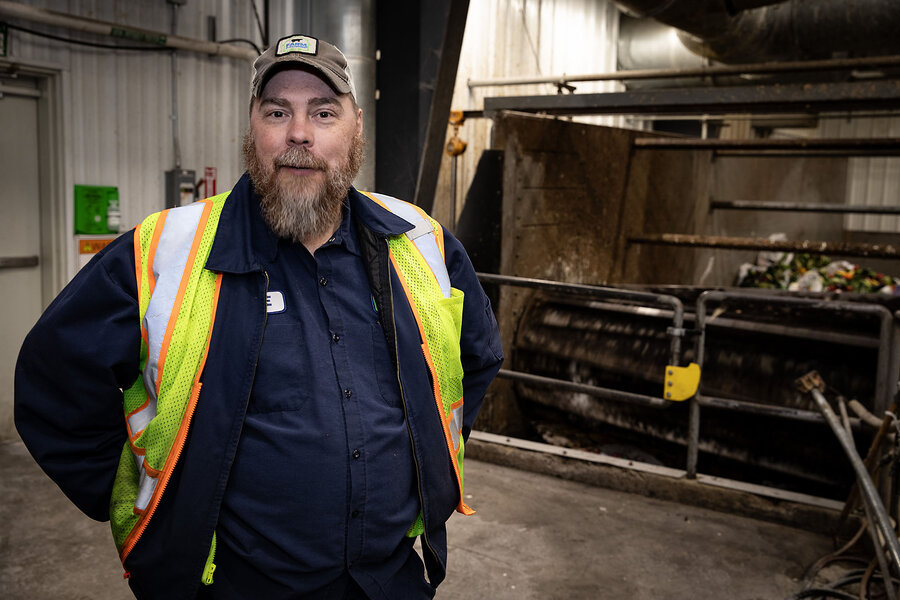
Photo: Melanie Stetson Freeman/CSM.
Abe Marciniec is the site manager of Vanguard Renewables, an organics recycling facility in Agawam, Massachusetts. It processes food waste from supermarkets, distribution centers, universities, and residential drop-offs, turning it to fuel.

Today’s story about Massachusetts being the only state to reduce food waste would seem to be a triumph, and in terms of intentions, it is. But I am ambivalent about the value of turning food waste into gas. Methane, after all, is one of the worst. See what you think.

Troy Aidan Sambajon reports at the Christian Science Monitor, “On a recent Thursday, Abe Marciniec unloads two dozen pallets of ice cream – enough to fill 31 refrigerators – into a machine that transforms it into fuel.

“Today’s flavor is room-temperature rocky road, but this facility handles all kinds of food waste from supermarkets, distribution centers, universities, and even residential drop-offs.

“ ‘We get everything you can find in Aisles 1 through 12,’ says Mr. Marciniec, site manager of the Agawam Organics Recycling Facility, owned and operated by Vanguard Renewables. Mr. Marciniec’s recycling facility is one of six in the commonwealth and only one of 25 nationwide.

“As the expired ice cream funnels into a turbo separator, Mr. Marciniec watches the machine strip food from its packaging. The organic waste is then trucked to a dairy farm, where it’s mixed with cow manure and processed into renewable natural gas.

“ ‘It’s really a great circle,’ says Mr. Marciniec. ‘Food starts at the farm, and our farms turn it back into energy. Farm to table, then back to farm.’ …

“Facilities like this one, which can process up to 250 tons of food waste daily, replace manual work typically done by hand or not done at all. That’s a crucial step in diverting waste away from landfills. Americans throw out about 40% of food annually – a waste of both money and natural resources. Reducing food waste can increase food security, promote resource and energy conservation, and address climate change.

“The Bay Sate has become a leader in reducing food waste. In fact, it’s the only state to significantly do so – to the tune of 13.2% – according to a 2024 study. Massachusetts was among the first five states to enact a food waste ban in 2014. (The others were California, Connecticut, Rhode Island, and Vermont.)

“ ‘The law has worked really well in Massachusetts,’ says Robert Sanders, an assistant professor of marketing and analytics at the University of California San Diego and co-author of the study. ‘That’s due to three things: affordability, simplicity, and enforcement.’

“[Food waste is] the largest category of waste – at 25% – sent to landfills in the United States. In 2019, 66 million tons of food waste came from retail, food service, and households. Around 60% of this waste was sent to landfills, according to the Environmental Protection Agency.

“Vanguard Renewables specializes in turning organic waste into renewable energy. The Massachusetts-based company partners with dairy farms to convert food scraps and manure into biogas through anaerobic digestion.

Microorganisms in cow manure digest organic matter, releasing biogas – a mix of methane and carbon dioxide. 

“The gas is captured in large steel vats on the farm and refined into renewable natural gas, which can be used to heat homes and power buildings. … Since 2014, Vanguard has processed more than 887,000 tons of food waste in New England, producing enough natural gas to heat 20,000 homes for a year. By 2028, the company plans to have more than 50 systems across the country.

“In western Massachusetts, Amherst College has become a model for limiting food waste at the source. Last year, it was recognized as the winner in the zero waste category in the Campus Race to Zero Waste Case Study Competition.

“ ‘The goal has been to push us aggressively to make sure everything is compostable,’ says Weston Dripps, director of sustainability. To achieve that, the school has phased out single-use plastics, to-go boxes, and even canned water, replacing them with refill stations and compostable materials.

“In 2023, Amherst College generated 238 tons of food waste – roughly 4 to 5 tons per week. But instead of ending up in landfills, Vanguard collected 100% of that waste and processed it at its Agawam facility.

“That total includes both pre-consumer waste – such as kitchen scraps from food prep – and postconsumer waste, like leftovers scraped off plates in the dining hall and campus cafés. ‘To really have a clean waste stream, we have to focus on the front end,’ says Mr. Dripps.

“Amherst’s approach goes beyond composting. Each month, the school donates 2,000 to 3,000 pounds of frozen surplus food to the the Food Bank of Western Massachusetts, ensuring edible food reaches those in need.

“Commercial businesses, too, are finding ways to cut down on waste. Maura Duggan, founder and CEO of Fancypants Baking Co., knows firsthand how much food can go to waste in the food industry. Her company produces hundreds of thousands of cookies each week.

“At its Walpole facility, Fancypants has large totes from Vanguard, which collect burnt cookies, food scraps, and anything that can’t be donated or sold. Last year alone, Fancypants diverted about 22 tons of waste. …

“Back in Agawam, Mr. Marciniec passes by 275-gallon totes full of leafy vegetables. Every day, he faces the reality that Americans waste 92 billion pounds of food a year – enough to make 145 million meals.

“ ‘It really makes you think about the things we take for granted,’ he reflects.

“ ‘Millions of people are starving everywhere, and the amount of food waste in this country is substantial,’ says Mr. Marciniec. ‘I’m sure we can do a better job.’ ”

Although I hate to quibble with this effort to at least do something, I know that enforcement has not reached my residential facility yet. Moreover, I’m pretty sure what we really need is not to have so much waste in the first place. What do you think? Is this a good first step?

Note Earle’s comment on my earlier post about this process, here.

More at the Monitor, here.

Read Full Post »

Photo: Thomas M Jauk.
This theatre’s climate impact report found wood made up half of the 41 tons of raw materials it used last year, but produced only 1% of its emissions.

What does it take to be climate neutral? This theater in Germany believes we all have role to play.

In June, Kate Connolly reported at the Guardian, “A handful of Spanish conquistadors fight through thick undergrowth to emerge in the ivy-clad ruins of a fallen civilisation during a rehearsal of Austrian playwright Thomas Köck’s Your Palaces Are Empty.

“Premiered last month at the Hans Otto Theater in Potsdam, south-west of Berlin, the bleak and unforgiving drama probes the wounds of a shattered capitalist world that has exploited its people and the planet’s resources.

“But it is not just the dystopian play that is embracing the subject of the climate crisis.

“The production itself has been declared climate neutral under a €3m [~$3.3 million] pilot project launched by Germany’s federal ministry of culture. The project, called Zero, is sponsoring the Potsdam theatrer and 25 other cultural institutions across Germany, from dance companies to libraries and museums, to completely restructure their creative modus operandi.

“ ‘It leads to restrictions,’ says the director, Moritz Peters, crouching on a wooden stool on stage as he takes a break from rehearsals. ‘But it also forces greater creativity.’

“No aspect of the process of making a play has been left unturned. From the lighting (switching to LED bulbs) to reducing travel (rehearsals are longer but less frequent to cut down on journeys) ‘everything has come in for scrutiny,’ says Marcel Klett, the managing director.

“Swapping to a green source of electricity in 2022 had already improved the theatre’s carbon footprint, reducing its annual 661 tons of emissions, or the ‘equivalent of 66 households,’ by more than 10%, but did not go far enough, Klett says. No less challenging is tackling a change in attitude. ‘Nurturing a sense that we all – from the set designer to the theatergoer – have a role to play and have to ask ourselves: “what can I concretely do?” ‘ Klett says.

“The costume designer, Henriette Hübschmann, says she initially struggled with having to abandon her usual task of creating new costumes from scratch. ‘At least half of the costumes have to come from the existing collection of props and costumes now,’ she says, on a tour of the wardrobe in the theater’s underbelly. ‘The rest should be from recycled, easily recyclable or renewable materials.’ …

“An inventory of its resources forms the basis of the theater’s first climate impact report. … It states that wood makes up half of the 41 tons of raw materials that the theater used last year, but is responsible for only about 1% of the emissions produced, while just four tons of steel and aluminum used in productions made up almost 30%. …

“Other forms of stage-set building are also being experimented with, such as growing constructions out of the organic building material mycelium. The potential use of this in other areas, such as exhibition architecture, is already being explored.

“Most [theaters], from a certain size upwards, will be required to do so from next year, under EU legislation that will treat theaters the same as all big commercial enterprises.

“Klett is hopeful of a knock-on effect among audiences and theatre staff as well as from other cultural institutes joining in. …

“He is appealing to local politicians to embrace the project by sponsoring the erection of solar panels on the theater’s roof and allowing the space – a former Prussian military stables – to be insulated, which is currently not allowed because the building is listed.

“The success of the project, though, will largely depend on the audience and the way they choose to travel to the theater. … Travel remains the theater’s single biggest polluting factor, contributing to about 50% of Hans Otto’s emissions. In response, theater tickets will double up as public transport passes in the three hours before and after the play.”

More at the Guardian, here. No paywall. Donations solicited.

Read Full Post »

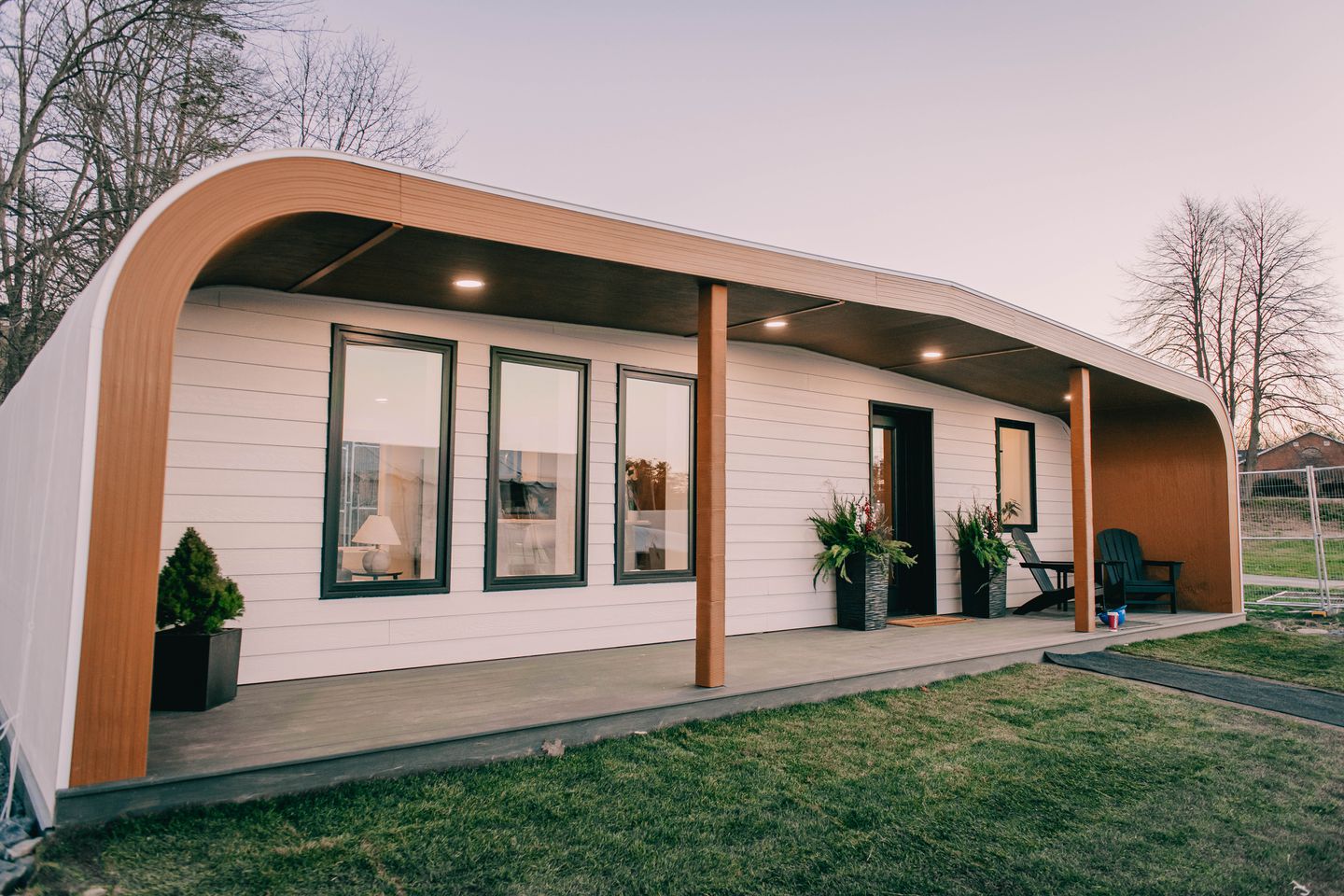
Photo: MJ Gautrau/ University of Maine.
BioHome3D, the first 3D-printed home made entirely of organic, renewable materials, was unveiled on Nov. 21 at the University of Maine’s Orono campus.

I wonder if writer Laura Graves, blogging from what she calls the Hinterlands of Central Maine, has heard about this initiative in her state. It actually looks like a good idea for any state (or nation). See what you think.

Maya Homan writes at the Boston Globe, “How do you create lots of affordable housing with limited materials, labor, and other resources? One group of researchers at the University of Maine has come up with a proposed solution: hook up a 3D printer.

“The United States faces rising rents and housing shortages, intensified by the COVID-19 pandemic, but Maine has its own unique, overlapping challenges: The state needs another estimated 20,000 homes to meet the current demand for low-income housing. It also has the oldest average population in the nation, with a median age of 44.7, an issue that exacerbates the state’s labor shortage. With pandemic-related supply chain issues and rising costs of raw materials, the already-expensive housing market has surged.

“Enter BioHome3D, the first 3D-printed home made entirely of organic, renewable materials.

“The prototype, which was created by the University of Maine’s Advanced Structures and Composites Center, has been in the works for three years, according to founding director Habib Dagher. It is 600 square feet in total, with a modern, unvaulted barrel roof, and a wide front porch with white shiplap exterior walls. The interior contains an open-concept kitchen, living, and dining area with grooved wooden walls and tall windows. The single bedroom doubles as an office, and a tiled bathroom completes the space.

“The materials used to manufacture the 3D-printed home also help address another issue in Maine: the shuttering of several pulp and paper mills that once processed residual sawdust and other byproducts from local sawmills. …

“Dagher said, ‘We asked ourselves, could we print a home with that material?’ The answer, thus far, has been yes.

“The prototype, which was unveiled Nov. 21 at the University of Maine’s Orono campus, is now undergoing tests to see how the building fares during Maine’s harsh winters. …

“Dagher’s lab is building on over two decades of research into using biomaterials to create sound structures. Though Dagher’s lab is not the first to 3D print a house, they are the first to use a 3D printer to create the entirety of the structure, as well as the first to use environmentally friendly and reusable materials.

“ ‘The walls, the floor, the roof are all bio-based, and it’s 100 percent recyclable,’ Dagher said. …

“While there are certain drawbacks to using engineered materials over natural ones — fire safety being one — Dagher said the homes have displayed an added durability throughout different climates, as well as increased resistance to termites. …

“The homes are designed using modular construction, meaning that individual rooms are manufactured indoors and driven to the construction site, where they can be quickly assembled. Dagher hopes that this method will help cut down on construction time, as builders will not be as impacted by weather conditions.

“As the project is still in the testing phase, there aren’t yet definitive estimates for how many people will be needed to construct the homes, or how much each tiny house will cost to manufacture. However, Dagher said the use of sustainable materials and the ability to 3D print the structure ‘really changes the game in terms of how we think of housing content and how we think of construction.’

“Though the research process is far from over, ‘we’ve learned a lot,’ he said. ‘We’ve learned what not to do, as well as what to do, and the learning has not ended.’

“The lab’s next steps are to build a manufacturing plant (which Dagher affectionately nicknamed the ‘factory of the future’) to be able to produce the homes en masse. Once the factory is up and running, they hope to be able to 3D print a home within 48 hours, and move on to larger projects like housing developments.

“ ‘There’s a lot of potential, not only to solve a crisis in Maine, but to assist in a solution to the housing crisis nationally as well,’ he said.”

More at the Globe, here. See also my 2018 post on a different kind of 3-D house in the Netherlands, here.

Read Full Post »

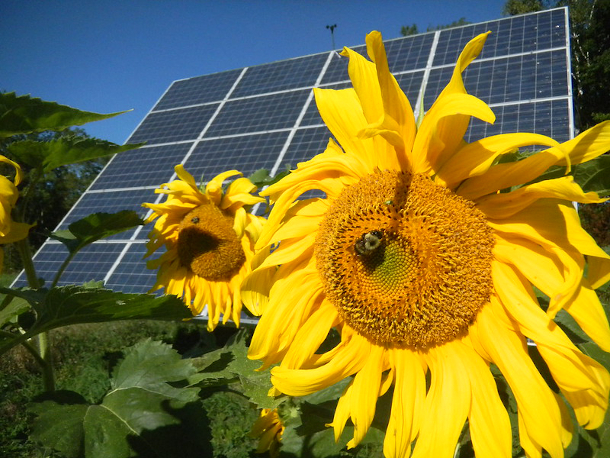
Photo: Sterling College, Flickr, CC BY-S.
Solar panels and sunflowers, the national flower of Ukraine. Solar energy and renewables can help keep oil tyrants from invading other countries.

One of the challenges Ukrainian allies have had in fighting back against Putin’s war is that so many of them have been dependent on Russian oil.

Bobby Bascomb at Public Radio International’s Living on Earth interviews environmentalist Bill McKibben on ways to get serious about renewables and free ourselves from the power of the fossil fuel industry.

“BOBBY BASCOMB: The horrors of Russia’s war in Ukraine are funded in large part by fossil fuels that it sells to the tune of half a billion dollars every day. Nearly half the federal budget for Russia comes from oil and gas revenue and the European Union is their biggest customer. … But the EU recently unveiled a plan to cut Russian gas imports by two-thirds this year and eliminate imports entirely by 2027.

“To help speed that phase out the Biden White House is reportedly considering a plan to use the Defense Production Act to rapidly manufacture and send electric heat pumps to European homes, many of which are currently heated by Russian gas. This idea to make Heat Pumps for Peace was first raised by writer and activist Bill McKibben, who co-founded 350.org and Third Act. … So first remind us, what exactly is a heat pump? …

“BILL MCKIBBEN: Think of it as an almost reversible air conditioner, made often by the same people. It takes ambient heat from the air, and uses that to heat the inside of your house, and does it pretty well, down to quite cold temperatures, because it turns out there remains some latent heat in the air even on a cold day. It’s wonderful technology because it’s able to produce heat with far, far less emissions than if you were running the gas furnace or the oil furnace in the basement. It runs off electricity, which means that the cleaner you get the grid, the cleaner the emissions result. And in the case of the current war in the Ukraine, it’s particularly significant because deployed in sufficient number across Europe, it would rob Vladimir Putin of his longtime weapon, the threat to turn off the gas supply to Western Europe. …

“What you really want, of course, is to connect them to a grid that gets steadily, steadily cleaner. … Not just in order to save the planet’s climate, though that would certainly be nice. But also because [fossil fuel] is the fuel of choice for autocrats.

“BASCOMB: Well, why push for heat pumps then and not say, expanded rooftop solar, for instance?

“MCKIBBEN: That works too, go to work on any of these things. In fact, some of the things are super easy. There’s a lot of spare capacity in the US, apparently, for producing insulation right now. And anybody who’s spent time say, in a British house knows that insulation was not a big feature of a lot of the housing stock. So let’s get bundles of that across the ocean as fast as we can. The point is that if we’re able to make use, say, of the Defense Production Act, which every president since the Korean War has used, and which both Trump and Biden used to speed up vaccine production, then we can take advantage of this spare capacity and get some of this stuff over to Europe before next October, when I would predict it’s going to start getting cold again. …

“BASCOMB: Well, how quickly can manufacturers ramp up production of heat pumps on the massive scale that would be needed to quickly phase Europe off of gas?

“MCKIBBEN: Well, the people that I’ve talked to in the federal government think that it can happen pretty fast, that there’s spare capacity at the big air conditioner manufacturers, companies like Carrier or Trane, that would allow them to start pretty quickly putting this stuff into operation — and that talking about the course of the next six months for getting a lot of these installed is not crazy. But again: heat pumps, insulation, whatever we can think of that help reduce the power of Vladimir Putin’s energy weapon. …

“BASCOMB: I looked into getting heat pumps in my house here in New Hampshire a couple years ago; we put up solar panels at the time and considered heat pumps to go along with them. But it was basically going to double the cost of our solar installation. What kinds of policies can be put in place to help bring down those costs, so they’re more affordable for many Americans?

“MCKIBBEN: Well, first of all, this is precisely, you know, one of the advantages of getting the government involved quickly in doing this. Once you start building things en masse, you get better at it, and they get cheaper, and more and more people know how to install them. And that’s already happening. You know, we have them installed here in [Vermont]. The local contractors are increasingly conversant with the technology. But that needs, as you say, to spread out fast. … There’s no way that we’re going to do what the IPCC has asked and cut emissions in half by 2030 if everybody’s still got a gas furnace blazing away in the basement.

“BASCOMB: Well, heat pumps are basically air conditioning systems in reverse, as you mentioned earlier, so they provide heat in the winter, and they cool homes in the summer. Around 5% of European homes currently have air conditioning. So to what extent can heat pumps [have] the added benefit of helping Europe prepare for the extreme heat waves that are going to be coming with climate change? …

“MCKIBBEN: A very significant point. It’s not just Europe, either. I mean, the demand for air conditioning is going to grow exponentially as this century goes on. And it’s going to grow most in the hottest and poorest places. Countries like India are forecast a huge growth in air conditioner usage. … Efficient, good technology like this is desperately needed around the world.”

More at Living on Earth, here. No firewall.

Read Full Post »

Photo: Steve Morgan/Alamy Stock Photo
Working on the Pelamis wave power converter in Orkney. The British island is leading the way on renewable energy generation.

This story about Orkney in the British Isles holds lessons for governments everywhere. If you are serious about generating the kind of energy that can save the planet, you have to invest. Orkney did so because energy from the mainland was costly and because the island had a wild amount of wind. But Orkney didn’t stop there, and now it’s leading the way for the rest of the world.

As Robin McKie reports at the Guardian, “It seems the stuff of fantasy. Giant ships sail the seas burning fuel that has been extracted from water using energy provided by the winds, waves and tides. A dramatic but implausible notion, surely. Yet this grand green vision could soon be realised thanks to a remarkable technological transformation that is now under way in Orkney.

“Perched 10 miles beyond the northern edge of the British mainland, this archipelago of around 20 populated islands – as well as a smattering of uninhabited reefs and islets – has become the centre of a revolution in the way electricity is generated. Orkney was once utterly dependent on power that was produced by burning coal and gas on the Scottish mainland and then transmitted through an undersea cable. Today the islands are so festooned with wind turbines, they cannot find enough uses for the emission-free power they create on their own.

“Community-owned wind turbines generate power for local villages; islanders drive nonpolluting cars that run on electricity; devices that can turn the energy of the waves and the tides into electricity are being tested in the islands’ waters and seabed; and – in the near future – car and passenger ferries here will be fuelled not by diesel but by hydrogen, created from water that has been electrolysed using power from Orkney’s wind, wave and tide generators.

“ ‘A low-carbon renewable future, which is much talked about elsewhere, is coming early to Orkney,’ says ethnographer Laura Watts in her book Energy at the End of the World: An Orkney Islands Saga. The book, published by [MIT Press], tells the intriguing tale of how Orcadians have begun to create their own low-carbon future against incredible odds and with only a little help from the mainland. …

“Orkney is leading Britain’s drive toward a carbon-free future. And the critical, vital ingredient in this revolution has been the manner in which islanders have turned the energy of the winds into a reliable source of power. Low-lying and exposed to both the Atlantic Ocean and the North Sea, Orkney is battered by winds and gales throughout the year. Rainstorms sweep the islands with unbridled savagery, tear down sheds, rip slates from roofs, and can take out metres of coastline in a night. You don’t need an umbrella here, you need a riot shield, one islander told Watts, who has been a regular visitor to Orkney for the past decade. …

“In the early 1980s, Britain began experiments aimed at developing turbines that could turn wind power into electricity – at a test site on Burgar Hill, on Orkney. ‘However, the UK pulled the plug on it and instead the Danes and Germans went ahead and developed wind turbine technology – because their governments invested in it,’ says Watts. ‘They put in millions. The British government did not. We could have had a UK wind energy industry but we just did not invest.’

“The impact of wind turbine technology in Orkney was nevertheless profound and islanders took to its generation in a big way. ‘Orkney used to import its power but now generates, on average over the year, electricity that fulfils 120% of its own needs,’ says Watts. ‘So you have all this energy. The question is: what are you going to do with it?’

“Watts outlines the three options open to islanders: build a new cable so it can export its excess renewable energy to the mainland; use more electricity on the islands; or turn its excess renewable power into another fuel – such as hydrogen – and then store it. Finding the right course is likely to have a profound impact on Britain as the nation looks to the example set by Orkney and embraces its low-carbon future. …

“Energy cannot be simply collected from a wind turbine and exploited later when conditions are calm and windless – because there is as yet no reliable way to store it. It is a basic drawback that Orcadians are now tackling. On the Orkney island of Eday, a device known as an electrolyser – powered by renewable energy sources – splits water into its two elemental components: hydrogen and oxygen. The former can be stored and later burnt to generate electricity when needed. Already a fuel cell – powered by locally derived hydrogen – is being used to generate electricity for berthed vessels on one Orkney pier.”

Pretty exciting stuff, don’t you think? More at the Guardian, here.

Read Full Post »

Photo: http://www.a-r-e-d.com
The Mobile Solar Kiosk, invented by Rwanda’s Henri Nyakarundi, is one of 10 renewable energy startups highlighted by Africa.com.

Great ideas for renewable energy are blooming in Africa, where it’s important that energy be both accessible and affordable. Africa.com recently rounded up ten of the most promising technologies.

“Africa has an immense energy crisis,” says the website. “In a continent with a population of close to 1 billion, over 625 million people are without power. According to the International Energy Agency, that makes up 68% of the population. This is ironic considering the fact that Africa has an abundance of natural resources available.

“For instance, the continent has a large coastline where wind power and wave power resources are abundant and underutilized in the North and South. Africa has much greater solar resources available than any other continent because it is the sunniest continent on earth.

“Energy is an essential factor for the reduction of poverty and economic growth. Major sectors like agriculture, education, communication, and technology all require abundant, consistent, and cost effective energy to spur the much needed development of the continent.

“Currently, many African nations already have small scale solar, wind, and geothermal plants that provide energy in rural areas. These modes of energy production are becoming very useful in remote locations, because they bridge the gap created by the excessive cost of transporting electricity from large-scale power plants. …

“Here we look at ten startups that are utilizing the vast amount of the continent’s renewable energy potential. …

“Mobile Solar Cell Phone kiosk is an alternative solar-powered mobile kiosk that charges phones and connects communities in Rwanda. It was founded by Henri Nyakarundi — a Rwandese who lived in the United States — after struggling with charging his phone whenever he went back to Rwanda or Burundi for holidays.

“He also noticed that even though many people had cell phones, they faced a challenge with charging their devices. It is estimated that over 70% of the population in Rwanda own a cell phone; however, at the same time, World Bank estimates that less than 25% of the Rwandan population has access to electricity.

“Prompted by this need, Henri sketched his first design on a piece of paper. He devised a solar-powered kiosk that can be towed by a bicycle and provides concurrent charging for up to 80 phones. The Mobile Solar Cell Phone Kiosk uses a franchise model that is low income and motivated by entrepreneurial objectives.”

Others on the website’s list include M-Kopa, which “sells solar home systems to low-income earners by allowing them to pay in installments over the course of a year using mobile money”; Shakti, “a South African startup that provides an alternative energy solution to thousands of households that do not have access to electricity”; electric vehicles; LED lights; and “batteries in a bottle.” More at Africa.com.

(I need to mention that the website seemed to slow down my computer, but no real damage was done.)

Read Full Post »

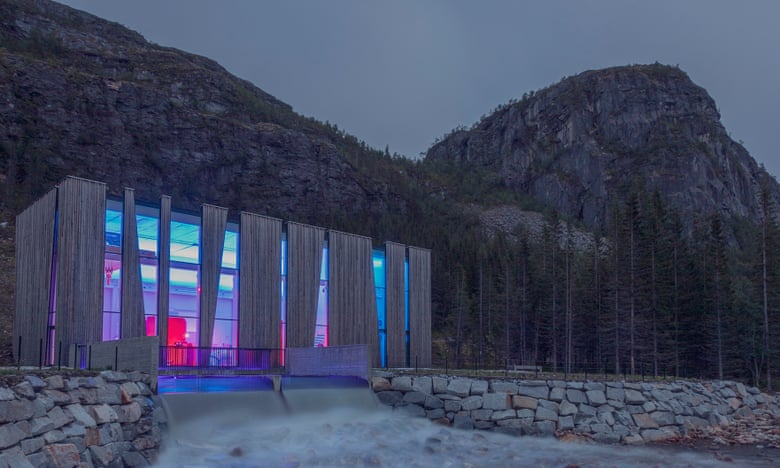
Photo: Pedro Alvarez for the Observer
Øvre Forsland hydroelectric station in northern Norway.

So while we’re on the subject of removing pollutants using artistic sculptures, how about an article on creating clean power in an artistic energy plant?

Stuart Dredge writes at the Guardian about “an unusually handsome hydroelectric plant” on the edge of a forest in northern Norway.

“Located in the Helgeland district in northern Norway, [Ovre Forsland is] a small hydroelectric power station capable of supplying 1,600 homes with power.

“Designed by Norwegian architecture firm Stein Hamre Arkitektkontor, it sits on a riverbed at the edge of a forest, with an exterior that aims to reflect the irregular shapes of the spruce trees forming its backdrop. …

“Says Torkil Nersund, production manager at the plant’s owner, energy company HelgelandsKraft … ‘This region is known for its spectacular nature, so we thought the building should try to live up to the surroundings.’ …

“ ‘Øvre Forsland does not only serve hydropower to people in the region. Its purpose is also to bring attention to hydropower, the history around it and the benefits,’ says Nersund. …

“Øvre Forsland is also angling for the attention of people who come to Helgeland for its hiking trails and beautiful scenery. Those visiting the power station can look through a tear in the building’s exterior that reveals its innards: the turbines. …

“The emphasis on this harmony, and on renewability in general, can be seen in the fabric of Øvre Forsland itself. The architects used Kebony wood, sustainable softwood that has been treated with a bio-based liquid to make it more like hardwood. …

” ‘We hope that the Government also sees that hydro power has a great future ahead and that they facilitate the development of Norwegian hydro,’ says Nersund.”

More here.

Hat tip: @VictoriaLynden on twitter.


Read Full Post »

In September, Victoria Lynden tweeted about Costa Rica’s clean electricity. Although hydroelectric and geothermal approaches sometimes have issues of their own and cars in Costa Rica still use gas, two months without using fossil fuels to generate electricity sounded pretty good to me.

Brad Plumer wrote at Vox, “Costa Rica is pulling off a feat most countries just daydream about: For two straight months, the Central American country hasn’t burned any fossil fuels to generate electricity. That’s right: 100 percent renewable power.

“This isn’t a blip, either. For 300 total days last year and 150 days so far [in 2016], Costa Rica’s electricity has come entirely from renewable sources, mostly hydropower and geothermal. Heavy rains have helped four big hydroelectric dams run above their usual capacity, letting the country turn off its diesel generators.

“Now, there’s a huge, huge caveat here: Costa Rica hasn’t eschewed all fossil fuels entirely. The country still has more than 1 million cars running on old-fashioned gasoline, which is why imported oil still supplies over half its total energy needs. The country also has cement plants that burn coal.

“What Costa Rica’s doing is nevertheless impressive — and a reflection of how serious the tiny Central American country is about going green. At the same time, a closer look at the story shows just how difficult it would be for other countries to pull off something similar.

“When many people think of ‘renewables,’ they tend to think of giant wind turbines or gleaming solar panels. But that’s not what Costa Rica is relying on. For years, roughly 80 percent of the nation’s electricity has come from a technology that’s more than a century old — hydroelectric dams …

“Another 12 percent or so of Costa Rica’s electricity comes from geothermal plants, which tap heat deep in the Earth’s crust and can also run around the clock. …

“So if Costa Rica can get 100 percent of its electricity from renewable sources, why couldn’t other countries do the same? Why can’t the United States, which is far richer?

“One obstacle here is that hydropower and geothermal are very location-specific — and only a few countries are lucky enough to have such rich resources. Iceland gets nearly 100 percent of its electricity from these two sources. Paraguay gets almost all of its electricity from the massive Itaipú Dam. Brazil gets more than 75 percent of its power from hydropower. But those are exceptions. For most countries, hydropower can only satisfy a portion of their power needs.” Read on.

Seems to me that when a country wants to be greener (whether for the environment or to save money or both), it has already taken the first step to finding solutions that work for its own geography.

Chart: Observatory of Renewable Energy in Latin America and the Caribbean


Read Full Post »

At the radio show Living on Earth, Steve Curwood recently interviewed Gary Cook of Greenpeace about an effort to get tech companies to be greener.

CURWOOD: “Back in 2012, you criticized Apple for using carbon-intensive energy from coal plants to power its servers. …

COOK: “Just after we spoke, they made a commitment to be 100 percent renewably powered, and as the end of last year, they even made that goal. So, it’s been quite a big shift.

CURWOOD: “100 percent renewable energy. How’s that possible?

COOK: “It requires some effort. Apple has done a lot in North Carolina where they have their largest data center in terms of deploying two different solar farms and an onsite fuel cell that’s powered with biogas energy, so it’s all renewable. They have several other data centers. … In Oregon they’re using wind; in Nevada they’re using solar.

“So they’ve actually shown a commitment from the top, been very aggressive, probably the most aggressive of any of the brands to make sure as they grow, they’re using clean energy.

CURWOOD: “Biogas. Where are they getting that from?’

COOK:” Currently, they’re getting that from landfill and some other renewable sources. The landfill is methane capture in the southeast, and they’re having that piped to where their data center is in North Carolina.”

The radio interview covers several other efforts tech companies are making. It’s a good thing, too, when you consider, as Living on Earth points out, “If the Internet were a country, it would be the sixth largest consumer of electricity in the world.” More here.

Photo: George Nikitin, Greenpeace
The Greenpeace Airship A.E. Bates flies over Facebook headquarters with a banners reading “Building a Greener Internet” and “Who’s The Next To Go Green?” Apple, Facebook and Google have committed to powering their data centers with renewable energy.

Read Full Post »

Building energy savings into school design means more money for education.

At Yes! Magazine, Erin L. McCoy describes what planners did for the rural Richardsville Elementary School near Bowling Green, Kentucky.

“When Richardsville opened its doors in fall 2010, it was the first net zero school in the nation, meaning that the school produces more energy on-site than it uses in a year.

“Solar tubes piping sunlight directly into classrooms eliminate much of the school’s demand for electric light, while a combination of geothermal and solar power cut down on the rest of the energy bill. Concrete floors treated with a soy-based stain don’t need buffing. The kitchen, which in most schools contributes to 20 percent of the energy bill, houses a combi-oven that cooks healthier meals and eliminates frying. This means an exhaust fan doesn’t pipe the school’s temperature-controlled air to the outdoors all day long.

“Meanwhile, ‘green screens’ in the front hall track the school’s energy usage so kids can see the impact of turning off a light in real time.

“These and other innovations make Richardsville better than net zero. It actually earns about $2,000 a month selling excess energy to the Tennessee Valley Authority. …

“Three factors are essential to making a green school work: First, you need the participation of the community and the local power company; second, you can’t forget that a school is a dynamic learning environment; and third, you need to speak the language of money.

“Since the economic recession began in 2008, school districts have suffered. Local tax bases were shaken as property values plummeted, and states have cut back on funding to districts, which were pushed to cut funds wherever they were able. Addressing energy use made a lot of financial sense.”

More.

Photograph: Michael Heinz/The Journal & Courier/AP/File
Students gather on the first day of school at Wyandotte Elementary School near Lafayette, Ind., in 2011. Wyandotte is one of many US schools that have made cutting energy use a priority.


Read Full Post »

Aren’t inventors great? There certainly seem to be a lot around these days.

Of course, I am still a bit high on the Mass Challenge Awards last night, thrilled about Erik and the other deserving winners, like the nonprofit GRIT (Global Research Innovation and Technology), which makes an inexpensive wheelchair for use in the Third World.

Here’s another cool invention, from Israel: a cardboard bicycle.

Ori Lewis and Lianne Gross write at Reuters, “A bicycle made almost entirely of cardboard has the potential to change transportation habits from the world’s most congested cities to the poorest reaches of Africa, its Israeli inventor says.

“Izhar Gafni, 50, is an expert in designing automated mass-production lines. He is an amateur cycling enthusiast who for years toyed with an idea of making a bicycle from cardboard. …

“Cardboard, made of wood pulp, was invented in the 19th century as sturdy packaging for carrying other more valuable objects, but it has rarely been considered as raw material for things usually made of much stronger materials, such as metal.

“Once the shape [of Gafni’s bicycle] has been formed and cut, the cardboard is treated with a secret concoction made of organic materials to give it its waterproof and fireproof qualities. In the final stage, it is coated with lacquer paint for appearance.

“In testing the durability of the treated cardboard, Gafni said he immersed a cross-section in a water tank for several months and it retained all its hardened characteristics.

“Once ready for production, the bicycle will include no metal parts, even the brake mechanism and the wheel and pedal bearings will be made of recycled substances, although Gafni said he could not yet reveal those details due to pending patent issues.” Read more from Reuters, here.

Check this video posted by Gadizmo.

Baz Ratner /Reuters /Landov

Read Full Post »