Feeds:
Posts
Comments

Posts Tagged ‘resilience’

Photo: Brian Otieno/The Guardian.
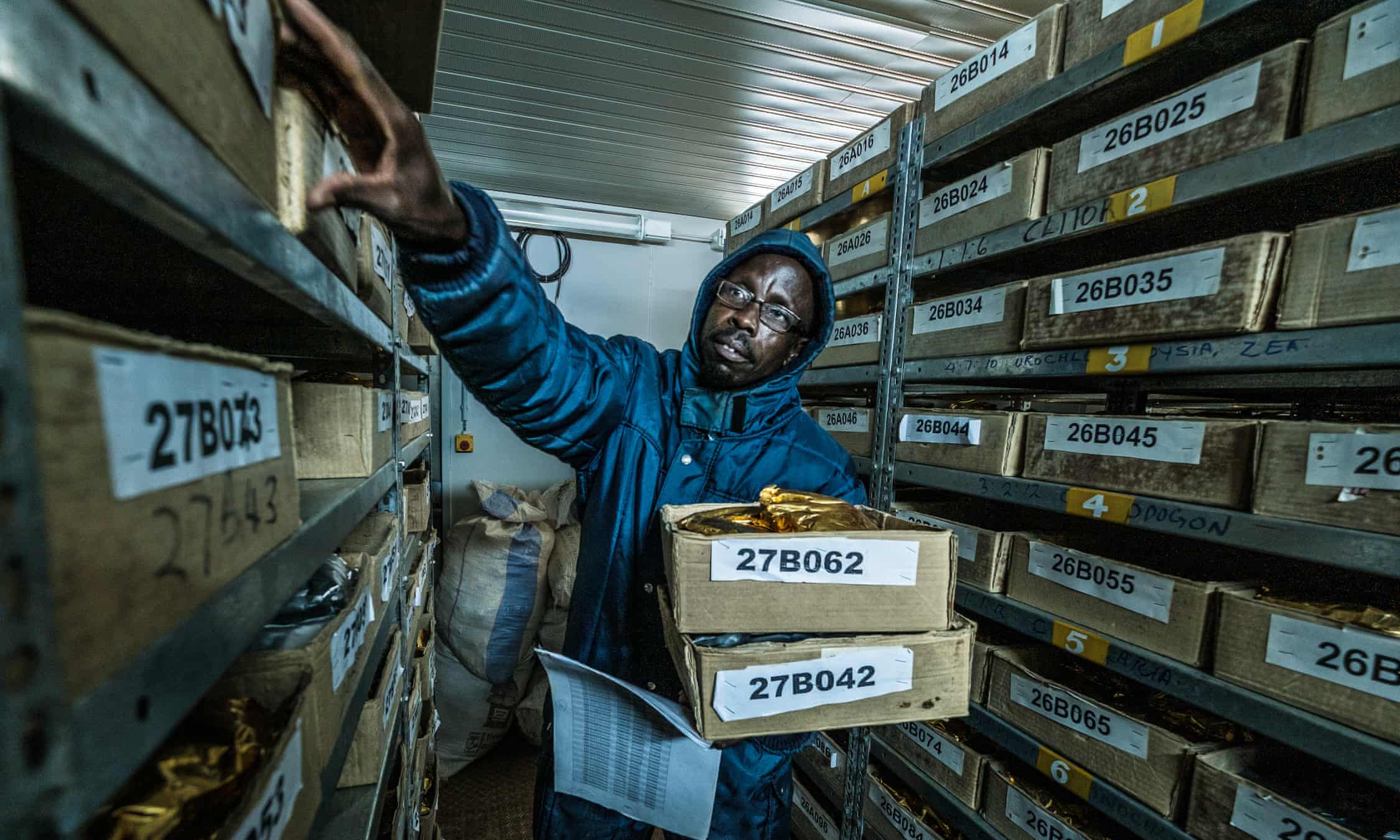
John Okemer, a seed technician, arranges some of the thousands of seeds stored inside Kenya’s gene bank. 

As our wounded planet hurtles through space, what should we take with us to replicate the better things as needed? Noah took two of each animal, bird, fish. Some of our contemporaries are taking seeds.

Caroline Kimeu writes at the Guardian, “On a winding road in the densely forested Kikuyu highlands of south-central Kenya lies a nondescript government building: the Genetic Resources Research Institute. Opened in 1988, during the country’s ‘green revolution,’ this little-known national gene bank was set up to hold and conserve seeds from the traditional crops that were in danger of disappearing as farmers and agricultural industry moved to higher-yield varieties.

“For decades, it has collaborated with researchers studying crop genetics and others working to develop improved varieties. But as the climate crisis worsens food insecurity, the repository of about 50,000 seed and crop collections could become a lifeline for farmers.

“ ‘We were established as a conservation unit, but these are unusual times with climate change, so we’ve had to diversify our work to respond to needs,’ says Desterio Nyamongo, who runs the institute. ‘Given the erratic weather these days, smallholder farmers need a diverse mix of crops.’

“Through a project with the Crop Trust organization the gene bank is now playing a part in the comeback of indigenous crops that are resistant to drought and pests, but fell from favor and have been neglected for decades.

“It stores backups of its most unique seeds at the Svalbard global seed vault in Norway, where it has been sending collections since 2008. The international repository contains more than a million seed samples from around the world.

“Matthew Heaton, the project manager for Crop Trust’s Seeds for Resilience program, says: ‘National gene banks can be overshadowed by the larger international ones, but they are best positioned to quickly improve local resilience and nutrition because their collections are adapted to local needs and growing conditions.’

“The national gene bank is a small operation, with few staff and limited funding, and its cold rooms, which plant scientists say contain only a third of the country’s plant diversity, are almost full. The Seeds of Resilience project, launched in 2019, has supported national gene banks in Ethiopia, Ghana, Kenya, Nigeria and Zambia with financial and technical support to keep resilient, healthy and nutritious crop collections, and to increase their support for farmers. …

“Farmers from the village of Obucuun in rural Busia county, on the border of Kenya and Uganda, say that before sourcing new sorghum varieties from the gene bank, growing the cereal had become challenging. Attacks by flocks of weaver birds, which can ravage entire cereal fields, increased in frequency after the wild grasses preferred by the birds became more scarce as a result of the climate crisis.

“Ruth Akoropot, a 50-year-old farmer from the area, spends hours each day watching over her crops during peak hours of attack, after studying the birds’ behavior patterns for years.

“ ‘If you don’t do that, your crop will be wiped out,’ says Akoropot, who runs the women’s sorghum farmers association, which sells bales of the grain to Kenya’s national beer brewery. …

“Most of Busia’s population rely on farming for food and to make a living, but … a number remain vulnerable to food insecurityFlooding in April and May [in 2024] swept away farmers’ seeds and yields, exacerbating poor agricultural productivity. Old improved crop varieties sourced from the gene bank, such as Kenya’s red-headed sorghum okoto, which farmers say is less prone to bird attacks, have become community favorites in Busia after decades of disuse. …

“Tobias Okando Recha, an impact researcher for the Seeds of Resilience program, says: ‘These are crops that farmers don’t need to pump a lot of fertilizer on. With just a little fertilizer, the yield is good and they are more [resilient] than hybrid varieties. …

“Plant scientists say that while the divide between farmers and seed conservationists is narrowing, more needs to be done. …

“ ‘The gene banks are not museums, but a resource for the future,’ says Heaton. ‘By linking them with farmers, we can swiftly build local resilience and food security.’ ”

More at the Guardian, here.
Read Full Post »

Photo:  Michael Willian.
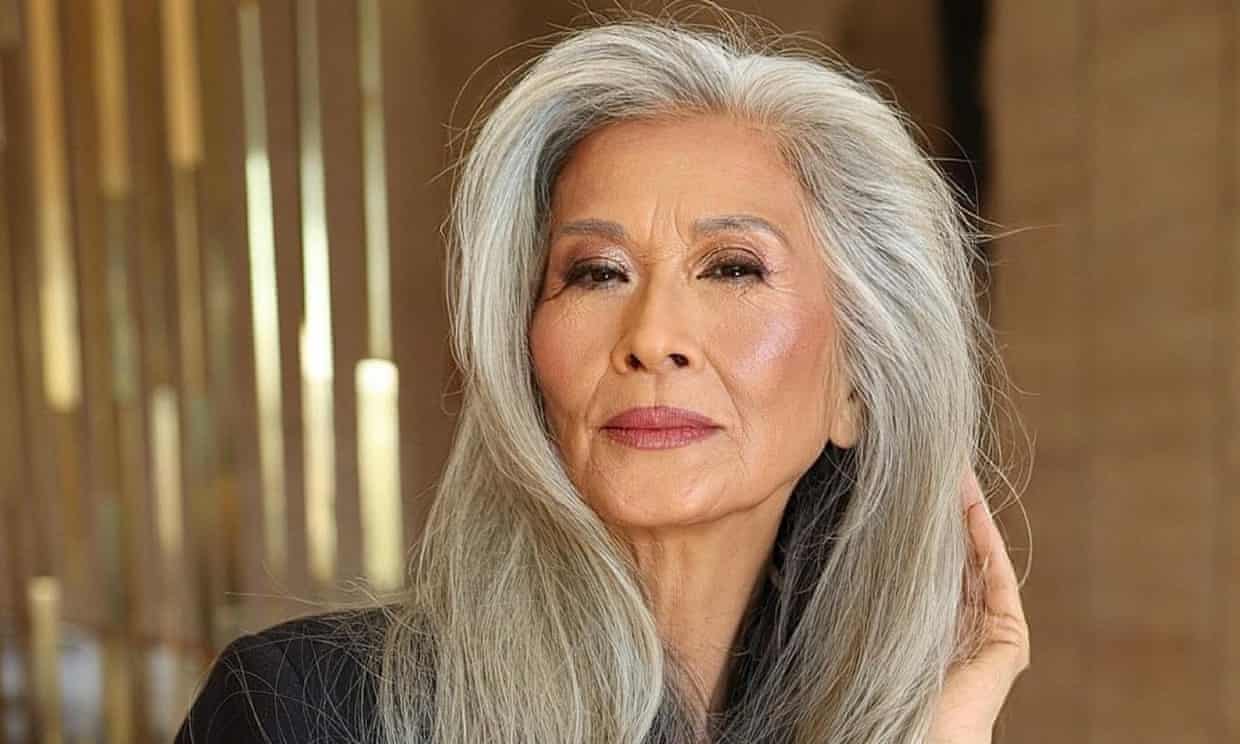
“I’m a natural person and I’ve never had any surgery,” says Brazilian model Rosa Saito, 73.

In today’s story from the Guardian, Brazilian model Rose Saito looks pretty glam in her 70s, but that is not the point. The point is she never gave up on something she wanted to do. And it wasn’t until she was 69 that the movers and shakers in the fashion world realized they were plum out of beautiful older models. Suddenly she was in demand.

Ammar Kalia writes, “For her 68th birthday in 2019, Rosa Saito decided to give herself an unusual present. Over the past year, she had been approached by photographers and casting agents three times on the streets of her home town in São Paulo, Brazil, each telling her she should consider becoming a model. Initially, she brushed off the flattering advances, but after deliberating for several months, she changed her mind.

“ ‘No one had commented on my appearance until I reached 67, when people suddenly started to notice me,’ she says. ‘It was very strange, but being spotted made me realize I could still achieve something for myself at this stage of my life. I had raised three children and now I wanted to see what I could do alone. If not now, then I never would.’

“Contacting one of the agencies that had previously approached her, she was immediately added to their roster and sent out to castings. ‘At my first casting they asked me to act like I was just getting home from a nightclub, but I have never done that before,’ she laughs. ‘I didn’t get the job, but I started to see how modeling is about inhabiting a character and performing. It was a challenge that began to excite me.’

“It would be another year until Saito booked her first job. Arriving at dozens of castings and routinely turned away with little explanation or feedback, she was determined to see these experiences as an opportunity to practice her posing and walking in front of other professionals. ‘The rejections only made me want to book a job more,’ she says.

‘I was used to facing difficulties in my life and so these were small setbacks compared with everything else I had been through. I was prepared to keep going.’

“Saito learned resilience from an early age after becoming the sole carer, at 22, for her mother, who had a stroke. After the death of her husband, to whom she was married for 20 years, in 2000, she raised her three children alone. She has always been passionate about natural remedies and plant medicine. ‘I think that is the most important thing that has helped me look the way I do today,’ she says. …

“In 2020, at 69 years old, Saito’s persistence paid off and she finally booked her first modeling job for a Brazilian cosmetics brand. … ‘As soon as we began, my experience from all the castings kicked in and I relaxed. The production team asked me where I had been hiding, since they said they had been looking for older women like me for years.’ …

“Saito also found herself unwittingly becoming a role model for the younger women on the shoot. ‘I got so many compliments from the other models and it made me realize that my presence was showing them that you can grow older without fear,’ she says. …

“Now 73, Saito has modeled for clothing brands, cosmetics and magazine editorials, while her highlight has been making her debut at São Paulo fashion week in 2022 as one of the oldest models on the catwalk. … ‘It’s a gift to be doing this in my 70s,’ she says. ‘I love modeling because each job is a unique challenge and it pushes me to give the best I can. It has made me a more confident person in all parts of my life.’ ” More at the Guardian, here.

Say, did you notice that at São Paulo fashion week, she was only one of the older models on the catwalk!?

Read Full Post »

Photo: Stephanie Hanes/The Christian Science Monitor.
A jogger runs on a path in Babcock Ranch, Florida, on Nov. 3, 2022. Babcock Ranch, which calls itself America’s first solar-powered town, survived Hurricane Ian with little to no damage.

When does the bottom line get in the way of building something to last? Too often.

But there are always outliers. At the Christian Science Monitor, I learned recently about housing developers in Florida who give “careful consideration of how the built environment will respond to an increasingly harsh climate.”

Stephanie Hanes writes, “As Hurricane Ian moved toward Florida’s west coast in late September, Amy Wicks drove around this rapidly growing community, trying to figure out what she hadn’t thought of yet. She checked for any debris that might be blocking water runoff paths; she took note of the restored wetlands; she hoped that no alligators had taken up residence in the drain pipes.

“Eventually, she returned to her own home here, hunkered down with her husband and three children, and listened as freight train winds moved over Babcock Ranch, a 4-year-old planned community some 20 miles inland from Fort Myers. At that point, she says, she could only hope that the unique storm water system she had designed and monitored over the past decade would be up for the task. …

“The storm sat overhead for nearly 10 hours, dumping more than a foot of rain on this swath of old Florida cattle ranches and newly built cul-de-sacs.

“By the time it subsided, it was clear that something extraordinary had taken place in Babcock Ranch. Created as a sort of laboratory for green development in Florida, and intentionally designed to survive extreme weather, the town proved remarkably resilient in the face of a Category 4 hurricane.

“Unlike surrounding areas, it did not flood, in large part because of Ms. Wicks’ years of planning and her unique stormwater management design that mimicked natural systems rather than fighting them. It did not lose power, thanks not only to its 700,000-panel solar grid and battery backup system, but also to the power line hardening developers undertook with their utility provider, Florida Power and Light. And because Babcock Ranch owns and operates its own water plant, which also survived the storm, it was the only town in Charlotte County that did not go under a boil-water alert. …

“Across the state, there is a small but growing effort to build more resilient communities in Florida – an effort to shift a yearslong pattern of rapid development that many here say exacerbates water shortages and other environmental risks. …

“With a constant flow of new homebuyers – an average of nearly 1,000 people move to Florida each day, according to oft-repeated state statistics – developers have tried to acquire as much land as possible, and as quickly as possible. That often means buying up faded ranches or long-ignored swaths of swamps and forest – green-covered lands that must be flattened and cleared to make way for housing developments and roads and shopping centers.

“Indeed, to meet building codes that require homes to be graded above street level, developers will typically bulldoze the landscape, dig storm ponds, and then use the fill from those holes to prep building sites, explains Timothee Sallin, co-CEO of Cherrylake, a landscape company working across the Southeast that has become a leader in sustainable design.

“Traditionally, developers would replant that denuded landscape with the types of species that outsiders tend to think about when they imagine Florida – green St. Augustine grass, colorful azaleas, draping bougainvillea. The problem, Mr. Sallin says, is that these plants aren’t native to the state, so they require a lot of inputs to stay healthy, such as water, fertilizer, and pesticides. They also struggle to thrive in soil devoid of organic material and nutrients.

“ ‘The developers have to mass grade a site to build efficiently and economically,’ he says. ‘The most efficient thing to do is to raze it and bring in fill. But that creates soils that are difficult to work with.’

“Meanwhile, because the natural topography of the land has been erased, and the natural water collection systems of wetlands and marshes eliminated, the man-made drainage system becomes the only way to capture water. This can be a problem in some storms – particularly those with unusually heavy rains thanks to climate change.

“All of this, says [Jennison Kipp, a resource economist with the University of Florida and the state coordinator for Sustainable Floridians] creates a system without resilience, suffering from both too much and too little water. ‘The landscapes are on life support,’ she says. …

“According to the state’s central water authority, the region will face a 235 million gallon a day shortfall by 2035 unless demand and usage patterns change. This is one of the reasons why when 27,000 acres of ranch land came up for development just south of Orlando – part of a 300,000 acre swath owned by the Church of Jesus Christ of Latter-Day Saints – executives at the development company Tavistock decided to approach the project differently. …

“To plan Sunbridge, which is about two-thirds the size of Washington, D.C., [Clint Beaty, senior vice president of operations for Tavistock and the lead on the Sunbridge project] and others at Tavistock coordinated with representatives from the University of Florida’s Institute of Food and Agricultural Sciences, the Sustainable Floridians, and other groups. They came up with a plan to use native landscaping – even eschewing the popular St. Augustine grass for the more drought and heat resilient (although occasionally browner) Bahia grass. They are saving and relocating some of the old live oak trees on the property. All of the new homes will be wired for solar panels and electric vehicle plug-ins, and one model house version boasts Tesla solar shingles and a battery backup system.

“Meanwhile, to help move away from fertilizers, scientists have built a living laboratory along a walking path at the development’s community center, called Basecamp, where they are testing the viability of different species of native plants as well as different sorts of compost amendments to soil and the impact on pollinator species. Mr. Beaty is also working to figure out how to arrange for large scale composting and food-waste recycling for the community.”

More at the Monitor, here. No firewall. Subscriptions welcome.

Read Full Post »

Photo: Chris Granger/The Times-Picayune/The New Orleans Advocate/AP
“Roofing contractors install a temporary roof on a home in New Orleans East, Sept. 8, 2021. FEMA and the U.S. Army Corps of Engineers are overseeing this Blue Roof program to help homeowners recover from the damage cause by Hurricane Ida,” the
Monitor reports.

Can humanity learn from history? Sometimes, yes. According to this September 2021 story, people are learning from climate disasters. Even I, as a child on Fire Island, learned that people who build houses on sand dunes ask for heartbreak. Collectively, the towns on the island learned the same thing.

Marshall Ingwerson wrote this report on collective learning at the Christian Science Monitor.

“In the weeks since Hurricane Ida landed at New Orleans, it has illustrated two very different stories. One is the rising violence of the changing climate. The other, which is only now fully emerging, is the human resilience that has already made the world far safer. …

“The aftermath of Hurricane Ida is now entering what we might call the resilience zone. It can be the most testing, and telling, phase.

“As part of the Monitor’s Finding Resilience project, here is a tale of two cities: The New Orleans hit by Hurricane Katrina 16 years ago and the New Orleans hit by Hurricane Ida late last [August]. 

“They were not identical storms. Ida struck with less sweeping girth than Katrina but more sheer force. They weren’t all that different, either.

“But they hit a different New Orleans. Katrina killed more than 1,800 people. The breaching of the levees put 80% of the city underwater. The blow was nearly existential to New Orleans as we knew it. Three in 10 residents vacated, many permanently. 

“After Ida struck last month, the now-fortified levees held against the surge. The toll in fatalities in Louisiana is at 28. A similar number died in New Jersey as Ida-driven rain flooded the Northeast. The scale of damage and heartbreak is so vastly different that clearly Louisiana is more robust and storm-hardy than in 2005. The population had even grown back in New Orleans, recently surpassing its pre-Katrina numbers.

“Ida has been covered as an example and a warning of the rising violence of climate change, making hurricanes stronger, floods higher, and fires bigger and more frequent in the dry West. And that’s an important context. 

“But here’s another: Even as climate events become more dangerously frequent and potent, humanity has actually become safer – dramatically safer.

“The economist Bjorn Lomborg finds that the number of people killed worldwide by climate-related events in the 1920s, a century ago, was 27 times higher than the number killed over the decade ending 2019.

Corrected for the far higher global population today, the death rate a century ago was more than 130 times what it is today.

“Dr. Lomborg’s point is that when we assess the costs, the dangers, and the difficulties that climate change implies, human resilience and ingenuity is a nontrivial factor. So far, in fact, it has been an overwhelming factor.

“A term like resilience can risk sounding a little minimizing and reductive – just a personal character trait. It is much more than that.

“Those who have been through a hurricane strike report that it is after the winds have gone quiet, the ground dried, and the sun shining in steamy afternoons, only then have they arrived at the hard part – the exhausting building back, the forging ahead, the relaunch into forward motion. …

“Many of the efforts to resuscitate post-Katrina New Orleans were deeply personal, with families making remarkable sacrifices to rebuild the economy and education, much less the roads, bridges, and buildings of the city itself.

“So resilience is a matter of spirit, of finding the heart to come back. But its structure, the ladder resilience climbs, is learning. We pick ourselves up, we learn what we need to learn, and we get to work.

And it’s not just person-by-person resilience that drives the kind of change we have seen. It’s collective.

“Only big, complex teams can achieve what New Orleans accomplished in the past 16 years. The scale of the investment, the engineering, the overlapping interests, the cross-cutting visions and values – only politics can put all that together and sort all that out. …

“Yet humankind has made the world, per Mr. Lomborg’s numbers, more than 99% safer against natural disasters in the last century by scaling resilience. And we do that through the institutions we use to work together. 

“The only way we can learn and then act on as massive a scale as demanded of New Orleans is through the institutions we’ve developed over centuries – whether it’s a city council, a police department, a university, an engineering association, a religious denomination, a news organization, a Supreme Court, or an updated building code.

“It’s the lack of robust institutions that reduce resilience in a country like Haiti – where such institutions were undermined by Western powers for centuries – to a more individual matter. Anyone who has visited the nation has witnessed the sheer energy and unoppressed vitality of the people that crowd the streets of Port au Prince. The spirit is there, but it’s a resilience on foot, a personal challenge, and not yet a resilience that can collectively build safety from the next natural disaster.

“Individual learning can be a flashlight for families, communities, organizations, nations. But it is collective learning, what we achieve together, that holds real power. In fact, civilization itself could be defined as collective learning.”

More at the Monitor, here.

Read Full Post »

Photo: Mark Naison.
Fordham students who helped launch the Bronx COVID-19 Oral History Project, stand with the project’s faculty adviser and an artist interviewed for the project outside the Crab Shanty Restaurant in the Bronx on May 20, 2021.

It’s hard to predict how anyone will respond to a stressful situation. A tightly controlled person may completely lose it; an anxious individual may find a reservoir of calm. As Harry Bruinius reports at the Christian Science Monitor, there were surprises like that in lockdown. What was clearly a stressful time had an unexpected positive side when kindness and resilience shone through the darkness.

“When Bethany Fernandez first began to document oral histories in the Bronx during the pandemic,” Bruinius writes, “her own life was ‘chaotic.’ … But the past year and a half has become, almost in a strange way, a time of profound personal growth and self-discovery, says Ms. Fernandez, a lifelong resident of the Bronx, a borough of New York City.

“The communities surrounding her were among the most afflicted in the country, and they were being documented relentlessly in the news. But when she decided to join a group of fellow students at Fordham University to launch the Bronx COVID-19 Oral History Project, she found a reality not fully captured in the news, she says.

“ ‘In moments like these, a cynical person might think,”Oh, people are going to be selfish” – resources are scarce, survival of the fittest, or whatever,’ says Ms. Fernandez. ‘But no, it was the complete opposite.’ …

“Far from tales of woe, in fact, she and the five others in the project found their subjects again and again using a particular word to describe their experiences: resilience.

“Resilience in the face of hardship and trauma has always been a part of the human story. But during the past few decades, researchers have probed more deeply into what some scholars call a ‘psychological immune system’ that enables many people to respond to even the worst of situations and to recover from their resulting traumas. …

“ ‘If there is a silver lining that could come out of this, it would be that people are understanding that while the negatives scream at you, the positives – the resilience you can always find in people – these are only whispers,’ says Ken Yeager, director of the Stress, Trauma and Resilience (STAR) Program at The Ohio State University in Columbus.

“Human beings are wired to take particular note of the dangers that surround them and even focus on stories of trauma and fear. ‘The fight-or-flight response actually helps the species as a whole to survive, but it does nothing to make you happy,’ Dr. Yeager says. ‘It does nothing to help you build resilience.’

“The Bronx COVID-19 Oral History Project tells this story.

“[According to] Alison Rini, a senior from New Jersey studying English and Italian … ‘It was such a surprising experience, finding these examples of people describing their resilience in the midst of such hard times – in the Bronx, in particular. …

“ ‘The pandemic has been a test of the global psychological immune system, which appears more robust than we would have guessed,’ wrote scholars Lara Aknin, Jamil Zaki, and Elizabeth Dunn in the Atlantic. ‘In order to make sense of these patterns, we looked back to a classic psychology finding: People are more resilient than they themselves realize.’

“The authors emphasize that such broad trends should not erase ‘the immense pain, overwhelming loss, and financial hardships’ so many have faced over the past year and a half, especially disadvantaged populations. …

“ ‘But [the] pandemic holds its own lessons,’ they wrote. ‘Human beings are not passive victims of change but active stewards of our own well-being.’ …

“In what Ms. Fernandez calls one of her most memorable interviews, the owner of a Bronx restaurant described how she lost nearly 85% of her business and struggled to stay afloat after laying off most of her employees.

“Though the restaurant specializes in Puerto Rican and American cuisine, the owner, Maribel Gonzalez, kept the original name of the restaurant she bought 16 years ago, South of France. …

“Describing herself as a person of faith, Ms. Gonzalez said she had always offered her local community a free buffet every Wednesday. During the pandemic, as she and one or two employees struggled to keep the restaurant open, she kept that tradition alive, providing a free buffet at the height of the shutdown, even if only for an hour or two a week.

“ ‘You know, in all of this devastation, there are also a lot of blessings, because you find that you’re more resilient, that you’re stronger than you may have thought,’ Ms. Gonzalez told the project. She said her restaurant provided hundreds of meals for front-line health workers in partnership with others, supported by donations from a GoFundMe page.

“ ‘When you need to lug that 50 pound bag because you have to make whatever money you can, because maybe some of it can go to feed families that can’t afford it, you find the strength, you get the stamina, you find the chutzpah, if you will, to lift that bag, because there are so many depending on it – myself, my business, my future, the future of my employees, and those of my community.’ …

“The project had a profound effect on Ms. Fernandez as she wrestled with the challenges in her own life. ‘It was the one thing that stood out to me, the generosity that was shown all over, even throughout the time of the pandemic,’ she says. ‘Because when you see how resources are limited, when you’re being stretched out by work, by family obligations, by life and all of that, even with all the suffering going on, people were willing to give, people were willing to offer compassion and kindness.’ ”

More at the Monitor, here.

Read Full Post »

In March, ecoRI posted an article about a Rockefeller Foundation proposal for  protection of four sensitive coastal areas.

The website reports, “Leading climate scientists, engineers, designers and scholars recently collaborated to create comprehensive resiliency design proposals for vulnerable coasts along the North Atlantic, such as Rhode Island’s.

Structures of Coastal Resilience (SCR), a Rockefeller Foundation-supported project dedicated to providing resilient design proposals for urban coastal environments, focuses on four vulnerable coasts: Narragansett Bay; Jamaica Bay in New York; Atlantic City in New Jersey; and Norfolk, Va.

“Each of the project locations feature ongoing projects by the Army Corps of Engineers, and each location is highly prone to flooding and socioeconomic vulnerability, according to project officials. The goal of SCR is provide actionable project recommendations for hurricane protection and climate adaptation. …

“As Rhode Island was spared the worst of the devastation associated with Hurricane Sandy [in 2012], it’s an ideal location for developing structures of coastal resilience that can be advanced gradually and through systematic evaluation and adaptation, according to project officials. …

“As increased urban runoff and higher saltwater levels merge on the coastal zone, some species are threatened while others adapt. Marsh and dunes recede while weedy forest cover creeps closer to the beachfront. Plants with high salt tolerance that are capable of rapid establishment have begun to colonize areas with accommodating soil. Designers can capitalize on this process, deploying plants to prevent erosion and build resilient coasts.” More here.

Folks, a woman involved with a movie about saving the oceans (Revolution) e-mailed to ask if I would review it, and I said sure. So watch this space.

Photo: CityData.com

Read Full Post »