Feeds:
Posts
Comments

Posts Tagged ‘rice’

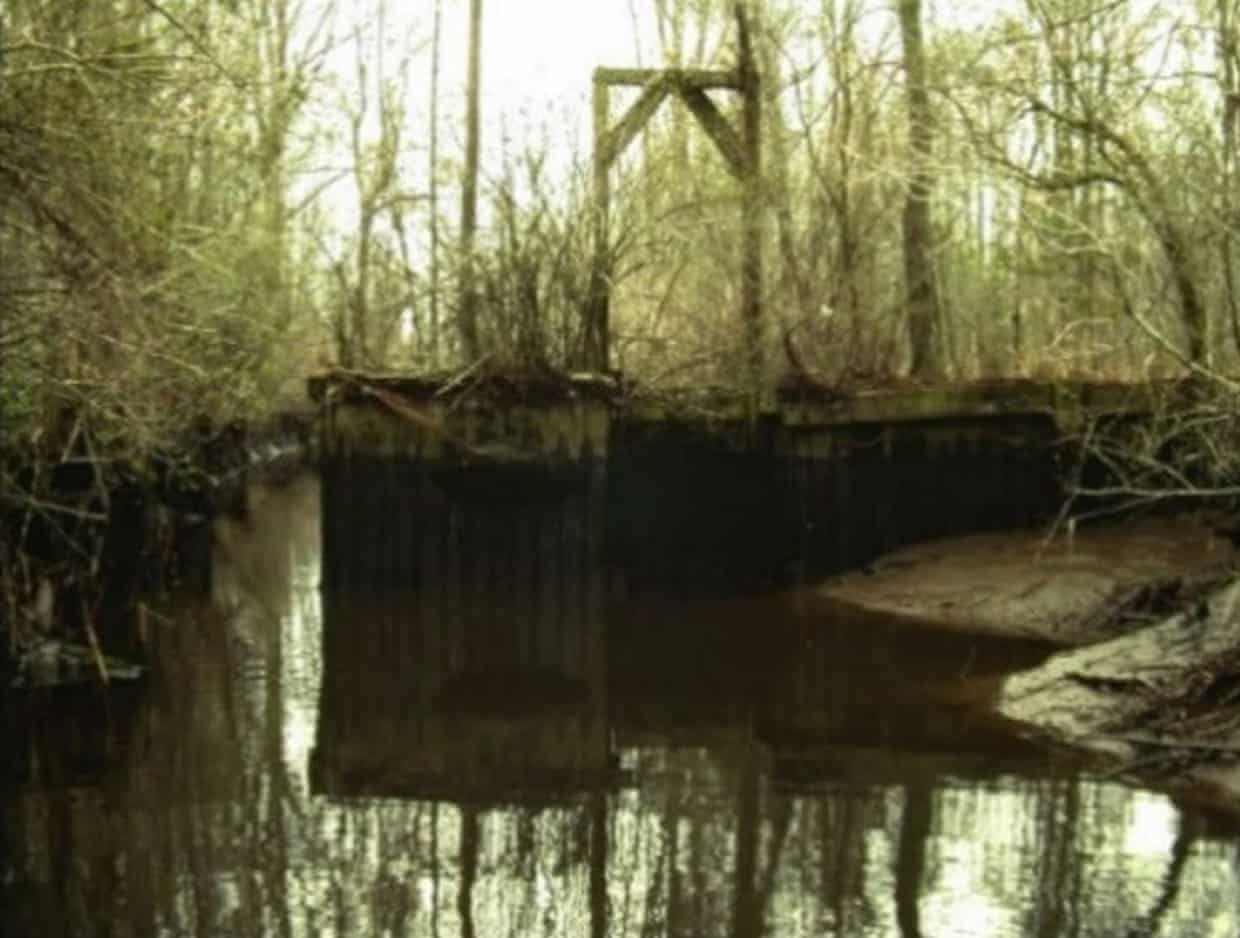
Photo: North Carolina office of state archaeology.
A rice gate, seen here in 1986. At Eagles Island, North Carolina, in the late 1700s, the enslaved Gullah Geechee people began creating ingenious rice fields. 

If the people described in this archaeological report used brilliant rice-growing techniques while enslaved, imagine what they might have done if they had been free! But, alas, slavery destroys lives of the enslaved and their descendants for generations, as Pat Conroy documented in The Water is Wide, his memoir about teaching.

In an in-depth article at the Guardian, Adria R Walker writes about recent archaeological discoveries concerning the Gullah Geechee people of the American South.

“As a former deputy state underwater archaeologist, Mark Wilde-Ramsing can’t help but look down. While rowing around North Carolina’s Eagles Island, at the tip of the Gullah Geechee corridor, he noticed signs of human-made structures, visible at low tide. Though he’d retired, he was still active in the field and knew his former agency hadn’t recorded the structures – which meant he had come across something previously undocumented. …

“Wilde-Ramsing knew the area had once been full of rice fields. His neighbor, Joni ‘Osku’ Backstrom, was an assistant professor in the department of environmental sciences at the University of North Carolina-Wilmington whose specialty was shallow-water sonar, and he had the skills and technology to explore the area. Using a sonar device, the duo detected 45 wooden structures in the river, and the remote sensing tool allowed Backstrom and Wilde-Ramsing to acoustically map the canal beds. …

“Spanning 2,000 acres (809 hectares) of the northern end of Eagles Island, the 45 irrigation devices were developed by enslaved people, who would later come to be known as the Gullah Geechee. The devices were used to control water flow for the rice fields in conjunction with earthen dams and levees, Wilde-Ramsing said.

Their existence provides further evidence of the engineering and technological skills that Gullah Geechee people used for rice cultivation, beginning in the late 1700s at the latest.

“Backstrom and Wilde-Ramsing documented their findings in a study published earlier [in 2024]. ‘The use of the island for this endeavor prior to the Civil War, in large part rested on the shoulders of transplanted and enslaved Africans and their descendant Gullah Geechee tradition,’ the study reads.

“The team’s discoveries, which came after two years of research in and around Eagles Island, have helped further shed light on the ingenious, skilled work of the Gullah Geechee people. Though Gullah Geechee people have been studied for centuries, Backstrom and Wilde-Ramsing’s research is the first to focus on their irrigation systems. The research couldn’t come soon enough: Eagles Island is environmentally vulnerable, both because of climate change and ongoing development. The duo registered their sites with the state, making development more difficult as a means to ensure the protection of cultural artifacts.

“ ‘The whole area was originally swamp. It was cleared mostly in the post-colonial, early 1800s period for tidal rice cultivation because that area was freshwater,’ Wilde-Ramsing said. ‘They were able to actually use, regulate, introduce the water and drain it with the tides.’ …

“The work the Gullah Geechee people did would have been exhaustive. Wilde-Ramsing says it required removing the cypress forests, then building dams and levees. Growing rice necessitated the use of water, so they created long wooden boxes, or ‘trunks,’ with gates on either side, that allowed them to let the water in by opening the gates. …

“The enslaved populations throughout the Gullah Geechee corridor – which spans the coasts of North Carolina to upper Florida – were isolated in such a way that they developed and maintained a culture different from that of most plantations.

“ ‘[They were] from coastal regions of west Africa, an area that had similar environs to those along the southern Atlantic seaboard centering on Georgia and the Carolinas, where rice agriculture was a mainstay of the economy,’ the study reads. …

” ‘I didn’t quite realize the role that rice played. It rivaled cotton during the 1840s and 50s,’ Backstrom said. ‘It was all over Europe and the US and it was all run by African Americans. A lot of it was developed based on their skills. I’m just happy that it’s coming to light and they’re getting their – I won’t say new – but recognition that this was an amazing thing, amazing work.’

“Even though Wilde-Ramsing and Backstrom’s discovery likely won’t permanently stop either development or climate change, not least because the island is owned by multiple private entities, the existence of historic, cultural artifacts can ensure that the Gullah Geechee structures are at least documented instead of simply being razed and forgotten.

“The researchers have been in communication with East Carolina University’s maritime program, and the school plans to send a contingent to the site to study some of the characteristic types. People from the school will be able to work on noting the various structures, trying to figure out how they operated and taking samples. Backstrom said that they’ve also been in contact with researchers at George Mason University in Fairfax county, Virginia, including a professor who had ancestors [from the area].

“In terms of further discovery, a mix of approaches best suits the complicated terrain. ‘We’re thinking about using drone imagery,’ Backstrom said. ‘We have some preliminary drone footage, which gives us access to these areas at dead low tide, areas that we had a lot of difficulty with, even with a very small vessel.’ The area is remote, full of tight nooks and crannies. It’s ‘particularly challenging because of the tides and the timing,’ he said. The different combinations of drone imagery and sonar mean the researchers aren’t limited by turbidity in the water.

“Backstrom hopes to go to west Africa, specifically to Senegal or the Senegambia region, where many Gullah Geechee people were from, to learn about the history of rice farming, including the roles women and children played. Children, for instance, tasted the water to ensure too much saltwater wasn’t being let in, and women helped in the actual cultivation of the rice, using skills from their home countries that were passed down throughout generations.”

More at the Guardian, here. No firewall. Donations help save reliable news.
Read Full Post »

Photo: Melanie Stetson Freeman/CSM.
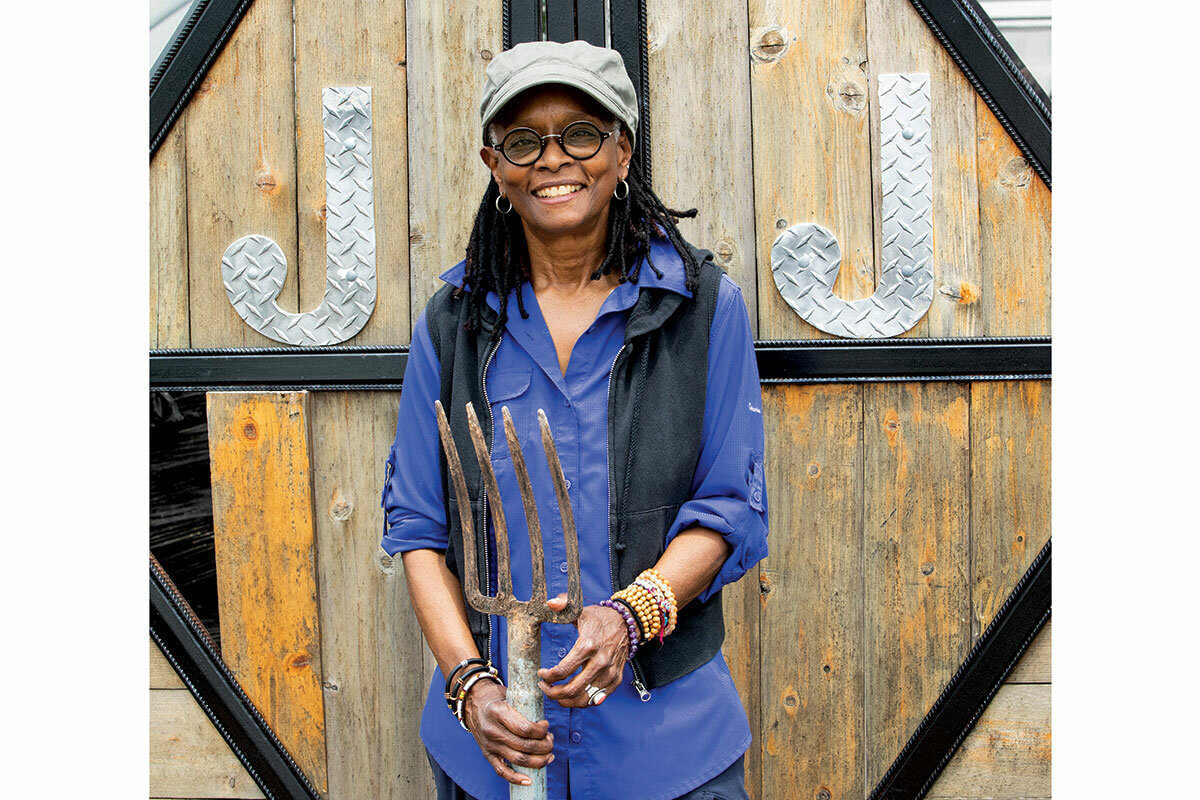
Konda Mason, founder of the nonprofit Jubilee Justice, poses at her farm in Alexandria, Louisiana, May 7, 2023. She teaches Black farmers a sustainable and environmentally friendly method for growing rice.

There are people who try their hand at many different things over a lifetime until something clicks. Or until all the pieces converge to make a new whole.

Consider Konda Mason, currently of Louisiana. Diane Winston has a long article about her at the Christian Science Monitor.

“It’s past daybreak on a muggy July morning when Konda Mason reaches the farm, a 5-acre plot in rural Louisiana. Mindful of the heat to come, several workers are already weeding, and Ms. Mason – her daily meditation and yoga done – is ready for a busy day.

“She’ll field calls from farmers and suppliers, check the progress of the industrial rice mill she’s building, and meet with a journalist curious about why a Black Buddhist from Oakland, California, is growing rice in a red county of a very red state. …

“A slender, muscled woman with waist-length dreadlocks, Ms. Mason sees the farm as the apex of her efforts as a social entrepreneur and eco-spiritual activist. Today she’s sporting a red bandanna to shade herself from the sun, but in her nearly 70 years, she has worn many hats. She’s been a concert promoter, filmmaker, and supporter of Black innovators and problem-solvers. As with her other endeavors, this new project manifests the values that have guided her life: love, justice, community, and a willingness to leap into the unknown.

“ ‘I was taught by my family that I had a role to play in making this world a better place,’ Ms. Mason told listeners in her keynote address at the 2015 Wisdom 2.0 forum in San Francisco. …

“ ‘The question I ask myself is, how can you go deeper, what do you have to let go of in order to do that, and are you willing to do it?’

“This time, going deeper meant leaving her home, her sister, her partner, and her friends to promote what she hopes is a revolution in rice production. Her goal is to support a more sustainable and less expensive way to grow rice, in hopes of staunching the loss of Black-owned farmland. Working alongside an agronomist from Cornell University, she uses what’s called the System of Rice Intensification, common in developing nations but new to American farmers. Going deeper has also meant mastering the complexities of soil and weed management, crop rotation, fertilization, the milling of rice, and bringing it to market. Equally complex, of course, is working in a region where race relations are historically fraught. …

“Though deeply committed to Buddhism, Ms. Mason is not an evangelist. At the farm, she rarely discusses her practice, and if she does, she talks about mindfulness, not Buddhism.

“ ‘Konda’s had many lives, and I never thought there would be a home for her,’ says Dianne Houston, a longtime friend. ‘But the combination of working on the land with people who share her beliefs about social justice – all the boxes are checked.’

“Ms. Mason’s work on the 3,700-acre former plantation is equal parts passion project, spiritual mission, and response to the loss of 12 million acres of Black farmland over the past century. … Since arriving in Louisiana in 2020, Ms. Mason has grown a network of nearly a dozen Black farmers whom her team visits regularly. Her agronomy colleagues offer technical assistance, and she provides rice seed and access to loans. She secured a centrally located, solar-powered industrial mill for processing the plants, and has a distributor to help with marketing. When she’s not working the land or promoting the project, Ms. Mason sometimes dons another hat, leading intentional conversations across racial and economic divides.

“Both the farming project and the conversations are part of Jubilee Justice, a nonprofit Ms. Mason created to help change a system that she says has profited by discriminating against people of color and despoiling the planet. It’s the natural outcome of her lifework. …

“in 1973, when she arrived for her first year at the University of California, Berkeley, … a new friend introduced her to yoga and broadened her taste in music. Soon Ms. Mason was running the Berkeley Jazz Festival, a well-funded community program sponsored by the university. Ultimately, she left school to team up with the manager for Sweet Honey in the Rock, a Black, female a cappella group whose music blended blues, gospel, and jazz. The two joined forces to promote female musicians. 

“ ‘We would put a Native American group with a Black group or a lesbian group,’ she says. ‘We kept building coalitions. We did it all over the country.’  …

“[Some years later in Louisiana] she helped organize a gathering of progressive women; most of the wealth-holders were white, and the activists people of color. Among the attendees was Elizabeth Keller, a white woman and devout Christian. Her grandfather had purchased a former plantation in Louisiana, hoping to ‘redeem’ the land, but he never did. When he died, he left all 3,700 acres to her.

“At the gathering, Ms. Keller spoke about the farm and her desire for healing there. She had prayed for someone to show her the way, and, to her surprise, Ms. Mason seemed to be the answer to that prayer.  The plantation could be redeemed, Ms. Mason realized, by using the System of Rice Intensification (SRI) to cultivate a pilot crop and develop a network of Black farmers to adopt the technique. 

“Ms. Keller, acknowledging that Ms. Mason ‘saw something I couldn’t,’ agreed to let her use the land.  Now Ms. Mason needed expertise. She cold-called Erika Styger, the Cornell agronomist, who knew from working with farmers around the world how SRI increases crop yields, improves the soil, cuts costs, enhances profits, and reduces the environmental impact of rice production. It took some convincing, but in the end, Ms. Mason’s vision and practicality persuaded her to provide technical assistance.”

Read more at the Monitor, here. No firewall. Subscriptions are encouraged and are reasonably priced.

Read Full Post »

Photo: Sophie Hills/The Christian Science Monitor.
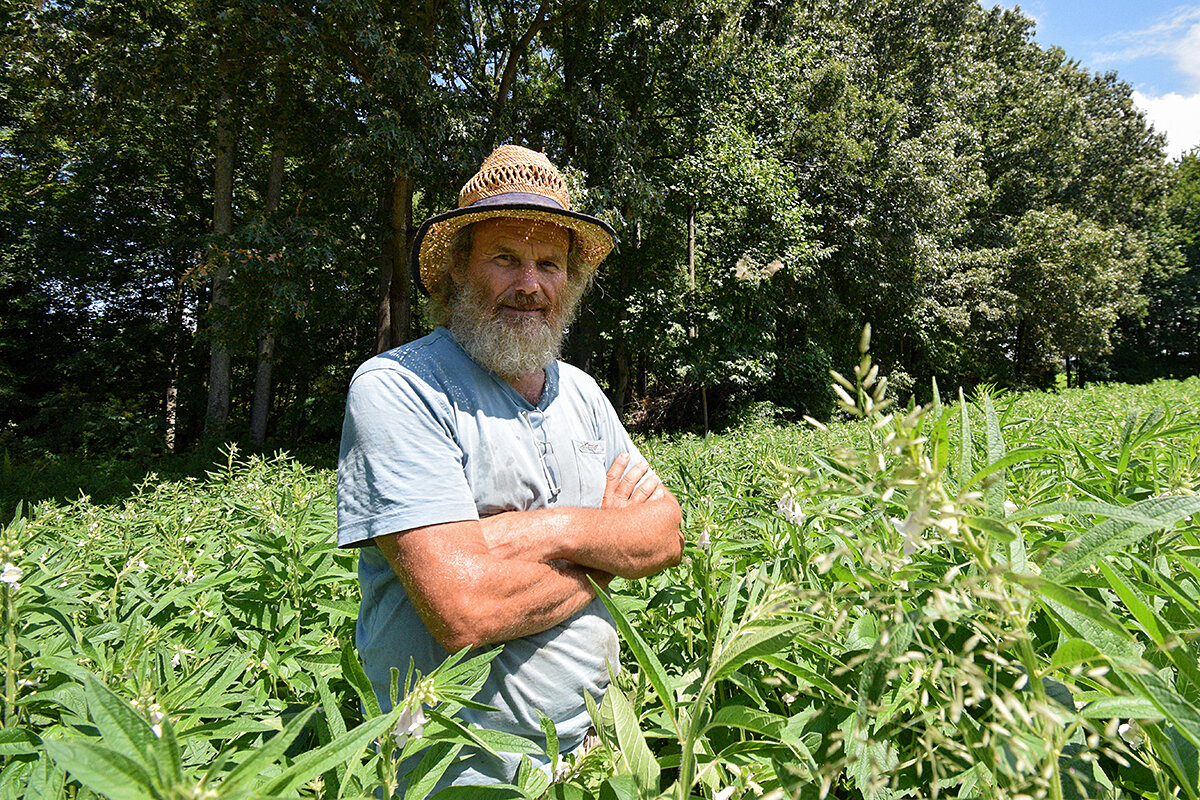
Heinz Thomet stands in a field of sesame on his farm in Newburg, Maryland, Aug. 17. Mr. Thomet tries to grow nearly everything he eats.

I love the first line of today’s story about “one of only two commercial rice farmers in Maryland.” Because who knew there were rice farmers anywhere in the US? Don’t you think of rice farmers as being almost entirely in places like Japan and Vietnam?

Sophie Hills writes at the Christian Science Monitor, “Heinz Thomet is one of only two commercial rice farmers in Maryland. The other is Nazirahk Amen of Purple Mountain Organics. Not one to accept the status quo, Mr. Thomet grows six varieties of rice on his farm in southern Maryland, where most fields are planted with soybeans and corn. Mr. Thomet didn’t start growing rice until sometime during the past decade. His explanation for why he added the crop is simple: ‘I eat rice.’ …

He is the sort of person who has utter faith in natural processes but none in institutions.

“He’s always been a farmer, from growing up on a farm in Switzerland to working on a famed biodynamic farm in the United States as a young man. Since 2000, he’s farmed in Newburg, Maryland. There, in addition to the rice, he grows barley, Sichuan peppers, bananas, grapes, bitter lemons, oats, kiwis, sesame seeds, figs, and more, depending on the season. 

“It’s difficult to make a profit on rice in Maryland. Farm-to-table was a natural concept for Mr. Thomet even before the movement expanded out of California in the early 2000s.

And though small-scale, direct-to-consumer farming is difficult to justify commercially, Mr. Thomet’s main concern remains the quality of the food he grows and stewardship of his land.

“In this case, that means successfully producing rice – a crop grown by few others on the East Coast. ‘Nothing of what I do makes sense for a cheap food system, but if you recognize a decentralized food system as food security, then I start to make sense,’ says Mr. Thomet. ‘If you look at diversified farms as part of the resilience towards a global weather pattern change, then I start to make change.’

“In an era of climate disruptions that are changing where everything from coffee and cacao to mustard and olives can be successfully grown, a decentralized food supply – like the one Mr. Thomet espouses – is getting a second look.

“After decades of factory farming and reliance on a global food chain that sends bananas, grapes, mangoes, and avocados thousands of miles to stores, returning to the idea that food should be grown where it is eaten is no easy task. And rice-growing is a useful case study.

“It’s unusual to find rice farmers anywhere on the East Coast, says Raghupathy Karthikeyan, Newman endowed chair of natural resources engineering at Clemson University in South Carolina. Rice production in the U.S. now takes place mainly on commercial farms in the Midwest and the South. But Mr. Thomet and fellow farmer Mr. Amen are holding on, despite the tight profit margin for small-scale, organic farmers.

“Both Mr. Thomet and Mr. Amen grow upland rice, a method that doesn’t use water for weed control, instead requiring labor-intensive weeding. While both sell their rice, neither grows enough to register on the U.S. Department of Agriculture census. Historically, Maryland farms mainly grew tobacco, and South Carolina was rice country. But the end of slavery and changing weather patterns made rice-farming less profitable. At one time, about 225,000 acres in South Carolina were planted with rice. Today, it’s somewhere between 25 and 50 acres. In Maryland, it’s 2.

“Agriculture in Maryland, as in most of the U.S., doesn’t supply much of the produce purchased in the state. Maryland farms produce more grain than other crops, and most of that is used for livestock feed and seed. 

“Mr. Thomet’s interest is in locally grown crops for food, and he has a loyal base of customers, including restaurants. 

“For Mr. Thomet, it’s not just about protecting the locavore movement. It’s also about stewardship. He quotes the motto of his family’s farm, Next Step Produce: ‘Committed to growing nourishing food in harmony with nature.’ …

“He eats what he grows and tries to grow whatever he wants to eat. In fact, Mr. Thomet has a nearly complete food system growing on the 30 acres he cultivates. The one thing he can’t grow is sugar cane, so he grows sweet sorghum instead, which is made into molasses. 

“Day length, sun exposure, and night temperature in Maryland are all sufficient for rice to thrive, he says. Next Step Produce starts the rice in a greenhouse and then transplants it, allowing for more growing days so the farm can grow higher-yield varieties.

“Whether upland or lowland, rice is no longer profitable to grow in South Carolina – the historical center of U.S. rice-farming – unless it’s grown as a hobby, says Dr. Karthikeyan, who’s leading a study on climate-resilient rice production. The remaining commercial rice farms he’s aware of in the U.S. all grow lowland rice in paddy fields.

“Rice is a labor-intensive crop, even if you flood it, says Dr. Karthikeyan. The yield gap between upland and lowland rice is large, making it hard to turn a profit growing commercial varieties upland. That extra labor limits how many acres of rice Mr. Thomet plants, since they’re weeded by hand. It’s also reflected in the price, he says.

“Still, in his eyes, everything comes down to priorities and societal values. There’s no good reason everyone shouldn’t have access to nutritious, locally grown food, he says. Next Step Produce, which he runs with his wife and daughters, was certified organic for two decades until last year, when a red-tape snarl was the last straw for Mr. Thomet. But his customers don’t care about the label at this point, he says. They know his growing practices. …

“Benjamin Lambert, the executive chef at Modena, a restaurant in Washington, D.C., has bought from Mr. Thomet since 2007, when he met him at a local farmers market. ‘As a chef, you look for good ingredients,’ he says, standing in the restaurant, a James Beard Award hanging just behind him.”

More at the Monitor, here. No firewall. Subscriptions solicited.

Read Full Post »