Feeds:
Posts
Comments

Posts Tagged ‘robotics’

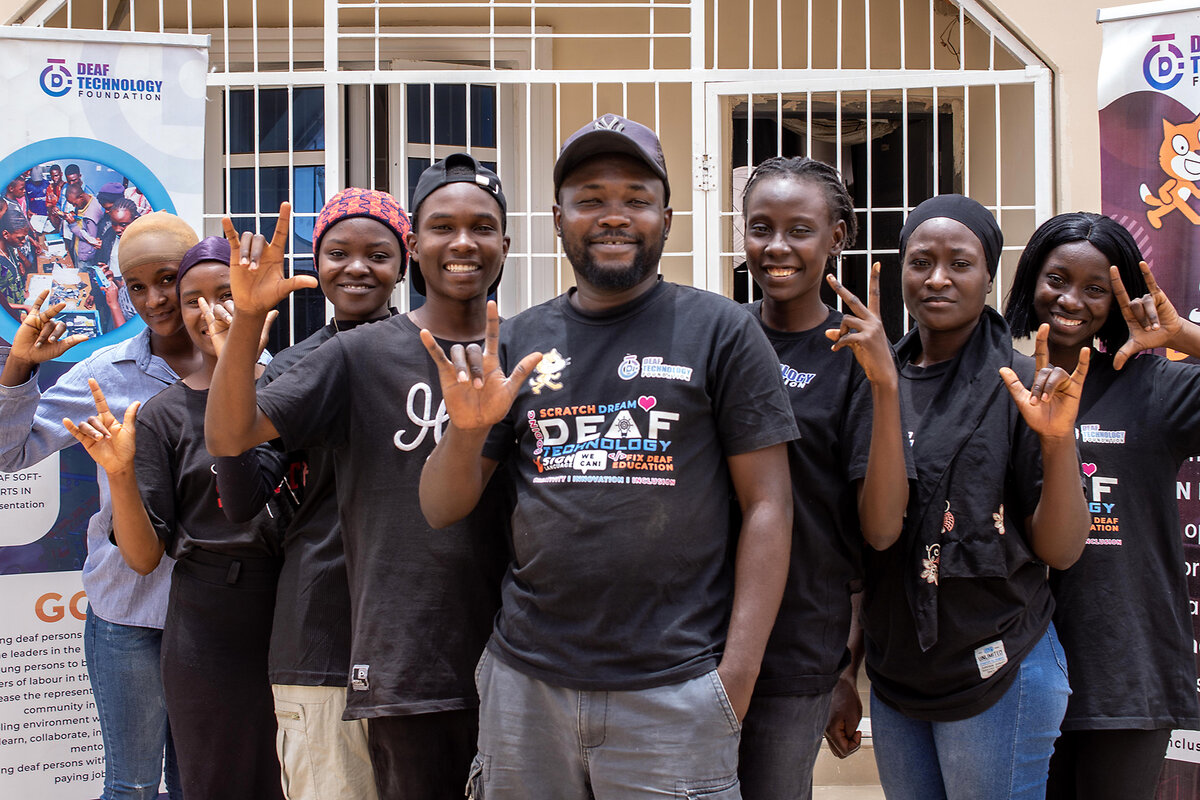
Photo: Nathaniel Bivan.
Wuni Bitrus (co-founder of the Deaf Technology Foundation) and some of his students sign “I love you” in Jos, Nigeria.

Things change so fast in our world that I can only hope a positive story I read in June is still true in August. It’s a worry. At the same time, we do know that people keep a good thing going — somehow — even with turmoil all around them.

I preface today’s story with that observation because I have been hearing about protests and riots in Nigeria that started with grievances about the economy and then went berserk as the government overreacted.

Nathaniel Bivan at Christian Science Monitor wrote in June about progress for the deaf community in Nigeria.

“In a one-room apartment in Jos, Nigeria, instructor Wuni Bitrus and almost a dozen students gather around a table cluttered with equipment – a toolbox, a 12-volt adapter, a coding panel, a set of jumper cables, a mix of colored wires. The students’ idea: to build the prototype for a ‘smart’ door that opens with the touch of a finger.

“The students chat back and forth in sign language, and Mr. Bitrus signs back. The group discusses using Arduino, an open-source electronics platform, and one student wonders how fingerprints can be stored. Mindful of Nigeria’s electricity problems, Mr. Bitrus genially advises the group to use a battery-powered keypad lock system first and incorporate a fingerprint feature later. 

“ ‘It works well, rather than waste time reinventing the wheel,’ Mr. Bitrus says. After nodding in agreement, the students excitedly start working.

“This is just another afternoon in a club run by the Deaf Technology Foundation, a nonprofit co-founded by Mr. Bitrus in 2017 that trains Nigerian children and young adults who are deaf in computer programming and robotics. The students also work to improve their reading skills, and receive career guidance and counseling to help them believe in themselves.

“Mr. Bitrus’ … desire to change the prospects of Nigeria’s deaf and hard-of-hearing community was sparked in 2014 by his encounter with a 13-year-old girl while he was teaching as part of the National Youth Service Corps in Zamfara state. Mr. Bitrus had noticed that the teen faced discrimination, and he became determined to learn sign language and teach her to use a computer. Three years later, he marshaled the resources, including funding from the Massachusetts Institute of Technology, to form the Deaf Technology Foundation.

“One of the darkest memories that Mercy Samson Grimah, a foundation student, has about growing up is looking at the faces of people around her and recognizing insults and negative energy directed at her. 

“ ‘That hurt me so bad because I knew in my heart that I could do anything. They just see us as lesser human beings,’ she says. ‘I wanted to show them that deaf people can become whatever they want to be.’ … 

“Ms. Grimah says her private secondary school did not formally teach sign language to her, nor much of anything else. But there was one teacher who knew how to sign, and she taught Ms. Grimah. … She dropped out in her third year because her parents could not pay her school fees, but fortunately, she had already formed a bond with the Deaf Technology Foundation. …

“Five years ago, Ms. Grimah and several other students made a road trip from Jos to Nigeria’s capital, Abuja, to compete in MakeX, a robotics contest. … Although Ms. Grimah’s team was not chosen to go on to represent Nigeria in the international competition, it emerged fourth among about 15 teams.

“ ‘Our team was the only one made up of the deaf,’ says Ms. Grimah, her eyes lighting up.

“Her father, Grimah Samson, adds, ‘What they are doing changed her.’ …

“Joy Yusuf, another Deaf Technology Foundation student, had wanted to become a doctor. But she was moved to a new school where the principal and staff said there was no way that could happen, even though the school welcomed students with disabilities.  

“ ‘It was a blow for me,’ Ms. Yusuf says. ‘I cried. I had to call Mr. Bitrus and my father to beg them, but [the principal and staff] still refused. For me, Deaf Tech is the only way I can have anything close to [studying] medicine.’  Now, she, too, wants to become a web developer.” 

More at the Monitor, here. No paywall.

The part of Nigeria where this story takes places is Jos. Online I found something interesting about it: “The state has over forty ethno-linguistic groups. Some of the indigenous tribes in the state are the Berom, Afizere, Amo, Anaguta, Aten, Bogghom, Buji, Challa, Chip, Fier, Gashish, Goemai, Irigwe, Jarawa, Jukun, Kofyar (comprising Doemak, Kwalla, and Mernyang), Montol, Mushere, Mupun, Mwaghavul, Ngas, Piapung, Pyem, Ron-Kulere, Bache, Talet, Taroh (Tarok), Youm and Fulani/Kanuri in Wase.” Wow.

Read Full Post »

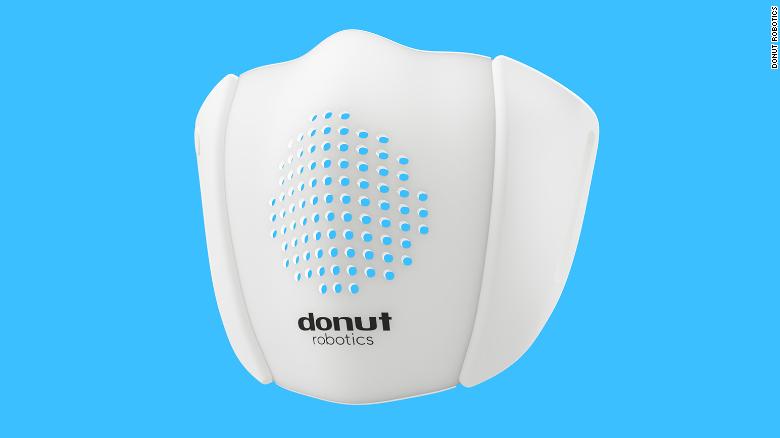
Photo: CNN
In Japan, wearing a mask was common even before the pandemic.

I’m told that in Sweden, it’s been hard to get people to start wearing masks now that the authorities have changed their approach to the pandemic. In Japan, where mask wearing on subways and elsewhere is normal to protect health, dialing up usage has not been a problem.

That has created an opportunity for a robotics company with an idea about putting a multipurpose mask over your Covid-19 mask.

As Rebecca Cairns reported at CNN Business last November, “When the Covid-19 pandemic made face masks an everyday essential, Japanese startup Donut Robotics spotted an opportunity. They created a smart mask — a high-tech upgrade to standard face coverings, designed to make communication and social distancing easier.

“In conjunction with an app, the C-Face Smart mask can transcribe dictation, amplify the wearer’s voice, and translate speech into eight different languages.

“The cutouts on the front are vital for breathability, so the smart mask doesn’t offer protection against the coronavirus. Instead, it is designed to be worn over a standard face mask, explains Donut Robotics CEO Taisuke Ono. Made of white plastic and silicone, it has an embedded microphone that connects to the wearer’s smartphone via Bluetooth. The system can translate between Japanese and Chinese, Korean, Vietnamese, Indonesian, English, Spanish and French.

Donut Robotics first developed the translation software for a robot called Cinnamon — but when the pandemic hit, the robot project was put on hold. That’s when the team’s engineers came up with the idea to use their software in a face mask.

“Donut Robotics started life in a garage in Kitakyushu City, in Fukuoka prefecture, in 2014. … With venture capital investment, [Ono and cofounder engineer Takafumi Okabe] applied to Haneda Robotics Lab — an initiative that sought robots to provide services for visitors at Tokyo’s Haneda Airport. …

“Donut Robotics’ Cinnamon robot — designed to provide tourists with useful information and help them to navigate the airport — was one of four translation robot prototypes selected by the project in 2016. Haneda Robotics Lab says Cinnamon beat the competition because of its appealing aesthetics and user-friendly design, and because the translation software performed well in noisy environments. …

“The team started testing a prototype at Haneda Airport in 2017 and continued developing the technology. But earlier this year, Covid-19 hit Asia and the airport project ground to a halt. ‘We were running short of money and wondering how to keep the company going,’ says Ono. The team sought a solution and came up with the idea to adapt its software for a product that would sell well in a pandemic. …

“Donut Robotics launched a fundraiser on Japanese crowdfunding platform Fundinno in June. They raised 28 million yen ($265,000) in 37 minutes, says Ono. ‘It was very surprising,’ he says. …

“A second round of crowdfunding on Fundinno in July raised a further 56.6 million yen ($539,000), which Ono plans to use to develop translation software for the international market. … Ono says the first wave of distribution is expected to take place in Japan, with 5,000 to 10,000 masks available by December [2020]. They will be priced at $40 to $50, he says, with an extra subscription for the app. Donut Robotics will not expand overseas until April 2021 at the earliest. …

“The mask’s Bluetooth chip can connect to smartphones up to 32 feet (10 meters) away, says Ono. He hopes the mask will make new social distancing norms in locations including hospitals and offices easier, by enabling good communication.”

Photo: Donut Robotics

More at CNN, here.

As I write this, the English language class where I volunteer is about to start. At the risk of throwing a wet blanket over this robotics story, I can’t help mentioning that translation devices really slow language acquisition.

But I do think the Donut software’s ability to clarify your words and make social distancing work better is great. I’m constantly misunderstanding muffled words spoken through a mask — which gave a granddaughter a really good laugh the other day.

Read Full Post »

Photo: Cliff Owen/Associated Press
The Afghan team at the opening ceremony of the First Global robotics competition in Washington in July.

Did you read about the ups and downs of the young Afghan girls who ran into the travel ban when they tried to come to July’s robotics competition in Washington?

Emily Cochrane wrote about it at the NY Times.

“It took an international outcry and intervention from President Trump and other officials to allow [six] girls from an Afghan robotics team to receive visas after two rejections, letting them travel to the United States for participation in First Global, an international robotics contest.

“For three days in the Daughters of the American Revolution Constitution Hall, where an African-American woman was once denied the right to sing before an integrated audience in the 1930s, the Afghan girls in head scarves were stars on an international stage, with cameras, lights and whispers trailing them from practice to competition. …

“Wai Yan Htun, 18, a member of Myanmar’s team who stopped to get the Afghans’ signatures on his shirt, said: ‘We love them. They’re like superheroes in this competition.’ …

“In the competition, teams of three, equipped with kits that included wheels, gears and two video game controllers, chased down blue and orange balls, which represented clean and contaminated water. In two-and-a-half-minute rounds, teams guided the robots to sweep the balls into openings based on their color.

“ ‘It’s way more fun, way more exciting than bouncing a ball,’ said Dean Kamen, one of the organization’s founders and inventor of the Segway. ‘That’s not a competition out there. That’s a celebration.’ …

“The six students were chosen from an initial pool of 150 applicants. They built their robot in two weeks, compared with the four months some of their competitors had, because their kit’s shipment was delayed. …

“While the team did not place in the top ranks overall, their final performance, they agreed, was better than they had hoped for. …

“ ‘I am so happy and so tired,’ Alireza Mehraban, an Afghan software engineer who is the team’s mentor, said after the competition concluded.

“Mr. Mehraban said the contest had been an opportunity to change perceptions about the girls’ country. ‘We’re not terrorists,’ he said. ‘We’re simple people with ideas. We need a chance to make our world better. This is our chance.’ …

“ ‘God made this planet for something like this, all the people coming together as friends,’ said Alineza Khalili Katoulaei, 18, the captain of the Iranian team, gesturing to the Iraqi and Israeli teams standing nearby. ‘Politics cannot stop science competitions like this.’ ”

More at the NY Times, here.

Read Full Post »