Feeds:
Posts
Comments

Posts Tagged ‘rochester’


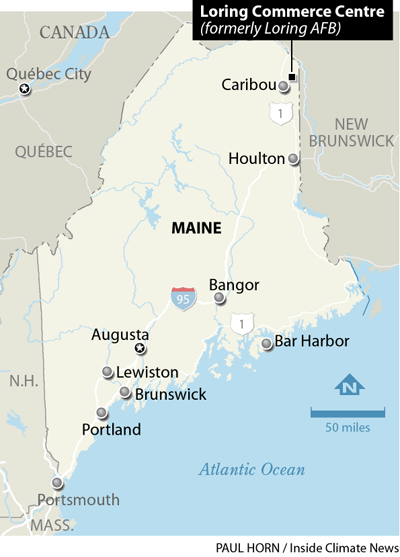
Above: At the former Loring Air Force base in Maine, there are hopes that a planned data center will use less water for cooling equipment by using a technique that submerges computer components in a nonconductive, oil-based fluid to draw heat directly from the source.

The rapid increase of energy-guzzling buildings for artificial intelligence has people talking about better ways to cool the systems. One idea is to build them in somewhere off Planet Earth, which sounds like a horrible idea to me. Meanwhile in Maine, developers are investigating a different approach.

Ryan Krugman writes at Inside Climate News, “Once a Cold War outpost near Maine’s northern border, the former Loring Air Force Base could soon be home to a very different kind of facility: the state’s first large-scale data center. The sprawling 450-acre site in Limestone, Maine, would host the giant server farm as part of a plan still in its early stages to reinvent part of the base as a hub for green technology.

“Since its closure in the early 1990s, the Loring Development Authority has redeveloped the base into a business park and a commercial airport. More recently, it has also become a sustainability-focused campus through the company Green 4 Maine.

“Developers say Loring’s fiber network and access to renewable hydropower make it an ideal site for a next-generation data center powered entirely by green energy and using water-free cooling technology. But questions remain over how such an energy-intensive project could impact utility rates, grid reliability and a sensitive surrounding environment.

“Traditionally, data centers, among the most power-hungry and resource-dependent buildings in the world, rely on massive cooling systems to keep thousands of servers from overheating. Some use energy-intensive fans that circulate air through vast server halls, while others depend on large volumes of water to absorb heat. ‘I wake up every morning wondering why we still use air to try and cool electronics,’ said Herb Zien, vice chair of LiquidCool Solutions, one of the developers of LiquidCool Data Center. ‘As a thermodynamics engineer, I used to use air to insulate, not cool.’

LiquidCool Solutions, a privately held company based in Rochester, Minnesota, takes a different approach to cooling electronic technology.

“Its ‘immersion cooling’ technology, Zien said, submerges computer components in a nonconductive, oil-based fluid that draws heat directly from the source — eliminating the need for fans, air conditioning or water. The system produces no toxic byproducts or emissions and, according to the company, nearly eliminates both noise and evaporative loss. Loring, company officials say, will serve as the first large-scale data center built entirely around its technology—its first real-world test. …

“The developers say [the data center] will be entirely powered by renewable energy—mainly hydroelectricity. [But] Versant Power, the region’s transmission and delivery utility, wrote in an email that … it could not verify that the supply would come from hydro or renewable sources. The utility added that grid upgrades would likely be necessary to support the project — costs that would be covered by the developers.

“A Harvard Law School Environmental and Energy Law Program study found that, while initial costs are paid for by the developers, data center projects often shift expenses onto ratepayers through discounted or tailored negotiated contracts, wholesale market charges and grid upgrades that may exceed what’s necessary for reliability.

” ‘Adding 50 megawatts to such a small, isolated grid is huge,’ said Hepeng Li, an assistant professor at the University of Maine’s College of Engineering and Computing. Northern Maine’s independent grid has a peak load of roughly 150 megawatts, meaning the data center alone could consume more than a third of the region’s total demand.

“Nearly 50 megawatts of mostly hydroelectric power — currently supplied by New Brunswick Power — is available at a nearby substation, according to Zien. New Brunswick Power told Inside Climate News that no supply agreement or memorandum of understanding is in place with either Green 4 Maine or the Loring Data Center project. …

“Developers also plan to install on-site diesel generators to provide backup power during grid outages. While standard for data centers, a diesel backup system can emit harmful air pollutants — including particulate matter, volatile organic compounds and nitrogen oxides — posing potential risks to the Mi’kmaq Nation and the Aroostook National Wildlife Refuge, which border the site. …

“Project officials say generators would not be installed immediately and that some future users might choose to operate without them. …

“Those uncertainties would only grow if the project succeeds and the developers expand the data center beyond its initial 2- to 6-megawatt capacity. Even so, supporters and researchers say that if the cooling technology performs as promised and the developers can secure a reliable supply of Canadian hydropower, the project has the potential to chart a new direction for cleaner, water-free data center development.”

More at Inside Climate News, here. I admire inventors who come up with useful ideas. But I don’t know about this one. When there is money to be made, inventors often seem too sanguine about how well things will work. Imagineering combined with practicality is a consummation devoutly to be wished.


Read Full Post »

If you were a toy, would you want to be in the toy hall of fame, or would you be afraid success would go to your head? I remember seeing room after room after room of dolls at the Strong Museum in Rochester, New York, so perhaps a toy just feels like one of many there.

In November, James Barron of the NY Times wrote about a big hall of fame event at the Strong. “The museum announced that just three toys — the puppet, another generic finalist; the Super Soaker squirt gun; and the game Twister — will join past inductees like the Barbie doll (1998), Mr. Potato Head (2000), Silly Putty (2001) and Lionel electric trains (2006). …

“Christopher Bensch, the museum’s vice president for collections and its chief curator, said the three new inductees easily met the basic criteria for admission. All three long ago achieved ‘icon status’ as playthings that are ‘recognized, respected and remembered.’ They also ‘profoundly changed play or toy design.’ …

“Mr. Bensch said that among the judges, the puppet was the big winner this year. ‘It was one of those “why hasn’t it happened before?” ones, which was like the ball,’ he said, ‘and Jon Stewart gave us hell for that.’ Mr. Stewart, in a segment on ‘The Daily Show’ in 2009, complained that not inducting the ball sooner was like having a ‘heat source hall of fame’ and not inducting fire. …

“[Curator Patricia] Hogan, who specializes in toys and dolls, said she had lobbied for the puppet. After all, she said, ‘Howdy Doody had his own show.’

“But what about Buffalo Bob Smith, the human host who bantered with the puppet that was the namesake of that 1950s children’s program?

“ ‘It was called “Howdy Doody,” ‘ she said. ‘Get over it, Bob. You’re just a puppet to Howdy.’ ” More here.

Photo: Heather Ainsworth/The New York Times
John Neidrauer, left, and Andrea Whitmarsh used Kinect motion control to play with classic toys at the Strong National Museum of Play in Rochester. 

Read Full Post »

The Eastman School of Music in Rochester, New York, has an entrepreneurial competition they call the Eastman New Venture Challenge.

This is how it got started: “The Institute for Music Leadership (IML) received a major part of a $3.5 million grant to the University of Rochester from the Ewing Marion Kauffman Foundation to support entrepreneurship education. The IML’s focus in ‘entrepreneurship in music’ is helping students learn how to turn promising ideas into enterprises that create value.”

Award winners Marissa Balonon-Rosen and Lauren Petrilli came up with the Pianos for Peace Project.

According to the Eastman website, Pianos for Peace “follows the idea that by actively involving people in music, we can make for a more peaceful community. This summer, about 10 pianos (upright and baby grand) will be placed throughout the City of Rochester (mostly outdoors) for anyone to play. They will be placed in several different neighborhoods, including those that generally do not have much access to the arts or pianos.

“Youth, local artists, and community members will work together to paint the pianos peace themed. After a couple weeks, we will create a ‘Piano Park for Peace’ by placing the pianos outdoors at the Gandhi Institute for Nonviolence … . There will be several events to bring the community together through music and peace — free piano lessons, yoga, lectures about nonviolence, etc. The surviving pianos will then be donated to youth-focused and nonviolence-focused organizations.”

I once read about something similar in New York City, here. The British artist Luke “Jerram got the idea at his local coin-operated laundry, according to a website about the project. He saw the same people there every weekend, but none of them talked to each other. He thought a piano might help bring people together in places like that.”

The Pianos for Peace Project seems to be building on that idea. Read more about Marissa Balonon-Rosen and Lauren Petrilli, here.

Photo: Suzanne’s Mom
Until Eastman posts pictures of the Pianos for Peace, this one in a public space will have to do. Who can tell me where it is?

random-piano-for-anyone

Read Full Post »

I moved from Rochester, New York, more than 30 years ago, so it was only when I went back for a visit that I got to see the storied collections of Margaret Woodbury Strong in a museum built to house them.

When one recovers from the enormity of her obsession, one feels deeply grateful for all the toys and dolls of one’s childhood so beautifully preserved.

The offerings and outreach of the museum have grown like topsy in 30 years. And today another new partnership was announced.

“The great minds of the toy industry will be honored alongside their famous creations when the Toy Industry Hall of Fame combines with the National Toy Hall of Fame under a partnership announced Tuesday.

“The 5,000-square-foot National Toy Hall of Fame gallery at the Strong museum in Rochester will undergo $4 million in renovations, with the goal of opening the combined hall in the fall of 2015.

“The Toy Industry Hall of Fame, whose inductees have included Milton Bradley, Frederick August Otto Schwarz, Walt Disney and George Lucas, has been without a physical presence for about eight years following the closure of the International Toy Center in New York City.

“Leaders of both halls have been talking for some time about combining the two as a way to raise their visibility and exposure and to promote their educational missions. …

” ‘The Strong is an ideal home for this homage to both the toys that have influenced generations of children and the innovative minds that brought them to life,’ Carter Keithley, president of the Toy Industry Association, said at a news conference at the Strong museum, where items like alphabet blocks, roller skates, the Frisbee, Lincoln Logs and the stick occupy places of honor.”

Read more at Yahoo, here. Click “like” if you believe in toys.

Photo: The Strong Museum
“The Strong’s founder, Margaret Woodbury Strong, had a particular interest in dolls and amassed one of the largest collections in the world. The National Museum of Play® at The Strong continues to refine and develop her collection, making it increasingly comprehensive and inclusive. It now includes more than 12,000 dolls and 2,800 paper dolls.”

Read Full Post »

Many flowering trees are early this year. I associate lilacs with Mother’s Day, the Lilac Festival in Rochester, New York, and Lilac Sunday at the Arnold Arboretum in Boston — events that occur May 13 this year. But here we are in April, and lilacs are delicious everywhere.

The unusually dark red of the Japanese Maple at Dunkin Donuts is hard to capture on film. But as amazing as the color is, even more amazing is the tree’s comeback after March’s unseasonal heat and frost blasted the first leaves to brown. I was sure that was it for this year, but the leaves are richer than ever.

Read Full Post »