Feeds:
Posts
Comments

Posts Tagged ‘Rohingya’

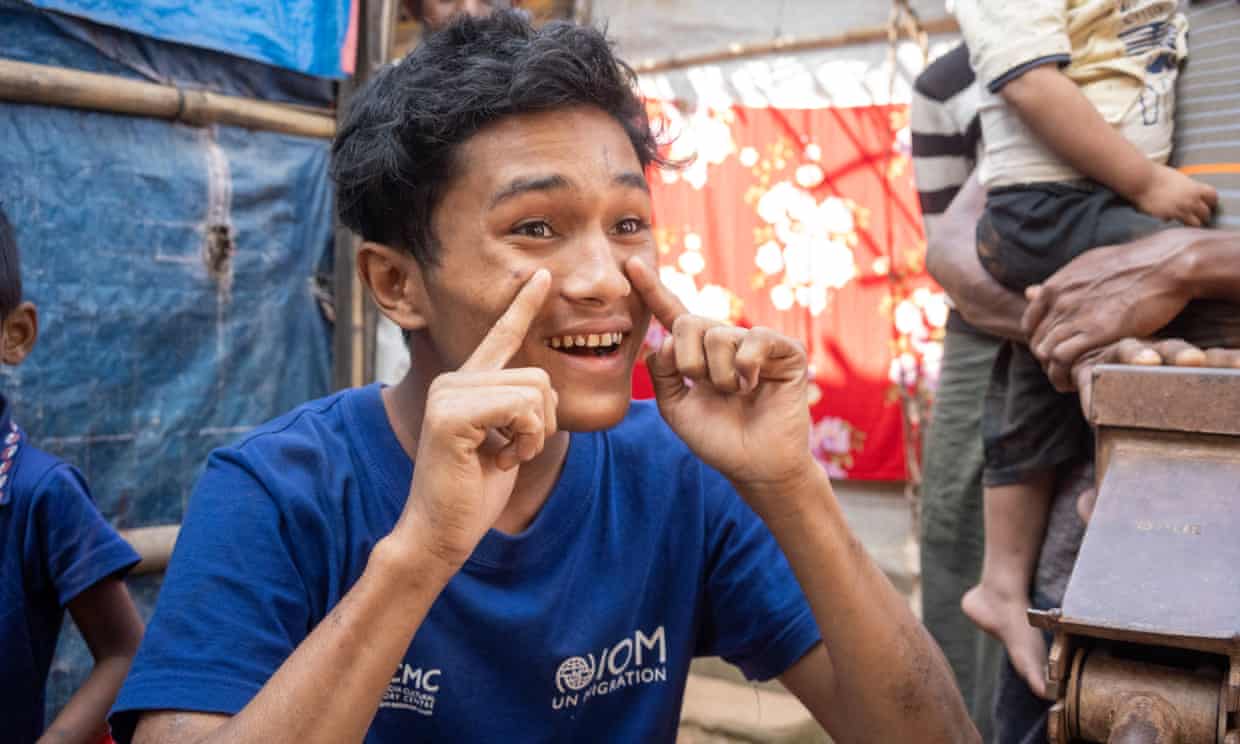
Photo: Kaamil Ahmed.
The Guardian writes: Asom Khan, who is deaf and mute, uses his own version of [signing] to communicate with friends and family in Bangladesh.” And he takes photos that speak, too. 

What a powerful need human have to communicate! Here’s a story of a boy with the deck stacked against him many times over who wanted badly to communicate and figured out his own way to do it.

Kaamil Ahmed  writes at the Guardian, “His own sign language of sweeping, dramatized gestures is rarely fully understood by those outside Asom Khan’s closest friends and family, but the 15-year-old is able to speak through his art and photography.

“From his shelter in the Rohingya refugee camps of south-east Bangladesh, Khan takes photos to share the stories of his community – of his elderly neighbors, disabled people, and of women at work and in times of crisis.

“It was a journey that started with a photograph of him in 2017 – tears running down his face as he hung on to the side of an aid truck – that won awards for a Canadian press photographer, Kevin Frayer, as 700,000 Rohingya fled to Bangladesh from massacres in what the UN described as ethnic cleansing by the Myanmar military.

“That photo has stuck with Khan, who is deaf and mute, and when he saw other Rohingya becoming photographers, using budget smartphones to document daily life, he fully understood the power of an image.

“ ‘I was inspired by other Rohingya photographers. When there were floods or fires or other issues, they would come and take pictures. I saw that there was some power in it,’ says Khan, whose friend interprets for him.

“Since arriving in Bangladesh, he has also been producing vivid paintings, sometimes of idyllic Myanmar villages scenes, others of those villages under attack and the chaos he witnessed.

“Raised by his aunt and uncle after his mother died in childbirth, Khan had no opportunity to learn formal sign language so he improvised, teaching his own version to those around him. But art and photography has given him a freedom to communicate without an interpreter. …

“The camps Khan arrived at six years ago quickly became the world’s largest, with almost 1 million Rohingya crammed into bamboo and plastic shelters. As conditions have worsened, with education, work and movement limited, international attention has died down, leaving the refugees to deal with their own problems. …

“ ‘I feel like when I show pictures of the Rohingya situation to the world, they understand a bit more what we face.’

“Frayer, the photographer now with Getty Images who took Khan’s photo in 2017, says … ‘I remember taking a few frames and then he disappeared into the crowd below. I remember feeling quite moved by how much courage this young boy showed,’ says Frayer.

“He found Khan again in 2018 and spent time with him, finally learning more of his story as they communicated through his sign language and his drawings.

“ ‘I was so moved and astounded to learn that he had taken an interest in photography. I saw in his artwork that he was incredibly talented at telling his story through his art, and that photography would indeed be a very strong tool for him,’ says Frayer.”

More at the Guardian, here. No firewall. Donations solicited.
Read Full Post »

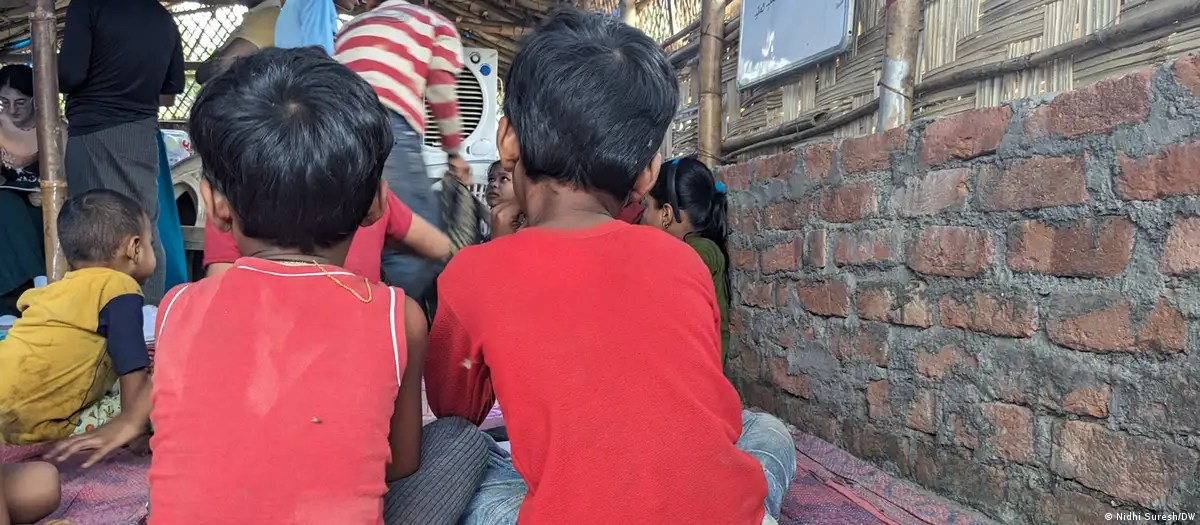
Photo: Nidhi Suresh/DW.
In May, a small classroom made of woven bamboo walls and a cardboard roof was set up in a refugee camp where around 30 children between the ages of 5 and 15 could be taught how to read and write the Rohingya language.

Did you ever feel a need to invent a written form of a language? The Karen language of Burma had no written system until the 1830s, and Somali got Latin characters in 1973. Meanwhile, the Rohingya are barely getting started.

Nidhi Suresh writes for DW, “Ayesha Siddique, an 11-year-old Rohingya girl, rushed into her classroom. She picked up a broom, swept the floor and laid out a plastic mat in front of the small white board.   

“Siddique’s family fled Myanmar soon after she was born to escape the widespread discrimination and persecution of the Rohingya, a Muslim minority group in the Southeast Asian nation. They spent a few years in Bangladesh‘s Cox’s Bazar refugee camp before moving to India in 2019.

“The young girl currently lives in a refugee camp in Faridabad, on the outskirts of the Indian capital, Delhi.

” ‘My grandparents often describe Burma as a beautiful land with mountains,’ Siddique said, referring to the country now known as Myanmar. ‘They told me about the trees behind our house, too. One day, I want to write a song about this in my own language.’

“For the past month, Maulvi Mohammad Ismail, himself a Rohingya asylum seeker, began teaching children like Siddique how to read and write in their mother tongue.

“In 2013, Ismail’s family also fled to Bangladesh’s Cox’s Bazar, which is currently home to at least 1 million Rohingya Muslims from Myanmar. After five years, he and his family made their way to India.

“They settled in the Faridabad camp, along with 50 other Rohingya families. The camp is located inside a garbage dump and most of the men work as ragpickers.

“The people in the camp speak to each other in Rohingya. They’re also fluent in Bengali and Hindi. However, most of them do not know how to read or write the script known as the Hanifi Rohingya. …

Rohingya living in Saudi Arabia and Bangladesh started a WhatsApp group called the Rohingya Zubaan Online Academy. 

“Ismail joined the group, downloaded the script, and spent a month learning the alphabet. Last month, he set up a small classroom made of woven bamboo walls and a cardboard roof where he started teaching around 30 children between the ages of five and 15 how to read and write the language. …

“Sabber Kyaw Min, founder and director of the Rohingya Human Rights Initiative in India, explained why it was so important that children learn the language.

” ‘We as a community do not have much documentation. Our children must learn to write our language and then our stories, which will become our history. … Through these stories we can hopefully demand justice some day.’

“The Rohingya language remained an oral tradition until the 1980s when Mohammad Hanif, an Islamic scholar, developed a script based on Arabic letters and a set of decimal numbers. [However,] due to a military crackdown, violence and an internet shutdown, most of the population could not access it.

” ‘What happens in any genocide is the systematic erasure of a cultural identity which had to be preserved,’ said Shehzar Doja, founder and editor of the Luxembourg Review. … The erasure of Rohingya culture began in 1964, when Myanmar’s then military dictator, Aye Ne Win, excluded the Rohingya language from Burmese Broadcasting Service.

“In 1982, the military government enacted the Citizenship Law, which excluded the Rohingya people from the list of recognized ethnic groups in the country. …

“In 2017, Myanmar unleashed a violent military crackdown in what many describe as a genocide against the Rohingya Muslims in the country. This led to a mass exodus, with more than a million Rohingya fleeing to Bangladesh and other countries.

“Mayyu Ali, currently residing in Canada, is a Rohingya poet and author of Exodus: Between Genocide and Me. Ali himself learned the language in 2013 while working at a research center in Myanmar which had access to the internet. …

“Ali was among the thousands of Rohingyas who fled to Bangladesh. While living in Cox’s Bazar, he began the ‘Art Garden Rohingya,’ a website which now brings together hundreds of Rohingya writers, poets and artists.

“The platform, launched in 2019, also documents and preserves ancient Rohingya folktales, proverbs and riddles. They’re published in Rohingya, Burmese and English.

“Ali also explained that another factor contributing to the slow erasure of the language is that after fleeing, most of the Rohingya focus on quick assimilation into their host countries. …

“Reefa Akhtar, 10, and Abdul Shukur, 12, are two children studying Rohingya language in Ismail’s class. When asked if they ever want to go home, both siblings immediately said, ‘yes.’

“However, Akhtar was quick to add, ‘but I also don’t want to go back to a place which makes my father sad even if he thinks about it for a minute.’ “

More at DW, here. No firewall.

Read Full Post »

Photo: Oxfam.
Folktales help preserve the threatened Rohingya culture.

To understand anything about a foreign culture, you need to turn to its arts: the music, the crafts, the folktales, for example.

Stephen Snyder at PRI’s the World reports about a threatened culture holding on by a thread far from home: “Mohammed Rezuwan is on a rescue mission: The 24-year-old who lives in Cox’s Bazar — the world’s largest refugee camp — is working to save Rohingya traditional stories before a generation of storytellers dies off.

“Rohingya people have lived in the region for over a thousand years, but Myanmar’s government considers them foreigners from neighboring Bangladesh. Over the last four years, hundreds of thousands of Rohingya have been driven out of Myanmar [Burma] by government troops and local militias. Many now live in dozens of refugee camps.

“ ‘We, Rohingya people, have our own culture, tradition. We are on the brink of losing all of them, unfortunately,’ Rezuwan said in a WhatsApp voice message from Kutupalong, one of more than two dozen encampments in Cox’s Bazar, on the coast of Bangladesh.

“The crowded area accommodates families who live in tents and shelters along narrow alleyways. United Nations figures put the exile population in the camp at nearly a million — four times the number of Rohingya still living in Myanmar.

“Rezuwan lives in a bamboo shelter with his wife, his mother, a brother and a sister. The family fled their home in Maung Daw, in the Rakhine district of Myanmar, on Aug. 25, 2017, as their village was set ablaze in a campaign that has forced most Rohingya out of Rakhine.

“ ‘I remember the gunshots ringing out like thunderclaps, the bullets strafing the sky like clouds of hungry locusts,’ Rezuwan wrote in the author’s note of his book, Rohingya Folktales: Stories from Arakan, as told by Rohingya refugees. …

“In 2020, after several years at Cox’s Bazar, he took on the role of folklorist — recording stories passed along in the oral tradition by Rohingya elders. …

“Rezuwan speaks his native Rohingya and learned to speak and write Burmese in school, but his English is largely self-taught. He spent a year collecting material for his English-language book, and the online version now includes 19 stories from storytellers in several of Cox’s Bazar’s camps.

“Research was no easy task. Rezuwan doesn’t have a car or bike, so he walked, sometimes up to five miles, to meet with each storyteller and record his or her story on the phone. …

“ ‘The hardest part is finding and meeting the people from different sorts of camps,’ Rezuwan said. ‘After all, not everyone has the same talents to remember the stories — just because they are uneducated — and so, finding the right person to tell the story was finding a gem from the ocean.’

“The Rohingya language is primarily spoken, without a standardized written script. Rezuwan translated the stories by playing back his recordings and, word by word, constructing English versions of the tales. He then pasted them into WhatsApp and sent them to his editor and friend, Alex Ebsary, in Buffalo, New York, who corrected grammar and word usage. Ebsary said he intentionally edited the stories with a light touch.

“ ‘Folktales are not a universal language,’ he said in a phone interview.

‘If you read these folktales, some of them are quirky. They’re kind of not even the morals that I would think of when thinking of a folktale.’ …

“Rezuwan said his mother used to tell him the story known as ‘A Hunter and a Flock of Heron.’ The version he collected from Rashid Ahmod, a 60-year-old resident of Kutapalong, was essentially the same story he heard as a boy, he said.

“The story is about a hunter who catches a group of beautiful herons in his net. The herons all try to escape by flying around in all directions, Ebsary explained. Rezuwan said the moral of the story is that birds — and people — can’t manage to go anywhere until they cooperate.

“Rezuwan and Ebsary both singled out a story from the collection called ‘A Queen’s Dream,’ which could serve as an allegory for Rohingya as an ethnic minority.

“The story is about a powerful queen who has a vivid dream about torrential rains after a period of drought. Everyone who drinks from the rain loses their minds. So the queen sends advisers to warn everyone.

“ ‘But of course, they don’t listen and everyone drinks the rain and goes mad. And in the end, the queen decides to join them by drinking the rain herself,’ Rezuwan said.

“The moral of the story is that if a country’s majority are wrongdoers, they have the power to ‘force [the] entire country into a very bad situation,’ Rezuwan said. ‘It’s what we are facing right now.’

“Rohingya have long faced discrimination and marginalization in their home country. The United Nations has called it ‘a textbook example of ethnic cleansing.’ If life in Myanmar was untenable, Rezuwan said, ‘in [the] camps, it seems like we are facing the second genocide.’

​​”Since coming to Kutupalong, Rezuwan has organized an educational network where Rohingya children — unable to attend schools — can follow the same curriculum taught in Myanmar. …

“ ‘I wanted the international community to know about our culture, about tradition and about the existence of Rohingya people in Arakan,’ he said.

“Arakan, the name Rohingya people give to their homeland in Myanmar, no longer appears on any maps of the region.”

More at PRI’s the World, here. There is no firewall. You can also listen to the recording of the show there.

Read Full Post »

Image: Mayyu Khan/Mohammed Rezuwan.
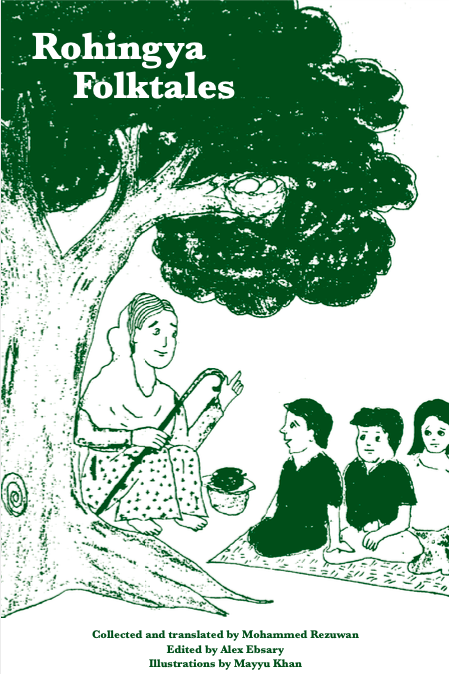
“The Blind Mother,” an illustration by Mayyu Khan, a Rohingya artist living in a Bangladesh refugee camp, from Rohingya Folk Tales, by Mohammed Rezuwan. 

While we’re on the subject of saving languages (see yesterday’s post), let’s look into how preserving folk tales can help keep a threatened culture from disappearing.

Few cultures are more threatened than that of the Rohingya of Myanmar, and today’s article is about a young folklorist in a Bangladesh refugee camp who is determined to do something about that.

Stephen Snyder has the report at Public Radio International’s The World. “Mohammed Rezuwan is on a rescue mission: The 24-year-old who lives in Cox’s Bazar — the world’s largest refugee camp — is working to save Rohingya traditional stories before a generation of storytellers dies off.

“Rohingya people have lived in the region for over a thousand years, but Myanmar’s government considers them foreigners from neighboring Bangladesh. Over the last four years, hundreds of thousands of Rohingya have been driven out of Myanmar by government troops and local militias. Many now live in dozens of refugee camps.

” ‘We, Rohingya people, have our own culture, tradition. We are on the brink of losing all of them, unfortunately,’ Rezuwan said in a WhatsApp voice message from Kutupalong, one of more than two dozen encampments in Cox’s Bazar, on the coast of Bangladesh.

“The crowded area accommodates families who live in tents and shelters along narrow alleyways. United Nations figures put the exile population in the camp at nearly a million — four times the number of Rohingya still living in Myanmar.

“Rezuwan lives in a bamboo shelter with his wife, his mother, a brother and a sister. The family fled their home in Maung Daw, in the Rakhine district of Myanmar, on Aug. 25, 2017, as their village was set ablaze in a campaign that has forced most Rohingya out of Rakhine.

“ ‘I remember the gunshots ringing out like thunderclaps, the bullets strafing the sky like clouds of hungry locusts,’ Rezuwan wrote in the author’s note of his book, Rohingya Folktales: Stories from Arakan, as told by Rohingya refugees.

“ ‘On that terrible day, my family and I ran to a nearby mountain where we hid for three days before we decided to cross the border to Bangladesh.’

“In 2020, after several years at Cox’s Bazar, he took on the role of folklorist — recording stories passed along in the oral tradition by Rohingya elders.

“ ‘Folk tales are used by Rohingya people to teach morals and lessons to their youngsters,’ he said. ‘I, myself, decided to make a book.’

“Rezuwan speaks his native Rohingya and learned to speak and write Burmese in school, but his English is largely self-taught. He spent a year collecting material for his English-language book, and the online version now includes 19 stories from storytellers in several of Cox’s Bazar’s camps.

Research was no easy task. Rezuwan doesn’t have a car or bike, so he walked, sometimes up to five miles, to meet with each storyteller and record his or her story on the phone. …

“ ‘The hardest part is finding and meeting the people from different sorts of camps,’ Rezuwan said. ‘After all, not everyone has the same talents to remember the stories — just because they are uneducated — and so, finding the right person to tell the story was finding a gem from the ocean.’

“The Rohingya language is primarily spoken, without a standardized written script. Rezuwan translated the stories by playing back his recordings and, word by word, constructing English versions of the tales. He then pasted them into WhatsApp and sent them to his editor and friend, Alex Ebsary, in Buffalo, New York, who corrected grammar and word usage. Ebsary said he intentionally edited the stories with a light touch.

“ ‘Folktales are not a universal language,’ he said in a phone interview. ‘You know, if you read these folktales, some of them are quirky. They’re kind of not even the morals that I would think of when thinking of a folktale.’ …

“Rezuwan said his mother used to tell him the story known as ‘A Hunter and a Flock of Heron.’ The version he collected from Rashid Ahmod, a 60-year-old resident of Kutapalong, was essentially the same story he heard as a boy, he said.

“The story is about a hunter who catches a group of beautiful herons in his net. The herons all try to escape by flying around in all directions, Ebsary explained. Rezuwan said the moral of the story is that birds — and people — can’t manage to go anywhere until they cooperate. …

“​​Since coming to Kutupalong, Rezuwan has organized an educational network where Rohingya children — unable to attend schools — can follow the same curriculum taught in Myanmar. He also works with humanitarian groups as a guide and interpreter.”

Read more here.

Read Full Post »

Photo: Ryan Donnell/Sesame Workshop
Grover from “Sesame Street” in a Rohingya camp in Bangladesh. The Lego Foundation will provide $100 million over five years to the makers of “Sesame Street” and their partners for a program for refugee children.

Most of what we know about the situation of Rohingya refugees — expelled from Myanmar (Burma) for their Muslim beliefs — is pretty dire. But here and there we see positive efforts to lessen the pain of living in overcrowded camps in Bangladesh, especially for children. Read about this partnership among humanitarian relief organizations, Sesame Street, and Lego.

Karen Zraick writes at the New York Times, “Can play help refugee children heal from trauma?

“That’s the belief behind a new partnership formed by the Lego Foundation, Sesame Workshop and organizations working with Syrian and Rohingya refugees. In its first major humanitarian project, announced [in December], the foundation will provide $100 million over five years to the makers of ‘Sesame Street’ to deepen their work with the International Rescue Committee in the countries around Syria, and also to partner with the Bangladeshi relief organization BRAC.

“The aim is to create play-based learning programs for children up to age 6 in Lebanon, Jordan, Iraq and Bangladesh. The programs will teach basics like the alphabet and numbers, but will also emphasize social and emotional development to counter the effects of stress and suffering. They will be offered both to displaced children and to some of their potential friends in host communities.

“Officials at the organizations involved said that helping children’s brains develop during their first years — when they are absorbing information like sponges — is crucial to helping them become healthy and successful later in life, and that play is an excellent way to do it.

“ ‘We know from child development research that the best way for children to learn is through exploring their world and play,’ said Sarah Smith, the senior director for education at the International Rescue Committee. …

“The families’ needs are great. In addition to basics like adequate food and shelter, children need to foster ties with nurturing caregivers to heal from what they have witnessed and endured, said Hirokazu Yoshikawa, a director of Global TIES for Children, a research center at New York University that will conduct testing and evaluation for the program.

‘Part of the magic of human development is that very few experiences doom a child to ruin,’ Dr. Yoshikawa said. ‘But we have to address the risks early. This is particularly critical in these first years.’ …

“Erum Mariam, a program director for BRAC, said that many of the 240 play labs the organization has created for refugees were built by the children’s fathers and painted and decorated by mothers and children.

“ ‘We place a lot of emphasis on culture and on strengthening community engagement,’ she said. Within those centers, trained facilitators focus on providing enough structure to make children feel safe, while allowing for spontaneous joy.

“ ‘When a child enters the humanitarian play lab, we want the child to feel very happy and very connected to their culture and heritage,’ she said.” More here.

You may recall I wrote about Sesame Street helping Syrian refugee children, here.

Read Full Post »

Rohingya-in-Bangladesh-ARC-photo

Photo: @coryt
American Refugee Committee, a nonprofit with Charity Navigator‘s highest rating, is one of a few organizations helping Myanmar’s persecuted Rohingya Muslims in Bangladesh camps.

With so many languages still in use, I have sometimes wondered how aid workers in refugee camps find people to translate languages that are rare.

Malaka Gharib reports about some of the challenges at National Public Radio (NPR).

“Imagine an aid worker in Bangladesh. Her mother tongue is Chittagonian. She’s trying to help a Rohingya refugee, whose language is similar to hers — but not 100 percent. The refugee tells her gaa-lamani biaram, ‘my body is falling apart.’ Would she know that phrase meant the refugee had diarrhea?

“That’s why a new glossary is being developed. And one of the 180 entries is that Rohingya phrase, indicating that a person is suffering from diarrhea.

“In June, a nonprofit group called Translators Without Borders, in partnership with Oxfam and UNICEF, created a special online glossary for humanitarians working in Rohingya camps in Bangladesh. The app, which aid workers can download on their mobile phones, includes terms with translations in five languages spoken in the camps: English, Bangla, Rohingya, Chittagonian and Burmese. …

“A November 2017 study from Internews, a nonprofit group that helps people in low-income settings access news and information, reported that almost two-thirds of the 570 Rohingya refugees surveyed at Cox’s Bazar [a Bangladesh camp] were unable to communicate with aid providers.

“That can be particularly dangerous when it comes to health care, says [Irene Scott, the program director for Translators Without Borders in Bangladesh]. … To create the glossary, Translators Without Borders assembled a focus group of aid workers and refugees to come up with ‘a dictionary list of terms they use at the camps every day and terms that field workers are having trouble trying to communicate,’ says Scott. Then they worked with members of the community and a staff sociolinguist to translate the words into the four languages. …

“Most of the words in this first iteration of the Bangladesh glossary focus on water, sanitation and hygiene. Over the past few months, the camps have faced acute water shortages, putting people at risk of waterborne diseases like cholera, bloody diarrhea, typhoid and hepatitis E. …

” ‘Chlorine tablet’ is an important word for aid workers to clearly translate, says Scott, because they’re asking refugees to put a foreign substance into their drinking water to make it safe to consume. ‘It’s hard to tell a traumatized community to put that tablet in water and drink it.’ …

There are a few unexpected words in the glossary — like ‘poem.’ Rohingya aid volunteers in the camps specifically asked for this word to be added.

” ‘Since Rohingya is an oral language, written communications like fliers or pamphlets [to convey important health information] may not be effective given the lack of a standardized script,’ says Krissy Welle, senior communications officer for Translators Without Borders.

“Rhyming conventions are a key way to transfer knowledge and historical facts in Rohingya culture, explains Eva Niederberger, Oxfam’s community engagement adviser in Cox’s Bazar, in a statement to NPR. So an aid worker might say something like, ‘Here’s a poem that will teach you how to protect yourself from certain diseases. …

” ‘When we talk about language with Rohingya women and men, they’re happy that someone is paying attention to something so crucially important to their cultural identity. For so long they’ve had their rights denied to them. It’s all about respect at the end of the day.’ ”

More at NPR, here.

Read Full Post »