Feeds:
Posts
Comments

Posts Tagged ‘seed bank’

Photo: Dani Anguiano.
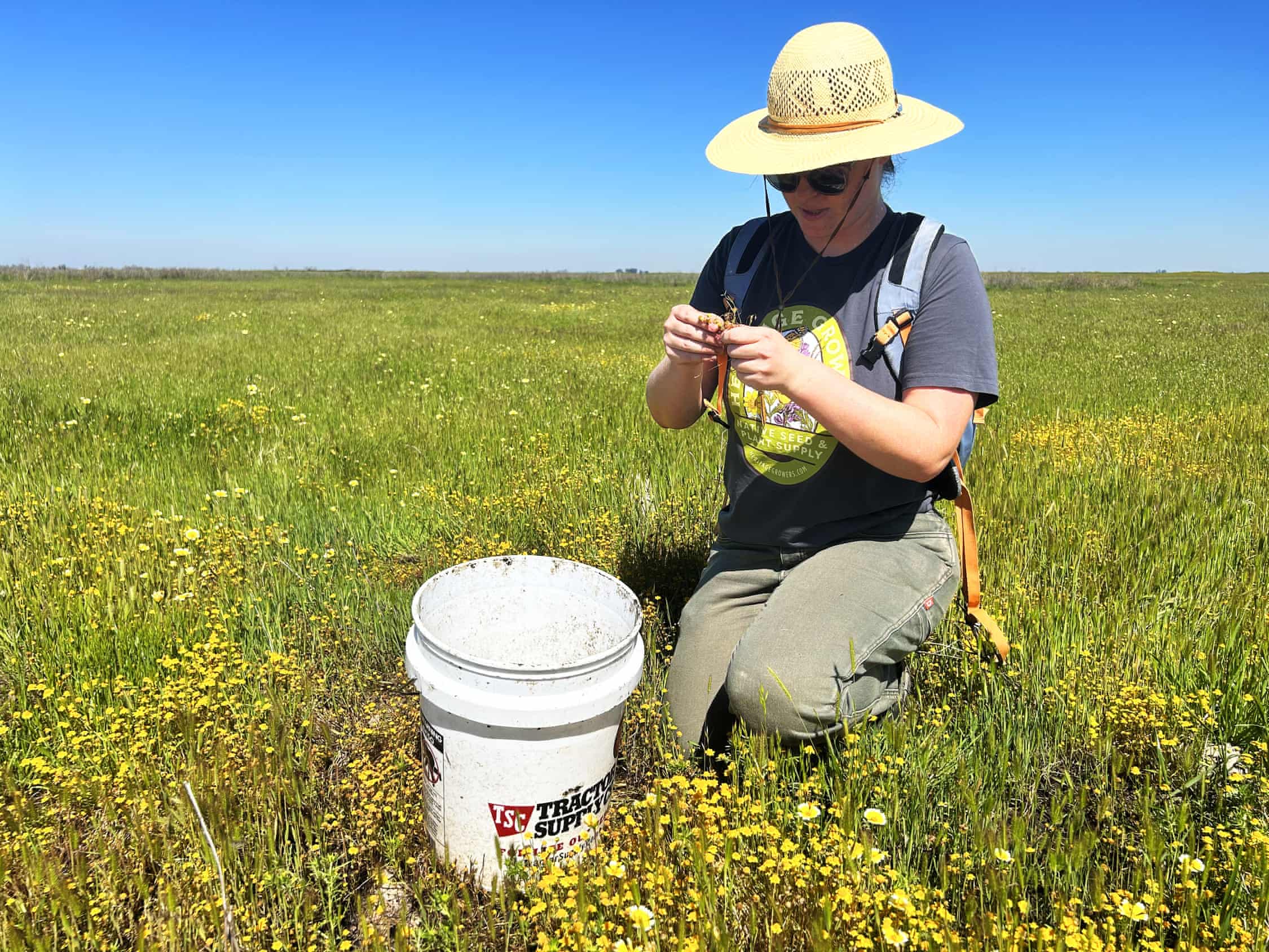
Haleigh Holgate, seed collection manager at Heritage Growers, inspects a seed in the San Luis national wildlife refuge complex on March 2025. Only the correct species will do.

I have blogged about seed banks in various countries (search on “seed bank”), and particularly about the global one that will keep seeds safe forever — if it stays frozen.

Today we learn what’s going on in California, where Heritage Growers is focused on local flora.

Dani Anguiano reported at the Guardian, “Deep in California’s agricultural heartland, Haleigh Holgate marched through the expansive wildflower-dotted plains of the San Luis national wildlife refuge complex in search of something precious.

“She surveyed the native grasses and flowering plants that painted the Central valley landscape in almost blinding swaths of yellow. Her objective on that sweltering spring day was to gather materials pivotal to California’s ambitious environmental agenda – seeds. …

“As a seed collection manager with the non-profit Heritage Growers native seed supplier, Holgate is tasked with traveling to the state’s wildlands to collect native seeds crucial for habitat restoration projects.

“The need has become particularly acute as California aims to conserve 30% of its land by 2030, with the governor pledging to restore ‘degraded landscapes’ and expand ‘nature-based solutions’ to fight the climate crisis. …

“But the rising demand for seeds far outpaces the available supply. California faces an ‘urgent and growing need’ to coordinate efforts to increase the availability of native seeds, according to a 2023 report from the California Native Plant Society. There simply isn’t enough wildland seed available to restore the land at the rate the state has set out to, Holgate said.

“Bridging the gap starts with people like Holgate, who spends five days a week, eight months of the year, traveling with colleagues to remote spots across the state collecting seeds – an endeavor that could shape California’s landscape for years.

“That fact is not lost on the 26-year-old. It’s something she tries to remind her team during long, grueling, hot days in the oilfields of Kern county or the San Joaquin valley. …

“Seeds play a vital role in landscape recovery. When fires move through forests, decimating native species and leaving the earth a charred sea of grey ash, or when farmlands come out of production, land managers use native seeds to help return the land to something closer to its original form. They have been an essential part of restoring the Klamath River after the largest dam removal project in US history, covering the banks of the ailing river in milkweeds that attract bees and other pollinators, and Lemmon’s needlegrass, which produces seeds that feed birds and small mammals.

“California has emphasized the importance of increasing native seed production to protect the state’s biodiversity. … Three-quarters of native vegetation in the state has been altered in the last 200 years, including more than 90% of California wetlands, much of them here in the Central valley.

“For the state to implement its plans, it needs a massive quantity of native seeds. … Enter Heritage Growers, the northern California-based non-profit founded by experts with the non-profit River Partners, which works to restore river corridors in the state and create wildlife habitat.

“The organization takes seed that Holgate and others collect and amplifies them at its Colusa farm, a 2,088-acre (845-hectare) property located an hour from the state capital. (The ethical harvesting rules Heritage Growers adhere to mean that they can take no more than 20% of seeds available the day of collection.) …

“Currently, the farm is producing more than 30,000 lbs of seeds each year and has more than 200 native plant varieties.

“The goal, general manager Pat Reynolds said, is to produce source-identified native seed and get as much of it out in the environment as possible to restore habitat at scale. …

“The benefit of restoring California’s wildlands extends far beyond the environment, said Austin Stevenot, a member of the Northern Sierra Mewuk Tribe and the director of tribal engagement for River Partners.

“ ‘It’s more than just work on the landscape, because you’re restoring places where people have been removed and by inviting those people back in these places we can have cultural restoration,’ Stevenot said. ‘Our languages, our cultures, are all tied to the landscape. … It’s giving the space back to people to freely do what we would like for the landscape and for our culture,’ he said. …

“The mission is worthwhile, Holgate said. The seeds she collects are expensive, but if they can be amplified and expanded, native seeds will become more abundant and restoration projects can happen more quickly.

“ ‘We can restore California faster,’ she said. … ‘I know that when I’m dreaming about a certain species, I should go check that population and see what’s happening. And normally there’s something going on where it’s like grasshoppers came in and ate all the seed, or the seed is ripe and ready, and I gotta call in a crew,’ she said. ‘I’ve really put my whole heart into this job.’ “

More at the Guardian, here. No firewall at this outstanding news site, but please support it.
Read Full Post »

Photo: Brian Otieno/The Guardian.
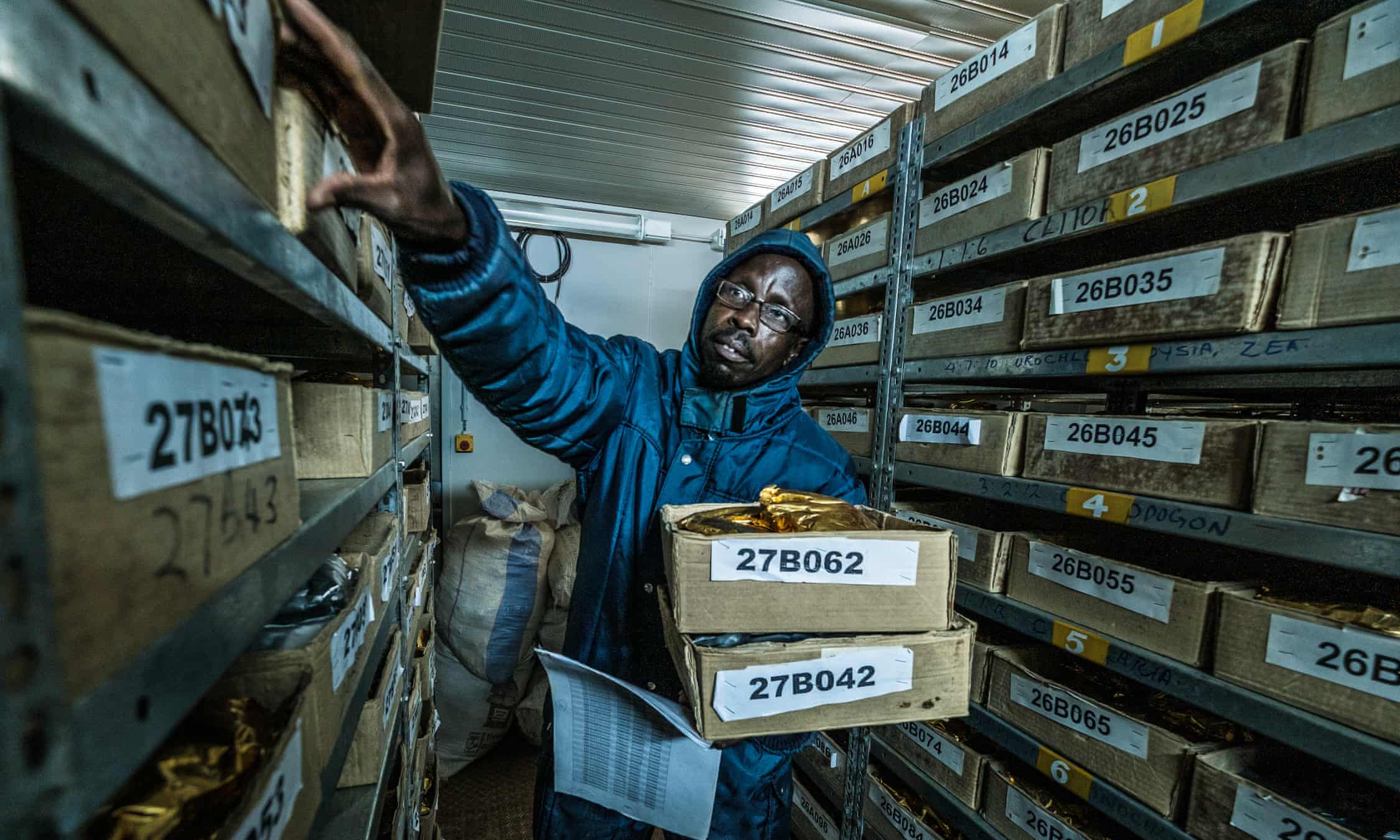
John Okemer, a seed technician, arranges some of the thousands of seeds stored inside Kenya’s gene bank. 

As our wounded planet hurtles through space, what should we take with us to replicate the better things as needed? Noah took two of each animal, bird, fish. Some of our contemporaries are taking seeds.

Caroline Kimeu writes at the Guardian, “On a winding road in the densely forested Kikuyu highlands of south-central Kenya lies a nondescript government building: the Genetic Resources Research Institute. Opened in 1988, during the country’s ‘green revolution,’ this little-known national gene bank was set up to hold and conserve seeds from the traditional crops that were in danger of disappearing as farmers and agricultural industry moved to higher-yield varieties.

“For decades, it has collaborated with researchers studying crop genetics and others working to develop improved varieties. But as the climate crisis worsens food insecurity, the repository of about 50,000 seed and crop collections could become a lifeline for farmers.

“ ‘We were established as a conservation unit, but these are unusual times with climate change, so we’ve had to diversify our work to respond to needs,’ says Desterio Nyamongo, who runs the institute. ‘Given the erratic weather these days, smallholder farmers need a diverse mix of crops.’

“Through a project with the Crop Trust organization the gene bank is now playing a part in the comeback of indigenous crops that are resistant to drought and pests, but fell from favor and have been neglected for decades.

“It stores backups of its most unique seeds at the Svalbard global seed vault in Norway, where it has been sending collections since 2008. The international repository contains more than a million seed samples from around the world.

“Matthew Heaton, the project manager for Crop Trust’s Seeds for Resilience program, says: ‘National gene banks can be overshadowed by the larger international ones, but they are best positioned to quickly improve local resilience and nutrition because their collections are adapted to local needs and growing conditions.’

“The national gene bank is a small operation, with few staff and limited funding, and its cold rooms, which plant scientists say contain only a third of the country’s plant diversity, are almost full. The Seeds of Resilience project, launched in 2019, has supported national gene banks in Ethiopia, Ghana, Kenya, Nigeria and Zambia with financial and technical support to keep resilient, healthy and nutritious crop collections, and to increase their support for farmers. …

“Farmers from the village of Obucuun in rural Busia county, on the border of Kenya and Uganda, say that before sourcing new sorghum varieties from the gene bank, growing the cereal had become challenging. Attacks by flocks of weaver birds, which can ravage entire cereal fields, increased in frequency after the wild grasses preferred by the birds became more scarce as a result of the climate crisis.

“Ruth Akoropot, a 50-year-old farmer from the area, spends hours each day watching over her crops during peak hours of attack, after studying the birds’ behavior patterns for years.

“ ‘If you don’t do that, your crop will be wiped out,’ says Akoropot, who runs the women’s sorghum farmers association, which sells bales of the grain to Kenya’s national beer brewery. …

“Most of Busia’s population rely on farming for food and to make a living, but … a number remain vulnerable to food insecurityFlooding in April and May [in 2024] swept away farmers’ seeds and yields, exacerbating poor agricultural productivity. Old improved crop varieties sourced from the gene bank, such as Kenya’s red-headed sorghum okoto, which farmers say is less prone to bird attacks, have become community favorites in Busia after decades of disuse. …

“Tobias Okando Recha, an impact researcher for the Seeds of Resilience program, says: ‘These are crops that farmers don’t need to pump a lot of fertilizer on. With just a little fertilizer, the yield is good and they are more [resilient] than hybrid varieties. …

“Plant scientists say that while the divide between farmers and seed conservationists is narrowing, more needs to be done. …

“ ‘The gene banks are not museums, but a resource for the future,’ says Heaton. ‘By linking them with farmers, we can swiftly build local resilience and food security.’ ”

More at the Guardian, here.

Read Full Post »


Photo: Diego Ibarra Sanchez for The New York Times.
Ali Shehadeh, a plant conservationist from Syria who fled the war in his country, at work in Terbol, Lebanon.

The harm that wars do seems endless. Every aspect of life is affected. And yet, against all odds, good people rise up to save or try to reconstruct what might be lost. In this post, everyday heroes protect a seed bank from the war in Syria.

Somini Sengupta has the story at the New York Times. “Ali Shehadeh, a seed hunter, opened the folders with the greatest of care. Inside each was a carefully dried and pressed seed pod: a sweet clover from Egypt, a wild wheat found only in northern Syria, an ancient variety of bread wheat.

“He had thousands of these folders stacked neatly in a windowless office, a precious herbarium, containing seeds foraged from across the hot, arid and increasingly inhospitable region known as the Fertile Crescent, the birthplace of farming.

“Shehadeh is a plant conservationist from Syria. He hunts for the genes contained in the seeds we plant today and what he calls their ‘wild relatives’ from long ago. His goal is to safeguard those seeds that may be hardy enough to feed us in the future, when many more parts of the world could become as hot, arid and inhospitable as it is here.

“But searching for seeds that can endure the perils of a hotter planet has not been easy. It has thrown Shehadeh and his organization, the International Center for Agricultural Research in the Dry Areas, squarely at a messy intersection of food, weather, and war.

“The center, though it received no state funding, was once known as a darling of the Syrian government. Based in Aleppo, its research had helped to make Syria enviably self-sufficient in wheat production. …

“By 2014, the fighting drew closer to its headquarters in Aleppo and its sprawling field station in nearby Tal Hadya.

“Trucks were stolen. Generators vanished. Most of the fat-tailed Awassi sheep, bred to produce more milk and require less water, were stolen and killed for food. … And the center’s most vital project — a seed bank containing 155,000 varieties of the region’s main crops, a sort of agricultural archive of the Fertile Crescent — faced extinction.

“But researchers there had a backup copy. Beginning in 2008, long before the war, the center had begun to send seed samples — ‘accessions’ as they are called — to the Svalbard Global Seed Vault, the ‘doomsday vault,’ burrowed into the side of a mountain on a Norwegian island above the Arctic Circle. It was standard procedure, in case anything happened.

“War happened. In 2015, as Aleppo disintegrated, center scientists borrowed some of the seeds they had stored in Svalbard and began building anew. This time, they spread out, setting up one seed bank in Morocco and another just across Syria’s border with Lebanon in this vast valley of cypress and grapes known as the Bekaa. …

“Mr. Shehadeh … is obsessed with the wild relatives of the seeds that most farmers plant today. He eschews genetically modified seeds. He wants instead to tap the riches of those wild ancestors, which are often hardy and better adapted to harsh climates. ‘They’re the good stock,’ he said.

“He hunts for the genetic traits that he says will be most useful in the future: resistance to pests or blistering winds, or the ability to endure in intensely hot summers. He tries to select for those traits and breeds them into the next generation of seeds — in the very soil and air where they have always been grown.”

The experts believe that the seeds from plants that thrive in this arid part of the world will be needed for feeding the planet as it warms.

Read the whole article here.

Read Full Post »

My husband is into all things Iceland and Frozen North, which led to his mentioning the other day that an island much farther north than Iceland was “where the seed bank is.”

“What seed bank?” said I, running to Wikipedia.

Wikipedia answered, “The Svalbard Global Seed Vault … is a secure seed bank on the Norwegian island of Spitsbergen … 810 mi from the North Pole. Conservationist Cary Fowler, in association with the Consultative Group on International Agricultural Research (CGIAR), started the vault to preserve a wide variety of plant seeds that are duplicate samples, or ‘spare’ copies, of seeds held in gene banks worldwide. The seed vault is an attempt to insure against the loss of seeds in other gene banks during large-scale regional or global crises. …

“The Norwegian government entirely funded the vault’s approximately … $9 million construction. Storing seeds in the vault is free to end users, with Norway and the Global Crop Diversity Trust paying for operational costs. …

“Running the length of the facility’s roof and down the front face to the entryway is an illuminated work of art that marks the location of the vault from a distance. In Norway, government-funded construction projects exceeding a certain cost must include artwork. KORO, the Norwegian State agency overseeing art in public spaces, engaged the artist Dyveke Sanne to install lighting that highlights the importance and qualities of Arctic light. The roof and vault entrance are filled with highly reflective stainless steel, mirrors, and prisms. The installation reflects polar light in the summer months, while in the winter, a network of 200 fibre-optic cables gives the piece a muted greenish-turquoise and white light.”

(You’ll forgive me for taking out all the hyperlinks for terms like “Norwegian,” “global crises,” “fibre-optic cables,” and “North Pole.” Wikipedia gets carries away with hyperlinks, but you can read the whole thing here.)

May 19, 2017 update: Uh-oh. The permafrost is melting and the safe house for seeds is starting to flood: https://www.theguardian.com/environment/2017/may/19/arctic-stronghold-of-worlds-seeds-flooded-after-permafrost-melts.

Photo: NordGen/Dag Terje Filip Endresen
Entrance to Svalbard Global Seed Vault in 2008

Read Full Post »