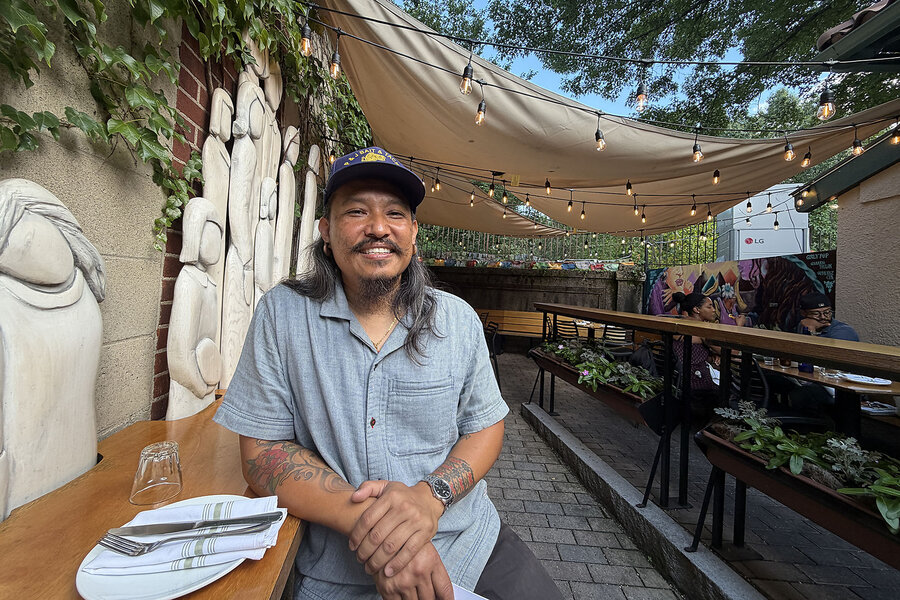
Photo: Kendra Nordin Beato/Christian Science Monitor.
Biplaw Rai, co-founder of Comfort Kitchen in Boston, is participating this year in Pay What You Can day.
A small, thoughtful book called The Serviceberry (from Braiding Sweetgrass author Robin Wall Kimmerer) offers a vision of a non-capitalistic “gift economy” similar to the traditional sharing mindset of indigenous tribes. Although reducing the hoarding of capitalism is a rather large order, the author gives many small examples of how people are sharing anyway — and experiencing the resulting satisfaction.
Today we have an article at the Christian Science Monitor by Kendra Nordin Beato and Whitney Eulich showing that some owners of high-end restaurants are also finding happiness in generosity. Hopeful customers do have to get in line early, though.
“Eva Olvera Mendieta was first in line,” the reporters write. “She had risen before dawn, traveled two hours via bus and metro, and by 8 a.m. was bundled up outside the front door of Masala y Maíz, a restaurant in Mexico City. There, she waited four more hours for a chance to try the restaurant’s renowned mix of Mexican, Indian, and East African flavors.
“Ms. Olvera Mendieta, who earns a modest income from making and selling face creams, typically could not afford to eat at a Michelin-starred restaurant like this one, where average prices hover around $25 a plate. But on Paga Lo Que Puedas (Pay What You Can) day, a growing, global hospitality initiative first started at this restaurant, financial barriers to a high-end meal are lowered. …
“ ‘It was marvelous! I took photos of everything,’ Ms. Olvera Mendieta raved on her way out after paying 500 pesos (about $30) for two small plates and a dessert. …
“Masala y Maíz, co-founded by chefs Norma Listman and Saqib Keval in 2017, has been hosting such pay-what-you-can events since 2020, when many people were struggling to make ends meet and many restaurants were closing [because of Covid]. They wanted to open their doors and offer the same professional hospitality and farm-fresh menu to anyone who came in.
“ ‘When we opened Masala y Maíz, we wanted it to be super community-based,’ says Mr. Keval. While hosting an event that could fail to cover its operating costs might seem like a high-risk move, it has had the opposite effect. The restaurant has never lost money on a Pay What You Can day, says Mr. Keval. …
“Through pay-what-you-can models, restaurateurs with a civic passion are finding creative ways to preserve both their pride in culinary artistry and care for their staff and community. Some offer pop-up events and meals with discounted prices, while others are more extreme. Modern Times in Minneapolis removed prices from its menu after unrest from Immigration and Customs Enforcement arrests and shootings this year roiled the city.
“Ms. Listman and Mr. Keval saw an opportunity to grow their own model. … ‘What unites all these restaurants that signed up,’ Mr. Keval says, is that they all believe ‘restaurants should be a tool for building and supporting community.’
“One first-timer is Comfort Kitchen in Dorchester, a Boston neighborhood. Situated in a renovated, historic streetcar station, the high-end restaurant that opened in 2023 specializes in flavors and ingredients from the African diaspora, spanning Asia to the Americas.
“Colorful prayer flags and string lights lined the outdoor patio where co-founder Biplaw Rai welcomed the event’s first guests and handed out a survey to capture their thoughts.
“ ‘We want our food, our service, to be approachable by people from all walks of life. We understand that dining out is a luxury, not everyone can afford to do it,’ says Mr. Rai. He hopes to learn which pricing model interests guests and whether they would be willing to pay more so that other guests could afford a meal out. “ ‘My ultimate goal would be, if today works really well for all parties involved, we want to do this on a regular basis.’ ”
More at the Monitor, here.


