Feeds:
Posts
Comments

Posts Tagged ‘capitalism’

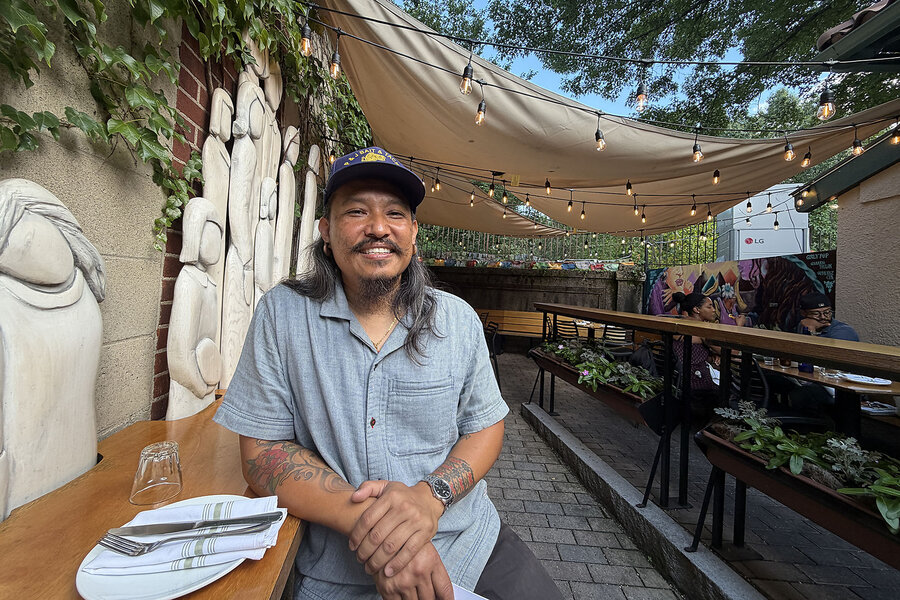
Photo: Kendra Nordin Beato/Christian Science Monitor.
Biplaw Rai, co-founder of Comfort Kitchen in Boston, is participating this year in Pay What You Can day.

A small, thoughtful book called The Serviceberry (from Braiding Sweetgrass author Robin Wall Kimmerer) offers a vision of a non-capitalistic “gift economy” similar to the traditional sharing mindset of indigenous tribes. Although reducing the hoarding of capitalism is a rather large order, the author gives many small examples of how people are sharing anyway — and experiencing the resulting satisfaction.

Today we have an article at the Christian Science Monitor by Kendra Nordin Beato and Whitney Eulich showing that some owners of high-end restaurants are also finding happiness in generosity. Hopeful customers do have to get in line early, though.

“Eva Olvera Mendieta was first in line,” the reporters write. “She had risen before dawn, traveled two hours via bus and metro, and by 8 a.m. was bundled up outside the front door of Masala y Maíz, a restaurant in Mexico City. There, she waited four more hours for a chance to try the restaurant’s renowned mix of Mexican, Indian, and East African flavors.

“Ms. Olvera Mendieta, who earns a modest income from making and selling face creams, typically could not afford to eat at a Michelin-starred restaurant like this one, where average prices hover around $25 a plate. But on Paga Lo Que Puedas (Pay What You Can) day, a growing, global hospitality initiative first started at this restaurant, financial barriers to a high-end meal are lowered. …

“ ‘It was marvelous! I took photos of everything,’ Ms. Olvera Mendieta raved on her way out after paying 500 pesos (about $30) for two small plates and a dessert. …

“Masala y Maíz, co-founded by chefs Norma Listman and Saqib Keval in 2017, has been hosting such pay-what-you-can events since 2020, when many people were struggling to make ends meet and many restaurants were closing [because of Covid]. They wanted to open their doors and offer the same professional hospitality and farm-fresh menu to anyone who came in.

“ ‘When we opened Masala y Maíz, we wanted it to be super community-based,’ says Mr. Keval. While hosting an event that could fail to cover its operating costs might seem like a high-risk move, it has had the opposite effect. The restaurant has never lost money on a Pay What You Can day, says Mr. Keval. …

“Through pay-what-you-can models, restaurateurs with a civic passion are finding creative ways to preserve both their pride in culinary artistry and care for their staff and community. Some offer pop-up events and meals with discounted prices, while others are more extreme. Modern Times in Minneapolis removed prices from its menu after unrest from Immigration and Customs Enforcement arrests and shootings this year roiled the city.

“Ms. Listman and Mr. Keval saw an opportunity to grow their own model. … ‘What unites all these restaurants that signed up,’ Mr. Keval says, is that they all believe ‘restaurants should be a tool for building and supporting community.’

“One first-timer is Comfort Kitchen in Dorchester, a Boston neighborhood. Situated in a renovated, historic streetcar station, the high-end restaurant that opened in 2023 specializes in flavors and ingredients from the African diaspora, spanning Asia to the Americas.

“Colorful prayer flags and string lights lined the outdoor patio where co-founder Biplaw Rai welcomed the event’s first guests and handed out a survey to capture their thoughts.

“ ‘We want our food, our service, to be approachable by people from all walks of life. We understand that dining out is a luxury, not everyone can afford to do it,’ says Mr. Rai. He hopes to learn which pricing model interests guests and whether they would be willing to pay more so that other guests could afford a meal out. “ ‘My ultimate goal would be, if today works really well for all parties involved, we want to do this on a regular basis.’ ”

More at the Monitor, here.
Read Full Post »

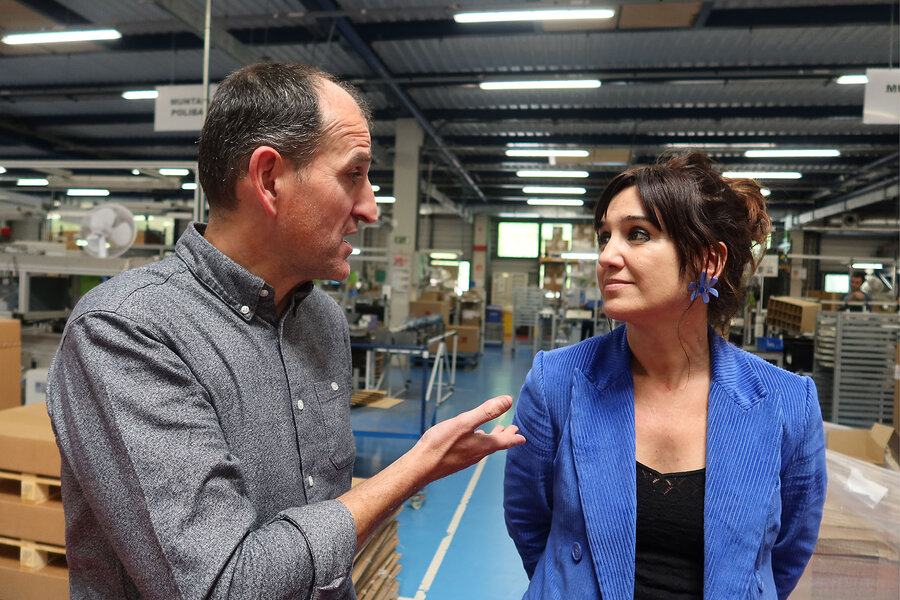
Photo: Erika Page/Christian Science Monitor.
Amaia Salbide speaks with plant manager Ander Jausoro on the factory floor of an industrial plant belonging to Copreci, one of the Spanish companies sharing ownership with workers. “No one is rich. No one is poor.”

Giving workers a piece of the responsibility for a company’s success — and a piece of the profits — is not a new idea. But lately it’s been gaining traction in Spain.

Erika Page reports at the Christian Science Monitor, “At first glance, this could be any industrial factory. Workers wearing protective gloves assemble control panels and heating plates amid the relentless whirring of machinery. Giant yellow robot arms swing back and forth, lining trays with tiny metal parts.

“But there is a reason that each year thousands of visitors from every continent come to this mountainous Basque landscape to study factories like this one. This is the home of the Mondragon Corp., the world’s largest federation of worker-owned cooperatives. 

“Copreci, which makes parts for home appliances, is one of 81 Mondragon cooperatives, ranging from manufacturing to finance and retail. By the end of the day, this floor alone will churn out 30,000 gas valves, destined for stoves worldwide.

“Yet it is also churning out a radically different vision of capitalism. For young people especially, capitalism brings to mind wealth inequality, cost-of-living crises, and environmental collapse. …

“The Mondragon Corp. sees itself as a third way, not as an alternative to capitalism, but as an alternative way of doing capitalism – one that can build trust, not widen divisions.

“ ‘The purpose of what we’re doing here is not the machinery or the production process,’ says Amaia Salbide, president of Copreci, on a visit to the factory floor. ‘Those are tools to reach a higher goal of social transformation.’ …

“Mondragon’s nearly 70,000 members, ranging from floor workers to top executives, are co-owners of their businesses. They have voting power at general assemblies, where they weigh in on company strategy and policy. The income disparity between the highest- and lowest-paid employees in Mondragon’s cooperatives is capped at a ratio of 6-to-1, compared with a typical ratio of 344-to-1 in the United States. …

“As the saying around here goes, Mondragon does not create rich people, but rich societies. That means prioritizing quality of life for the employees who live and work in the towns dotting these forested hills rather than maximizing profit for investors.

“ ‘I think of it as a sort of attractive form of capitalism,’ says Nick Romeo, author of The Alternative: How To Build a Just Economy. ‘One that works more effectively for more people but retains some of the benefits of markets and efficiency and competition.’

“Hugo Montalvo knows he could make more money as a sales manager at a regular multinational company. But he wouldn’t trade his middle-class status or the small town where he is raising his two children. At the end of a day’s work, Mr. Montalvo often finds those on the assembly line picking up their children from the same schools as top managers and gathering at the same tables at local bars. The base pay for a Mondragon worker is on average 40% higher than Spain’s minimum wage.

“ ‘Here, no one is rich,’ says Mr. Montalvo, who works for Ecenarro, a Mondragon cooperative. … ‘But no one is poor either. We’re all in that middle range, earning decent salaries.’

“Solidarity permeates the business model. To become a member of a cooperative, a worker invests €17,000 ($18,400), normally bit by bit over time. As for company profit, 60% is reinvested in the business, 30% goes to employees as capital, and 10% is for the local community. At the end of each year, Mondragon reviews each cooperative’s earnings, and companies in better financial positions contribute to those that are struggling.

“ ‘Just as we’ve received in the past, now it’s our turn to give,’ says Mr. Montalvo.

“Back in 2013, he was working for Fagor Electrodoméstico, a Mondragon cooperative that at the time was Spain’s leading home appliance company. When the company went bankrupt in the aftermath of the financial crisis, his job and initial investment disappeared.

“Within two weeks, he was transferred to Ecenarro, and Mondragon covered his membership fee. Of the almost 2,000 people who lost their jobs at Fagor, 95% were relocated within the Mondragon network. During the pandemic, workers came to collective agreements to avoid job losses, including salary reductions. …

“ ‘The cooperative is a creator of wellness, so it has to exist for decades and decades,’ says Ander Etxeberria, who leads Mondragon’s cooperative outreach program.”

As with anything, there are challenges here, too. Get more details at the Monitor, here.

Read Full Post »

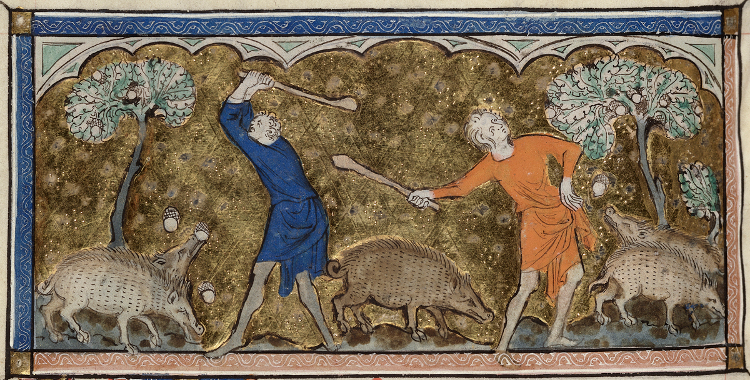
When pannage was common, commoners had the right to run their pigs in the woods. The picture “Harvesting acorn to feed swine” is a miniature from the Queen Mary Psalter, 1310-1320. British Library.

There was a time that poor people could make a living off land that was shared. Then wealthy nobles decided that property rights meant they could close off shared land and keep it to themselves. Some scholars think the enclosure of the commons in England centuries ago was the beginning of capitalism.

Eula Biss at the New Yorker, puts it this way: “Across centuries, land that was collectively worked by the landless was claimed by the landed, and the age of private property was born.

“On the train to Laxton I was facing backward, heading south from Scotland, with the fields of England rushing away from me. I searched their dark creases and their uneven hedges for something I didn’t know how to see, something I wasn’t even certain was visible. I was trying to locate the origins of private property, a preposterous pursuit.

I was looking for a living record of enclosure, the centuries-long process by which land once collectively worked by the landless was claimed by the landed.

“That land already belonged to the landed, in the old sense of ownership, but it had always been used by the landless, who belonged to the land. The nature of ownership changed within the newly set hedges of an enclosed field, where the landowner now had the exclusive right to dictate how the land was used, and no one else belonged there. …

”Walls, fences, hedges, and ditches were all used to mark the boundaries of enclosed land, so that sheep could be kept there, or some other profit could be pursued. Enclosure is how nearly all the agricultural land in Britain came to be owned by less than one per cent of the population. In The Making of the English Working Class, the historian E. P. Thompson writes that enclosure was ‘a plain enough case of class robbery, played according to fair rules of property and law laid down by a parliament of property-owners and lawyers.’

“The pilgrims who sailed on the Mayflower were not property owners but economic migrants financed by property owners. They were also communists, in that they agreed to work communally and share the profits of their labor for the first seven years of their settlement, though that agreement did not last beyond the first year. They settled on land held by the Wampanoag people, who did not practice the absolute ownership of land. Among the Wampanoag, rights to use the same plot of land could overlap, so that one family might hold the right to fish in a stream and another might hold the right to farm the banks of that stream. Usage rights could be passed down from mothers to daughters, but the land itself could not be possessed. …

“Enclosure [unfolded] slowly, in the course of about five hundred years. It began in the Middle Ages and was completed by acts of Parliament in the eighteenth and nineteenth centuries. This land revolution set the stage for the Industrial Revolution. Enclosure, Marx argued, is what produced the landless wage workers who became the proletariat. Historians disagree on that, so it is safer to say that enclosure produced Romantic poetry, a literature marked by nostalgia for a lost world. …

Laxton is the one remaining village in England that was never enclosed, and where tenant farmers still work the land coöperatively, as they have for at least the past seven hundred years

“They use the open-field system, cultivating crops on narrow strips of land that follow the curvature of the hills. There are no hedges or fences between these strips, and working them requires collaboration among the farmers.

“In the time before enclosure, shared pastures where landless villagers could graze their animals were common. Laxton had two, the Town Moor Common and the much larger Westwood Common, which together supported a hundred and four rights to common use, with each of these rights attached to a cottage or a toft of land in the village. In Laxton, the commons were a resource reserved for those with the least: both the commons and the open fields were owned by the lord of the manor, and only villagers with little more than a cottage held rights to the commons.

“As a visitor from the age of private property, it seems remarkable to me that commoners held rights to land they did not own or rent, but, at the time, it was commonplace. In addition to common pasture, commoners were granted rights of pannage, of turbary, of estovers, and of piscary — rights to run their pigs in the woods, to cut peat for fuel, to gather wood from the forests, and to fish. These were rights to subsistence, rights to live on what they could glean from the land. In the course of enclosure, as written law superseded customary law, commoners lost those rights. Parliament made property rights absolute, and the traditional practice of living off the land was redefined as theft. Gleaning became trespassing, and fishing became poaching. Commoners who continued to common were now criminals. An entire legal history is told in the four lines of one anonymous English poem:

“The law locks up the man or woman
“Who steals the goose from off the common,
“But lets the greater villain loose
“Who steals the common from the goose.”

More at the New Yorker, here. The book Ramp Hollow: The Ordeal of Appalachia offers considerable insight on the world’s loss of the commons. Fascinating read.

Read Full Post »