Feeds:
Posts
Comments

Posts Tagged ‘shell’

Photo: Brett Phelps for the Boston Globe.
At her new studio space in Providence, Felicia Neuhof holds a bag of shells she gathered at her sister’s wedding to create new products sustainably.

Today’s story is about a designer who looked around for a way to do her work using more-sustainable materials and found them almost under her nose.

Alexa Gagosz writes at the Boston Globe, “After spending seven years as an art director in New York City working for Fortune 500 brands, Felicia Neuhof grew increasingly frustrated with the unsustainable materials of her industry. She was constantly surrounded by plastic with a single-use lifecycle that would later become landfill waste.

“When she moved to Providence to earn her master’s degree at the Rhode Island School of Design, she started eating a ton of shellfish and wondered what would eventually happen to the discarded shells, which were typically thrown away. That‘s when she set out on a mission. She started by experimenting with the shells being tossed into dumpsters behind her favorite restaurants, and began molding them into building materials.

“Neuhof is now the founder and chief executive officer of Shellf Life, a Providence startup that transforms discarded seafood shells into innovative building materials. She’s also received international praise, winning the Terra Carta Design Lab, a global competition where she was able to place her material into the hands of King Charles III.

“What is Shellf Life and how does it work?
“Shellf Life transforms discarded seafood shells into innovative building materials through a process I developed on my kitchen stove. We take what restaurants throw away — oyster, mussel, clam, crab, and scallop shells — and create architectural surfaces, furniture, and lighting with properties ranging from rigid to flexible to translucent. Since winning the Terra Carta Design Lab competition, I’ve been scaling operations at our 50 Sims [incubator] facility in Providence.

“[We turn] waste into valuable building materials through processes accessible to people from all backgrounds and skill levels.

“How much seafood waste is there in New England?
“The numbers are staggering. One Rhode Island shellfish processor alone generates 7 tons of shell waste weekly — that’s 728,000 pounds annually, enough material for 30,000 square feet of tiling. When combined with restaurant waste across New England, we’re looking at a tremendous resource: Rhode Island could produce enough material for 3,000 kitchen backsplashes annually, Massachusetts enough for 5,000 bathroom floors, Maine sufficient for 20,000 serving bowls that return to the restaurants supplying the shells, Connecticut enough for 1,500 countertops, New Hampshire enough for 1,000 shower surrounds, and even my home state of Vermont contributes. …

“What kind of materials are you creating? Furniture and fixtures? Raw materials?
“Both. I create three product lines: furniture for residential and commercial settings, homeware like bowls and lighting, and architectural materials including tiles and surfaces. I’m also developing specialized applications for marine environments — working with City Island Oyster Reef to create alternatives to concrete currently used in aquaculture farms and coastal defense. …

“Walk me through the process.
“I collect shells from restaurant partners, clean and sanitize them, then crush them into a calibrated material. This is blended with my proprietary binder — much like following a recipe — and molded into form. During curing, the material actually captures CO2. At my facility at 50 Sims [Ave.] in Providence, I’ve scaled this process from my kitchen to a manufacturing microlab. I’ve secured a provisional patent on both the material composition and manufacturing method, which was an important step for commercialization. My goal has been to develop a system so refined that making a tile is as easy as flipping burgers. …

“What kind of seafood waste are you using?
“I primarily use oyster, mussel, clam, and scallop shells — any bivalve shells typically tossed in restaurant dumpsters. Each brings unique qualities: oysters provide strength and texture, mussels offer beautiful color and luminosity, clams contribute creamy hues with flecks of purple, and scallops add structural pattern variability. Like a chef selecting ingredients, I blend these shells in various ratios to customize the material for specific applications.

“What was it like to meet King Charles, and develop Shellf Life as part of the Terra Carta Design Lab?
“Meeting King Charles III was transformative. … He asked thoughtful questions, revealing someone who truly understood the potential, calling the idea ‘genius.’ What struck me most was seeing how Shellf Life made intuitive sense to everyone — from farmers and chefs to a King.

“How can restaurants, consumers, and others direct seafood waste to Shellf Life?
“I’ve made it as simple as recycling. For restaurants, I provide collection buckets and regular pickup that fits into their existing workflow. … For individual consumers, I’m looking to establish community collection points. My goal is to make shell recycling as normal as glass or paper recycling.

“Do you have any investors?
The Terra Carta award has funded my initial development. Now I’m seeking additional investment to support my two-year growth plan as I move from R&D into commercial production. I’m looking for partners who understand both the environmental opportunity and the social impact — investors who recognize the value of creating accessible manufacturing jobs while addressing environmental challenges.”

More at the Globe, here.
Read Full Post »

Photo: A24.
This is Marcel the Shell. Says stop-motion storyteller Kirsten Lepore, “No one in the industry ever works with puppets that small.”

As a child, I was fascinated with shells, and I have noticed that other children are, too. My grandchildren, when they were younger, liked a picture book series that featured photos of clay-sculpted child figures and the shells the children collected at the beach.

Carlos Aguilar writes at the Los Angeles Times about a shell that has become an unlikely star.

“ ‘Marcel the Shell’ began as a series of lovingly crafted homemade shorts for YouTube by Dean Fleischer Camp and Jenny Slate. So when it came time to give the diminutive breakout star the feature film treatment — in A24’s ‘Marcel the Shell With Shoes On,’ now playing in theaters nationwide — some technical concerns needed to be addressed.

“ ‘The challenge for me was always, “How do we maintain that authenticity and the texture from the shorts?” ‘ Camp recently told the Times. …

“He enlisted independent stop-motion storyteller Kirsten Lepore as his animation director to lend her expertise to the meticulous frame-by-frame technique. Her seasoned ability for subtlety of movement in the performance of stop-motion characters was paramount in the decision.

“ ‘It’s a very mechanical process and because of the technical elements, it’s hard to get stuff that feels loose and organic. Every time you watch a stop-motion anything, you’re watching a time lapse of a sculpture being manipulated. Kirsten, more than any other young stop-motion artists I know, really embraced that in her work,’ Camp said. …

“To that end, Lepore and the animation crew first had to create a puppet of Marcel suitable to make multiple copies of.

For the short films, Camp used an actual shell, but since carapaces vary in shape and size, it would have been nearly impossible to naturally find enough similar ones.

“Instead, they did 3D scans of the actual original Marcel figure and then worked with a company called Stratasys. They were able to 3D print a large number of them in a way that the inner translucency and luster of real shells would come across. …

“The petite size of the Marcel puppets, which don’t have any internal armature as most stop-motion characters do, also required added precision when bringing it to life. ‘It’s literally 1 inch by 1 inch. It’s the smallest puppet that any of the animators had ever worked with before,’ said Lepore. …

“ ‘The work that they did is not just a feat of stop motion. It’s a feat of expressing emotion in all the little movements of Marcel’s eye and the nuanced postures they got him to make. They did that acting,’ Slate said. …

“In order to create the illusion that Marcel coexists with our reality, the film had to be shot twice with two different cinematographers.

“First, the live-action shoot in a real house was lensed by Bianca Cline, which occurred like most other productions, except that for the most part the shots were devoid of characters. Lepore had a stand-in of Marcel that she would place in the location to mark where the puppet would go once the stop-motion scenes were composited into the frame. They filmed with the stand-in present, and then again without it. Twice for every single shot.

“For the sake of light continuity, it was pivotal for the stop-motion director of photography, Eric Adkins to be present for the live-action operation in order to take copious notes on how each shot was lighted — down to the measurements of the distance between the light source and the character — to be able to re-create them on the stop-motion stages months later.

“One of the most impressive examples of Adkins’ skills, Lepore recalled, is the car ride that Marcel takes with Dean early in the film. After studying the live-action footage of that sequence and creating an equivalent of the dashboard, where Marcel stands, on a stop-motion stage, Adkins had to program his lights frame by frame to flicker in a way that would perfectly match how trees or other objects block the light from hitting Marcel as the vehicle moves.

“Lepore had a stop-motion staff of around 50 artists working on 10 stages running simultaneously.

“ ‘For every interaction that Marcel has with a live-action character or a live-action prop, there was nothing spontaneous about it,’ she noted. ‘It was all meticulously choreographed to make it look ultimately like it’s just off the cuff, as if it just happened.’ ”

More at the LA Times, here.

Read Full Post »

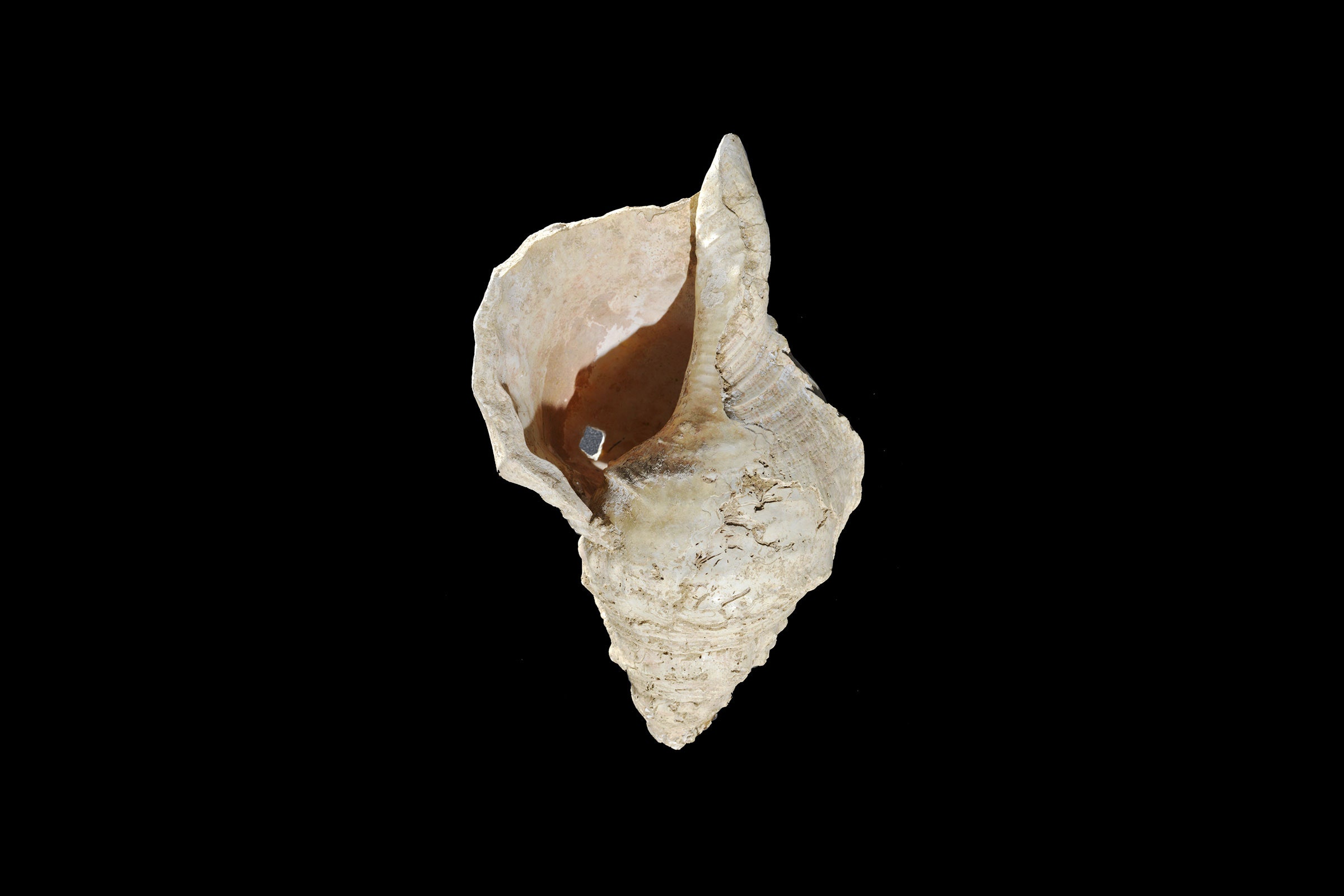
Photo: Carole Fritz.
This ancient conch shell from modern-day France was once used to play music.

For today’s story, you’ll want to go to the original article to see the detailed illustrations showing how a conch shell was turned into a musical instrument thousands of years ago — and how archaeologists figured it out.

Matt Simon reports at Wired, “Some 18,000 years ago, in a cave in what we now call France, a human being left behind something precious: a conch shell. It was not just any conch shell. Its tip had been lopped off—unlikely by accident, given that this is the strongest part of the shell—allowing a person to blow air into it. The shell’s jagged outer lip was trimmed smooth, perhaps to assist in gripping, and it also bore red, smudgy fingerprints that matched the pigment from a cave painting just feet away from where the object was found in 1931.

“But those archaeologists missed its true significance: It was an intentionally crafted musical instrument. Writing today in the journal Science Advances, researchers from several universities and museums in France describe how they used CT scans and other imaging wizardry to show that a person during the Upper Paleolithic age took great care to modify the shell, the oldest such instrument ever found. They even got a musician to play it for us, revealing sounds that have not rung out for millennia.

“The first clue to suggest this shell was actually an instrument is that broken tip, or apex. If you find a conch shell on a beach, you can’t just toot it as-is — you’ve got to knock that tip off to get air flowing through the internal chambers and to exit through the opening of the outer lip. …

“The researchers had a musician try playing the shell in the lab. You can hear three notes [at Wired]. The sound is a bit breathy, like a more earthy version of a trumpet or trombone.

“But the breakage around the apex turned out to be quite jagged. ‘It’s very irregular, and it was hurting his lips,’ says archaeologist Gilles Tosello of the University of Toulouse, a corresponding author on the paper. … Why would an ancient human take the trouble to modify a conch shell and then not add a mouthpiece? …

“As for the shell’s outer lip, Tosello and his colleagues could tell it had been chipped away, both from wear patterns and by comparing it to pristine shells of the same species, which have significantly larger lips. In addition, the researchers enhanced a photo of the inside of the lip … to reveal faint red splotches.

These are fingerprints left behind in ocher, and the pigment matches a wall painting of a bison that was mere feet from where the shell was found. That bison was actually etched into the wall, then covered with over 300 ocher fingerprints to shade it in.

“The researchers couldn’t date the shell itself, since that’d require breaking a piece of it off to do carbon dating. But … based on these nearby objects, which they think would have been used by the same people around the same era, they surmised that the shell is likely 18,000 years old. …

“This was in pre-agricultural times, so they would have been Upper Paleolithic hunter-gatherers. [It is] likely that this person belonged to a band of 10 or 20 humans working together to survive.

“We also know that life must not have been too terrible, since people had the time and energy to make music. And after all, they didn’t need an instrument to make music in the first place. ‘With a voice, you can make music,’ says archaeologist Carole Fritz of the University of Toulouse, a corresponding author on the paper. That is, the shell is extraneous. ‘I think music is a very symbolic art for people,’ Fritz adds. …

“This find emphasizes the richness of Upper Paleolithic culture, says University of Victoria paleolithic archaeologist April Nowell, who wasn’t involved in the research. ‘We have music, we have art, we have textiles, we have ceramics,’ she says. ‘These were really complex people.’

More at Wired, here.

Read Full Post »