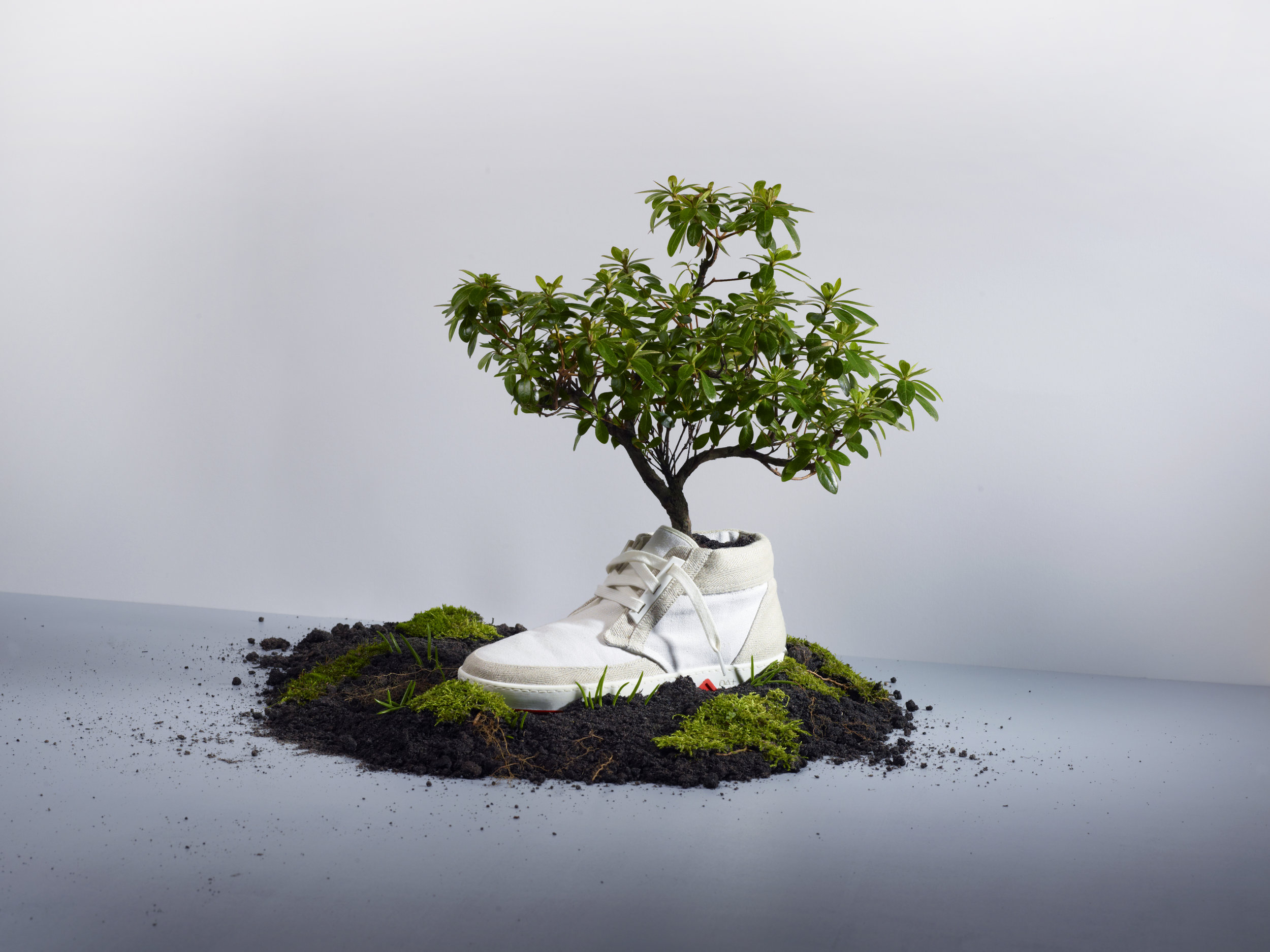
Photo: OatShoes.
One of the companies vying to be first in sustainable footwear is Oat. Plant your shoes when done, the company says!
I try to follow sustainable practices, but shoes for an old person’s feet need to be pretty strong, which means that when they’re worn out, the pieces end up in a landfill. So now I’m wondering if the recent initiatives to improve the sustainability of shoes can work for me.
Here are some thoughts from the Washington Post.
Daliah Singer writes, “Thomas Bogle was logging dozens of miles on the spruce- and pine-lined backcountry trails that weaved around his home in Steamboat Springs, Colo., as he trained for an ultramarathon. His mind wasn’t focused on his target pace, though. Instead, he couldn’t stop thinking about the micro bits of plastic and rubber the soles of his shoes were shedding on the forest floor.
“With every step we take, our shoes leave behind an invisible trail of toxic contaminants that can potentially harm the soil, water and animal health.
“Nearly 24 billion pairs of shoes were produced in 2022. Each contains myriad plastics and synthetic, petroleum-based rubber. Of the 500,000 tons of microplastics that seep into the world’s oceans each year, up to 35 percent come from synthetic textiles, including footwear, according to one estimate, from the International Union for Conservation of Nature.
Footwear alone accounts for 1.4 percent of global greenhouse gas emissions, not that far below the airline industry, which is responsible for around 2 percent.
“Though shoe brands have taken strides toward sustainability, from offsetting carbon emissions to swapping out materials in the upper sections of shoes, they have largely overlooked soles. Now a slew of companies are starting to focus underfoot by developing new plant-based soles that won’t leave plastics behind when they degrade.
“Bogle, who spent eight years working in product development at a footwear company, is now working on an outsole from plant byproducts, while Keel Labs, a sustainable materials company started by two fashion design students, is making soles out of seaweed-based fiber. Native Shoes has a line of slip-ons made from an algae-based material, and Unless, a plant-based streetwear company in Portland, Ore., rolled out a shoe made entirely of biodegradable materials in conjunction with NFW.
“Shoes are designed ‘to last 1,000 years, and we use [them] for 100 days,’ said Yuly Fuentes-Medel, program director of climate and textiles at Massachusetts Institute of Technology. Americans alone toss out 300 million pairs of shoes every year. According to the Environmental Protection Agency, only about 13 percent of clothing and footwear is recycled in the United States.
“That’s partly because of the complexity of the shoemaking process. The average sneaker is composed of more than 130 individual pieces, according to Fuentes-Medel, who recently helped create the Footwear Manifesto, a report on how to make the industry more sustainable. Manufacturinga pairrequires at least 100 steps on average, including stitching and gluing, she said. That makes it nearly impossible to recycle them or take them apart to reuse their materials.
“The plastics in shoes also pose problems while consumers are wearing them. A 2022 study in the Journal of Hazardous Materials suggests abraded plastic from shoe soles reduces soil’s capacity to hold water and impedes photosynthesis. Another study, published in Science of the Total Environment, attributed mass coho salmon die-offs to 6PPD, a chemical added during tire manufacturing that is also found in footwear. …
“Bogle had an idea to create an entirely plastic-free shoe outsole — the component that was the first to wear out on his shoes during his long runs in the Colorado wilderness. He enlisted Gene Kelly, a professor of pedology (or soil science) at Colorado State University and a fellow runner, who helped develop a shoe sole made of beeswax, vegetable oils and plant byproducts such as leaves and husks from corn, hemp and other crops.
“Bogle’s company, Solum, partners with farmers and producers across the country to grow and harvest the materials, before converting them into bio-pellets and blending them with natural rubber to craft the sole.
“Instead of shedding toxic chemicals, Bogle explained, Solum’s soles deposit biologically derived nutrients back into the soil as they naturally wear down over time. A consumer survey by the company found that the average lifetime of a shoe outsole is around three years. Solum’s break down about 11 percent faster by design.”
Check out BlueView shoes and Ponto, too.


 Suzanne's Mom's Blog