Feeds:
Posts
Comments

Posts Tagged ‘slave’

Photo: Museum of Fine Arts, Boston.
Descendants of potter David Drake, seen at the Museum of Fine Arts with one of the artist’s works

If we are in a hurry for the many evils we see to be defeated, we’re likely be disappointed. But in time, even a foundering ship can right itself. The growth of initiatives to return artifacts stolen in the past is an example.

Jori Finkel writes at CNN that in a “likely precedent-setting agreement, the Museum of Fine Arts (MFA) Boston has agreed to return two works from 1857 by the Black potter David Drake, who made his ambitious jars while enslaved, to his present-day descendants.

“By the terms of the contract, one of those vessels will remain on loan to the museum for at least two years, according to the lawyer George Fatheree, who is representing Drake’s descendants. The other vessel — a masterpiece known as the ‘Poem Jar’ — has been purchased back by the museum from the heirs for an undisclosed sum. Now the work comes with ‘a certificate of ethical ownership.’

“ ‘In achieving this resolution, the MFA recognizes that Drake was deprived of his creations involuntarily and without compensation,’ a museum spokesperson said in a statement. ‘This marks the first time that the museum has resolved an ownership claim for works of art that were wrongfully taken under the conditions of slavery in the 19th-century US.’ …

‘Ethan Lasser, chair of the art of Americas at the MFA, said the museum has learned from its work restituting Nazi-looted art. ‘We’ve become very expert in Holocaust restitution. We’re dealing with (repatriation) issues in our African collections and Native American collections,’ he said over the phone. …

“He considers Drake’s work an example of ‘stolen property,’ too, ‘since the artist is always the first owner of his work and he never got to make the call about where it went or what he was paid for it.’

“Born enslaved around 1800 in Edgefield, South Carolina, a region known for its rich clay, Drake (who was also known as Dave the Potter) was one of relatively few African American potters to sign his work. He also dared — despite punitive anti-literacy laws for enslaved people in the state — to etch short sayings or poems on the jars, making them powerful acts of resistance. Some inscriptions boast of the jar’s intended contents or enormous capacity; others remark more poignantly on his own life or working conditions.

“The ‘Poem Jar,’ which the MFA originally bought in 1997 from a dealer in South Carolina, features a couplet that hints at Drake’s financial exploitation. The inscription reads: ‘I made this Jar = for cash/Though its called Lucre trash.’ Currently in a gallery for self-taught and outsider art at the museum, it will assume a more prominent spot at the entrance of the Art of Americas wing once renovated in June 2026. …

“Another jar made the same year, 1857, has a particularly wrenching inscription in light of Drake’s forced separation from a woman believed to be his wife and her two sons. That vessel, at the Greenville County Museum of Art in South Carolina, reads: ‘I wonder where is all my relation.’

“One of Drake’s great-great-great-great grandsons, the children’s book author and producer Yaba Baker, said he feels the restitution process offers one answer to that question. ‘It’s been exciting, overwhelming and feels full circle,’ he said in a video call. He praised the MFA for ‘showing integrity and leadership’ in ‘allowing us to connect to Dave’s legacy,’ noting that ‘to go from being slaves to having a family of engineers and doctors and people in executive positions is a testament to Dave’s legacy in a different way.’

‘These descendants began talking about getting involved in Drake’s legacy in 2022, upon the opening of ‘Hear Me Now: The Black Potters of Old Edgefield, South Carolina,’ an exhibition jointly organized by the MFA and the Metropolitan Museum of Art in New York. The family soon hired Fatheree, fresh from his win in the Bruce’s Beach land reparation case. Earlier this year they established the David Drake Legacy Trust, governed by five of the oldest heirs.

“So far there are about 15 family members involved, according to Fatheree, but they have created a website so that other descendants of Drake can be identified and join the efforts — what Fatheree calls ‘a big tent approach.’ …

“There are thought to be around 250 pots by Drake still in existence, and over the past five years the market for his work has exploded, driven mainly by American museums competing for pieces in the hopes of telling a more complex story about the history of slavery in the US. Several have paid six figures for his work, and in 2021 the Crystal Bridges Museum of American Art in Arkansas paid a record-setting $1.56 million for a 25-gallon stoneware jar at auction.

“Other museums that own Drake’s work include the Met, the Philadelphia Art Museum, the De Young Museum in San Francisco, the Art Institute of Chicago, Harvard Art Museums, the St Louis Art Museum and the Smithsonian American Art Museum in Washington, DC, as well as smaller venues in the American South.

“Fatheree confirmed he has begun to reach out to some of these other art institutions on behalf of the family. ‘Our approach has been one of collaboration and invitation. I am not a litigator; we did not go to the museum and file a lawsuit (or) threaten to sue them. But our hope and frankly our expectation is that other institutions’ — and private collectors of Drake’s work, he added — ‘will follow the Boston museum’s lead here.’ ”

More at CNN, here.
Read Full Post »

Photo: AP/Luis Andres Henao.
“Voices of Gullah” members, Joe Murray, from left, Minnie “Gracie” Gadson, Rosa Murray and Charles “Jojo” Brown, sing Gullah spirituals at the Brick Baptist Church, St Helena Island, South Carolina.

Not long ago, I read a fascinating memoir called The Water Is Wide, by Pat Conroy, about teaching poor children on a South Carolina island in 1969-1970. The depravation on that island was troubling to read about.

Today’s story about a different South Carolina island shows a different side. The island elders in this article about preserving tradition have agency.

Luis Andres Henao writes for the Associated Press (AP), “Minnie ‘Gracie’ Gadson claps her hands and stomps her feet against the floorboards, lifting her voice in a song passed down from her enslaved ancestors who were forced to work the cotton and rice plantations of the South Carolina Sea Islands.

“It’s a Gullah spiritual, and the 78-year-old singer is one of a growing group of artists and scholars trying to preserve these sacred songs and their Gullah Geechee culture for future generations. …

“On a recent summer day, her voice rang out inside Coffin Point Praise House. It’s one of three remaining wooden structures on St. Helena Island that once served as a place of worship for the enslaved, and later, for generations of free Black Americans.

“Gadson grew up singing in these praise houses. Today, as a Voices of Gullah member, she travels the U.S. with others in their 70s and 80s singing in the Gullah Creole language that has West African roots.

“ ‘This Gullah Geechee thing is what connects us all across the African diaspora because Gullah Geechee is the blending of all of these cultures that came together during that terrible time in our history called the trans-Atlantic slave trade,’ said Anita Singleton-Prather, who recently performed and directed a play about Gullah history.

“The show highlighted Gullah contributions during the American Revolution, including rice farming and indigo dying expertise. At the theater entrance, vendors offered Gullah rice dishes and demonstrated how to weave sweetgrass into baskets.

“More than 5,000 descendants of enslaved plantation workers are estimated to live on St. Helena Island, the largest Gullah community on the South Carolina coast where respect for tradition and deep cultural roots persists.

“Singleton-Prather [says] that despite slavery’s brutality, the Gullah people were able to thrive, ‘giving our children a legacy — not a legacy of shame and victimization, but a legacy of strength and resilience.’ …

” ‘It’s important to preserve the Gullah culture, mainly because it informs us all, African Americans, where they come from and that it’s still here,’ said Eric Crawford, author of Gullah Spirituals: The Sound of Freedom and Protest in the South Carolina Sea Islands.

“For most of his life, he hadn’t heard the word Gullah. That changed in 2007 with a student’s master’s thesis about Gullah culture in public schools.

“ ‘As I began to investigate it, I began to understand that “Nobody Knows the Trouble I’ve Seen,” “Roll Jordan Roll,” “Kumbaya!” — all these iconic songs came from this area,’ he said.

“Versions of these songs, he said, can be traced back to the 19th century when ‘Slave Songs of the United States,’ the first book of African American spirituals, was recorded on St. Helena Island. …

“He was so curious that he traveled to St. Helena, where he met the singers and began recording their music. … Crawford said, sitting on the original wooden pews of the island’s Mary Jenkins Praise House, ‘They were forced to go to their owners’ church and stay in the balcony. But then in the evening, typically on Sunday evenings, Tuesday and Thursday, they had this space by themselves, away from the watchful eye of the owners, and they could engage in their own songs.’ …

“At a recent concert they clapped their hands in one rhythm, stomped the floor in another and swayed, singing at the island’s Brick Baptist Church.

“ ‘These singers are as close as we would ever come to how the enslaved sang these songs,’ Crawford said. ‘That authenticity — you just cannot duplicate that.’

“He began to take the singers on tour in 2014. Since then, they’ve performed across the U.S. as well as in Belize and Mexico. The touring band’s members include Gadson; 89-year-old Rosa Murray; 87-year-old Joe Murray; and their son, Charles ‘Jojo’ Brown.

“ ‘I’m gonna continue doing it until I can’t do it no more, and hope that younger people will come in, others younger than me, to keep it going,’ said Brown who, at 71. …

“His mother agrees. Sitting in her living room, surrounded by framed photos of dozens of grandchildren, she said she’ll continue singing for them.

“ ‘I hope and pray one or two of them will fall in my footsteps,’ she said.”

More about the Gullah culture at AP, here.

Read Full Post »

Although most of the country will celebrate the beginning of the American Revolution in 2026, the anniversary of the signing of the Declaration of Independence, in my town the big event is 2025 — 250 years after farmers with muskets confronted British soldiers at the North Bridge.

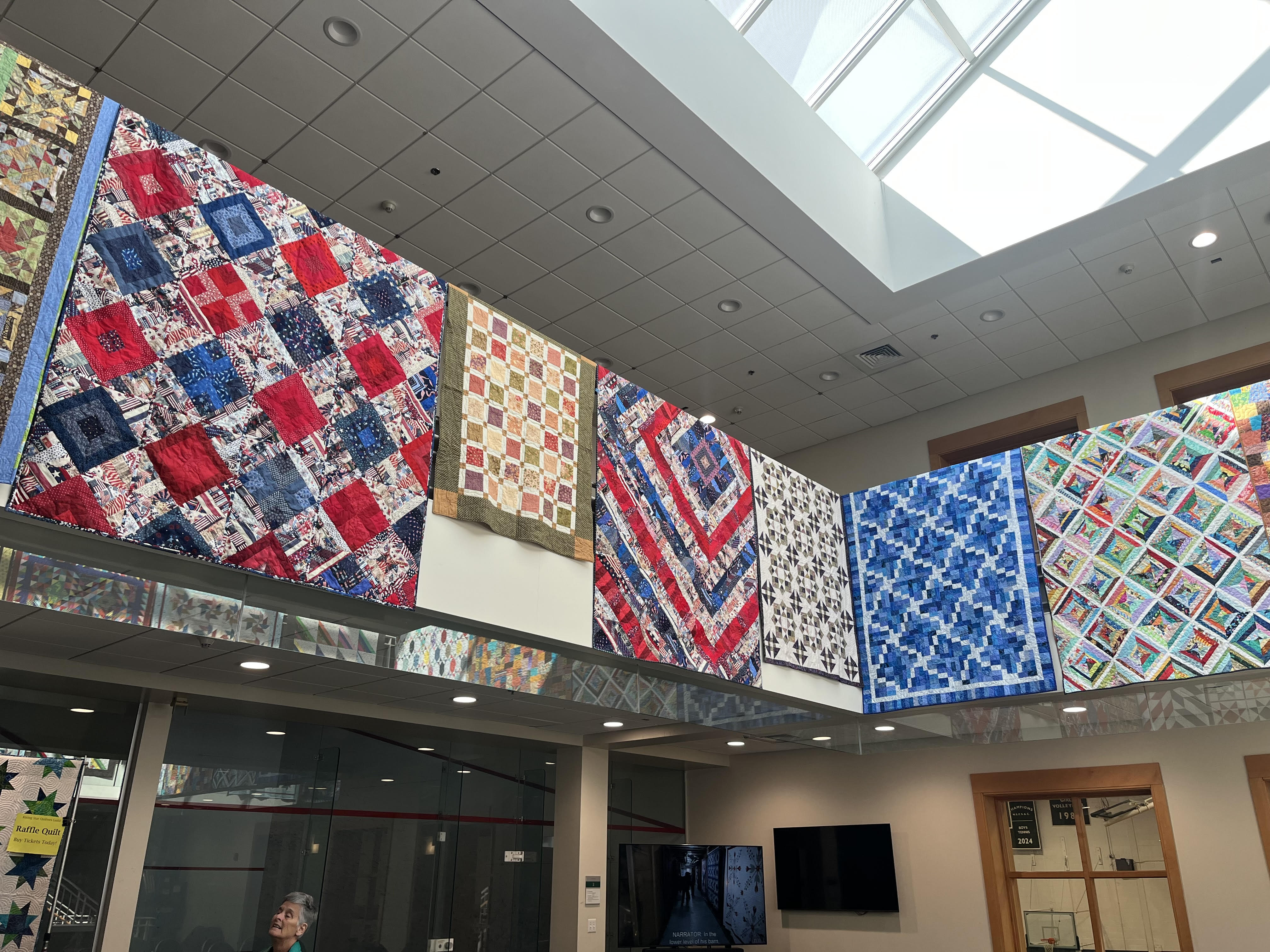
All New England calls it Patriots Day, and this year it will be more like Patriots Month. We started early with activities, and I took some pictures at the quilt show.

I couldn’t study every quilt as there were too many, but I’ll explain why these caught my eye.

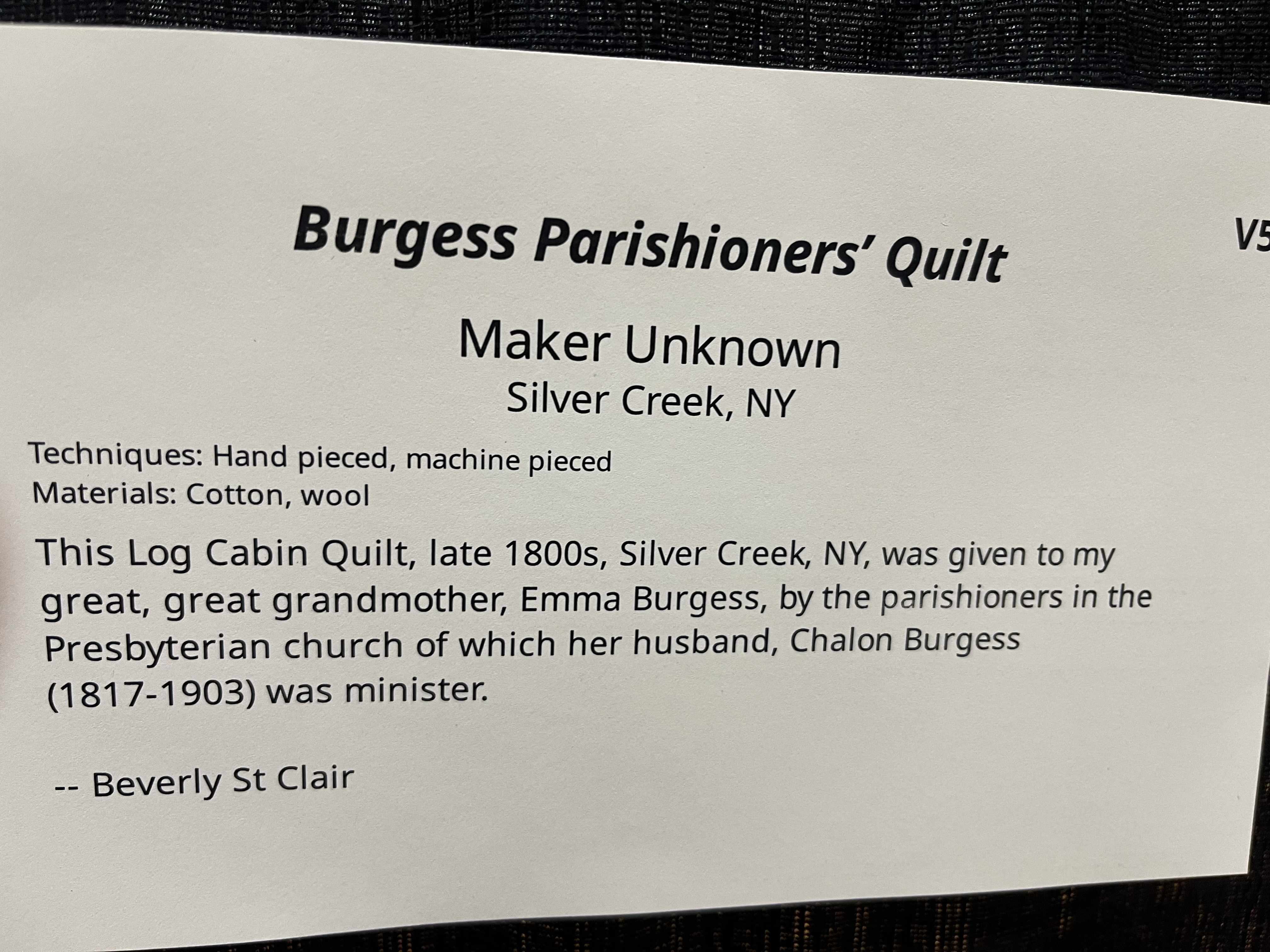
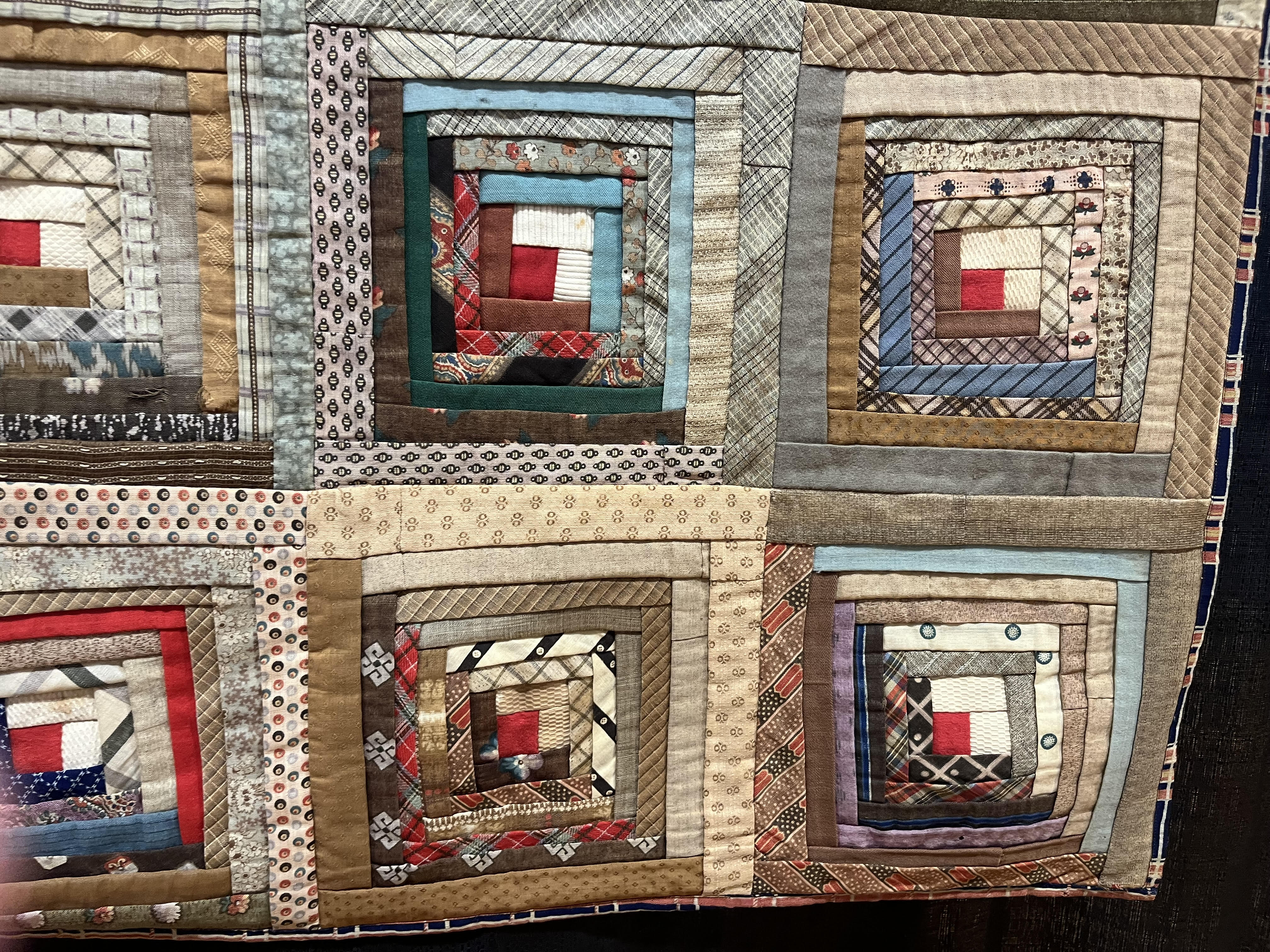
The first, a traditional log cabin style, I thought was in amazing condition to have lasted from the late 1800s.

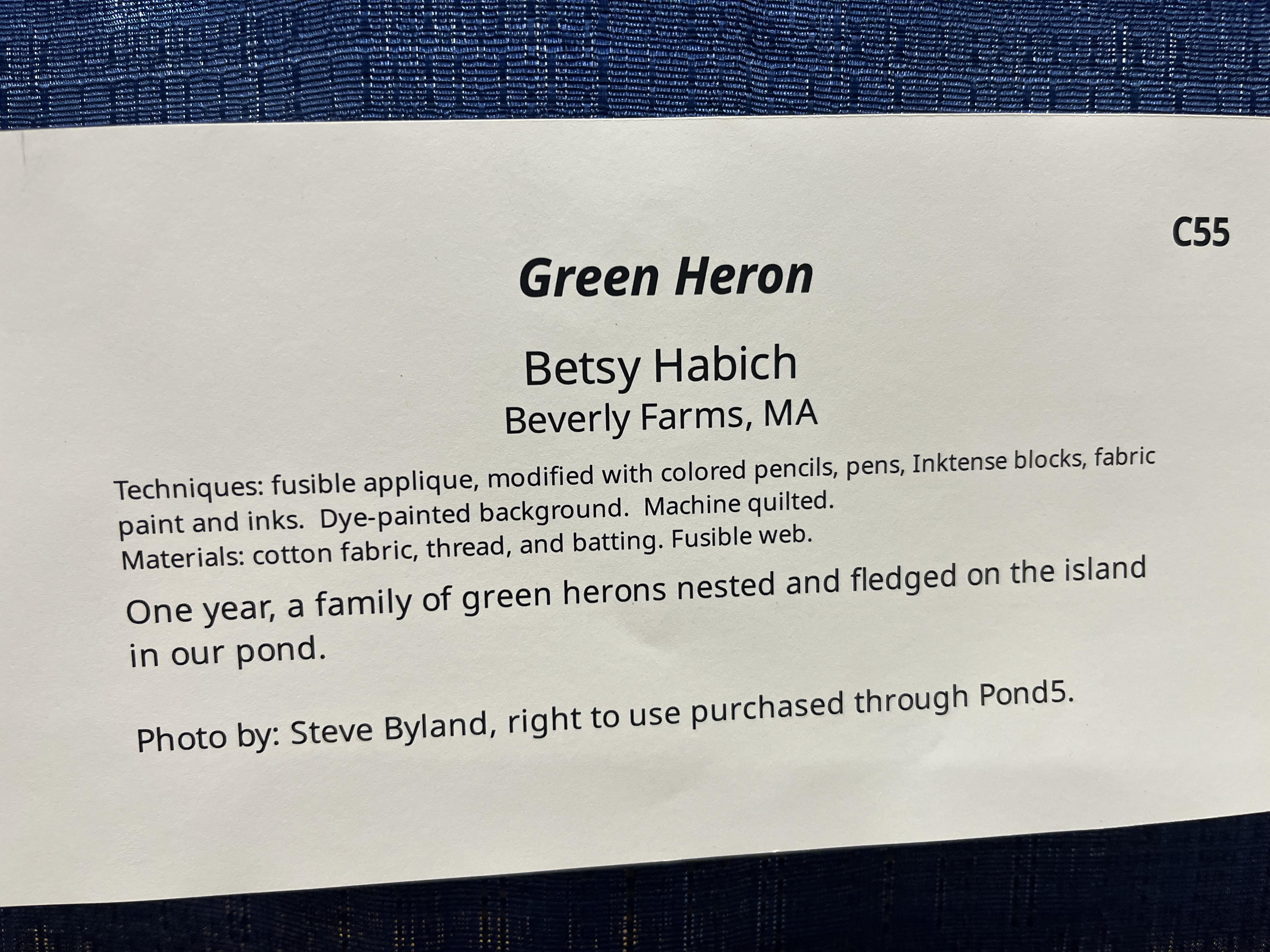
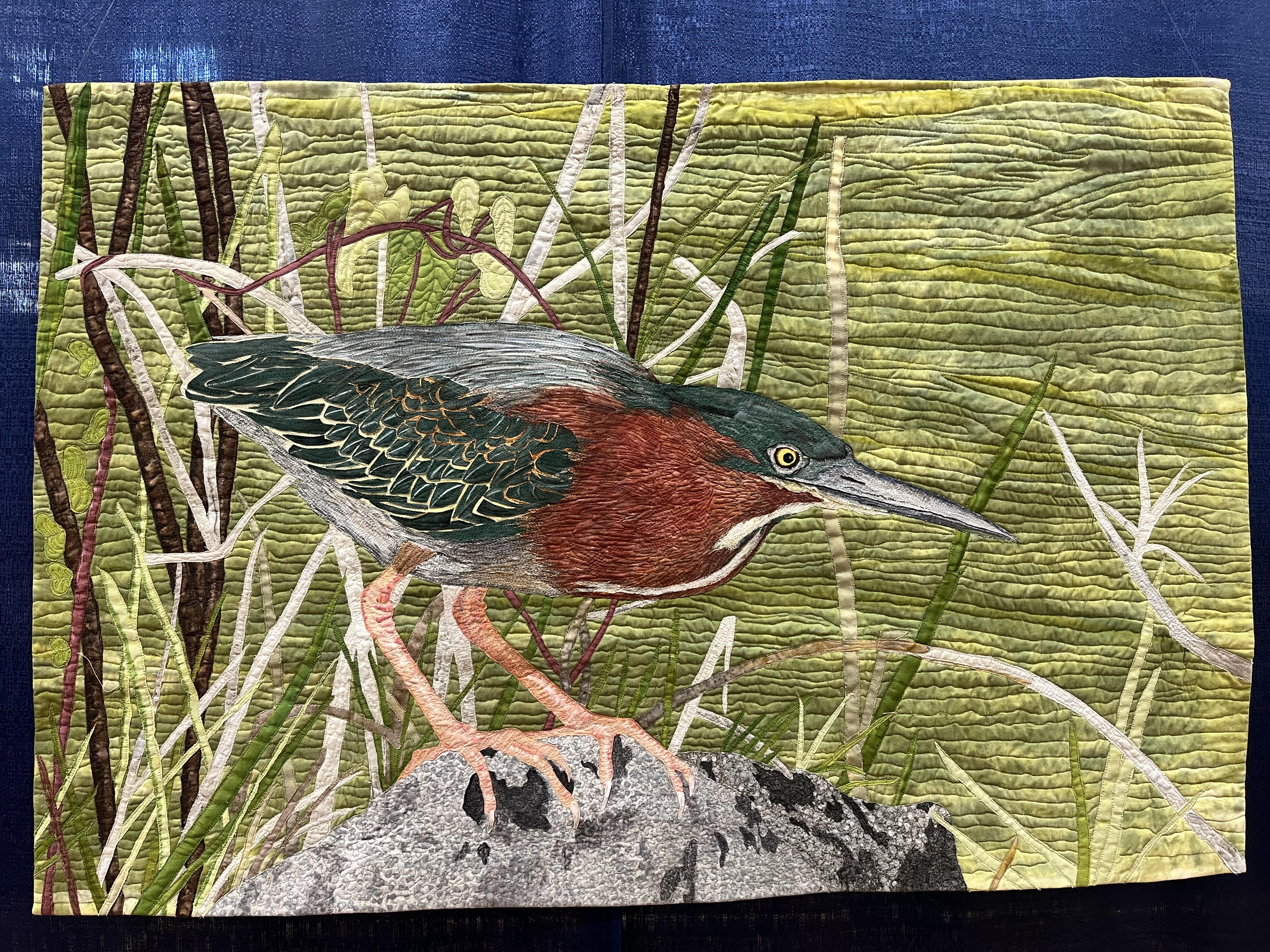
I photographed the green heron because I love herons and I liked this realistic one.

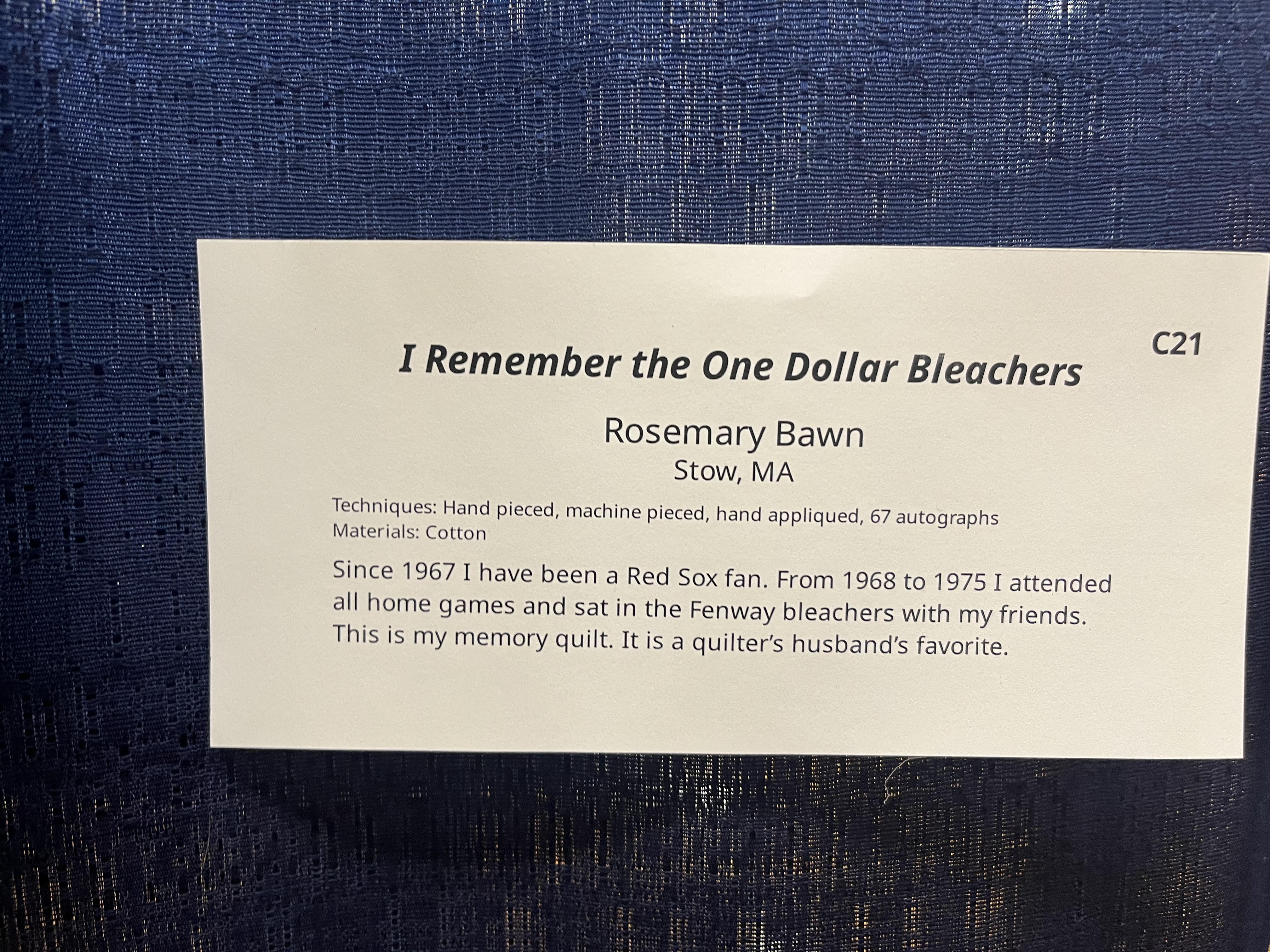
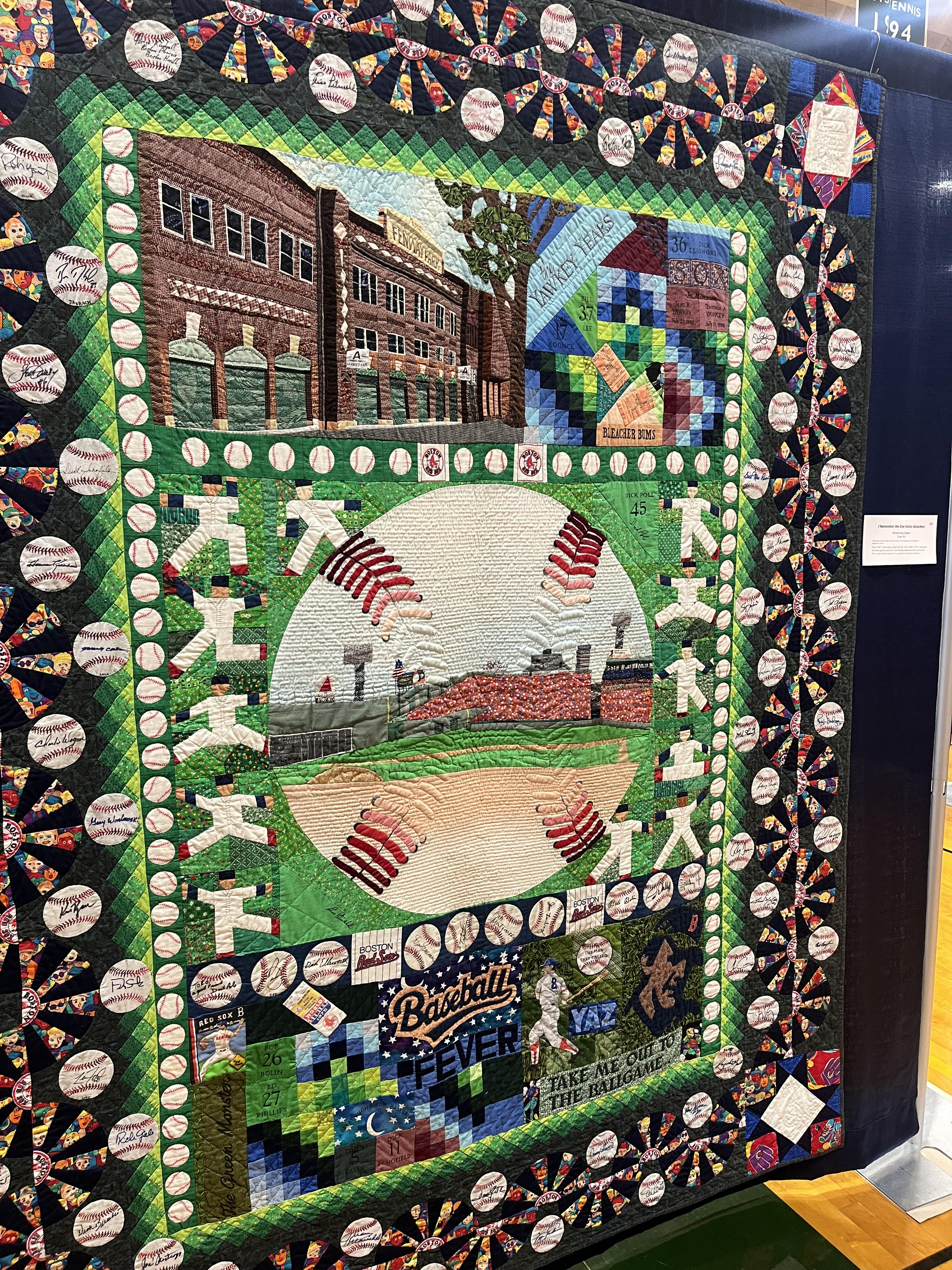
Contemporary New England cherishes its baseball team, the Red Sox, and Fenway Park, where the Sox play. Rosemary Brown, of Stow, went to town on that.

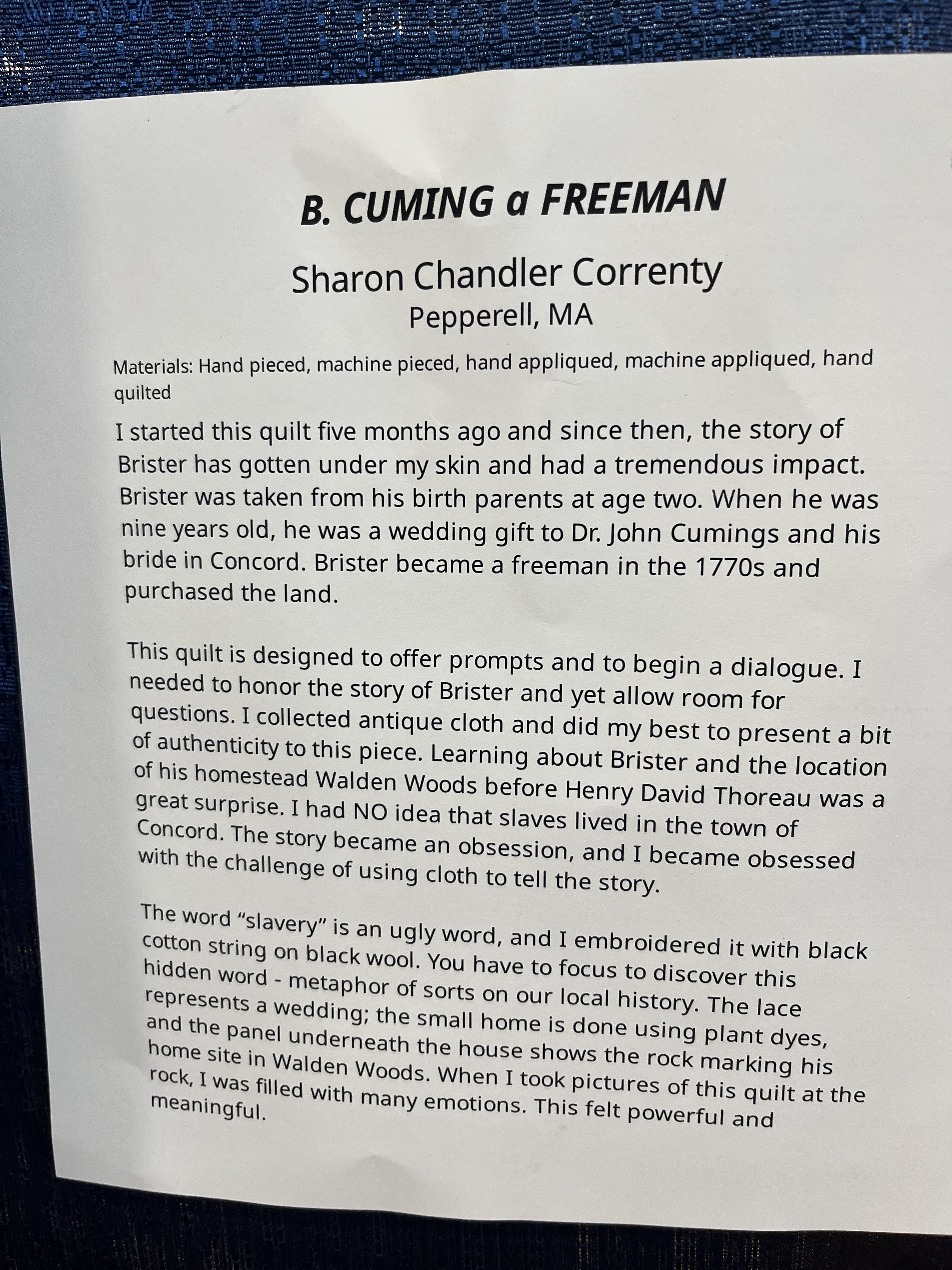
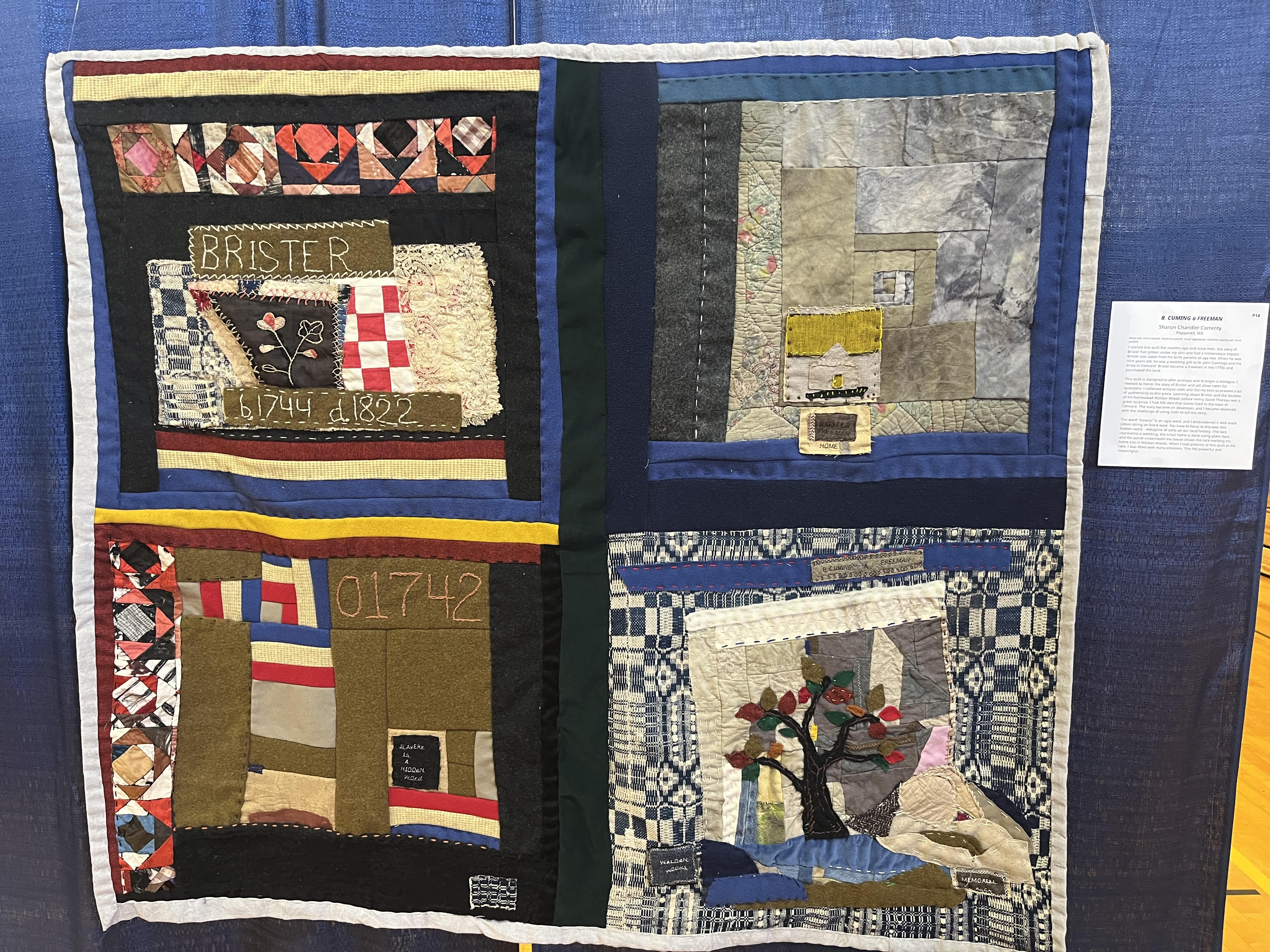
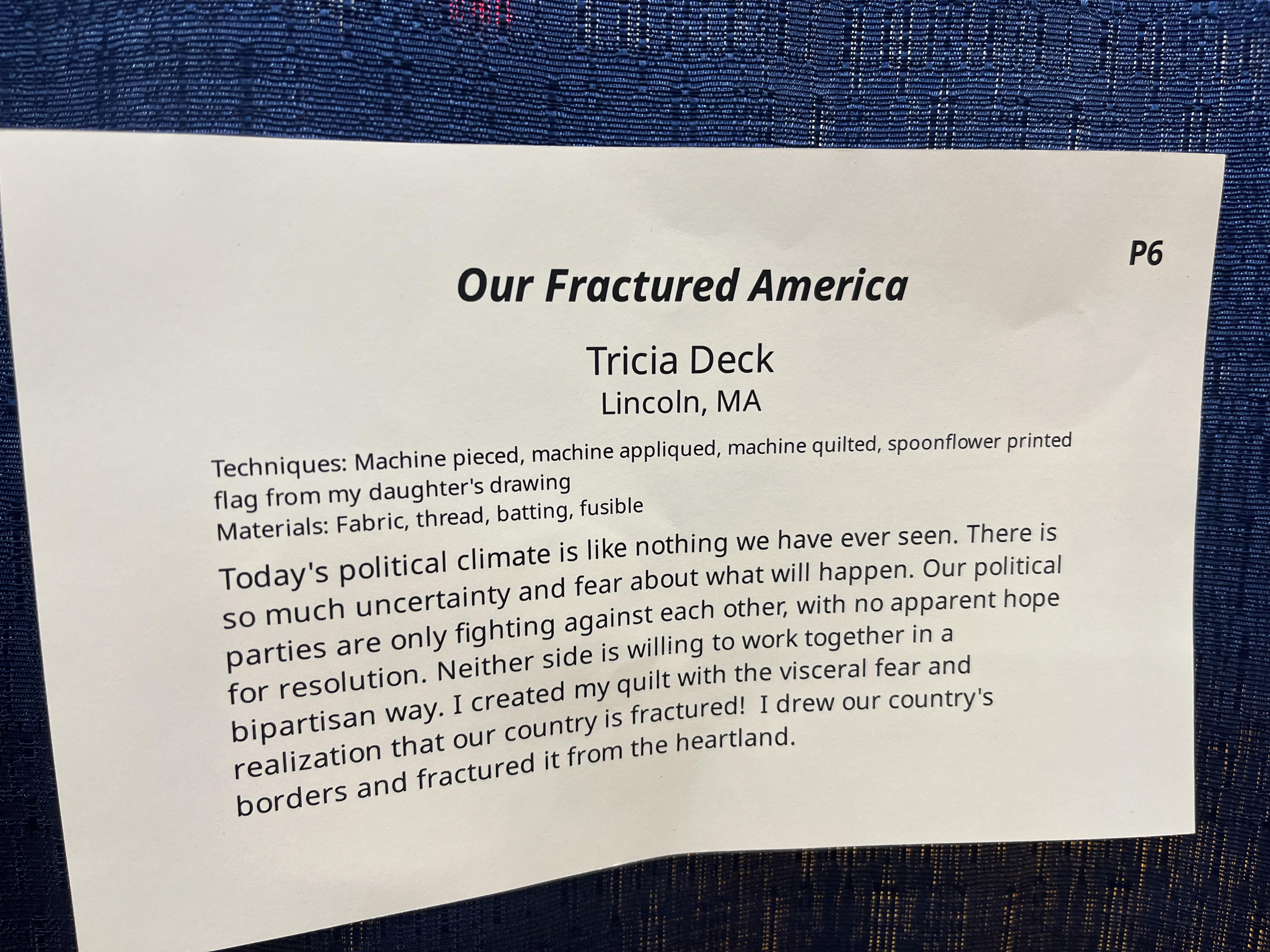
Until recently most Concordians didn’t realize there had once been slaves in our holier-than-thou town. In fact, I’m told, some slaves kept the farms going as the farmers took up their muskets. Brister Freeman is one we’ve been learning more about in recent years. He eventually gained his freedom, and he has an area of town named after him. Sharon Chandler Correnty explains her quilt below.

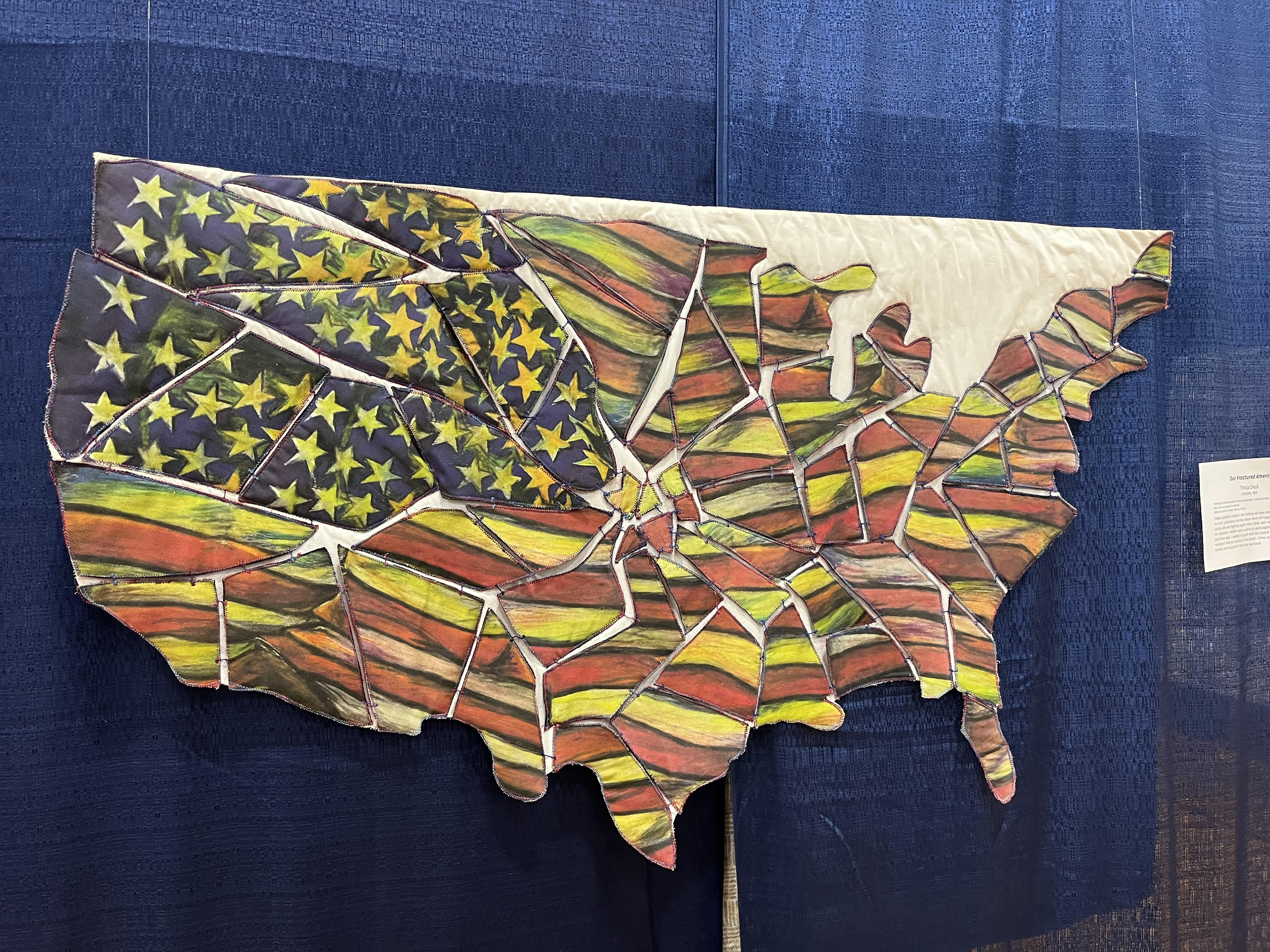
I was really moved by the next one, a nontraditional concept. Heartbreaking.

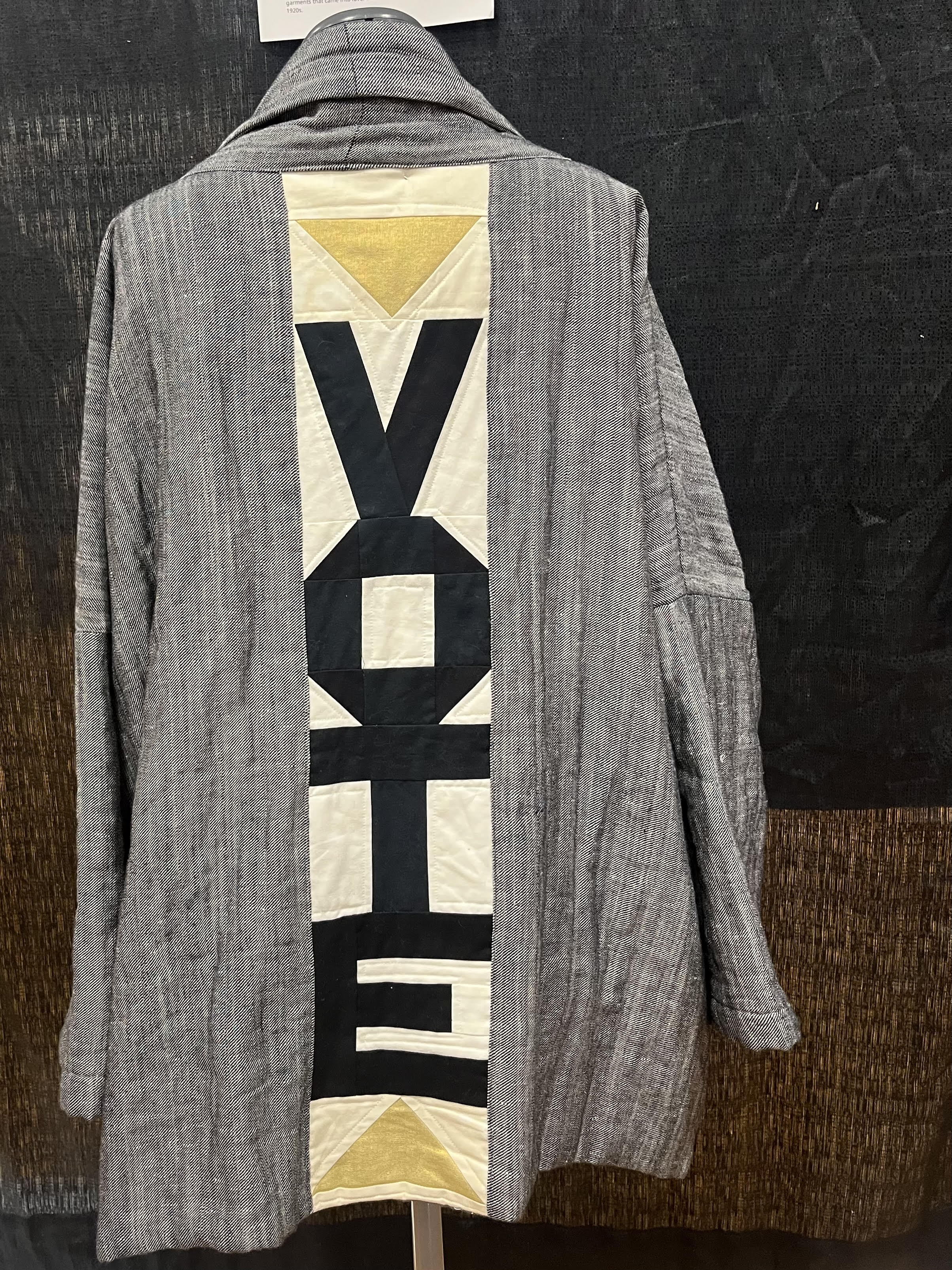
Below I share one thing I can do to help mend my broken heart. My thanks to the coat maker for the reminder that the country belongs to the people. We had a revolution for that.

Read Full Post »

Photo: North Carolina office of state archaeology.
A rice gate, seen here in 1986. At Eagles Island, North Carolina, in the late 1700s, the enslaved Gullah Geechee people began creating ingenious rice fields. 

If the people described in this archaeological report used brilliant rice-growing techniques while enslaved, imagine what they might have done if they had been free! But, alas, slavery destroys lives of the enslaved and their descendants for generations, as Pat Conroy documented in The Water is Wide, his memoir about teaching.

In an in-depth article at the Guardian, Adria R Walker writes about recent archaeological discoveries concerning the Gullah Geechee people of the American South.

“As a former deputy state underwater archaeologist, Mark Wilde-Ramsing can’t help but look down. While rowing around North Carolina’s Eagles Island, at the tip of the Gullah Geechee corridor, he noticed signs of human-made structures, visible at low tide. Though he’d retired, he was still active in the field and knew his former agency hadn’t recorded the structures – which meant he had come across something previously undocumented. …

“Wilde-Ramsing knew the area had once been full of rice fields. His neighbor, Joni ‘Osku’ Backstrom, was an assistant professor in the department of environmental sciences at the University of North Carolina-Wilmington whose specialty was shallow-water sonar, and he had the skills and technology to explore the area. Using a sonar device, the duo detected 45 wooden structures in the river, and the remote sensing tool allowed Backstrom and Wilde-Ramsing to acoustically map the canal beds. …

“Spanning 2,000 acres (809 hectares) of the northern end of Eagles Island, the 45 irrigation devices were developed by enslaved people, who would later come to be known as the Gullah Geechee. The devices were used to control water flow for the rice fields in conjunction with earthen dams and levees, Wilde-Ramsing said.

Their existence provides further evidence of the engineering and technological skills that Gullah Geechee people used for rice cultivation, beginning in the late 1700s at the latest.

“Backstrom and Wilde-Ramsing documented their findings in a study published earlier [in 2024]. ‘The use of the island for this endeavor prior to the Civil War, in large part rested on the shoulders of transplanted and enslaved Africans and their descendant Gullah Geechee tradition,’ the study reads.

“The team’s discoveries, which came after two years of research in and around Eagles Island, have helped further shed light on the ingenious, skilled work of the Gullah Geechee people. Though Gullah Geechee people have been studied for centuries, Backstrom and Wilde-Ramsing’s research is the first to focus on their irrigation systems. The research couldn’t come soon enough: Eagles Island is environmentally vulnerable, both because of climate change and ongoing development. The duo registered their sites with the state, making development more difficult as a means to ensure the protection of cultural artifacts.

“ ‘The whole area was originally swamp. It was cleared mostly in the post-colonial, early 1800s period for tidal rice cultivation because that area was freshwater,’ Wilde-Ramsing said. ‘They were able to actually use, regulate, introduce the water and drain it with the tides.’ …

“The work the Gullah Geechee people did would have been exhaustive. Wilde-Ramsing says it required removing the cypress forests, then building dams and levees. Growing rice necessitated the use of water, so they created long wooden boxes, or ‘trunks,’ with gates on either side, that allowed them to let the water in by opening the gates. …

“The enslaved populations throughout the Gullah Geechee corridor – which spans the coasts of North Carolina to upper Florida – were isolated in such a way that they developed and maintained a culture different from that of most plantations.

“ ‘[They were] from coastal regions of west Africa, an area that had similar environs to those along the southern Atlantic seaboard centering on Georgia and the Carolinas, where rice agriculture was a mainstay of the economy,’ the study reads. …

” ‘I didn’t quite realize the role that rice played. It rivaled cotton during the 1840s and 50s,’ Backstrom said. ‘It was all over Europe and the US and it was all run by African Americans. A lot of it was developed based on their skills. I’m just happy that it’s coming to light and they’re getting their – I won’t say new – but recognition that this was an amazing thing, amazing work.’

“Even though Wilde-Ramsing and Backstrom’s discovery likely won’t permanently stop either development or climate change, not least because the island is owned by multiple private entities, the existence of historic, cultural artifacts can ensure that the Gullah Geechee structures are at least documented instead of simply being razed and forgotten.

“The researchers have been in communication with East Carolina University’s maritime program, and the school plans to send a contingent to the site to study some of the characteristic types. People from the school will be able to work on noting the various structures, trying to figure out how they operated and taking samples. Backstrom said that they’ve also been in contact with researchers at George Mason University in Fairfax county, Virginia, including a professor who had ancestors [from the area].

“In terms of further discovery, a mix of approaches best suits the complicated terrain. ‘We’re thinking about using drone imagery,’ Backstrom said. ‘We have some preliminary drone footage, which gives us access to these areas at dead low tide, areas that we had a lot of difficulty with, even with a very small vessel.’ The area is remote, full of tight nooks and crannies. It’s ‘particularly challenging because of the tides and the timing,’ he said. The different combinations of drone imagery and sonar mean the researchers aren’t limited by turbidity in the water.

“Backstrom hopes to go to west Africa, specifically to Senegal or the Senegambia region, where many Gullah Geechee people were from, to learn about the history of rice farming, including the roles women and children played. Children, for instance, tasted the water to ensure too much saltwater wasn’t being let in, and women helped in the actual cultivation of the rice, using skills from their home countries that were passed down throughout generations.”

More at the Guardian, here. No firewall. Donations help save reliable news.

Read Full Post »

Photo: Candace Dane Chambers for the New York Times.
Arianne King Comer, an artist, wearing hand-made textiles in her home studio on Wadmalaw Island, S.C. She first learned batiking at Howard University.

I was drawn to this story about about dyeing textiles on the South Carolina mainland and islands after reading Pat Conroy’s amazing memoir The Water Is Wide. That book recounts his 1960s teaching experience among impoverished black children on one of the islands — a sad and moving tale.

I am happy to learn something more upbeat about the islands.

The New York Times says reporter Patricia Leigh Brown “followed South Carolina’s indigo trail from Charleston to Johns Island to St. Helena Island” for this story.

“On a spring morning nearly a decade ago, Leigh Magar was out walking rural Johns Island, off Charleston, S.C., with her ‘snake stick,’ a wooden cane with a jangling Greek goat be. … As she tells it — and she swears this story is true — a beautiful blue dragonfly alighted on her stick and then encircled her, before fluttering toward the woods. She followed it into a thicket of pines, where she discovered a patch of wild blue indigo hidden among the trees.

Magar, a textile artist and dressmaker partial to indigo-dyed jumpers and indigo-stained silk ribbons tucked into her hair, is at the artful forefront of the ‘seed to stitch’ movement — the growing, harvesting and processing of Indigo suffruticosa, a robust plant that flourishes in the tropics and produces a deep, cherished ocean-blue color, one of humankind’s oldest dyes.

“This benign-looking bush is used in designing garments and batiks. It was a major export in 18th-century South Carolina. Like rice and cotton, the lucrative indigo crop was dependent on the skills and labor of enslaved Africans, who tended the plantation fields and extracted the dye in preparation for shipment to England for its burgeoning textile industry.

“Today, the revival of indigo by a diverse group of artists, designers and farmers is hardly confined to South Carolina. … In the United States, the passion for indigo dovetails with a growing appreciation for nontoxic plant-based dyes, including turmeric and marigolds, and the renewed focus on Africa’s role in contemporary fashion, spotlighted by recent museum exhibitions like ‘African Fashion‘ at the Brooklyn Museum and the Portland Art Museum, and by ‘Blue Gold: The Art and Science of Indigo,’ which opened at the Mingei International Museum in San Diego on Sept. 14 [until March 16, 2025]. …

“Fashion designers like Awa Meité van Til, who is based in Bamako, Mali, draw inspiration from her ancestors. In Africa, her grandmother re-dipped her clothes in what the older woman called ‘the blue of life’ when they aged, van Til recalled by email. In Lagos and other major cities, adire, a woven indigo-dyed cloth historically made by the Yoruba, is a fashion staple. …

“Magar was drawn to indigo after a career designing hand-stitched hats and fedoras for Barneys New York from her shabby chic cottage in Charleston. In 2015, she and husband, Johnny Tucker, an architect and artist, moved to a house on Johns Island. …

“Madame Magar, as she is known professionally, became infatuated with the idea of creating art from Mother Nature and began reading histories about Johns Island indigo. At the time, indigo seeds were hard to come by. Then a local botanist told her about a ‘hermit monk’ deep in the woods who not only had seeds but a thriving indigo garden. …

“The ‘hermit’ turned out to be an affable Eastern Orthodox monk named Father John, who lives down a rutted sand road. In his black cassock, he had a slightly bohemian air, with a bountiful silver beard and hair pulled back in a tight bun. …

“Father John is adept at ‘resist techniques,’ in which certain areas of a textile are blocked from receiving the dye, most often by applying molten wax (the process is often called batik). He prefers making a golden paste out of rice bran which he then applies through intricately hand-cut stencils to create patterns on fabric, in a centuries old Japanese technique known as katazome.

“He pulled out a small plastic bag full of tiny brown curlicues — they were indigo seed pods (you could hear them rattling). He demonstrated their alchemy in the yard, in tubs — one dye steeped with dried leaves, and a deeper color, from concentrate, its bubbling iridescent surface resembling a liquid stained-glass window.

“When Father John immersed his stenciled textile into the brew, it turned a distressing pickle green. But as he fished it out and exposed it to the air, it transformed into a breathtaking blue, enhanced by intricate white patterns where the rice paste had been. …

” ‘Every country that does indigo honors ancestors through this magical blue,’ said Arianne King Comer, an artist who first learned batiking at Howard University and has an indigo plant tattoo above her ankle.

“ ‘It aligned me,’ she said of her indigo education, which began in 1992, when she made her first trip to Nigeria on a grant to study with Nike Davies-Okundaye, a celebrated textile artist who has built centers for young people to learn traditional arts and crafts. …

“King Comer’s indigo-dyed tunics and silk scarves, sold on her website, practically spill out of her trailer, many employing shibori, a Japanese technique in which cloth is twisted or folded to create different patterns. … She will stay in her DIY outpost until she is able to build a center honoring historical and cultural crafts techniques, through her nonprofit, IBILE. Her work is part of the permanent collection of the Acres of Ancestry/Black Agrarian Fund, a cooperative that supports efforts to secure and protect Black farmlands.”

More at the Times, here.

Read Full Post »

Photo: Lane Turner/Globe Staff.
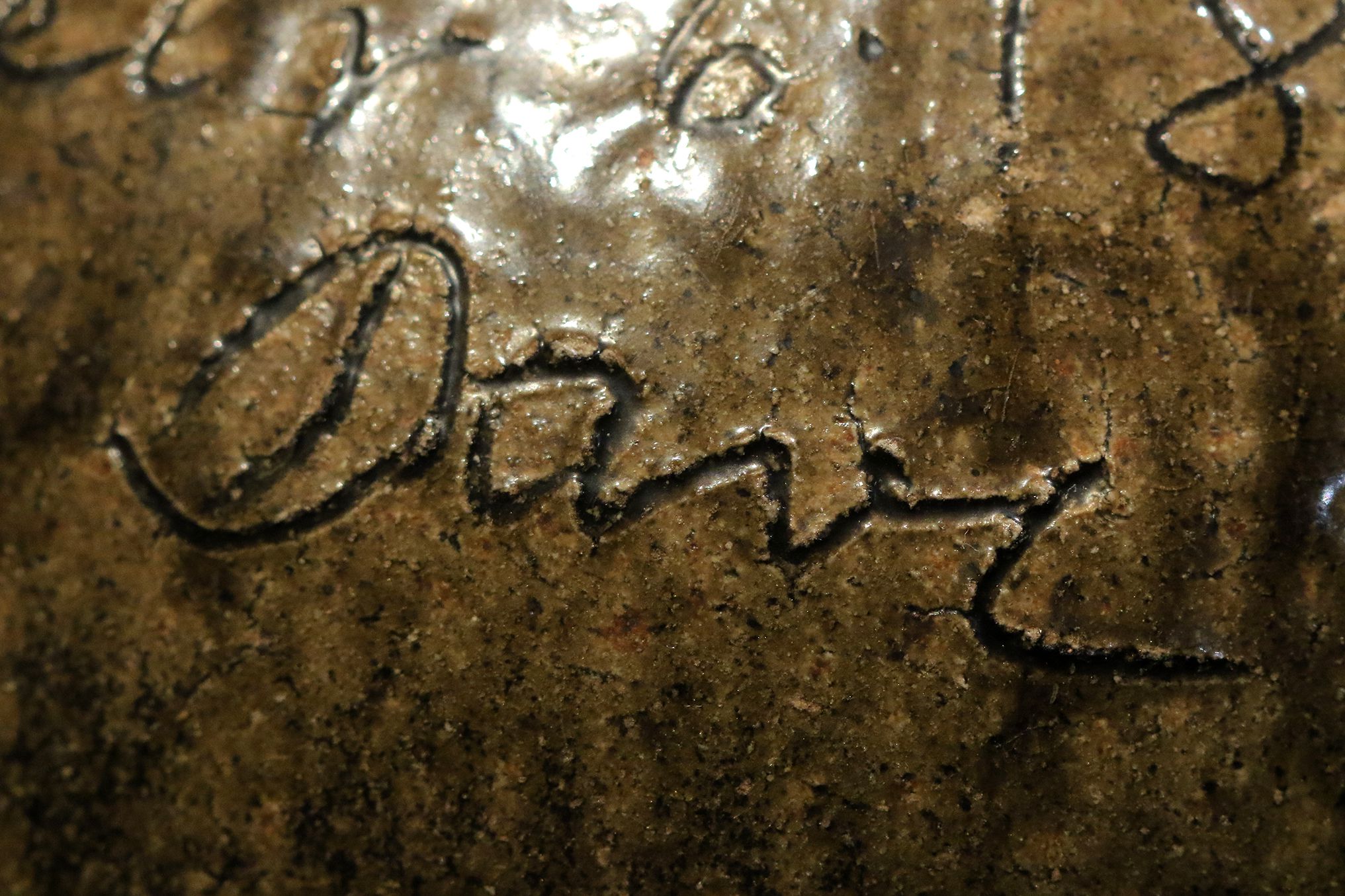
“Hear Me Now: The Black Potters of Old Edgefield, South Carolina,” an exhibition at Boston’s Museum of Fine Arts, presents 12 works by enslaved potter David Drake. Above, David Drake’s signature, “Dave,” on a storage jar from 1858. 

Today’s story is about an enslaved potter and the descendants who found him 150 years later. It is so painful to read about him being “bought.” You really have to wonder about the depths to which humanity sometimes descends.

Malcolm Gay reports at the Boston Globe, “In 1857, an enslaved potter in South Carolina’s Old Edgefield district carved a brief poem into a pot he’d turned in the mid-August heat.

“The potter had been bought and sold by a series of owners by then. He’d lost a leg, but his gifted hands won him local renown: His expert work with clay ensured he would be kept in the district known for its stoneware, even as his family was torn from him at auction.

“Using a sharpened tool, he etched into the jar’s shoulder: ‘I wonder where is all my relation/Friendship to all — and every nation.’ The potter then added his enslaver’s initials, the date, and, finally, his own name: ‘Dave.’

“In that simple act, the man, long known as Dave the Potter, and later David Drake, was not only wondering about his lost family: He was committing an extraordinary act of defiance in pre-Civil War South Carolina, indelibly asserting his existence in an age that sought to obliterate the humanity of Black people.

“Originally created to store meats and other foods, Drake’s 40 or so poem jars are today highly sought after by museums. His inscribed vessels routinely fetch six figures at auction, and his stoneware features prominently in ‘Hear Me Now: The Black Potters of Old Edgefield, South Carolina,’ an exhibition featuring enslaved potters [at Boston’s] Museum of Fine Arts.

“Perhaps most significantly: More than 150 years after Drake composed his mournful verse, researchers appear finally to have found his direct descendants.

“ ‘He was sending these messages,” said Daisy Whitner, 84, whom genealogists have identified as Drake’s great-great-great-granddaughter. ‘He wanted people to know: I’m a human being; treat me as such.’

“Now in their mid-70s and 80s, Whitner and her three siblings, Pauline Baker, John N. Williams, and Priscilla Ann Carolina, believed for most of their lives that their known family tree began in Aiken, S.C. They hadn’t known they’d had family in Edgefield. They’d certainly never heard of David Drake.

“But that changed in 2016, when April Hynes, an independent genealogist and researcher who’s been tracking down descendants of enslaved people from the area, cold-called Whitner. By pairing historical research with publicly available documents, Hynes had determined that Whitner and her siblings were the potter’s direct descendants. …

“ ‘I don’t have a word to describe him,’ said Baker, 75, seated on a sofa in her niece’s tidy home outside Washington, D.C., a replica Drake pot placed prominently on the dining room table. …

“Seated to her right, Whitner grew emotional as she described touching one of Drake’s pots during a trip to New York’s Metropolitan Museum of Art, which organized the exhibition with the MFA.

“ ‘It just tore me to pieces,’ she said. ‘I can’t stop reading and reading, trying to dig more and more.’

“The family has read nearly everything published about their ancestor, as they puzzle over his poems, searching for possible meanings and seeking clues about his life.

“Whitner is haunted by a particular jar Drake created and inscribed in 1836. It reads: ‘horses mules and hogs —/all our cows is in the bogs —/there they shall ever stay/till the buzzards take them away.’ ‘He’s using farm animals rather than to say slave,’ she said. …

“The [family] had mixed emotions when Hynes first called them with the news about Drake, but soon they were traveling down to Edgefield with around 30 family members to take part in celebrations to honor the potter.

“ ‘It’s a joyous feeling,’ said John N. Williams, 81. ‘But then there was a sadness about it, because you thought about the atrocities that happened.’

“They appreciate how rare it is, as the descendants of slaves, to be able to read their ancestor’s thoughts — particularly while he was still in bondage. But discovering a forebear who spent most of his life enslaved has also personalized their perception of the era, wrestling as they do with the scant details, and many unknowns, of Drake’s life.

“Whitner said she’d previously avoided looking at movies about slavery because ‘my heart couldn’t take it.’

“ ‘It hurt me to my core,’ she said. ‘And I will look now.’ ”

More at the Globe, here.

Read Full Post »

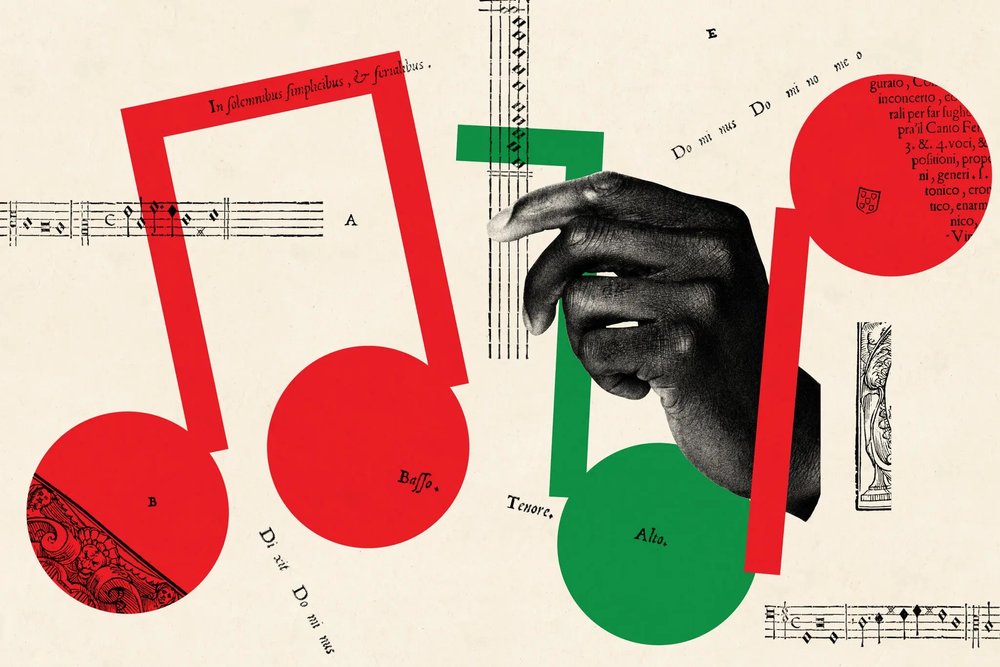
Illustration by Cristiana Couceiro at the New York Times. Photo: Getty Images.

A black musician who composed sacred and secular vocal music more than 400 years ago is getting attention at last, thanks to the internet. Garrett Schumann recently wrote for the New York Times about composer Vicente Lusitano.

“On a day in June 2020, Alice Jones was in her Brooklyn apartment getting ready to attend a Black Lives Matter rally. Dr. Jones, a flutist and composer who serves as an assistant dean and faculty member at the Juilliard School, was adamant about expressing herself as a Black classical musician. …

“Dr. Jones designed a sign that listed Black composers throughout history. After adding Joseph Boulogne, Chevalier de Saint-Georges, the 18th-century subject of the upcoming film ‘Chevalier, she faintly remembered another, older name: Vicente Lusitano.

“Lusitano was an African-Portuguese composer and music theorist who was most likely born between 1520 and 1522, and who died sometime after 1562. Probably the child of an enslaved African woman and a Portuguese noble, Lusitano traversed Europe in a career that saw him depart the Iberian Peninsula for Rome as a Catholic priest in 1550 and, around a decade later, relocate from Italy to Germany as a married Protestant.

“He wrote sacred and secular vocal music, taught extensively and produced scholarship that includes a unique manuscript treatise on improvised vocal counterpoint. …

“It took until the late 19th century for new scholarship to revisit Lusitano’s printed works, beginning a 150-year-old reclamation project. Important strides were made in the 1960s and ’70s as new sources emerged, most notably a 17th-century manuscript that describes Lusitano as ‘homem pardo,’ a historical Portuguese term for certain mixed-race people of African descent. And since 2000, the internet has become increasingly important to Lusitano scholarship; the summer of 2020 saw the onset of a new and ongoing flurry of interest whose roots are entirely digital.

“Dr. Jones’s demonstration sign played a part in the current wave of activity: A picture of her placard went viral on social media and broadcast Lusitano’s name to a new audience. Joseph McHardy, a Scottish-Congolese conductor and early music specialist based in London, was stunned when he saw Dr. Jones’s post. ..

‘Learning about Lusitano reminded me of the feeling I got when I learned there were Black people in the Roman Empire.’

“After seeing the sign, McHardy quickly searched for scores of Lusitano’s music to perform with his church choir, but could only find scans of the 16th-century originals. So, he spent that summer making his own updated versions. He’s one of many experts and enthusiasts who produced the first modern editions of Lusitano’s compositions and shared them on free online databases. The result was a burst of new performances in the months that followed. Nearly five centuries after Lusitano’s death, dozens of choirs in the United States, Canada and Europe performed his music for the first time, largely because his scores were finally accessible.

“Britain has been the epicenter of Lusitano’s current musical resurgence. In June, McHardy partnered with the Chineke! Foundation to produce a tour highlighting Lusitano’s sacred works with an ensemble composed entirely of vocalists of color. The motets’ beauty astonished McHardy, who said, ‘We had no idea Lusitano’s pieces would be so enjoyable to sing.’

“His collaborators, too, were impressed. ‘I have fallen in love with Lusitano’s music,’ said Malcolm J. Merriweather, an American baritone and conductor who performed on the tour.

“The Marian Consort, another British choir, led by the conductor Rory McCleery, preceded McHardy’s tour with a 2021 concert series featuring one of Lusitano’s works, which they also performed at that year’s BBC Proms. …

“Today, Lusitano is not easy to study, even if you can find performances of his music on YouTube. Little correspondence and few records of his life are known to have survived, both because earlier scholars had no interest and because his sociopolitical disenfranchisement constrained the production of such documents. Contextual evidence is critical, especially with respect to his identity.

“We know other pardo people existed in 16th-century Portugal. At the time, thousands of African and African-descended people, most of whom were enslaved, lived in the country. … Lusitano’s experience as a historical figure illustrates the kind of collective activity that has traditionally excluded composers of African descent from classical music’s conventional performance and academic institutions. Melanie Zeck, a reference librarian at the Library of Congress’s American Folklife Center and former reference librarian at the Center for Black Music Research, emphasized that the first historians of Black classical music responded to these exclusionary tendencies by developing what she called a ‘totally separate practice from mainstream academic scholarship.’ …

“Now, the internet and social media can empower these principles of Black music scholarship, though, as Dr. Zeck said, ‘misinformation abounds.’ But for Lusitano, these technologies nevertheless have helped the truths of his life and music become more accessible than ever, 500 years after his birth.”

More at the Times, here.

Read Full Post »

Photo: Fabio Nascimento/Outlaw Ocean Project.
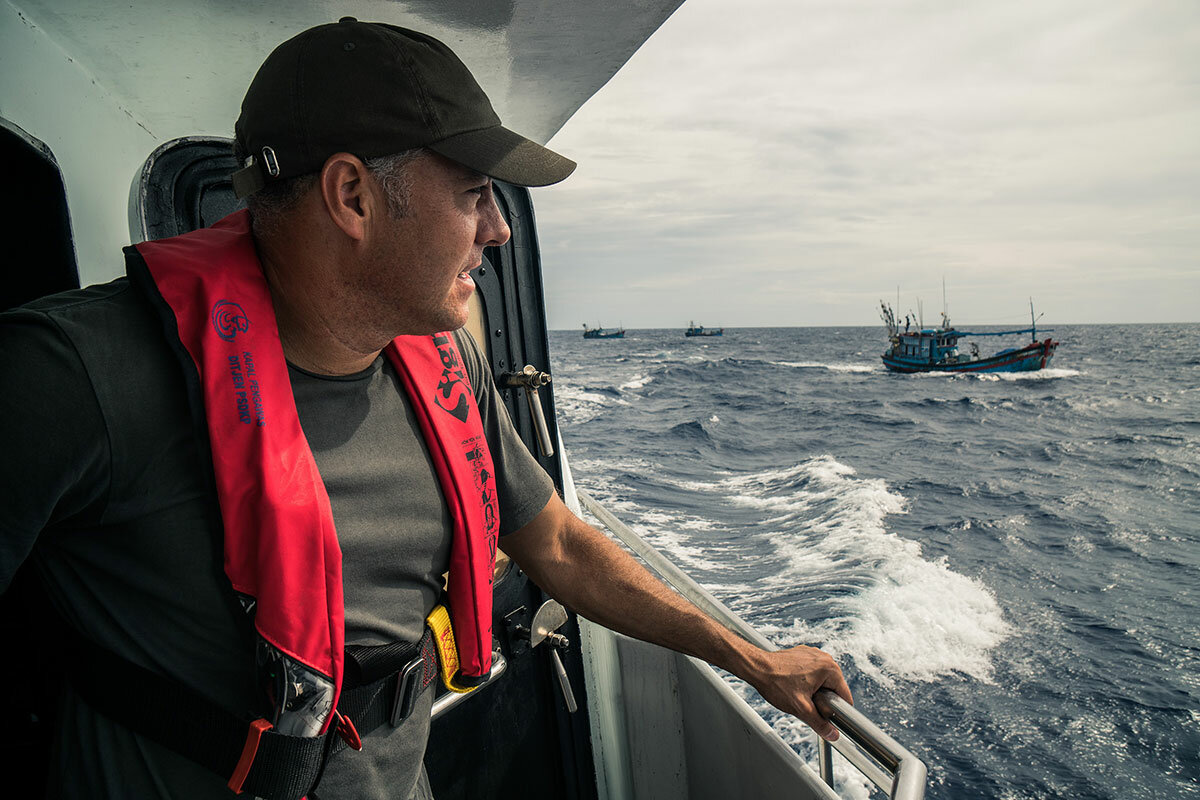
Investigative reporter Ian Urbina on an Indonesian patrol ship chasing Vietnamese fishing boats suspected of illegal activity.

Because we face so many monumental problems around the world, it’s easy to get discouraged and say, What can one person do? But as Pete Seeger once sang, “One and two and 50 make a million.” In other words, individual efforts add up.

Mark Trumball at the Christian Science Monitor interviews a journalist who covers the work to protect the environment and human rights on the high seas — and shares how the informed consumer can help.

“Ian Urbina is what you might call a globe-trotting journalist, except he focuses his reporting on the oceans, not the land.

“Earlier this year he was honored for his investigative writing by the Society of Professional Journalists, for stories tied to the treatment of migrants in Libya (and off its Mediterranean coast) and disruption in Gambia’s fisheries, published during 2021 in the New Yorker and the Atlantic. Another story from his Libya reporting – about Europe’s treatment of African migrants – ran here in the Monitor.

‘Now Mr. Urbina’s Outlaw Ocean Project is launching a podcast series based on his work, in partnership with the Los Angeles Times and CBC Podcasts. …

Trumball: You explore what you call the ‘outlaw ocean.’ Why are oceans so different from land – and so difficult to police?

“From the perspective of governance, you have this situation where the high seas belong to everyone and no one, and therefore jurisdictionally it’s an unusually complicated, murky space. … The second issue is geography. The reality of the high seas is it’s so incredibly sprawling, two-thirds of the planet.

“And then when it comes specifically to the category of abuses of crimes that pertain to people – murder on camera and slavery and abuse of stowaways and wage theft and abandonment of crew, you know, all these human rights and labor abuses – a contributing factor to that subcategory of crimes is who’s getting harmed. Most often the victims of those sorts of crimes are poor, are folks from developing nations. … A lot of them are not literate. A lot of them have signed contracts in languages they don’t even speak. …

“And the boss of the [floating workplace] is from one country. The flag of the factory is to another. The guys working in there, getting abused, are from a third. The catch is being all loaded on a fourth. …

Many of us might feel like, well, my connection with the ocean is when I buy some fish for dinner. But is it much more than that?

“If you think of the planet Earth as a living organism, maybe metaphorically, it has inherent systems. It’s got lungs. The lungs of the planet – 50% of the air we breathe – are cleaned by the oceans. So the lungs of the planet are at stake. If you think of it as the commercial circulatory system, 80% of our [global] commerce gets to us cheaply and efficiently … by ship. So not just fish, but iPhones and, you know, tennis shoes and grain and oil. … The oceans are also a temperature stabilizer of our body, you know, of the body planet. … They take off a lot of the heat. …

You have a seven-part podcast with the goal of shedding light on these varied challenges. … Does the stress on the oceans amount to a disaster in the making? 

“Yes, it is a disaster. But that doesn’t mean we have the luxury of being demoralized. … Do I think it’s unsolvable? No, I think there are lots of ways in which things can be done to mitigate the disaster and better govern.

A lot of people are doing lots of things in different places, in individual fights, in individual battles.

One episode features the nonprofit group Sea Shepherd chasing down a ship on Interpol’s wanted list for illegal fishing.

“Sea Shepherd [said] We’re going to go after these guys and we’re going to find them wherever they are, and we’re going to chase them and harangue them and draw a lot of media attention on them. …

“And they succeeded. You know, they found the Thunder, which was at that time ranked the top worst illegal fishing vessel on the planet, $67 million worth of illicit catch. And they found these guys – nets in the water – and proceeded to chase them for 110 days all across the planet. And all sorts of dramatic stuff happened in the interim. And ultimately the Thunder – spoiler alert here – sunk itself and all the crew were rescued … by Sea Shepherd, handed over to law enforcement, and the officers were prosecuted and served time. So I think there are cases like that where you see various actors make savvy use of the media and the law to try to make a difference. ….

“There’s more wind in the sails of the advocates and the academics who were in the trenches already fighting this fight. Now they’ve got more media behind them. I think you also see more market side players having an awareness that, you know, this issue isn’t going away. 

“Whether it’s the issue of slavery and the use of captive labor as a cost-saving tactic on fishing vessels, or intentional dumping of oil as a cost-saving tactic, or illegal fishing – meaning going places you’re not supposed to or using gear you’re not supposed to – all these things are cost-saving tactics. And who benefits from that but the companies? And the companies writ large, you know, the ship-owning companies, the insurers, the fish sellers, wholesalers, grocery stores, restaurants, all these market players are the ones who turn a blind eye. … The decentralization of the supply chain has allowed them to say, ‘Well, we don’t know what’s happening.’ You know, ‘we outsource’ … and so they can’t be held accountable. Well, I think there’s a reckoning coming on that. …

“We’re catching wild caught fish in places like Gambia that historically was eaten by the locals and was free at the market, often, because it was so plentiful. Now the locals can’t touch the stuff because they’re priced out, because it’s all going to the factory to get ground up and exported. That’s the crazy economy we have.

What can the average person do in their own actions? What would you recommend?

“First, I’d say, don’t get demoralized and don’t think that you should or can solve the war. Just think about battles, and choose which of the many battles interest you most, whether it’s sea slavery or plastic pollution or whaling or illegal fishing or murder and violence at sea or whatever. Just narrow it down, choose a bite-size thing, and then focus on that.” 

More at the Monitor, here.

Read Full Post »

Photo: Ed Meek/ Ole Miss News.
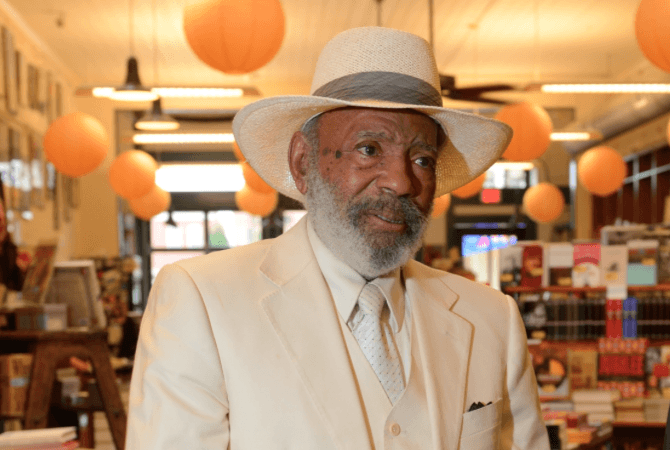
Civil Rights icon James Meredith and his immediate family have welcomed into their lives the white relatives descended from their slave-owner ancestor.

My friend Suzanne Lowe, who is white, was doing genealogical research back in the early 2000s when someone gave her a publication written by the man who broke the color barrier at the University of Mississippi. In a flash, she realized she and civil rights icon James Meredith shared the same white ancestor.

Eager to reach out but full of trepidation about what Meredith might say to her, she searched the web for his phone number and called him, explaining who she was. There was a long pause, she says, and as she waited with increasing anxiety, her heart pounded. Then she heard Meredith say, “I’ve been waiting for this call for 50 years.”

Last Sunday, I had the privilege of listening in on a Coming to the Table episode describing how my friend’s white family got to know Meredith’s black family. I can hardly describe how uplifting it was. One of Meredith’s close relatives presented the history of Mississippi slaveholder J.A.P. Campbell and his role in writing the laws of white supremacy. So it was a serious occasion. But we also savored the joy of Campbell’s black descendants at finally being seen and the joy of the white family members who were thrilled to connect.

It is true, as my friend reported when asked in the chat questions, that her outreach to other white Campbell descendants did not meet with universal acceptance. A few were nasty and unbelieving — as if the country hadn’t been through all that with the descendants of Thomas Jefferson and slave Sally Hemings. But others were fascinated and delighted. As Meredith’s son John said, his side of the family always knew they had white relatives. In fact, he said, many black families know they have white relatives. Seeing the white side of the family enjoy their new consciousness had been a big part of the pleasure he experienced.

I learned new things about the disastrous effects of laws preserving white supremacy, at the same time as I got the feeling that the two families were focused on how happy they were to be united. I got no sense that Meredith’s side wanted their new cousins to bear the brunt of national reparations. (I myself believe federal reparations are due — like those that President Ronald Reagan authorized for Americans of Japanese descent after their WW II internment in US concentration camps.)

Everyone was just enjoying having a large, interesting family and new kinds of connectedness.

Read Full Post »

Photo: Kirk Brown/via Boston Globe.
Kirk Brown is the founder and CEO of the Black think tank Melanin MeetUps. The group launched The Better Together Project, which is demanding an end to what it calls the glorification of plantation houses, and the use of their grounds for parties and weddings.

In recent years, tourists at plantations in the South and stately homes in the North have started giving more thought to the people who kept the mansions running. There’s so much that wasn’t in our school histories. I, for one, was amazed to learn that when the colonial farmers fought the British at Concord’s North Bridge April 19, 1775, many of the folks minding the farm were slaves. What? In Massachusetts? Yes.

So I was interested in a recent Boston Globe story about a new, more thorough, house tour. Jon Marcus wrote, “After she graduated from Clark University in Worcester, Carolyn Michael-Banks worked as general manager for a tour company in Washington, D.C., where she quickly noticed that certain people and events were being left out of the script.

“ ‘We had absolutely nothing in there about African-American history,’ said Michael-Banks, who is Black. … So she added information about the Black abolitionist and writer Frederick Douglass. About Benjamin Banneker, a Black surveyor who helped lay out the district. About how enslaved people were among the builders of the White House.

“Then the CEO called. ‘His question to me was, “What’s all this Black stuff?” ‘ Michael-Banks remembered.

“Today Michael-Banks runs her own tour company, A Tour of Possibilities, in Memphis, which visits the birthplaces and workplaces of cultural icons including Aretha Franklin and Black investigative journalist Ida B. Wells, landmarks of the civil rights movement and sites of the city’s slave markets and lynchings.

‘History can be uncomfortable but it doesn’t mean we shouldn’t talk about it,’ Michael-Banks said. …

“Offerings like these are popping up all over the country, by and about people often excluded from the narratives delivered on those jump-on, jump-off bus and trolley tours.

“There are women’s history tours of Philadelphia, St. Louis, Buffalo, and Detroit, and LGBTQ tours of Charleston, S.C., St. Louis, New York’s West Village, and San Francisco’s Castro district. Native Americans tell their own stories on Navajo Tours USA in New Mexico and Nez Perce Tourism in the Pacific Northwest. The Wing Luke Museum of the Asian Pacific American Experience in Seattle offers tours of Chinatown that cover its history and not just its food.

“There are growing numbers of tours focused on Black history and culture, not only in Memphis, but in Austin, Texas; Birmingham, Ala.; Charleston; Chicago; Miami; Savannah, Ga.; Selma, Ala.; and Washington. Atlanta has Black history and civil rights tours and a cycling tour of off-the-beaten-track neighborhoods called Civil Bikes. In Tulsa, Okla., there are now tours of the places where the Tulsa Race Massacre occurred.

“A ‘truth and reconciliation’ tour of Montgomery, Ala., is run by a nonprofit from an office in a building where the words ‘white’ and ‘colored’ are still chiseled in the wall above a water fountain. And Alexandria, Va., last year launched a Black history trail and an Underground Railroad-themed tour. …

“Several house and plantation museums including Monticello and Belle Grove Plantation in Virginia and the Belle Meade Historic Site and Winery near Nashville, have started telling more about the enslaved people who built and worked at them. The state of Nevada last year converted the Stewart Indian School into a museum to illustrate the story of how Native American children were taken there to be assimilated. …

“When historic sites are treated solely as places for entertainment, said Stephanie Rowe, executive director of the National Council on Public History, ‘it becomes easier to focus on the furnishings and the stories of success and riches. But when we approach these sites as places to learn about our pasts, we’re called to broaden the narratives’ to include such things as who did the work, and under what conditions.

“In fact, said Paul Melhus, CEO of ToursByLocals, whose guides increasingly focus on the people who have been left out, ‘the history of America is the history of Black people. And gays are part of American history, and Hispanics. It’s all real, and you don’t really understand anything if all you’re doing is just looking at the pretty houses.’

“Others want to do more than change the script. The Better Together Project is demanding an end to what it calls the glorification of plantation houses, and the use of their grounds for parties and weddings.

“ ‘These were labor homes,’ said Kirk Brown, founder and CEO of the Black think tank Melanin MeetUps, which launched the project. … ‘Why is there this glamorization of these homes? It’s depressing and it’s disrespectful and it prevents us as a country from truly healing.’ …

“ ‘We haven’t been able to express ourselves in a way that’s proud,’ said Stacia Morfin, a member of the Nez Perce, or Niimíipuu, tribe and CEO of Nez Perce Tourism, which she started after finding that none of the tourism-related businesses in her part of Idaho were run by descendants of tribal people. … ‘The marginalized and the indigenous people are taking that power back.’ ”

More at the Globe, here.

Read Full Post »

I learned recently that years before Thoreau built his famous little cabin at Walden Pond in Concord, Mass., a former slave called Brister Freeman and his family made their home in Walden Woods.

Robbins House reports, “Brister Freeman was enslaved in Concord for the first 30 or so years of his life. After taking his freedom in the late 1770s, he purchased an acre of ‘old field’ in Walden Woods. Other formerly enslaved people followed and Walden Woods became one of three black enclaves that sprung up in Concord following gradual emancipation in Massachusetts.”

I happened upon Freeman’s house site this morning when I took my walk, and because my photo is hard to read, I copied down what the marker says.

“Near here lived Brister Freeman (d. 1822)
formerly enslaved in Concord
Fenda Freeman (d. 1811) and their family

” ‘Down the road on the right hand on Brister Hill lived Brister Freeman, there where grow still the apple trees which Brister planted and tended.’ Thoreau, Walden, 1854.”

When I got home, I looked up more information. I felt woefully ignorant considering that I have lived in the town for many years.

The National Endowment for the Humanities posted about Black Walden back in 2010. It’s painful to read some of these details though we already know slavery is repellent.

“In Black Walden: Slavery and Its Aftermath in Concord, Massachusetts, published by the University of Pennsylvania Press, Elise Lemire (rhymes with sheer), a literature professor at Purchase College of the State University of New York, describes an aspect of Concord’s history that most accounts have overlooked. …

“[One] former slave, Brister Freeman, is the hero of Black Walden. He was named with a diminutive form of Bristol, after the English slave-trading port, whose ships plied routes to both Africa and the West Indies. Black Walden’s other main protagonist is Colonel John Cuming, a wealthy landholder and doctor in Concord who was Brister Freeman’s master for twenty-five years, having received the nine-year-old slave boy as a wedding present from his father-in-law. …

“Ironically, history has reversed the two men’s positions. ‘Unlike Brister Freeman, whose name survives in Walden the book and at Walden the place, where a hill [Brister’s Hill] bears his name,’ Lemire writes, ‘John Cuming has been largely forgotten.’ His large estate was broken up long ago and is now the site of a state prison; Cuming’s mansion house is a prison office building. The Cuming name survives only on a local medical building. …

“Freeman, who served alongside Cuming in the Revolutionary War, had acquired a wide range of farming and survival skills while managing the Cuming estate during his master’s numerous absences, and likely learned a good deal about local politics by watching Cuming rule the town of Concord. Though many liberated slaves continued to live on their masters’ estates as paid servants (their options being few), Freeman, who took his telling surname after gaining his liberty during the Revolution, instead managed to buy and farm an acre of ‘lousy, sandy soil’ near Walden so that he could marry and have children. ‘He was harassed all the time,’ Lemire says, ‘but he never gave up. I see why Thoreau saw him as heroic.’”

Then there’s this from the Walden Woods Project: “Brister’s Hill is a few hundred feet from Walden Pond, and was one of Henry David Thoreau’s study sites later in his life. In the late 1980s, a large commercial development was proposed on Brister’s Hill that was such a significant threat to the Walden ecosystem that the National Trust for Historic Preservation twice listed Walden Woods as one of America’s Eleven Most Endangered Historic Places. This threat, as well as another proposed development at Bear Garden Hill, spurred the foundation of the Walden Woods Project. …

“In 2013, we installed a Toni Morrison Society Bench by the Road at Thoreau’s Path on Brister’s Hill. The Bench by the Road Project seeks to recognize the contributions of enslaved people to the building of this nation. For much more about the program, we encourage you to visit the official Toni Morrison website.

Find more information at the historic Robbins House website, at the National Endowment for the Humanities, and at the Walden Woods Project. Enjoy!

Read Full Post »

It’s been sweltering in Southern New England lately, but one doesn’t want to stay indoors all summer.

Taking pictures can be a distraction from the heat. Some of the pictures I’m posting may actually look like they were taken on a cool day, but take my word for it, they weren’t. Even the indoor photo of my grandson and his construction project reminds me it was too hot to play outside last Thursday.

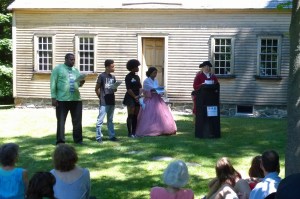
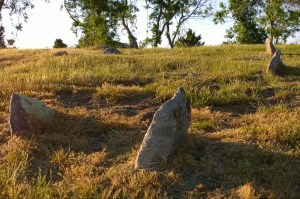
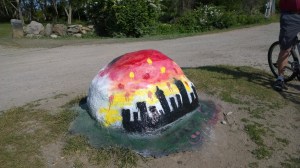
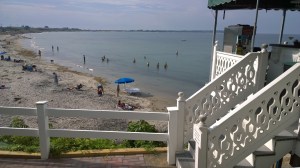
So, here’s what I have: A weed by the dry cleaner’s, Ragged Sailor (chicory) beside a lichen-covered rock, a Fourth of July reading outside the home of a former slave who fought in the American Revolution, my grandson, boats moored in New Shoreham’s Old Harbor, the Indian burying ground at Isaac’s Corner, a city scene on the Painted Rock, Crescent Beach swimmers, Bouncing Bet flowers at Fresh Pond, and yours truly reading Evicted and trying to stay cool.

To expand on a couple of these: I’m told that the Manissean Indians in the cemetery were buried standing up so they could walk into the next life.

And the Fourth of July reading at the home of ex-slave Caesar Robbins was amazing. First the Declaration of Independence was read, which was an eye opener for me because I remembered only the first lines.

Next, anyone who wanted to could read aloud a section of Frederick Douglass’s powerful 1852 Fourth of July speech on the lack of independence for so many people on that Independence Day. Hearing this speech, I could readily imagine how Douglass’s soaring rhetoric helped pave the way for the Civil War and Emancipation.

063016-weeds-by-dry-cleaner

063016-chicory-Ragged-Sailor


070416-Robbins-House-Concord

071416-a-serious-builder


062616-Old-Harbor-boats

062516-Indian-burying-ground-New-Shoreham


062616-painted-rock-cityscape

071516-surf.-restaurant-view


071617-bouncing-bett-fresh-pond

071616-finding-a-breeze-in-heat


Read Full Post »

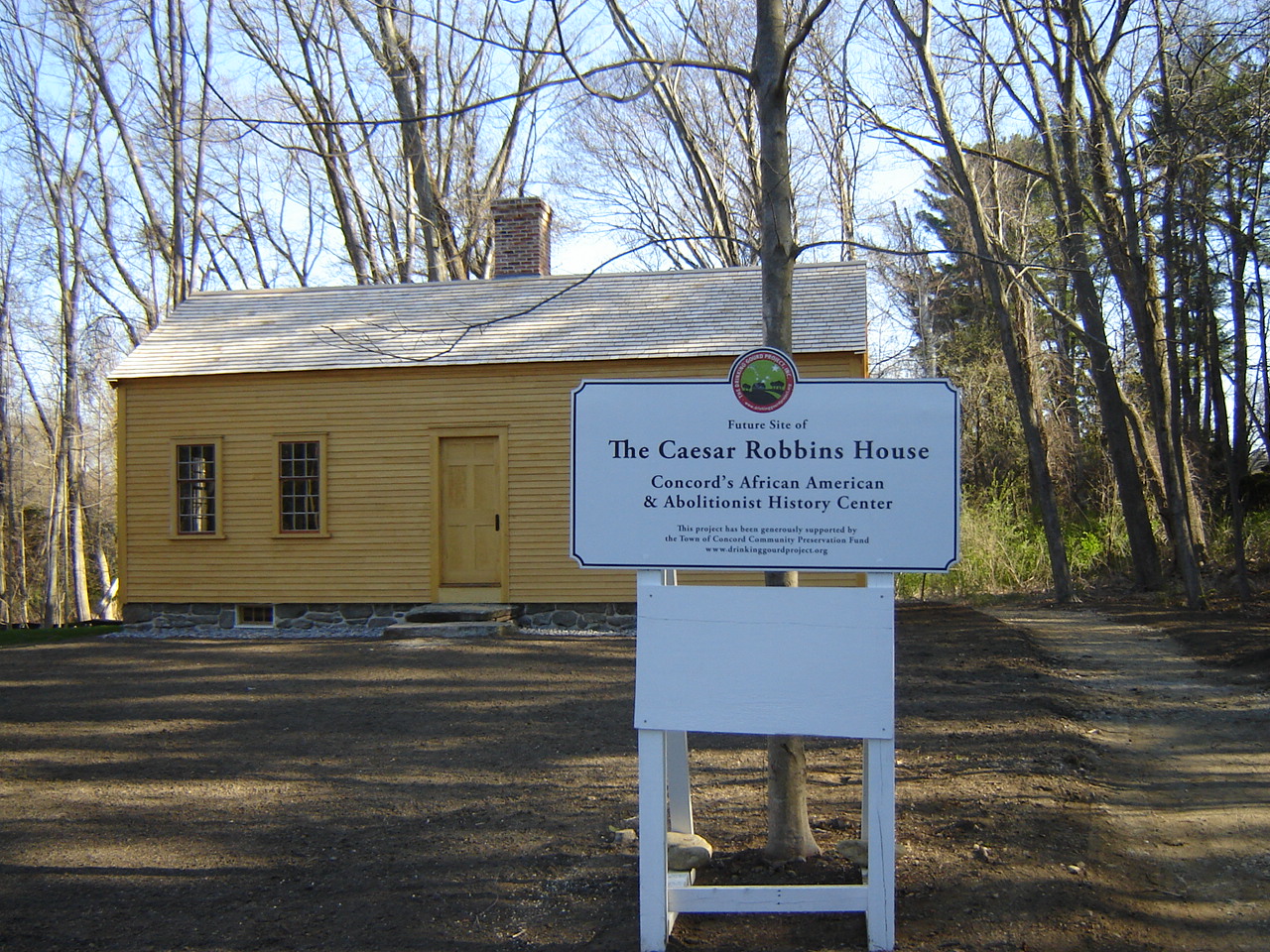
When I first wrote about the Concord home of former slave Caesar Robbins, a group of concerned citizens had just raised enough money to save it from demolition and move it near the North Bridge (in the Minute Man National Historical Park). See that post here.

Quite a lot has happened since then, and it looks like the refurbished house should be open to the public soon, if not in time for Patriots Day 2012, celebrated today.

Concord was once a stop on the Underground Railway, so saving the first Concord home owned by a freed slave is in keeping with that history.

By the way, if you are my reader in Australia or South Korea, you may not know about Patriots Day, which is a big deal in most of New England. People here consider April 19, 1775, the start of the American Revolution, although there are other worthy claimants for that honor. Paul Revere and Samuel Prescott rode to warn colonists that the British were coming, and shots were fired in Concord and Lexington.

Nowadays the day is commemorated on the closest Monday. Schools and libraries close. The Boston Marathon is run. Parades and reenactments sprout all over the region. One of my colleagues gets up at crack of dawn to march between towns in costume, playing the fife. In spite of all the hoopla, there is something about it that touches people.

Read Full Post »