Feeds:
Posts
Comments

Posts Tagged ‘small town’

Photo: Suzanne and John’s Mom.
Island people need transportation on the mainland. Some folks leave a car in the state parking lot near the boat. A mainland-based van allows school teams to compete with other towns and allows other islanders to go on outings.

I went on a theater junket with the New Shoreham senior citizens on a sweltering day mid-July. It was a lot of fun — and also an education in how small towns often manage daily challenges.

Of course, New Shoreham is not a small town in mid-July. The year-rounder number that the Ground Hog Day census captures — about 1,000 — can swell to 20,000 in the summer. Such are the ways of resort towns, islands or not.

But there are a couple aspects of small-town life that you can see anytime of year, like the ability to adapt. On that theater trip I was impressed with how people handled the transportation. And I’m always amazed at the island’s Bulletin Board, a Google Group that can find almost anything you need.

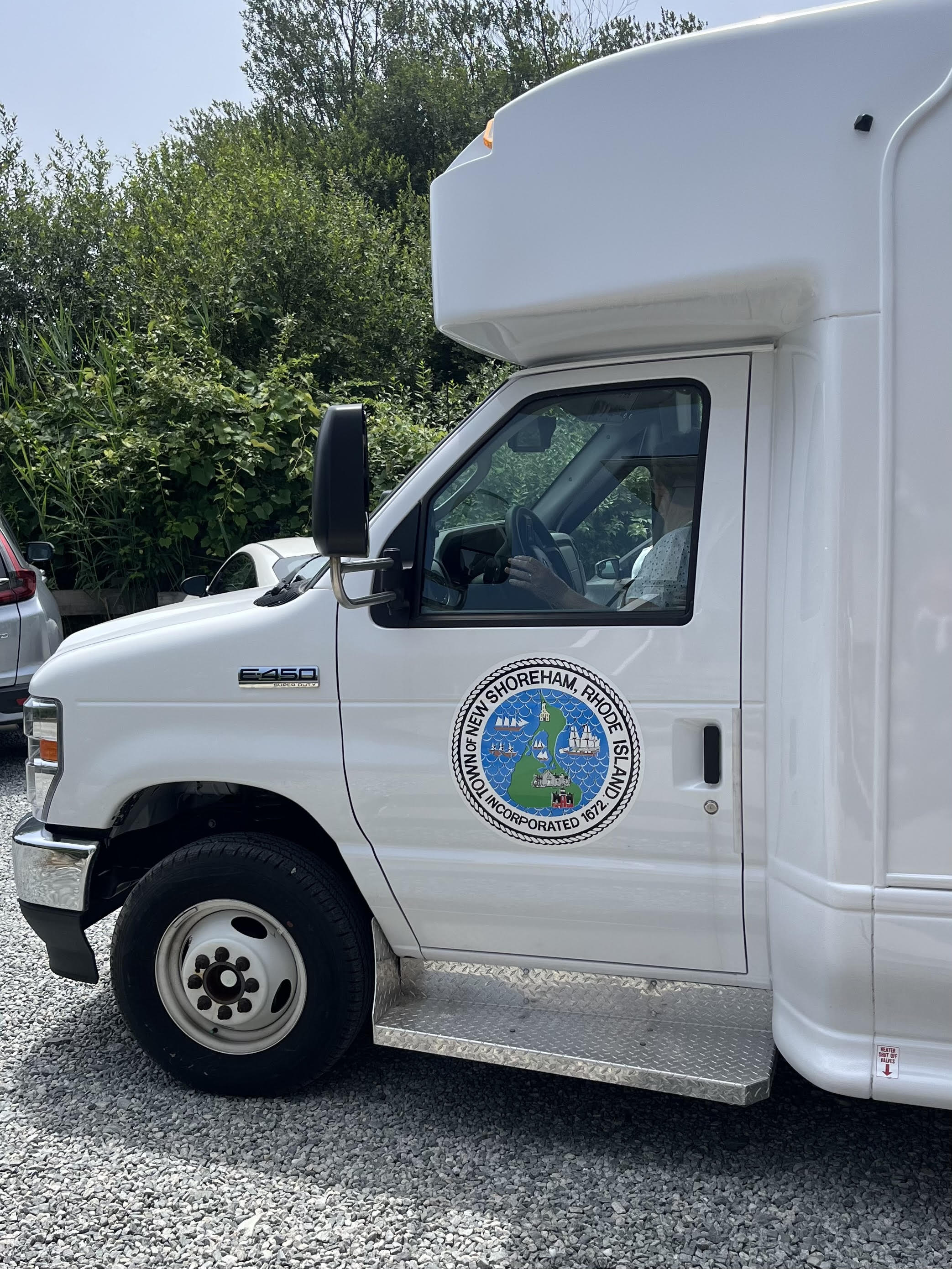
I’ll start with the transportation. The state provided a beautiful van that hangs out in a mainland parking lot near the boat. It has no paid driver. If it’s a question of going to a school sports event or an activity organized by the recreation department, the director of the department will drive.

Otherwise, maybe one of the many island taxi drivers will volunteer. There was one in our theater group, and her license for carrying passengers in a taxi qualified her for the van, too.

We all piled in, and she started the engine.

Then she called to the back of the bus, “Looks like we’re almost out of gas.”

Advice about the closest gas stations flowed from all the seniors. One offered to pay. Another called the recreation director, who told her, “Just fill it with as much as you need.” The driver made a reasonable guess at how much that might be, and off we went for a great afternoon at the theater.

On the way back, a passenger said she’d just got a text that her husband’s glasses had come in at the eyeglass store and asked if we could pick it up at the shopping mall. Everyone agreed we would still have plenty of time to catch the boat. So the van bounced over a few curbs and pulled up at the shop.

I loved how adaptive people were. They know that sometimes it’s their own request that others are willing to fill.

It’s the same with the Bulletin Board, an initiative that my neighbor and two other women came up with some years ago.

The women approve (or disapprove) posts all day from wherever they are in the world. The messages may be offers of free household items, ways to sign up for outings, the town council agenda, an electricity-disruption alert, or where to get oysters.

But most posts are quite idiosyncratic, and you’d be amazed how often those requests are met. Especially amazing to me is that people with a car that they leave in the mainland lot are so often willing to lend their car to someone else. Here goes.

“Just reaching out to ask if anyone may have a slide projector (for those of you who remember what they are!) for my family to use through Sunday afternoon.”

“Hi my Yamaha 9.9 engine on my dinghy keeps stalling every time we put it into gear is there anyone on the island that can work on it?”

“My son’s friend lost a navy blue Nike Elite backpack with Nike Kobe Grinches (red with green laces) size 5/5.5 as well as size 7 pink Lamello shoes a couple of days ago. Please call or text if you see any of these items.”

“I am looking to borrow someone’s mainland car from Sunday night until Monday last boat. I will be going to my apartment in Providence with fenced-in parking area and maybe to Trader Joe’s. I am a super safe driver who has never gotten in any accidents.” 

“Is anyone going thru Westerly that could pick up a package at 35 Broad St for my niece and either drop off at airport or bring on the boat for me – it’s a supplement so doesn’t take up much space.”

“Amazon sent me 4mg Nicorette quit-smoking gum by mistake. I can’t use them and Amazon doesn’t want them back. If you want them, please text …”

“We have friends visiting and their dog could use a vet visit for an infection. Before they head off Island I thought I’d check here.”

“Can someone please contact Hugo M to let him know the Post Office has his DHL package? I can’t remember who posted the inquiry for him.”

“I have this bird and it seems to be injured not able to fly any distance. Attached is a photo of the bird. I would love any help on what to do!”

“I’m looking for someone who is taking the ferry sometime today who doesn’t mind sitting with my 8.5 daughter? Grandparents will be waiting for her on the other side!”

“I am making my granddaughter a Peter Rabbit birthday cake and was wondering if anyone had 1-4 very small or small carrots with the greens on them that I could have or purchase?”

“Can anyone provide a contact telephone number for R— the electrician?”

“Does anyone have a large amount of black lace or similar material that I could buy from you or borrow for the day next Monday (8/4)? Will be used in costuming but will not be altered.”

“Posting for a friend who needs to get a car key to east Providence asap. Looking for a ride, to borrow a car, or the car key to be dropped off in East Providence.”

“Anyone want a August 1939 National Geographic? decent condition with some separation of cover . articles about Iowa and midwest, Australia.”

​​”Does anyone have a car I can borrow for this Saturday please? Only going to be in Wakefield. [A later post says] All set with car.”

“I know this is a huge favor to ask. Looking for a car Friday-Saturday. Trying to get to NYC for the night and train tickets are insane. I’ll fill w gas, wash, wax on wax off. Anything!”

“Is this your dog? I’m a dog lover but this dog has peed on every plant I own.”
Read Full Post »

Photo: Enita Jubrey.
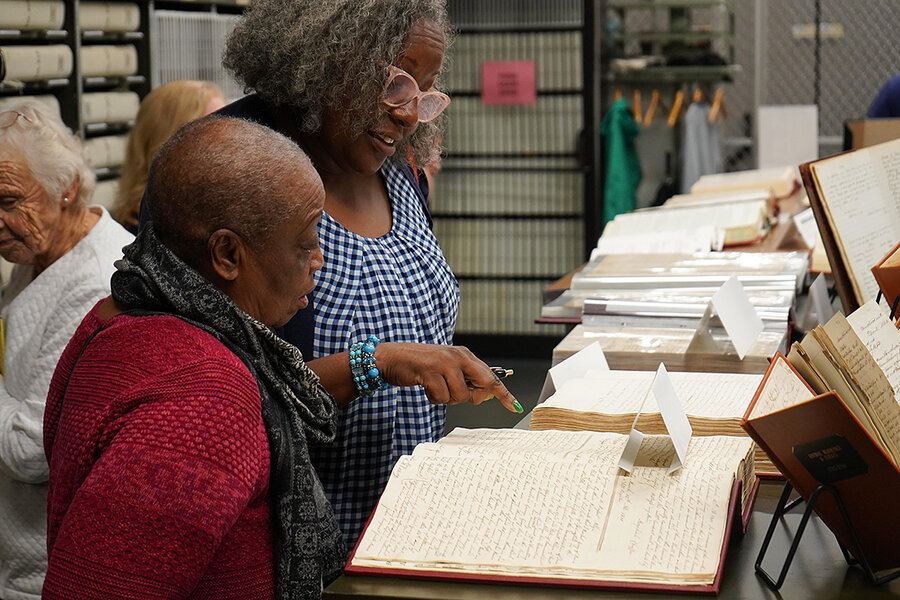
The Citizen’s Academy of Windsor, Connecticut, lets participants view historical documents dating back to the 1600s in the town clerk’s vault. 

Have you heard of the Citizen’s Academy movement? It was new to me. According to the Christian Science Monitor, there are about 1,000 in the United States. They help to build trust in local government and a sense of community.

Sarah Matusek and Sara Lang have a report at the Christian Science Monitor.

“The lifeguard’s legs disappear into the pool. A few tense seconds pass. He emerges with an arm around a limp young man whom he hauls to the deck for CPR.

“The audience applauds. Over a dozen Coloradans on bleacher seats are touring Woodland Park’s aquatic center, a sparkling, tiled complex with ample lap lanes. They convened earlier that April evening to learn about Parks and Recreation … the city department that hires local teens as lifeguards. The evening’s visit is part of an eight-week citizens academy, which ends with a graduation ceremony.

“ ‘It’s been super interesting,’ says Dan Carroll in the pool parking lot. His doubts about the building’s $11.9 million expense to the city were quelled, he says, after learning about its use.

“ ‘I’m going to promote it,’ says Mr. Carroll about the academy program. ‘I think more and more people need to know how the city operates.’ …

“The programs educate civic-minded folks about the gears of local government, and how they might chip in. Proponents also say they have a role to play in shoring up trust.

“ ‘It’s a cheap, easy, very direct way to get meaningful community engagement,’ says Michael Lawson, Woodland Park city manager. …

“The town of roughly 8,000 in conservative Teller County has had its share of community tension recently, with national attention on its school board, which has sparked local protests.

“The city itself, however, doesn’t run schools. Neither does it handle social services like food benefits – that’s the county. Explaining the limited purview of what the city does is a key feature of the citizens academy, Mr. Lawson says. …

“The programs, which go by different names, can last several weeks and are often free. Participants meet local officials like the mayor and visit a range of departments – public safety, waste management, zoning offices – led by local staff. 

“Citizens take advantage of local services daily, like when they turn on the tap or take trash to the curb, but that exists as ‘background noise for most people,’ says [Rick Morse, professor at the University of North Carolina at Chapel Hill School of Government]. Through citizens academies, he adds, ‘that faceless bureaucracy now becomes a person.’

“That’s a lesson the Decatur 101 program in Georgia tries to hit home. Participants receive ‘a book with a picture of all the people that have talked and what their job description is and what they do,’ says Shirley Baylis, business development manager, ‘so they know how to reach each of those people.’

“Dr. Morse conducted a 2016 survey of 658 citizens academy participants across six states. He found 84% of respondents said their program ‘somewhat or significantly positively’ shaped their level of trust in local government.

“A behind-the-scenes look at the water treatment plant in Wichita, Kansas, inspired a perception shift for participant Christopher Parisho. 

“ ‘I already knew it took a while and that it was really expensive, but now I had a better understanding of why,’ he says. … Understanding how your city works doesn’t just help in knowing the right person to field complaints, he adds. It can help someone ‘reach out to the right people when something is done right.’ …

“Several participants say learning about the fiscal responsibility and budgets of their towns is compelling – after all, cities and states can’t rack up debt as easily as the federal government. That includes longtime Woodland Park resident Catherine Nakai. She joined the program in early 2020, between volunteering on a local land-use board and running for City Council. 

‘I understand the budget a whole lot more,’ because of the program, says Council member Nakai. …

“Staffing is one area that citizens academies report as a challenge, in terms of the time commitments the programming demands. [And] broadening access to a wide range of residents presents another hurdle.  

“That’s why Alachua County Citizens Academy in Florida tries to ensure its sessions take place along community bus loops. In Georgia, Decatur 101 offers evening and morning sessions to accommodate different schedules.

“Matt Leighninger, director of the Center for Democracy Innovation at the National Civic League, challenges programs to think beyond the hope that spreading the gospel of government functions will automatically invoke trust. That’s a ‘defensive posture,’ he says, and not always earned. Public officials can also work to better trust their constituents.

“ ‘It’s not enough just to say: Here’s how government works,’ says Mr. Leighninger. ‘The question really should be: Here’s how a government could work,’ with more citizen input.”

More at the Monitor, here. No firewall.

Read Full Post »

Photo: Jerry Holt, Star Tribune
Bill Gossman is mayor of New London, Minnesota, and a potter who knows firsthand how arts can build community. Legacy funding from a law updated in 2009 has helped spur the town’s revival. 

The arts are often good for business, and the experience of towns in rural Minnesota provides a good example.

Jenna Ross reports at the Star Tribune, “One by one, they took the stage and told their stories. A man in his 80s, leaning on a cane. A teenage girl. A retired farmer.

“ ‘Times were good for farmers in west-central Minnesota in the 1940s,’ Ed Huseby began his tale about a tractor that went rogue.

“In the audience, residents laughed, cheered and, after one man described how lung cancer cut short his wife’s life, cried. They were gathered for a Sunday afternoon ‘story show,’ organized by the owner of the Flyleaf Book Shop. The one-page program didn’t mention funding from the Legacy Amendment. But like all shows onstage at the Little Theatre — and most arts events in this small but growing city two hours west of Minneapolis — that money played a key role.

“Legacy funding cuts the cost of renting the theater to $100. It pays the part-time salary of the manager who greeted audience members and pulled closed the curtains. Soon, it’ll fund a new projector and screen. …

“New London, like small cities across Minnesota, has felt the influx of dollars from the Legacy Amendment, passed a decade ago. …

“ ‘In the Twin Cities, there’s a pretty established arts infrastructure,’ said Sue Gens, executive director of the Minnesota State Arts Board. Now Legacy grants are helping build that in communities across the state, she said. …

“In New London, pop. 1,355, such grants have funded a summer music festival. A 10-foot-tall sculpture that stands near the Middle Fork Crow River. And a wood-fired kiln in Bill Gossman’s backyard.

“Gossman is a potter, one who whistles while he digs his thumbs into a piece of porcelain clay. He’s also the mayor. …

“In 2010, Gossman won a $7,000 Legacy grant to add a large new chamber onto his kiln, which is fueled by firewood, giving his pots, vases and vessels an earthy glow. Last month, as they do each year, potters from across the state trekked to Gossman’s place. They drank coffee, chopped wood and packed the massive chamber with hundreds of their pieces. …

“When Gossman took office in 2008, [the] recession had weakened a local economy in flux with the consolidation of family farms. The grocery store had closed, and the hardware store was about to. For-sale signs hung in Main Street windows.

“Today, not a single empty storefront remains. Galleries and gift stores line the compact downtown. …

“A Star Tribune analysis of Legacy dollars shows that from fiscal 2010 to 2017, the biggest recipients of funds via the state and regional arts boards was the Guthrie Theater. …

“Outstate Minnesota has received its fair share of Legacy dollars [largely] because of the 11 regional arts councils, established in the 1970s, that broadened the reach of public arts funding. …

“Speaking at rural conferences across the country, [John Davis, executive director of Lanesboro Arts,] always mentions Minnesota’s Legacy Amendment, which other places regard as a model. …

“But the amendment isn’t perfect, Davis said. He believes that some arts funds should be set aside for rural capital projects, as many small cities struggle with infrastructure challenges in the wake of waning tax revenue and cuts to Local Government Aid.

“ ‘Right now an organization could get money to host a ballet, but if their roof is caving in … they can’t access it,’ Davis said. ‘I think that was something that just out of the gate was a structural flaw.’ ”

More here.

Read Full Post »

Photo: Clay Masters/IPR
Storm Lake Times Editor Art Cullen stands outside newspaper he started with his brother in 1990. The newspaper won a Pulitzer Prize this year for its editorial writing.

I’ve been following a twitter discussion about why big newspapers are doing more reporting via video. Critics contend the move is about pleasing advertisers and is hurting quality.

Judging from a recent National Public Radio (NPR) story on small-town newspapers, I think the big outlets would be better off focusing on building trust with readers.

Clay Masters reported, “Large media outlets could learn from small town newspapers about being authentic and winning the trust of readers. …

“Take the Storm Lake Times [in Iowa], for example. It recently gained national attention when this twice-a-week newspaper for this town of around 11,000 people won a Pulitzer Prize for its editorials. They won the prestigious journalism award for challenging powerful corporate agribusiness interests in the state.

” ‘We inform each other through the newspaper about the reality of Storm Lake,” says Editor Art Cullen. …

“Their classified section is pretty robust … and there’s even a section devoted to local birthdays. Art Cullen says newspapers like his are the thread that holds the fabric of a small town together.

” ‘They know we’re honest and they know we love Storm Lake … that we stick to the facts of a story, and we will argue, argue, argue on our editorial page.’ …

“One of the big differences between larger metro newspapers and community journalism is the staff has to face its audience every day.

” ‘People have no problem coming up to me and telling me what they think of the newspaper,’ says Jim Johnson, who owns newspapers in Kalona and Anamosa, two small newspapers in eastern Iowa. …

“Johnson has the advantage of owning small town newspapers near metro areas. When this former Omaha World-Herald editor bought the papers in Kalona and Anamosa, he wanted to show community newspapers can do just as good or better than large papers.”

More at NPR, here.

Read Full Post »

The Upper Midwest has some unusual races. One year in Minnesota, for example, my husband and I went to an outhouse race, and I wrote up the experience for an East Coast community paper.

Today I read in the NY Times about a Wisconsin race. Mitch Smith writes, “In Spain, they run bulls. In Kentucky, thoroughbreds. But here in America’s Dairyland, llamas are the four-legged athletes of choice.

“On Saturday afternoon, the llamas converged on this tiny town in the corn-covered hills of western Wisconsin, as they do each September. A llama named Lightning, a 14-year-old with swift feet and a bit of a temper, claimed the heaping basket of tomatoes and peppers that goes to the speediest camelid.

“To the roughly 1,900 residents of Hammond, the Running of the Llamas is something far more than an annual excuse to watch South American pack animals lope down Davis Street. In the 18 years since a local bar owner first let the llamas loose, the event has become a source of communal pride and identity in a state where it seems every dot on the map has its own quirky festival.

“ ‘It makes our town unique,’ said Ariel Backes, 16, the reigning Miss Hammond. ‘It just shows small towns are the best.’ …

“Some llamas were eager to race, sprinting swiftly behind the handler holding its reins. Others were compliant but unenthusiastic, making their way past the cheering fans, lined up four and five deep on some stretches of sidewalk, at more of a brisk walk than a run. And a few llamas were downright uninterested, forcing their handlers to practically drag them to the finish line.” More here.

Suzanne and Erik’s two-year-old fed a llama this summer. I can’t quite picture that llama wanting to do anything but eat.

Photo: Colin Archdeacon on Publish September 14, 2014.
This llama-racing event is in its 18th year in Hammond, Wisconsin.


Read Full Post »