Feeds:
Posts
Comments

Posts Tagged ‘sounds’

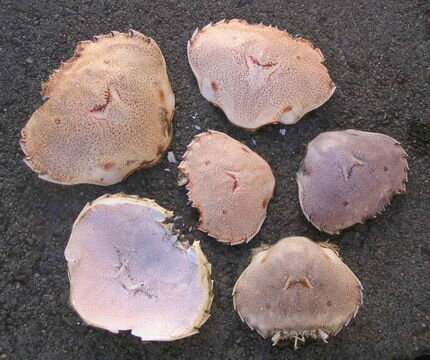
Photo: Encyclopedia of Life.
Paddle crab, endemic to New Zealand. A new study reports on “ways to monitor visually elusive but vocal species in aquatic environments.”

Technology is being used in ways that that sometimes hurt, sometimes help, the creatures of the natural world. Today’s story is about helping.

Shweta Varshney at Samachar Central introduces us to the Global Library of Underwater Biological Sounds and its wonderful acronym GLUBS. GLUBS uses audio technology to help monitor changes in marine life.

“Of the roughly 250,000 known marine species,” reports Varshney, “scientists think all ~126 marine mammals emit sounds — the ‘thwop’, ‘muah’, and ‘boop’s of a humpback whale, for example, or the ‘boing’ of a minke whale. Audible too are at least 100 invertebrates, 1,000 of the world’s 34,000 known fish species, and likely many thousands more.

“Now a team of 17 experts from nine countries has set a goal of gathering on a single platform huge collections of aquatic life’s tell-tale sounds, and expanding it using new enabling technologies — from highly sophisticated ocean hydrophones and artificial intelligence learning systems to phone apps and underwater GoPros used by citizen scientists.

“The Global Library of Underwater Biological Sounds, ‘GLUBS,’ will underpin a novel non-invasive, affordable way for scientists to listen in on life in marine, brackish and freshwaters, monitor its changing diversity, distribution and abundance, and identify new species. Using the acoustic properties of underwater soundscapes can also characterize an ecosystem’s type and condition.

“Says lead author Miles Parsons of the Australian Institute of Marine Science: ‘The world’s most extensive habitats are aquatic and they’re rich with sounds produced by a diversity of animals. With biodiversity in decline worldwide and humans relentlessly altering underwater soundscapes, there is a need to document, quantify, and understand the sources of underwater animal sounds before they potentially disappear.’

“The team’s proposed web-based, open-access platform will provide:

  • “A reference library of known and unknown biological sound sources (by integrating and expanding existing libraries around the world);
  • “A data repository portal for annotated and unannotated audio recordings of single sources and of soundscapes;
  • “A training platform for artificial intelligence algorithms for signal detection and classification;
  • “An interface for developing species distribution maps, based on sound; and
  • “A citizen science-based application so people who love the ocean can participate in this project

“The wide range of uses for PAM [passive acoustic monitoring] is expanding in step with advances in technology, providing a large volume of easily-accessible data. …

“Many fish and aquatic invertebrate species are predominantly nocturnal or hard to find, the paper notes, making visual observations difficult or impossible. As a result, ‘PAM is proving to be one of the most effective ways to monitor visually elusive but vocal species in aquatic environments, which can potentially aid in more effective conservation management,’ including zoning in marine park areas or fishery closures, the paper says.

“Besides making sounds for communication, many aquatic species produce ‘passive sounds’ while eating, swimming, and crawling — often less acoustically complex or distinct than active sounds but important contributions to an ecosystem’s tell-tale soundscape.

“ ‘Collectively there are now many millions of recording hours around the world that could potentially be assessed for a plethora of both known and, to date, unidentified biological sounds. …

“ ‘This developing library is a key way to catalog, monitor and track changes in biodiversity on reefs and other ocean habitats before they are gone but also help us define “what a healthy reef is” as we seek to rebuild reefs.’ …

“ ‘A database of unidentified sounds is, in some ways, as important as one for known sources,’ the scientists say. ‘As the field progresses, new unidentified sounds will be collected, and more unidentified sounds can be matched to species. …

“ ‘A global database could serve broader questions, like determining universal trends in underwater sound production, while individual, specialized repositories could continue to inform and detail other topics, such as documenting the presence of soniferous species in a particular region.’

“[Listening] to the sea has revealed great whales swimming in unexpected places, new species and new sounds.” Learn about what listening is doing for other species here. No firewall.

Read Full Post »

Photo: AP
Hurricane Marie, as seen from the International Space Station last year.

To understand more about how tropical storms evolve and become hurricanes, two Penn State professors from very different fields are joining forces.

Mark Ballora, professor of music technology, and Jenni Evans, professor of meteorology, report on their research at the Conversation.

“During the 2017 hurricane season, major storms in the North Atlantic devastated communities in and around Houston, Florida, Puerto Rico and the wider Caribbean. The destruction shows how important it is to understand and communicate the serious threats that these storms pose. …

“Since 2014, we have been working together to sonify the dynamics of tropical storms. In other words, we turn environmental data into music. …

“Most of us are familiar with data visualization: charts, graphs, maps and animations that represent complex series of numbers. Sonification is an emerging field that creates graphs with sound.

“As a simple example, a sonified graph might consist of a rising and falling melody, instead of a rising and falling line on a page.

“Sonification offers a few benefits over traditional data visualization. One is accessibility: People with visual or cognitive disabilities may be better able to engage with sound-based media.

“Sonification is also good for discovery. Our eyes are good at detecting static properties, like color, size and texture. But our ears are better at sensing properties that change and fluctuate. Qualities such as pitch or rhythm may change very subtly, but still be sensed quite easily. The ears are also better than the eyes at following multiple patterns simultaneously, which is what we do when we appreciate the interlocking parts in a complex piece of music. …

“We distilled the changing characteristics of a hurricane into four features measured every six hours: air pressure, latitude, longitude and asymmetry, a measure of the pattern of the winds blowing around the storm’s center. …

“In our recordings, air pressure is conveyed by a swirling, windy sound reflecting pressure changes. More intense hurricanes have lower values of air pressure at sea level. The winds near the ground are also stronger in intense storms.

“As pressure lowers, the speed of the swirling in our sonic recordings increases, the volume increases and the windy sound becomes brighter.

“The longitude of the storm center is reflected in stereo pan, the position of a sound source between the left and right speaker channels.

“Latitude is reflected in the pitch of the swirling sound, as well as in a higher, pulsing sound. As a storm moves away from the equator toward one of the poles, the pitch drops to reflect the drop in temperatures outside the tropics.

“A more circular storm is typically more intense. Symmetry values are reflected in the brightness of a low, underlying sound. When the storm has an oblong or oval shape, the sound is brighter.

“So far, we have sonified 11 storms, as well as mapped global storm activity from the year 2005. …

“Even for experts in meteorology, it can be easier to get a sense of interrelated storm dynamics by hearing them as simultaneous musical parts than by relying on graphics alone. For example, while a storm’s shape is typically tied to air pressure, there are times when storms change shape without changing in air pressure. While this difference can be difficult to see in a visual graph, it’s easily heard in the sonified data.”

More here.

Read Full Post »

You probably don’t need to be told this, but bathing yourself in nature can help you calm down, reduce stress. When I was a child, I lived near forest and could take a walk in the woods almost anytime. Not everyone can do that, which is why it’s so important to bring nature into cities and towns as much as possible. Even listening to recordings of nature can be soothing.

Anjali Nayar at Motherboard writes, “When Cale Holmes moved from Virginia to New York City for grad school, he started to have trouble sleeping. All night long the trains thundered past his building, garbage trucks groaned, and police sirens wailed. …

“One night, Holmes recalled how calm he used to feel whenever he visited a beach. He went to YouTube and ran a search for ocean sounds. Innumerable recordings of ocean waves popped up, some as long as 12 or 14 hours. He selected a nighttime version and let his room fill with the sound of the crashing of waves. …

“The next thing he knew, warm sunlight was filtering in through the curtains. When he checked his laptop, he saw that the recording had paused at just after four minutes when the laptop had powered off. … How had the recording helped him so much? …

“Jake Benfield, soundscape researcher and professor of Environmental Psychology at Penn State University, has been studying nature sounds for over a decade. … In 2014, Benfield led a research study to examine whether natural sounds had any impact on participants’ moods. The researchers first evaluated the volunteers’ moods and then deliberately spoiled their moods by showing them disturbing medical videos of hand surgeries. ‘As we would expect,’ Benfield said, ‘watching medical videos makes people disgusted, negative, and generally in a bad mood.’

“The researchers then randomly assigned the volunteers to three groups and made them listen to different soundscapes. One group was made to listen to city sounds and traffic. Members of this group reported that their moods became worse. Another group listened to mixed environments containing nature and city sounds, and this group reported no significant mood changes.

“The third group, however, listened to purely natural sounds — like the sound of the wind rustling through trees or the chirping of birds. Participants in this group reported a complete mood recovery.”

In another study, Benfield told Motherboard, “Researchers at University of Gavle, Sweden [designed] an ambiguous, fuzzy sound, which wasn’t entirely discernible, and hence open to interpretation. The researchers then enlisted participants and told half of them that the sound was that of a waterfall while telling the others that it was from an industrial source.

“What they discovered was that the first group, the one that had thought that the sound was that of running water, showed remarkable mood recovery. On the other hand, the second group that had assumed the sound was unnatural, reported no mood recovery.”

Several related studies are described at Motherboard, here. Enjoy!

Read Full Post »

Did you know that plants can protect themselves from predators?

Writes Douglas Quenqua at the NY Times, “It has long been known that some plants can respond to sound. But why would a plant evolve the ability to hear? Now researchers are reporting that one reason may be to defend itself against predators.

“To see whether predator noises would affect plants, two University of Missouri researchers exposed one set of plants to a recording of caterpillars eating leaves, and kept another set of plants in silence. Later, when caterpillars fed on the plants, the set that had been exposed to the eating noises produced more of a caterpillar-repelling chemical. …

“Plants exposed to other vibrations, like the sound of wind or different insects, did not produce more of the chemical, suggesting they could tell the difference between predator noises and atmospheric ones. The researchers published their work in the journal Oecologia.” More here.

I have an idea. How about farmers, instead of using genetically modified seed to protect plants, just pump recordings of crunching predators into their fields so that the plants could protect themselves?

As they say where I work, “More research is needed.”

The NY Times posted this Pieris Silhouette video by mubondlsc
Can you hear the crunching of the caterpillar?

Read Full Post »