Feeds:
Posts
Comments

Posts Tagged ‘sport’

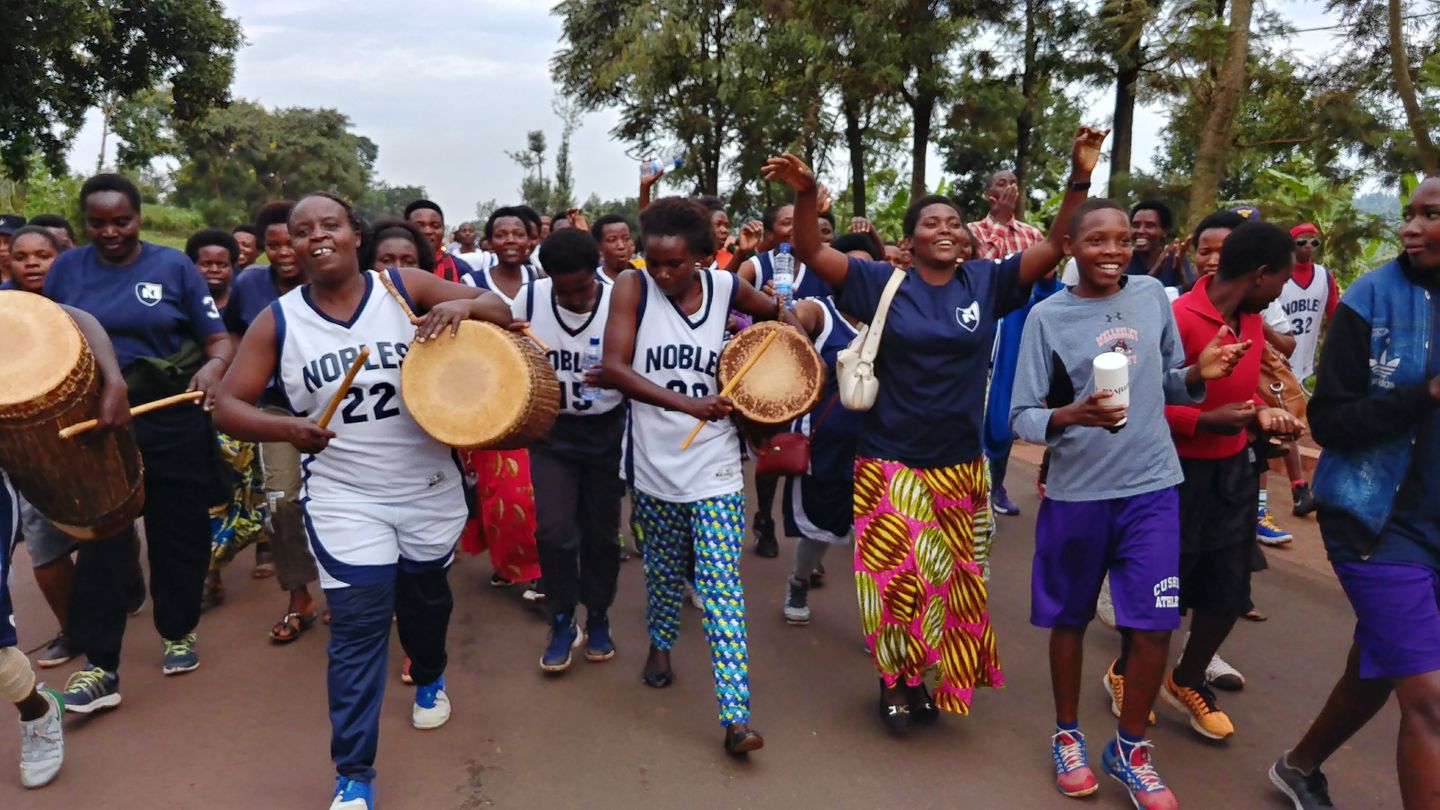
Photo: Noble and Greenough School.
A group of 25 students and faculty from Shooting Touch and the Noble and Greenough School went to Rwanda for a trip to help spread Shooting Touch’s mission of health advocacy for women and children and empowerment through sport.

You may remember my young friend Shagufa Habibi, who escaped an abusive child marriage in Afghanistan through the power of sport. It all started with her taking up golf. In May, she will graduate from Brandeis with a master’s degree.

Today’s article also addresses the power of sport. In this case, basketball.

Tara Sullivan reports at the Boston Globe, “Vin Bui met the initial offer of financial assistance and basketball support with a requisite dose of skepticism, narrowing his eyes just enough to make any self-respecting Dorchester native proud. But since the AAU team he was building for his niece, Christina Pham, and her fellow players was still in its infancy, he figured it couldn’t hurt to listen to a pitch. [So] he took a call from a local organization called Shooting Touch.

“He had no idea it would change his world. …

‘I figured it was a basketball pyramid scheme, too good to be true. Money, enrichment, and education. Come on. But I took the chance and called them up. They ended up being everything they said and more.’ …

“Had Bui heard of Shooting Touch before, he would not have been surprised. The program, which grew from its roots in Rwanda to expand into Boston, defines itself as ‘an international sport-for-development organization whose mission is to use the mobilizing power of basketball to bridge health and opportunity gaps for youth and women facing racial, gender, and economic inequalities.’ …

“From sponsoring an AAU team in the city to sending players on an international relief trip abroad, what you get is an ongoing lesson in how small acts of empowerment for those who have it least but appreciate it most can truly make the world a better place.

“[Seven] years after joining forces with Shooting Touch, Bui, Pham, and Pham’s fellow basketball player Tahira Muhammed are 6,000 miles across the world, completing a circle that Shooting Touch founder Lindsey Kittredge could barely imagine more than a decade ago, when she and her husband started the grassroots program.

“As part of a group of 25 students and faculty from Shooting Touch and the Noble and Greenough School (where both young women go to school and play on the championship-winning basketball team), their current trip to Rwanda connects two chambers of the same charitable heart, with Rwandan Shooting Touch participants and their Boston counterparts meeting for the first time.

“ ‘It is pretty emotional,’ Kittredge said recently. … ‘It’s proving the point and seeing the future potential of this sport and what it can build, how you can reach anybody in any demographic, any environment, any geographic presence or background, and you can make an impact for positive health.’

“To help understand it best, think of Shooting Touch as being built on two primary pillars — basketball and women’s health. See it as living proof of how each pillar can keep the other up, and realize how it can do it in a country once ravaged by genocide with long-standing human rights issues rooted in misogyny and gender-based violence just as faithfully as it does in Boston neighborhoods such as Dorchester and Roxbury. …

“In Rwanda, women’s health clinics run concurrently with basketball skills events, serving women from the youngest to oldest ages, offering vaccinations, malaria and HIV screenings, examinations, and information free for all. The level of empowerment that goes with that is almost impossible to calculate, just as the network of experience, people, and contacts young women in Boston can make through the program. When kids are empowered, when they see opportunities they might have never known existed, they head into an adult world much better prepared for success.”

More at the Globe, here.
Read Full Post »

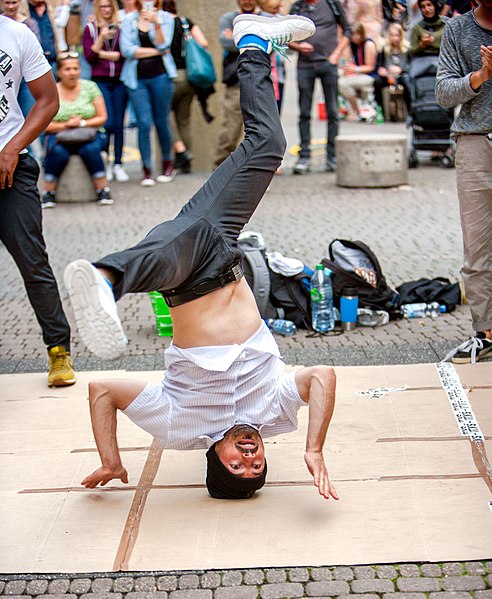
Photo: Wahrmund/ Wikimedia.
Break dancing in Cologne, Germany, 2017.

Back in the 1980s, John was really into break dancing. I think he mainly replicated what he saw other people doing, although he might have taken a class.

Today break dancing is considered athletic enough to be included as a competitive sport in the Olympics. Wow.

Rick Maese has the story at the Washington Post. “When her son had his fill of piano lessons, Ellen Zavian began looking for some other activity to keep him busy. She paid a visit to a dance studio in Washington that specialized in breaking — better known as break dancing to anyone who remembers the 1980s or simply breakin’ to many participants — and it didn’t take long before mother and son were hooked.

“Zavian is a sports law professor at George Washington University. … It didn’t take long before she started brainstorming about what was possible with breaking, an acrobatic urban dance style long associated with oversized boomboxes, hip-hop music, athletic spinning, whirling and ‘freezing.’

“ ‘I just thought: “My kid loves it. I work in sports. I’ve created associations. Why not? This is what I do,” ‘ Zavian said

“That was a full decade ago. The result was the United Breakin’ Association (UBA), an early step in organizing a sprawling, disorganized collection of young dancers, known as b-boys and b-girls, many of whom had no interest in formalizing and codifying their preferred form of self-expression. They were part of an anti-establishment counterculture that feared being co-opted by people who didn’t understand the dance or its dizzying band of denizens.

“The story of breaking’s meteoric rise to the Olympic stage — it’s set to make its debut at the Paris Summer Games in 2024 — involved an unlikely and reluctant partnership between street-savvy breakers and traditional ballroom dancers. …

“’Most of us knew that this could be big one day. We just didn’t really know how it would happen,’ said veteran b-boy Moises Rivas, who dances under the name ‘Moy.’ …. ‘We just had to deal with the misconceptions, negative connotations and people who didn’t always want to give it the credibility it deserves.’

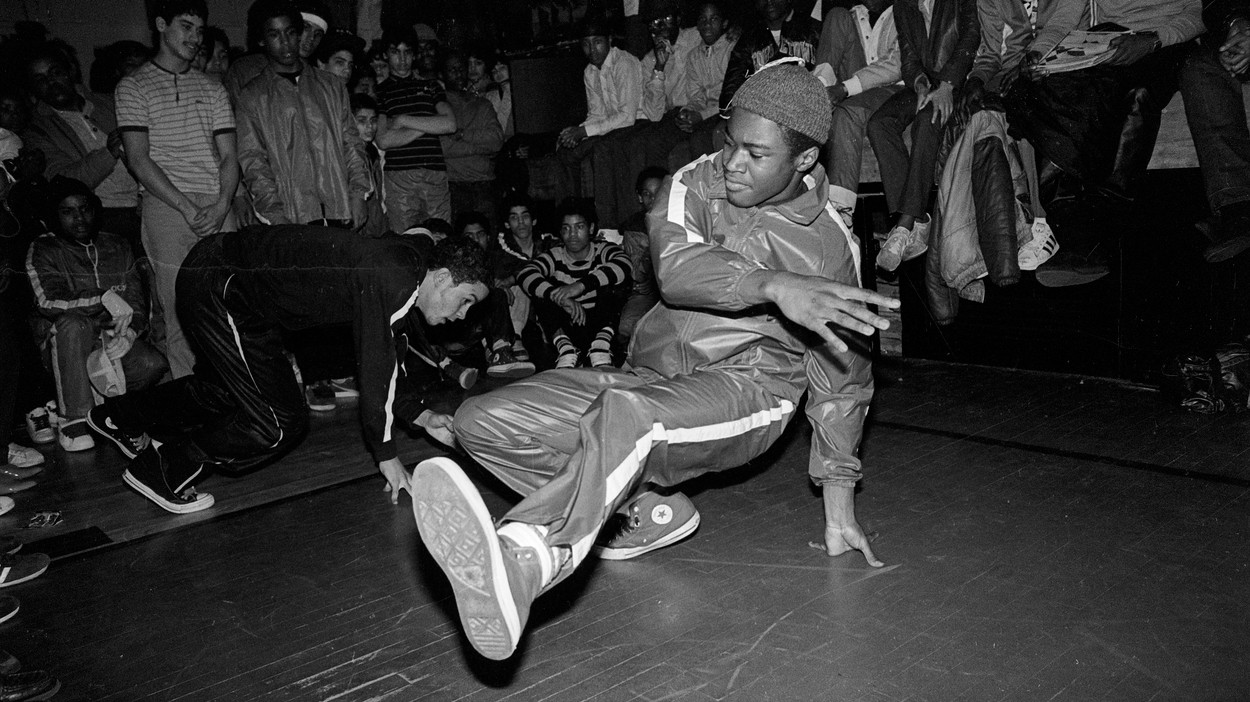
Photo: Ricky Flores.

“Born in the South Bronx nearly 50 years ago, breaking long ago had spread across the world. … From Los Angeles to Miami, there were parallel efforts to grow the sport but little coordination. Steve Graham had dabbled in breaking in college in the early 1980s. He worked on Wall Street and then established a successful private equity firm in Philadelphia. He gravitated back to breaking in his 50s, dancing alongside his children. He saw the potential for growth. The dance wasn’t just a form of expression; competition was baked into it with fierce dance battles between b-boys and b-girls.

“He ran a popular competition in Philadelphia and established a Pro Breaking Tour and a nonprofit membership organization called Urban Dance & Educational Foundation with a vision of drawing together the fragmented breaking world. Many of the competitions were spectacles, drawing large crowds with elaborate lights and window-rattling beats, but the sport was driven by independent event promoters without any movement trained on the Olympics.

“Far removed from booming bass notes and twirling young b-boys, however, serious efforts were afoot to get other forms of dancing on sport’s biggest stage. The global governing body was called International DanceSport, an umbrella organization for all dance disciplines, from Boogie Woogie to salsa. It was formally recognized by the International Olympic Committee in 1997, but officials there failed in their efforts to get ballroom dancing accepted into a Summer Games. Rather than pack up their tap shoes, they rebranded as the World DanceSport Federation (WDSF) and decided to double-down. …

“Breaking was far from the organization’s core when WDSF enlisted the help of Jean-Laurent Bourquin, an IOC veteran, in 2015, asking him for his help in wooing Olympic officials. The WDSF leaders were hopeful they could push specific styles of dance — either Latin or rock-and-roll — but after consulting with his colleagues in the Olympic world, Bourquin surprised them. …

“Dancing would be a viable candidate for the Olympics, he told them, but not the style they were used to.

“The WDSF’s top governing board included no breakers, so the proposition was something of a quandary: The organization could realize its Olympic dream, but only with a rogue, largely unfamiliar discipline.

“ ‘It was a bitter pill that was hard for everyone to swallow,’ recalled Ken Richards, who was on the board at the time and is now president of USA Dance. … ‘We had to come to this understanding and agreement that if dance can get a foot in the door with a style the IOC wants, then maybe the other dances aren’t as far behind as we feared.’

“Bourquin planted a seed with the IOC in 2016 and traveled to the Rio Olympics to chat up IOC members. [He] wanted to see breaking at the 2018 Summer Youth Olympics in Buenos Aires, a more apt platform and a friendly way to introduce the sport to Olympic officials, who skew older. For many in the Olympic world, it was the first time they considered dancing a true sport. And for many in the breaking world, it was the first time they considered the Olympics a realistic goal. …

“ ‘They didn’t view their talent as a sport,’ Zavian recalled, ‘so I had one of the skateboarders come to our meeting and talk about the difference between a sport and art. It was a very heated topic: “You’re going to take our culture away. You’re going to take our art away.” ‘ …

“But the ball was moving. While Graham provided much of the funding, the critical push for the Summer Youth Olympics was spearheaded by the larger dancing community, not the breakers.”

At the Washington Post, here, you can read what happened next.

Read Full Post »

Maria Toorpakai is the top-ranked female squash player in Pakistan. Toorpakai is coached by retired Canadian squash star Jonathon Power, pictured here.

WBUR’s Only a Game is great at searching out fascinating sports stories that few media channels cover. Here is one about a female squash player bucking the odds in a conservative part of Pakistan, where girls just don’t do this kind of thing.

Karen Given reports, “There are places in this world where games aren’t just games and where sports heroes have the power to be more than just pixels on a television screen.

“One of those places is Waziristan, part of Pakistan’s tribal region. That’s where Maria Toorpakai grew up. Her sport was squash, and her hero was Jonathan Power — a Canadian who, in 1999, became the first North American squash player to become No. 1 in the world.

“From an early age, Toorpakai wasn’t like the other girls.

” ‘When I was two years old, I could see the happiness in boys’ faces and more glow. But most of the women are just no one, you know? …

” ‘I thought maybe it’s the differences because boys have different clothes than girls. So then I took all my girly dresses and I took it to the backyard and I burnt them, and I was four-and-a-half. I saw my father and he didn’t say anything but when I looked at him he just smiled and said, “Well, I guess I have a fifth son now.” ‘

“Toorpakai’s father allowed her to masquerade as a boy and play sports. But when she discovered squash at the age of 12, the family’s secret began to unravel.

” ‘There’s a proper squash academy and he took me there. And he asked what we should do for squash, and my son wants to play squash. The director of the squash academy, he said definitely we will give membership to this kid. You have to bring the birth certificate first. My father got a little nervous.’

“Maria Toorpakai tells her story In Her Own Words. To hear the full story, click [this page] the play button below the headline at the top of the page. Toorpakai’s book is called ‘A Different Kind of Daughter.’ ”

I really recommend becoming familiar with WBUR’s Only a Game, here. It’s syndicated nationally, and non-sports fans love it as much as sports fans.

Longtime host Bill Littlefield is an unusual sports maven. An English professor, he covers football but especially how it hurts athletes, and he has instituted an approach to interviews (like Toorpakai’s) in which a talented interviewer (like Karen Givens) asks probing questions that enable interviewees to tell their own story. The interviewer’s voice doesn’t appear. I love this idea. It sounds so natural.

Read Full Post »

Since I like to walk everyday, even going round and round indoors for much of this past winter, I was fascinated to hear about walking as a competitive sport in the 19th century.

At his WBUR radio show yesterday, Only a Game, Bill Littlefield talked to Matthew Algeo, author of Pedestrianism: When Watching People Walk Was America’s Favorite Sport.

Here’s Algeo: “Edward Payson Weston was a door-to-door books salesman from Providence, R.I. In the autumn of 1860, he made a bet with a friend on the outcome of that year’s presidential election. Weston bet that Lincoln would lose, and, of course, Weston lost the bet. The loser had to walk from Boston to Washington in 10 days and arrive in time to witness the inauguration of Lincoln on March 4, 1861.

“So Weston set out and made his way south. Of course, this was a very tense time in American history. Southern states began seceding. There wasn’t a lot of good, uplifting news. And the idea that this guy would walk from Boston to Washington in the middle of winter on terrible roads — it really did capture the imagination of the public, especially along the East Coast. Huge crowds would turn out to see him just walk through their town. Weston didn’t make it in time. He was four hours late to the inauguration. He did meet Lincoln a couple of days later and Lincoln offered to pay his rail fare home, but Weston said he would try to walk home. But the Civil War intervened.”

Littlefield then refers to Weston as one half of “the first great rivalry in the annals of American sports” and asks Algeo who the other half was.

“Daniel O’Leary, an Irish immigrant from Chicago,” says the author. “And what happened was Weston, to capitalize on his fame, decided to take his act indoors. He began walking inside roller rinks, and he would try to walk say 100 miles in 24 hours and charge people a dime for the pleasure of watching him walk in circles all day. This proved immensely popular — thousands of people would do it. Naturally competitors rose up and Daniel O’Leary actually walked 100 miles in 22 hours. And so he bested Weston’s record and so that set up the big showdown in 1875 that you mentioned. It was a 500-mile race over six days between Weston and O’Leary. …

“They would draw a dirt track on the floor of an arena. … The competitors would be sent off, and they would walk continuously day and night for six days right up until midnight the following Saturday night. And the rules were pretty simple: whoever walked the farthest was the winner.” Read more here, where you also can listen to the interview and read Littlefield’s book review.


Read Full Post »