Feeds:
Posts
Comments

Posts Tagged ‘stereotype’

Photo: Gavin Doran.
“Song of the North” involves 483 puppets, 208 animated backgrounds, 16 masks and costumes and nine performers.

Here’s how an incredibly creative Iranian is showing the world something deeper than the stereotypes about his home country.

Jennifer Schuessler wrote about his puppet epic at the New York Times in March.

“On a recent afternoon on 42nd Street in Manhattan, a mythological bird was preparing to take flight. Backstage at the New Victory Theater, a black-clad puppeteer put on an elaborately stylized mask and stepped into a beam of light, throwing the shadow of fluttering hands onto a large scrim.

“Nearby, two other performers were gearing up to practice a sword fight. Then the music started, and a crew of nine began a full run-through of Song of the North, an elaborate shadow puppet staging of stories from the 10th-century Persian epic the Shahnameh.

“From the audience, the show unfolded like a seamless animation. But backstage, the next 80 minutes were half ballet, half mad scramble, as the performers grabbed hundreds of different puppets, props and masks stacked on tables and, with split-second timing, jumped in and out of the light beams streaming from two projectors.

“Leaning against a backstage wall was the show’s creator, Hamid Rahmanian. His role? ‘Stressing out,’ he said.

“Since premiering in 2022 in Paris, Song of the North (which is intended for audiences 8 and older) has received enthusiastic reviews and played to packed houses on three continents. Its arrival in the heart of Times Square [was] timed for Nowruz, the Persian new year celebration. It also coincides with the release of a new contemporary prose translation of the Shahnameh that Rahmanian produced in collaboration with the scholar Ahmad Sadri — the first complete English version by Iranians, Rahmanian said.

“The show is mind-dizzyingly complex, involving 483 puppets, 208 animated backgrounds, 16 character masks and costumes and nine performers who follow more than 2,300 separate cues.

“But the idea behind it, Rahmanian said, is simple: to bring the richness of Persian culture to young audiences and adults whose views of Iran may be dominated by negative stereotypes.

“ ‘Everything about Iran is seen through the lens of politics,’ he said. ‘Iranian culture is a symphony. But in the West, we only hear the drumbeat.’

“The Shahnameh, or Book of Kings, is said to be the longest poem ever written by a single author — twice as long as the Iliad and the Odyssey combined. It was composed by the Persian poet Abu al-Qasem Ferdowsi, who spent 33 years turning centuries of historical and mythological lore into more than 50,000 couplets.

“In Iran, where many people give their children names of characters (Rostom, Sohrab), it remains a cultural touchstone. But growing up in Tehran, Rahmanian, now 56, was resistant to his father’s admonitions to actually read it.

“He was more drawn to visual art, and by 19, he said, had founded his own graphic design business. In 1994, he moved to New York to study computer animation at the Pratt Institute. In 1996, he was hired by Disney, where he worked on projects like Tarzan … but he felt like he didn’t fit in, and left two years later. …

“In 2008, Hamid pivoted to what has become his life’s work: promoting the Shahnameh. … Rahmanian was inspired to create a theatrical piece after seeing a restored version of Lotte Reiniger’s 1926 silent film The Adventures of Prince Achmed, believed to be the oldest surviving full-length animated film. ‘I thought, “I want to do something like that!” ‘ he said. …

“Nazgol Ansarinia, a visual artist visiting from Tehran who was watching backstage, said she was amazed by both the intricacies of the performance and the immediacy of the storytelling.

“ ‘In Iran, everyone knows the stories and characters from the Shahnameh, but the text itself is not that accessible,’ she said. ‘Hamid has really made it accessible.’ ”

More at the Times, here. Beautiful photos and videos.
Read Full Post »

Travel Trip 5 Free Things Nashville

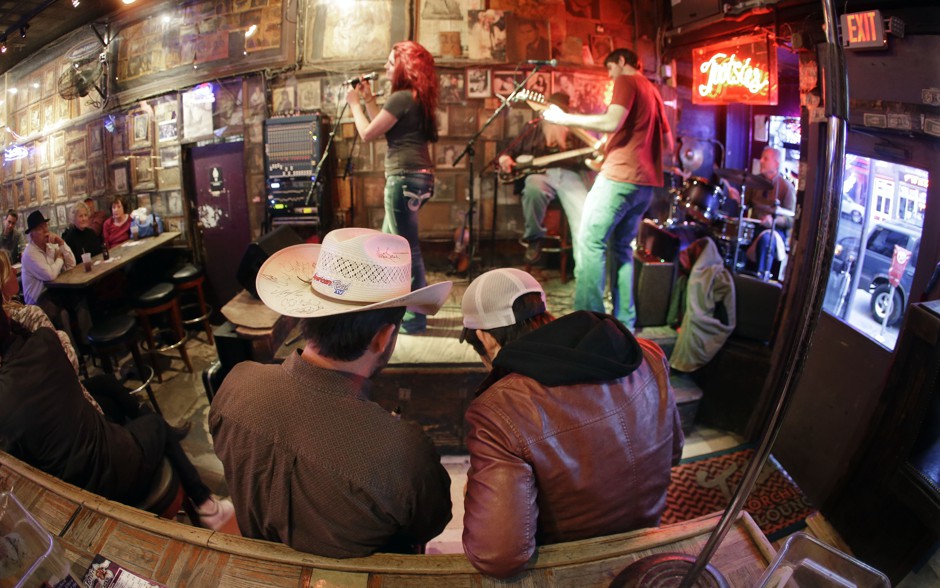
Photo: Mark Humphrey/AP
“More than 15 million visitors came to Nashville last year, and country music is a big reason why,” says
CityLab.

I have never been to Nashville, but when John visited, he was impressed. He told us that music and signs of music were on very street corner. A recent article added other angles to Nashville’s music story.

Lee Gardner at CityLab writes, “Thanks to a surging economy and an onrushing hot-city rep, the Music City has been gaining about 100 new residents a day. … But as the skyscrapers and rents have risen, many of the hallowed offices and studios of Music Row, the industrial heart of the country, have come under threat from the wrecking ball.

“Country music has survived a lot worse, according to Don Cusic. He’s is a Nashville-based historian of the genre who served as a consultant for Country Music, the massive new 16-hour PBS documentary series from filmmaker Ken Burns that charts the genre’s trans-Atlantic influences and tracks its nearly 100-year rise from disrespected ‘hillbilly music’ to the vox populi of the white working class, and a multi-billion-dollar business in the streaming age.

“Cusic spoke with CityLab about why Nashville became synonymous with country [and about] what’s next for the city. …

“Gardner: Why do you think Nashville became synonymous with country?

“Cusic: Actually it was Chicago and country music that were synonymous until about World War II, and after that Nashville. It starts becoming synonymous because of the radio stations. In Chicago it was WLS, in Nashville WSM — the National Barn Dance in Chicago, the Grand Ole Opry in Nashville. But the Chicago show lost its sponsor, which was Alka-Seltzer, and the Grand Ole Opry didn’t. It was sponsored by Prince Albert Tobacco.

“The other basis for the Opry’s stability was that it was owned by the National Life and Accident Insurance Company. The company used the Grand Ole Opry as a ‘door opener.’ Salesman would knock on doors with a brochure about the Opry, and that would lead into sales of insurance policies. When rock ‘n’ roll hit in the late 1950s, a number of radio stations switched to rock, [but] the Grand Ole Opry kept going because it could sell insurance. …

“Gardner: What is it about Nashville other than the Opry that allowed things like Music Row to take root?

“Cusic: It’s the people behind the scenes that made a difference. … You had a lot of these key figures who were executives who said, ‘If we’re going to have a show, it’s going to be top-notch show.’ I think that’s a lot to do with it right there.

“Gardner: People now talk about Music Row … as a forerunner of the ‘innovation district’ concept. Do you think that having this tight concentration of companies and creatives had an effect on the rise of country, and of Nashville?

“Cusic: Absolutely. Nashville attracted … a creative community, and that creative community feeds off of itself. I teach at Belmont College, and my students are always saying, ‘Where I come from, I’m the only person that writes songs; I’m the only person that plays the guitar. I get here and everybody writes songs and everybody plays the guitar.’ …

The other thing was the Nashville musicians’ union. Here, musicians could make a living playing, and when the studios developed, you had top-notch musicians here.

“Gardner: Country music — and perhaps Nashville, too — get stereotyped as being extremely white. … I gather the series explores some of those stereotypes. …

“Cusic: They did a survey not long ago, where about a third of the people in this country didn’t like country music, and not because of the music, not because of the artists, not because of the songs, but because of the image they had of it. They didn’t want that to be their self-image, and the image they had was we were backwards, we were hicks and hillbillies, we were racist. … I think this documentary takes that down quite a bit. …

“Gardner: Nashville has seen a lot of economic changes. … How is that affecting the city’s country music identity?

“Cusic: I wrote a book called Nashville Sound, and it really should have been Nashville Sounds. The public perception of Nashville is not accurate, totally, with music, because there’s a thriving jazz scene here. Contemporary Christian music has a huge presence here. You’ve got pop and rock acts here. …

“Gardner: I imagine, though, that many of the people now moving to Nashville don’t really care much about music. Do you think that the city’s musical identity has been watered down?

“Cusic: One of the things that comes through in Ken’s documentary — you can’t kill it. You can hold it underwater, but you just can’t kill it. It’s like a rubber ball that keeps bouncing back. That’s kind of frustrated the Chamber of Commerce at times, because they still want Nashville to be the Athens of the South. [But] it comes back to country music over and over again. That’s what stuck in people’s minds. Believe me, the business establishment and social establishment have tried to change that. They can’t do it.”

More at CityLab, here.

Read Full Post »

Here’s a nice story by NY Times reporter Dan Bilefsky about a British Muslim bake-off contestant who is a winner on many levels.

Bilefsky writes, “Prime Minister David Cameron praised her coolness under pressure. Bookmakers monitored her performance as they do election candidates.

“Television watchers admired her raspberry mille-feuille and soda-flavored cheesecakes — along with her blue chocolate peacock, and a mountain of éclairs in the form of a nun.

“The victory of Nadiya Jamir Hussain, a petite 30-year-old, head-scarf-wearing mother of three from northern England, in a wildly popular reality show called ‘The Great British Bake Off’ on [Oct. 7] has been greeted by many in Britain as a symbol of immigration success …

“Ms. Hussain’s popularity, bolstered by her self-deprecating humor and telling facial expressions, helped the final episodes of the baking program, in which contestants vie with one another to make a variety of desserts, attracting well over 10 million viewers per show, according to news reports. She has also become a darling of social media, with more than 63,000 followers on Twitter as of [Oct. 8]. …

“Ms. Hussain’s triumphant final dessert, a ‘big fat British wedding cake,’ offered a multicultural message of sorts by fusing her Bangladeshi and British identities. The lemon drizzle cake was decorated with jewels from her own wedding day in Bangladesh and was perched on a stand covered with material from a sari in red, blue and white, the colors of the Union Jack.”

More here.

Photo: Mark Bourdillon/Love Productions, via BBC
Nadiya Jamir Hussain, the winner of “The Great British Bake Off.” 

Read Full Post »