Feeds:
Posts
Comments

Posts Tagged ‘stewardship’

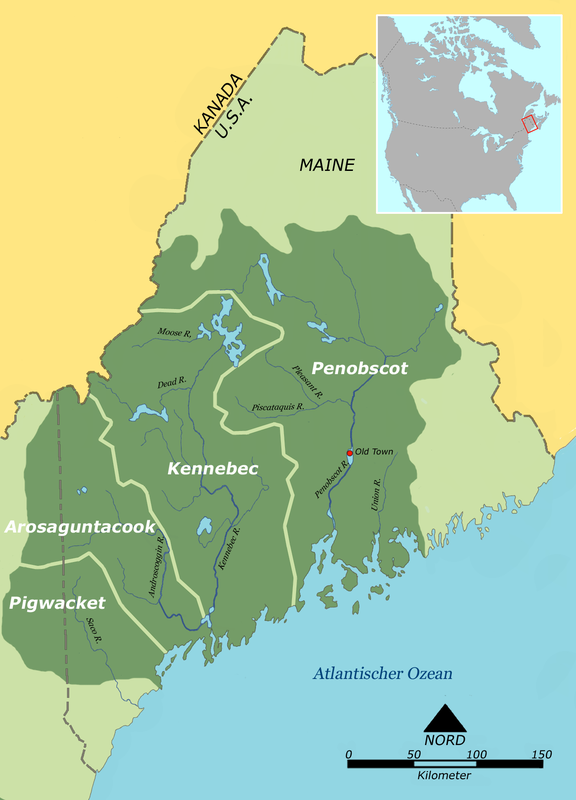
Map: Wikipedia.
Eastern Abenaki tribes (Penobscot, Kennebec, Arosaguntacook, Pigwacket/Pequawket). Indigenous people often exhibit the best stewardship of natural resources.

What can we learn from people who have been taught from infancy how to live in harmony with the natural world? In an op-ed at the Washington Post, Bina Venkataraman suggests that “in Maine, a return of tribal land shows how conservation can succeed. …

“On a recent morning at the Penobscot Nation headquarters, moose mating rituals dominated the office banter: the wacky way a lovesick moose had stumbled around someone’s pickup truck [when] he heard a hunter’s [mating call]. …

“The Penobscot Nation’s record of caring for nature while still using it — hunting moose and duck while keeping their populations steady, selectively harvesting timber to preserve forests and restoring rivers to support fisheries — inspired an effort to return a 31,000-acre tract of forested land to tribal ownership.

“Late last year, the Trust for Public Land, a conservation group, bought the parcel from an industrial timber company, and today it announced it will give the land to the tribe once it pays off $32 million in loans. …

“The land is close to Mount Katahdin, sacred in Penobscot tradition, and to an 87,000-acre national monument created in 2016 in the North Woods of Maine. It contains 53 miles of streams in the watershed of the Penobscot River, which has been for the tribe a central highway and a source of food and water.

“The transfer is part of a movement to return lands to Indigenous stewardship and work with tribal communities to protect biodiversity. The hope is both to restore justice for tribes that were long ago stripped of their ancestral homelands and to learn from long-standing Indigenous practices new ways to save a beleaguered planet. The pending land return in Maine, or ‘rematriation’ as some Indigenous people call itstands out because of its scale — many previous land returns in the eastern United States have been on the order of hundreds of acres — and because the Penobscot will decide how the land will be managed.

“This is a significant change. For most of the past two centuries, Western conservationists have largely ignored Indigenous people’s knowledge of landscapes and wildlife, along with tribes’ historic claims to the land. But that is no longer tenable. Worldwide, Indigenous-managed lands host 80 percent of the world’s biodiversity, by some estimates, and encompass much of the world’s remaining intact forests, savannas and marshes. If environmentalists and political leaders hope to conserve more natural landscapes … collaboration with tribal nation leaders is critical.

Modern environmentalism has been deprived of Indigenous knowledge, in part, because it has seen nature as something apart from humans.

“Early thinkers hold some responsibility for this. John Muir, long lauded as the father of the national parks, believed that natural landscapes needed to be stripped of the Native Americans who lived on them to create his ideal of pristine wilderness. In the Muir tradition, the U.S. government drove tribal people out of areas that today are considered America’s most beloved landscapes — Yellowstone, Yosemite, the Everglades — a history documented by David Treuer, an Ojibwe writer.

“The federal government created the National Bison Range in 1908 by evicting tribal members from more than 18,000 acres of the Flathead Indian Reservation — ignoring century-old practices for keeping up the bison herd. Only recently has the government returned the land to the Confederated Salish and Kootenai Tribes, whose successful traditional methods for maintaining the herd are featured in a forthcoming ABC documentary.

“When Henry David Thoreau … traveled to the Maine woods in the 19th century, he distinguished between ‘scientific men’ and Indian guides, even as he acknowledged the latter’s navigational expertise. It’s laughable now to think that communities that had inhabited a place for centuries, gaining intimate knowledge of the natural features, flora and fauna and passing down that knowledge across generations, could have less to offer scientifically than settlers encountering those lands for the first time. Yet it was only last year that the U.S. government formally recognized how much tribes can contribute to ecological knowledge of their ancestors’ landscapes. …

“For decades, tribal members in Maine advocated bringing down Penobscot River dams that once powered saw and paper mills to restore an Atlantic salmon fishery. The Penobscot method of timber harvesting, which leaves 75- to 100-foot buffers of trees around rivers and streams, creates ideal conditions for salmon. Salmon like to spawn upriver in shady pools, created by allowing the forest at a river’s edge to thicken and birch trees to fall into it. …

“Some evidence suggests that, globally, the track record for Indigenous management of wildlife is at least as good as that of formal conservation. Researchers have shown, for instance, that Indigenous-managed lands in Canada, Australia and Brazil contain biodiversity equivalent to that of areas designated for conservation.

“But perfect alignment between tribes and environmental groups doesn’t always happen. The economic challenges that many tribes face — and their efforts to acquire land to reclaim sovereignty — often force tough decisions about development, gambling and heavy industry. Some tribal nations have greenlighted oil and gas drilling. The Penobscot have allied with conservationists to oppose a proposed zinc mine in northern Maine because of its likely harm to fisheries. But several tribal members expressed to me their misgivings about wind farms, which most environmentalists see as essential to combat climate change.

“Penobscot leaders have varying visions about how they might one day develop the land that is now being returned to them. Some imagine using it to adapt to sea-level rise — by building housing or growing food; others envision ecotourism lodges or a cultural center that could be accessed by the general public. In the near term, tribal leaders aim to make it accessible to hikers and hunters with permits and to offer public access to the national monument via an old logging road.

“In other parts of North America, co-management of conservation areas is becoming more common. … Groups such as the Trust for Public Land and the Nature Conservancy are brokering more land returns and collaborating with tribes to manage ecologically important landscapes. But more private landowners, philanthropists, nonprofit groups and governments should mimic the efforts in Maine. …

“Environmental movements might have better protected nature if they had long sought to conserve cultures and communities along with land. Earning the trust now of people who have inherited wisdom for living in balance with nature will give conservation a fighting chance on a warming planet.”

More at the Post, here.
Read Full Post »

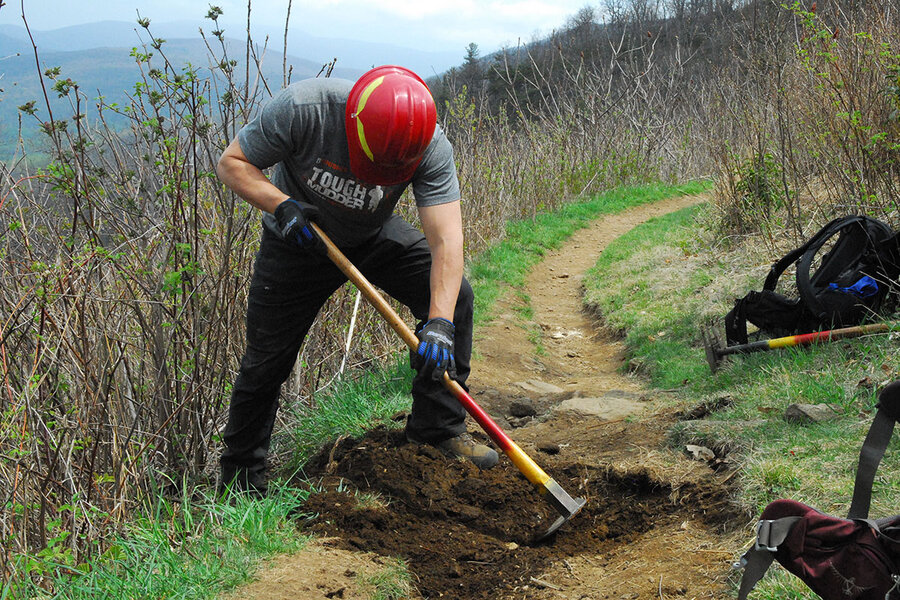
Photo: Noah Robertson/The Christian Science Monitor.
“Trail maintainer Russell Riggs digs an impromptu drain in Virginia’s Shenandoah National Park, May 1, 2022. The drain helps water gently slope down the mountain and off the trail, limiting erosion,” CSM reports.

I grew up at the foot of the Ramapo Mountains and although I never became a serious hiker, I always loved walking in the woods there. The Ramapo Mountains are part of the Appalachians. Today we learn how volunteers maintain the famed Appalachian Trail. Even in a pandemic.

Noah Robertson has the story at the Christian Science Monitor. “The view from Jewell Hollow overlook is hard to beat. More than 3,000 feet above ground in Shenandoah National Park, it’s a 180-degree window into miles of valley and mountains. Surrounded by a mossy stone fence and hiking trails, the sight is one of the best in Virginia.

“But today, Kris English isn’t focused on that. Instead, she’s looking at dirt – grassy green to tan to gravelly brown. 

“She pauses when the ground gets dark. Telling her three-person crew to stop, she teaches them to study dirt like paint swatches (every artist needs a canvas). Darker dirt is wetter dirt. Wetter dirt means the trail will erode faster. 

“Then Ms. English, a technical trail specialist for the Appalachian Trail Conservancy, shows them how to dig a drain. 

“Grabbing a 4-foot hybrid rake known as a McLeod, she clears debris in wide brushstrokes and carves a gentle slope. Five minutes later there’s a comet-shaped channel to guide water down the mountain. …

“Ms. English, leading a training session that morning in early May, helped add a few volunteers to the roster of those who routinely preserve the Appalachian Trail – the East Coast’s 85-year-old, 2,200-mile hikers’ paradise. Her role is professional, but each year a 14-state network of trail crews from Georgia to Maine volunteer hundreds of thousands of hours to keep the trail sustainable, accessible, and clean. 

The pandemic has made it harder. When indoor gatherings were off limits, people went outdoors in record numbers. And, not knowing basic hiking etiquette, they made a mess. 

“That hasn’t stopped the volunteers. Last fiscal year, the Potomac Appalachian Trail Club, which oversees 240 miles of the trail – 101 of which are in Shenandoah National Park – amassed 2,000 more volunteer hours than it did the year before the pandemic. [To] Wayne Limberg, one of the PATC’s district managers in Shenandoah National Park, … the response shows that people understand the Appalachian Trail’s inherent contract. It offers humans an almost unrivaled opportunity to interact with nature. But that agreement takes preservation. 

“ ‘We want to make sure that it can be enjoyed by those of us living now and also future generations,’ says Mr. Limberg, who helped Ms. English lead the training session in May. ‘Trails need to be maintained.’ …

“Humans want to see nature. But nature doesn’t always appreciate the interest. Trails solve that problem by concentrating folks into a single, relatively small path, she says. The arrangement maximizes people’s exposure to nature and minimizes their impact. 

“But this is a fragile agreement. Humans – particularly new hikers – can disturb the forest with litter, graffiti, music, and millions of footprints. Nature, for its part, will always try to take the trail back with weeds, moving water that erodes the path, and fallen trees known as ‘blowdowns.’ 

“Hence, the need for trails creates a need for trail maintainers. And trail maintainers need training. 

“After a series of safety tips, Ms. English walks her group to a set of tools. … The fire rake’s harsh triangles help clear gravel and debris. The mattock’s two ends can dig earth and tear roots. …

“ ‘I could nerd out about tools for a minute,’ she says. And briefly she does, even posing in proper technique – like the relaxed stance of a surfer, not the hunch of an ‘old witch.’

“Maintainers follow several simple rules. Preserve a 4-foot-by-8-foot rectangular ‘trail prism’ free of weeds and fallen trees so hikers can freely walk. Gather litter. Report anything they can’t fix.

“And, perhaps most important of all, guide water. Rain needs to flow down the backslope and off the edge, not pool on the treadway. Otherwise, the path will erode, gather debris, or change shape entirely as months of nature junk accumulates. 

“Official policy is that the treadway should slope down at a 5-degree angle. The reality is almost never that precise. If they want an impromptu level, Ms. English says, a half-filled, transparent water bottle will work.

“Ms. English, Mr. Limberg, and the crew’s other two members remove a rickety log ‘water bar’ and replace it with a fresh channel. Pulling the log up, Ms. English finds two curled millipedes. Mr. Limberg finds a AA battery. 

“In the last two years, litter like that has only become more common. ​​… The motto for seasoned hikers is ‘leave no trace.’ But many of the new visitors during the pandemic hadn’t yet learned the code. The Appalachian Trail has many access points and can’t record each hiker. But the multiple trail maintainers interviewed by the Monitor described a clear increase in use over the last two years. With it, too, they found an increase in waste and degradation – from little bags of dog poop left in a stack at the trailhead to spray-painted boulders. 

“ ‘When you see stuff that frustrates you, you don’t like it, but you realize that’s why I’m here,’ says Jim Fetig, who manages the PATC’s program of paid seasonal trail ambassadors known as ‘ridgerunners.’ ‘You just rise to the occasion and take care of it and move on.’

“To Mr. Limberg, the good news is that trail maintenance is getting back to its natural state. When national and state parks closed at the beginning of the pandemic, his trail crew’s work stopped as well. Even when things reopened, there were capacity limits and required social distancing. …

“It’s been more than 20 years since Mr. Limberg joined the PATC. Two decades of maintenance have reminded him that ‘the mountain always wins.’ No matter how many times he digs drains, whacks weeds, and lifts litter, the trail will need more work. It’s humbling.  But it also gives him a connection to the land he might not otherwise have.”

More at the Monitor, here.

Read Full Post »

I have mentioned the Block Island Poetry Project in past years, and I wanted to let you know that I just got the scoop on this year’s theme.

Nancy writes, “The Block Island Poetry Project weekend will be April 16-19 and will focus on Poetry of the Wild, a project of Ana Flores, who visited just a few days ago to show us examples of what she’s been doing around the country for the last twelve years. … I’m in the process of developing my Poetry of the Wild poetry box project for the school.”

The Poetry of the Wild website explains, “Poetry of the Wild invites the public out for a walk to see their world anew through the keenly felt perspectives of poets and artists. Using a unique presentation of ‘poetry boxes’ that combine art and poetry, the project serves as a catalyst for exploring our towns and considering how place informs mindfulness. The public becomes engaged by finding the boxes which are sited as a network on mapped trails, reading the poems, and responding in the public journals contained in each.

“The sculptor Ana Flores created Poetry of the Wild in 2003 while she was the first artist in residence for the Wood-Pawcatuck Watershed Association in Southern Rhode Island. Her mission was to use the arts to foster public awareness and stewardship of the land and waterways protected by the Association. That first project had a dozen boxes created by students from area schools, members of the environmental group and other artists. The public response was overwhelming during its three month tenure. It turned out that many people roaming the trails were poetic– but they had had no place to express themselves. Journals were replaced three times and the trails leading to boxes also became less littered.”

For more about Ana’s work, see earthinform.com. And for more about the Block Island Poetry Project (founded by 2008-2013 Rhode Island poet laureate Lisa Starr), click here.

Ana Flores

Read Full Post »