Feeds:
Posts
Comments

Posts Tagged ‘surprise’

Photo: Jeremie Souteyrat for the New York Times.
Steve Mills shows his copy of The Naughtiest Girl Again, by Enid Blyton, with marginalia by a child.

In a fun story from the New York Times, Jonathan Wolfe writes about a children’s-book collector in England who was surprised to discover who did the childish drawings inside an acquisition. It reminded me of some favorite childhood books — and how I loved to draw pictures of girls with pointy noses on any piece of paper I could find.

“In retirement,” writes Wolfe, “Steve Mills began collecting secondhand books that he had read as a child. It was an effort to reawaken lost memories. …

“He was at home in Hockley, east of London, flipping through titles from a recent book haul from a charity shop. Inside the pages of an early hardcover edition of The Naughtiest Girl Again, by the English author Enid Blyton, he found a girl’s handwritten notes from more than 50 years earlier. It took a few moments for Mr. Mills to grasp who the writer was: his wife, Karen.

“At first, Mr. Mills, a 67-year-old former civil servant, simply recognized an address in the town where his wife had grown up, written in a child’s handwriting. He brought the book to Ms. Mills, and said, ‘Oh look, they used to live in the village you came from,’ Mr. Mills recalled.

“The address had been her childhood home, though it was spelled wrong. Ms. Mills couldn’t believe it. …

“ ‘I thought at first that it was him being a silly bugger,’ she said. ‘I actually said to him, “Are you trying to misspell our first address?” But I looked at it again, and I thought, “Oh my word, this is written by my brother and me when we were 9 and 10,” ‘ she said. … There were timetables she had carefully recorded, pages she had folded to save her place and a sketch of little Karen, freckles dotting her face. …

“[Ms. Mills] grew up in Staffordshire, about 170 miles northwest of Hockley. Her parents, Brenda and David Larden, both 87, told their daughter that they must have donated the book to a church or school drive around 1975, when they moved. …

“ ‘For 50 years,’ Ms. Mills said, the book had ‘gone around the country, doing I don’t know what — entertaining children — and then it came back to us.’ …

“But his discoveries weren’t over. A few days after finding his wife’s name in The Naughtiest Girl Again, Mr. Mills suddenly realized that there were other titles in the haul that he hadn’t looked at. Could some of those, too, have been from his wife’s childhood home?

“ ‘I picked up another couple of books and, lo and behold, there was my wife’s name,’ he said.

“He found doodles by Ms. Mills and her brother Mark on two other Enid Blyton books, The Adventures of Pip and The Famous Five: Five on a Treasure Island. The latter was one of Mr. Mills’s favorite books as a boy.

“The find was particularly meaningful for him, he said, because Ms. Blyton’s stories reminded him of boyhood adventures with his mother in Cornwall, on the English coast. …

“In the back of one of the three books, he said, his wife had written, ‘I have got 12 of Enid BLYTONS Books.’

“ ‘So that leaves me with another nine to try and find now,’ he said.”

More at the Times, here. What did you draw in your books — or hide inside? Four-leaf clovers?
Read Full Post »

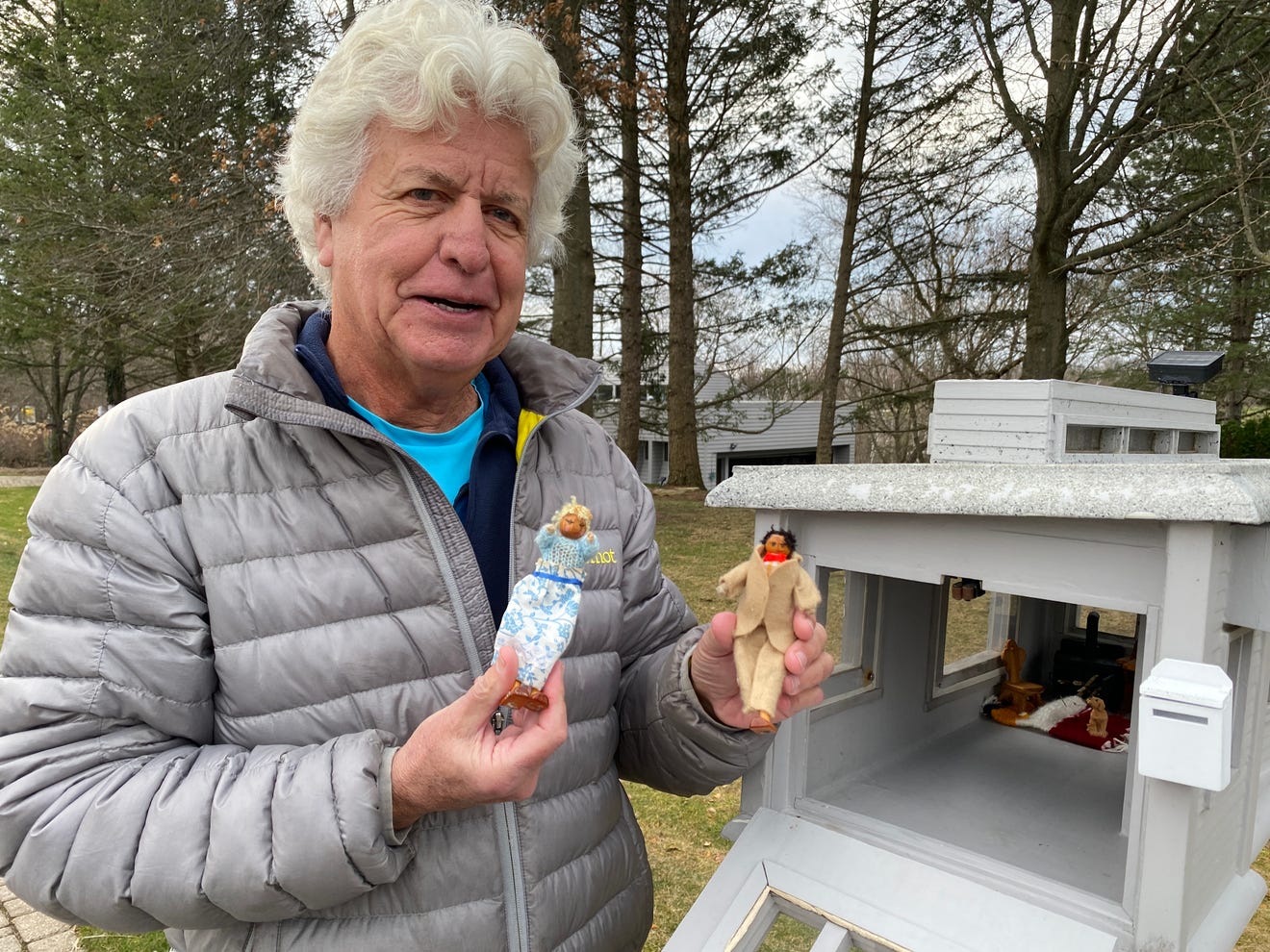
Photo: Laura Colvin/HometownLife.com.
Don Powell shows off his custom mailbox, where a mystery family moved in last year.

I love kindly stealth projects. If you search this blog on the word “stealth,” you will find several I’ve written about.

Today, Cathy Free reports at the Washington Post that a Michigan man who put up an especially nice mailbox got a surprise one day. Tiny dolls had moved in under cover of darkness and decided to stay.

“Don Powell was sliding the usual assortment of envelopes from the mailbox outside of his home when he noticed something out of the ordinary: A tiny doll couple was sitting on a love seat inside the mailbox. A small sticky note was also tucked inside.

“ ‘We’ve decided to live here,’ the message read. It was signed from Mary and Shelley. …

“Powell and his wife, Nancy Powell, had a custom-designed mailbox installed about four years ago to resemble the contemporary white house they’d moved into in Orchard Lake Village, Mich., about 25 miles from Detroit. …

“ ‘I asked the neighbors whether anybody had left dolls in their mailboxes, and everyone told me no,’ he said. ‘So I thought, “This must just be a joke, and whoever left them here will come back to get them.” ‘ …

“A few days passed and nobody retrieved the dolls, he said, noting that he and his wife soon discovered that the small couple had acquired an end table, a throw rug and a pillow. …

“ ‘I left a note of my own, saying that what the home really needed was a refrigerator stocked with food,’ he said.

“The fridge was never delivered. But over the next several months, additional items mysteriously showed up: a four-poster bed, a painting and a wood-burning stove, to name a few.

“More than eight months later, Mary and Shelley are still living rent-free in the mailbox, to the delight of neighbors who now follow updates by Don Powell on Orchard Lake Village’s Nextdoor page. …

“ ‘A homeless couple has taken up residence inside our mailbox,’ he wrote on Nextdoor. … ‘Some people initially thought that I had planted the dolls myself, but that is definitely not the case,’ Powell said. ‘All I did was provide a mailbox. Somebody else decided to make it into a home for Mary and Shelley.’

“Nancy Powell said she can vouch for her husband. ‘Our two sons even wondered if he was doing it, but it was honestly a surprise to us,’ she said. …

“ ‘Whoever is doing this is obviously somebody who is incredibly artistic and clever,’ [the Powells’ next-door neighbor, Terry Falahee] said. ‘Don has a lot of skill sets, but doing something this detailed with dolls isn’t his forte.

” ‘It’s just somebody out there who is having some fun, giving us all a little community humor,’ Falahee said, noting that there are 25 homes in the subdivision, connected to three other neighborhoods of similar size.

“Powell works as a psychologist and is the president and CEO of the American Institute for Preventive Medicine, an organization that helps hospitals around the country implement wellness programs.

“After he and Nancy moved into their home in Orchard Lake Village about five years ago, he said they decided to pay a local craftsman $250 to design a mailbox resembling their house, with lots of windows on the top and sides to let the light in. …

“The interior of the box is roomy, measuring 26 inches long, 15 inches wide and 10 inches high, Don Powell said, adding that it also has solar-powered ceiling lights to illuminate the mailbox at night.

“Although a person can be fined up to $5,000 for putting items without postage inside somebody else’s mailbox, Powell said he could not imagine alerting the authorities and evicting the dolls.

“ ‘I asked our mail carrier if there would be a problem delivering our mail with the dolls in there, and he told me no — there was plenty of room,’ he said. ‘He also said he got a kick out of seeing what was going on inside my mailbox.’

“Every month or two, particularly around holidays, the Powells find something new tucked inside the box for Mary and Shelley.

“Last Halloween, the doll couple temporarily disappeared and were replaced by two small skeletons, he said, and at Christmastime, a decorated tree was left with tiny presents. Powell said whoever left the gifts took them back right after Christmas before he could open the boxes to see if anything was inside. The doll couple has also acquired a cat, he said.

“ ‘It’s getting a little crowded, especially because their cousin Shirley has also moved in with a service dog named Maggie,’ Powell noted.

“ ‘The note left in the mailbox said they were all grateful to find a one-story, because they’d previously lived in a Dutch-style dollhouse,’ he said. ‘I’m assuming that place had more stairs.’

“After packages were left for the holidays, Powell said he added a tiny addition of his own outside the mailbox: a miniature letterbox.

“ ‘I decided it made sense to give them one, since their tiny letters were getting mixed up with ours and could get lost in the mail,’ he said. …

“ ‘People in the neighborhood are enjoying it and stop by sometimes to ask questions,’ he said. ‘They want to know what we’re charging for rent and who mows the lawn. Some people ask if I’ve thought about installing an outdoor camera, but personally, I like the mystery of it.’ “

More at the Post, here.

Read Full Post »

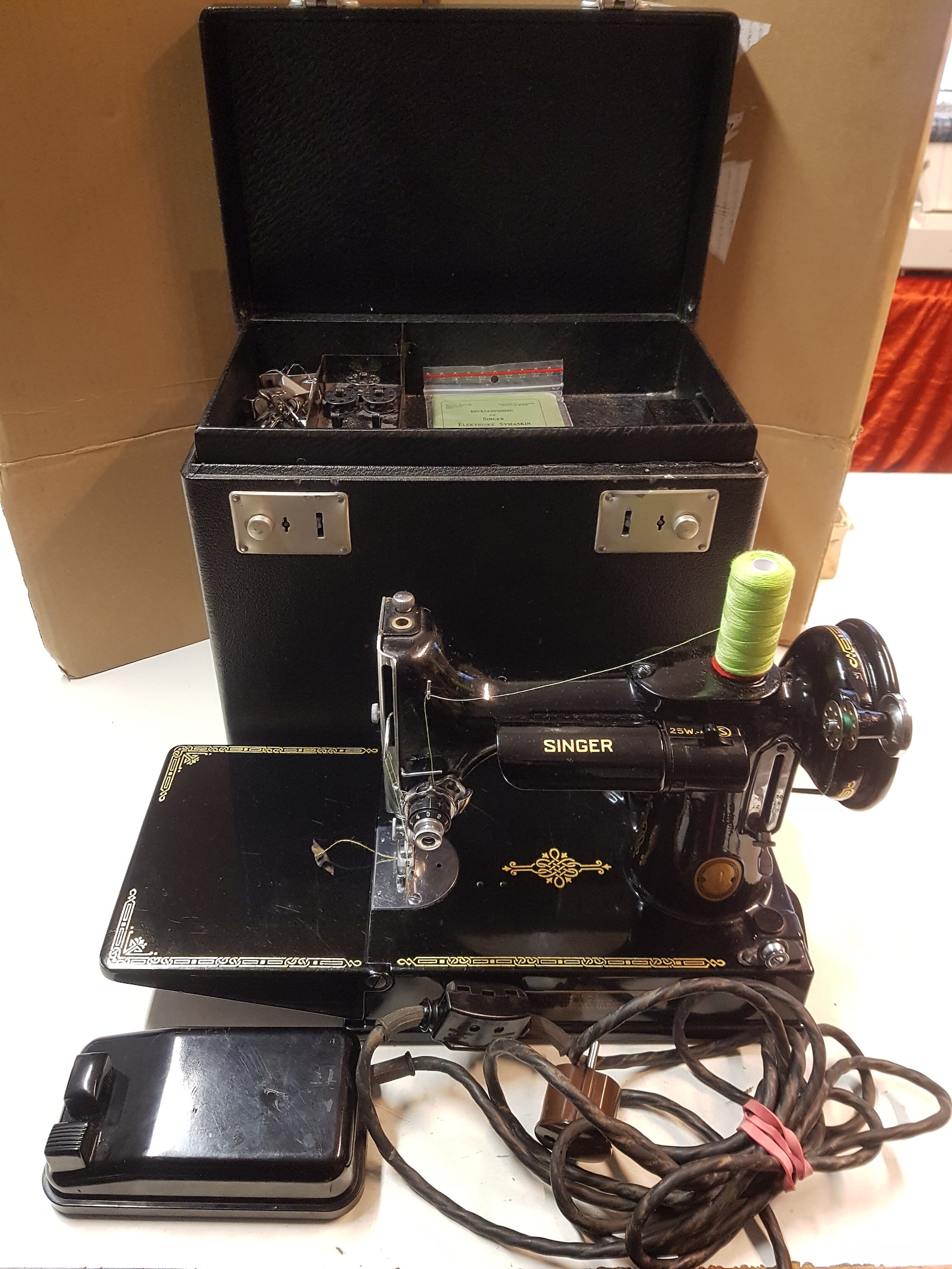
Singer sewing machine just like the one I sold to woman in Oklahoma years ago.

A nice thing happened to me recently. I got a phone call out of the blue from a woman in Oklahoma who had bought my old sewing machine on eBay years ago and kept my contact information. A real surprise.

She responded to my recorded message as if she were talking to me in person. “Yes, Ma’am. This is Margie M—. I had bought a sewing machine around 2014, I’m not sure. But anyway I was just wondering about it. I love the machine and wish I’d a called sooner. [She give her number.] Thank you and have a blessed day.”

I called her back. She was utterly charming. She said she’d wondered if the seller of the machine was even still alive, and she wished she’d called sooner. She’d had a number of sewing machines, but mine was the best. She said either I took very good care of it or I didn’t use it much. (I didn’t use it much.)

We talked a little about what was going on in her life, about ailing family members and how she was caring for them. At the end she wished me a blessed day again.

I think the experience of chatting with someone like Margie, a stranger with a very different life in a very different part of America, made it a blessed day, all right.

Read Full Post »

Photo: Daguerre Val de Loire via the Guardian.
The family thought their painting was a fake, but it turned out to be an authentic work by Pieter Bruegel the Younger, “L’Avocat du village” (“The Village Lawyer”). It sold at auction for $850,000.

It can sometimes happen in families as younger generations come along, new people marry into the family — and those who know the history of a painting on the wall die off — that the importance of a work becomes something no one takes seriously.

I remember the husband of a babysitter John had when he was three scoffing about a painting his wife said was a Turner. I believed the babysitter was better informed. Today I wonder where that painting is.

Jonathan Edwards reports at the Washington Post about a similar situation.

“Malo de Lussac entered the tiny, dimly lit TV room in October, expecting the unremarkable as he assessed the value of the art and artifacts in his new client’s home in northern France. Then, a painting caked in dust and almost entirely hidden by a door caught the auctioneer’s eye.

“Pay it no mind, his client told de Lussac. Yes, the family had long called it ‘The Bruegel,’ but it was an affectionate dig at a painting that was clearly a fake.

“Turns out, the family joke was a hidden masterpiece, a genuine work of Pieter Bruegel the Younger, a 17th-century Flemish artist. Painted more than 400 years ago, ‘L’Avocat du village’ — or ‘The Village Lawyer’ — sold [in March] at auction in Paris for the equivalent of about $850,000 — the result of a discovery that de Lussac described as one of the most thrilling of his career.

“ ‘I was very, very surprised,’ de Lussac said.

“His coup started out as a workaday assignment: Travel from Paris to a client’s home in northern France to estimate how much their artwork and artifacts would sell for at auction. Because of the home’s size, he’d blocked out the entire day to accomplish the job.

“For the first hour, everything went as expected. After a half-hour of chatting and building a rapport with the owner over coffee, they started touring the house by surveying the living room. They then moved to the kitchen. Everything fell within de Lussac’s expectations: furniture, china, some ‘interesting’ but relatively unimportant paintings.

“They moved on to a TV room, where his client directed his attention to some 19th-century paintings they thought would be of the most interest. … Then de Lussac spotted part of a painting covered in dust and mostly obscured by a door. He shut it to get a look at the entire work. The brushstrokes, the colors, the canvas material: It all rang true with de Lussac’s knowledge of Bruegel the Younger. Born in Brussels around 1564, Bruegel was the eldest son of Pieter Bruegel the Elder, one of the most prominent artists of the Flemish Renaissance in Flanders, a Dutch-speaking region of what is now Belgium. …

“ ‘My heart was beating so hard,’ de Lussac said.

“The owners broke the bad news: The painting had long been regarded as a knockoff by the family. Their forebears had purchased it in the late 1800s, and it spent the next century bouncing to different houses as younger generations inherited the work. …

“But acting on his hunch, de Lussac pressed the current owner. Everything he observed jibed with what he knew of Bruegel the Younger, who had painted several works depicting the same scene of a Spanish official collecting taxes from Flemish peasants.

“The owners were skeptical but willing to let de Lussac send the painting to a Bruegel expert in Germany. In December, they got word: It was genuine.

“[DeLussac] said that he believes the original buyer purchased it as a genuine Bruegel, and that knowledge of its authenticity was lost to time.”

More at the Post, here. At the Guardian, there is an earlier version of the story without a firewall, here.

Read Full Post »

Blind Photographer

A disability may make a person think about things in new and interesting ways. Remember the blind architect whose other senses helped him carve out an inspiring career? (Blog post here.)

In a first-person account at Audubon magazine, Liz Bossoli, describes her life as a mostly blind photographer of birds.

She writes, “As far back as I can remember, I’ve been enthralled with animals. Wherever I went, it wouldn’t take long for me to orient to the nearest one. By age eight, I could identify upward of 100 dog breeds. Yet when it came to birds, my list wouldn’t have gone far beyond Northern Cardinals and Blue Jays. I often heard my grandfather warmly refer to ‘chickadees,’ but this species only existed vaguely in my mind’s eye as a small, probably cute bird. Until recently, I never actually saw a Black-capped Chickadee in a way that I could appreciate. When my grandparents marveled over a bird at their feeder, I only experienced their joy vicariously.  

“I was born with a congenital condition called Septo-Optic Dysplasia, and as a result, I’m almost totally blind in my left eye and legally blind in my right. Blindness is not a binary condition, but rather affects individuals across a broad spectrum. … I’m among the majority of blind individuals who have some usable vision, and I happen to fall on the end of the spectrum with the greatest degree of functional eyesight.

“I’ve been known to describe myself as having ‘pretty good vision for being legally blind.’ It’s my light-hearted spin on living in an awkward space where I don’t need a lot of adaptive tools or assistance from others, until I do. That also makes it easy for people to forget I can’t see well — including myself. Day to day, I’m not often cognizant of the degree to which my vision impairment affects me. Still, one of the most poignant reminders occurs when I can’t perceive my environment in the same manner as those around me. In my yard, I’m consistently awestruck when a friend immediately points out birds I don’t know are there.

“For nearly as long as I’ve been fascinated by animals, I’ve used art to express that fondness; first, through drawing and then, photography. I purchased my first DSLR camera in 2009, so I could create images that would do justice to the relationships I had with my dogs and other animals in my life. 

“I spent the better part of the last decade honing my skills as a dog portrait photographer, but a 2016 visit to Audubon’s Corkscrew Swamp Sanctuary in Naples, Florida, reignited a passion for connecting with the natural world. That trip to Corkscrew gifted me with up-close encounters with wild birds, unlike anything I had experienced. Equipped with an entry-level zoom lens, my camera gave me just enough visual reach to see the Red-shouldered Hawk that landed on a low branch right above my head, and to engage in a game of peek-a-boo with an active Pileated Woodpecker. …

“Back home, in Connecticut, my husband and I continue to adapt our small suburban property to create a more hospitable environment for native birds. This year, while spending most of my time in my own yard, I appreciate their presence more than ever.  I’ve found myself fully engrossed in the art of bird photography, driven by desire to understand the wildlife around me. My photo of a Gray Catbird even made it into the final gallery of reader submissions for Audubon’s Bird From Home project. …

“I employ three different strategies for photographing birds in my yard. The first two are intentional: I either actively seek out birds that I hear in nearby trees, or I plant myself in a position from which I know I’ll be able to observe birds. The third strategy usually looks something like me being surprised by an unexpected bird encounter, frantically running into my house to get my camera, and returning in hopes I didn’t miss everything.

“Bird feeders, nest boxes, and a birdbath are often just as integral to my process as the camera itself. They take the guesswork out of finding birds to photograph. I admit that photographing birds in these contexts lacks the thrill of successfully locating a bird on a branch, but that doesn’t mean it’s a passive process. For my purposes, any amount of predictability is a vote in favor of creativity.

“And when I do hear the sound of uncharacteristic rustling in the trees or a bird call close nearby, I hope for the best. I rely on the goodwill of birds who are generous enough to remain in the same location for minutes at a time, as I visually scan the area with my camera. Through the viewfinder, I trace the outline of branches in order of my best guess that the sound came from that specific area. I repeat this with other branches until I have to refocus and scan the same area at a different distance from me. In the course of this process, I’m likely pointing my camera directly at the bird I’m seeking several times without realizing it. I estimate that at least 90 percent of my attempts at photographing birds under these circumstances are fruitless, but the occasional success makes the time investment worthwhile.” More.

There’s something wonderful about the unexpected in any art. Take the happy accidents of Raku pottery, for example. I don’t imagine anyone can control precisely how Raku turns out. There may also be good surprises in domestic arts like cooking and knitting, not just horrible glitches. And what about the scientific arts? Scientifically minded readers should check out the eight beneficial mistakes described here.

Read Full Post »

I have been reading a comic book by Jessica Abel, “How to Make Radio That’s Good,” about Ira Glass and his special brand of storytelling for Public Radio International’s “This American Life.” The book was recommended by a National Public Radio guest speaker where I work. The library was able to order it from WBEZ in Chicago, but it might be out of print.

I have to admit that I have never been a huge fan of “This American Life” or the Ira Glass style of speech. But I’m really liking his ideas on how to build a story from a central character and hooking onto “something surprising.”

And I love this little animation of one of the shows, which is a near-perfect illustration of the comic book’s precepts.

Read Full Post »