The party guest told Dustin Hoffman in The Graduate that “there’s a great future in plastics,” but today there’s a better future in non-plastic packaging.
At Debra’s Natural Gourmet, there’s demand for shampoo and conditioner in cardboard, skin cream in tins, water bottles in glass. I have also seen lip balm in cardboard at Earthling, here, and at Booda Butter, here. Imagine! Thoughtful people out there are noticing how often we throw plastic ChapSticks into landfills!
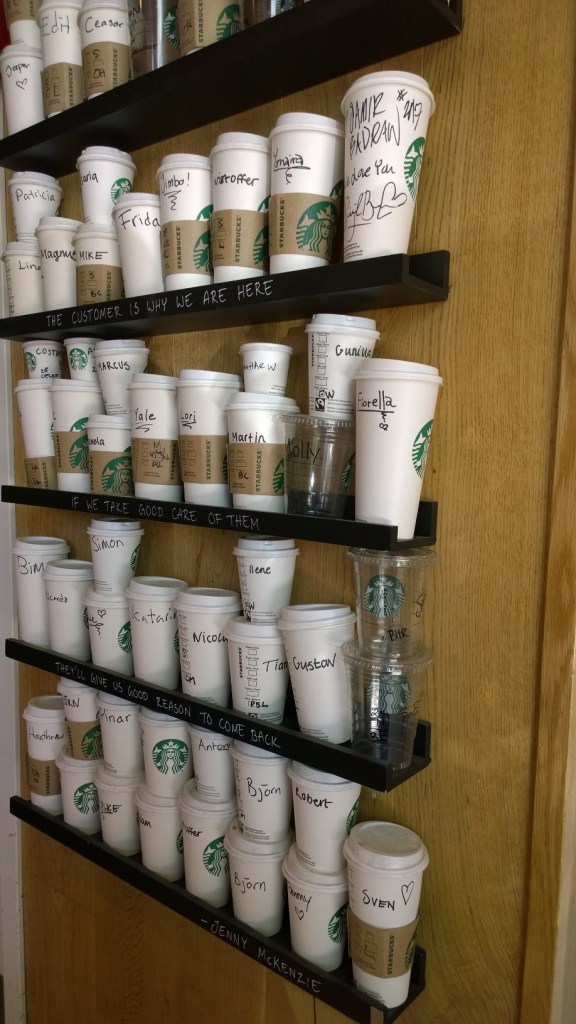
Joanna Detz writes at ecoRI News about a company called Usefull that is tackling our wastefulness with takeout coffee cups.
“What if your coffee shop had reusable mugs on demand that you could carry out with you and return to any other participating coffee shop when you were done? Alison Rogers Cove, founder and CEO of Cambridge, Mass.-based Usefull, envisions just such a circular foodware solution that would spell the end of disposable takeout products, most of which are not recyclable and wind up in a landfill or as litter.
“Usefull, an app-based foodware service that provides silicone-lidded stainless-steel containers for customers to check out and return (like a library book), recently wrapped up a pilot program on Block Island.
“The pilot, run in partnership with the Block Island Conservancy, was supported by a Small Business Innovation Research grant funded through the Environmental Protection Agency (EPA). A handful of cafes, a food truck, and a farmers market participated.
“ ‘The pilot was very successful in testing out a lot,’ Rogers Cove said. However, she admitted there were challenges in running the program in a largely transient community of day-trippers, where not all food-service providers opted into the system, and where single-use takeout containers were still an option. …
“Her data show a closed-loop returnable program such as Usefull’s has a better success rate in places where there is an outright ban on single-use takeout containers.
“ ‘From a business perspective, we can’t take the risk of going into a community without a ban. That’s part of our lesson learned,’ she said.
“Marin County in California is one of the few municipalities that has passed such a ban, which will take effect Nov. 10, 2023.
“As a result, Usefull has decided to focus its business efforts on serving colleges and universities invested in eliminating single-use takeout products on campus. … ‘College campuses are able to fully commit to their zero-waste goals and eliminate the option of single-use packaging.’
“On participating campuses, students download the Usefull app, place their takeout order, and scan a tracking code on their takeout container. After they are used, the containers — bowls and cups — can be dropped off at any of Usefull’s return locations on campus, regardless of where the container was checked out. Once the containers are returned, they are run through commercial-grade dishwashers and put back in circulation.
“Users are only charged if they return the container late — schedules vary by location — or if they lose the container.
“The idea for Usefull was born in 2013, when Rogers Cove was working in management consulting. … But it wasn’t until 2018 that she shared her idea outside her social circle, when she presented at a Boston Globe pitch event with angel investors. …
” ‘[The pandemic] was when we pivoted to colleges,’ Rogers Cove said, because it wasn’t clear when downtown Boston was going to reopen. She and her team figured college revenue was tied to having bodies on campus and bet that colleges would be first to reopen.
“The first college to partner with Usefull was Mount Holyoke, followed by other Bay State colleges and universities.”
More at EcoRI, here.


 Suzanne's Mom's Blog