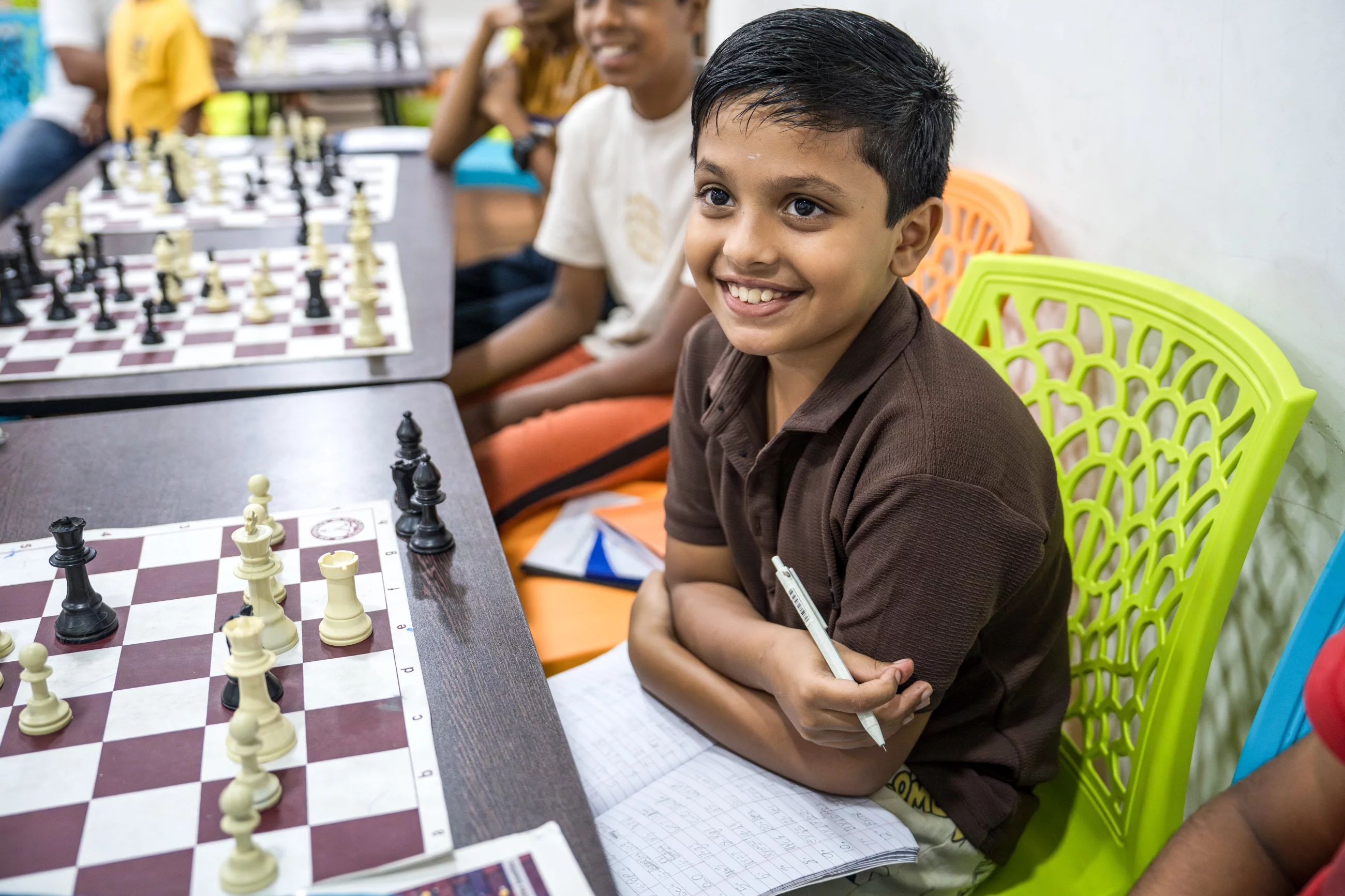
Photo: Viraj Nayar for NPR.
Ten-year-old Keashaanth, with a notebook and chessboard in front of him, follows along as his coach Selvabharathy leads a class at the Madras School of Chess in Chennai.
Our whole family takes an interest in chess, partly because Suzanne and Erik’s son is so good at it. He has represented his state and age group in two national competitions so far. That’s why I notice chess stories like today’s, which comes from NPR (National Public Radio).
Omkar Khandekar writes, “On a balmy morning [in fall 2024] in the coastal Indian city of Chennai, dozens of fans perched on their seats as they watched an elite-level tournament unfold. … On stage, some of the world’s best players were gathered for the annual Chennai Grand Masters. After a thrilling tiebreaker, 25-year-old Indian prodigy Aravindh Chithambaram prevailed. The audience broke into applause. …
“This level of attention is wild, says the world’s 11th-ranked chess player, Levon Aronian, who was the runner-up. Even he, an Armenian-American, is stopped on the streets here. ‘I can understand that happening in a country like Armenia with a population of three million. … ‘But for that to happen in India, I think that speaks to the popularity of the game.’
“Chess has seen a worldwide resurgence since the pandemic-induced lockdown. … With more leisure time, people began playing on streaming platforms like chess.com and on YouTube. India has been among the biggest beneficiaries of the boom.
“The country has 85 grandmasters — an elite group of chess players — and some of the youngest top-rankers in the world. Last year, both of its men’s and women’s teams swept the Chess Olympiad — the Olympics of chess — held in Budapest, Hungary. At the World Chess Championship in Singapore, held in December, Indian national Gukesh Dommaraju became the youngest-ever world champion at age 18.
“This is a remarkable shift. After decades of Russian and European chess dominance, the spotlight is on India, the likely birthplace of the ancient game. Many historians believe that modern chess originated from chaturanga, an ancient Indian board game that spread to the world via traders, pilgrims and conquerors. Within India, it’s the southern state of Tamil Nadu, and its coastal capital Chennai, that has emerged as the epicenter of chess. …
“At the Madras Chess Academy, children trickle in after school. They sit in a windowless room, surrounded by portraits of chess legends, including world champion Gukesh Dommaraju, once a student here.
“Many of these dozen or so kids spend their weekends sparring at chess tournaments across Chennai. If they perform well, trainers like Selvabharathy — he only has one name — invites them to stand before the class, and orders the other kids to clap, as he did on a recent day. …
“Chess coach Vishnu Prasanna started this academy two years ago. He says the day before NPR visited, one parent walked in with their 3 ½-year-old child to train. Another parent, Suresh Dasarathan, proudly shared his 6-year-old son’s daily routine: Wake up at 7, an hour of chess practice, school, then an hour of chess coaching at the club, then homework and bedtime at 9 p.m. …
“Parents often play a crucial role in the success of young prodigies. Gukesh’s father Rajinikanth often put his day-job as a surgeon on hold to double up as a de facto manager of his son. … But one 6-year-old girl, Rivina, says some parents at chess tournaments also get overbearing. ‘They will say, “I will give you dinner only if you win this game,” ‘ she says. …
“In 1995, India got its first world champion in Chennai-born Viswanathan Anand. Today, his successors in India are often called ‘Vishy’s kids.’ Now 55, Anand is still among the world’s top 10 players. … Anand thinks the culture surrounding chess has changed because now, it’s something you can make a living from. That’s key in a country where good-paying jobs are scarce.
“The Indian government often gives high-ranking players a job in the public sector — a dream opportunity for many because of the job security and perks: monthly pay, housing allowance, pension, insurance and paid leave they can use to practice. High-ranking players can win prize money in a newly launched global Chess League. Many also work as chess coaches. …
“Some chess watchers say there’s a major obstacle to India becoming the world’s unchallenged chess power: the English language. Most chess books, software and classes are in English. The government’s 2011 population census found that a little more than 10% of Indians fluently speak the language. Most English-speakers in India are from the country’s country’s middle and upper classes.
“One man wants to move beyond that. Two years ago, Venkatesh Enumalai founded the Tamil Chess Channel on YouTube. It teaches the basics of chess in Tamil, a language spoken by some 80 million Indians, concentrated in the southern state of Tamil Nadu. The channel has more than 80,000 followers and millions of views, including among Tamil-speakers in Sri Lanka and the United States. One of his students there, he says, became a state champion in Illinois recently.
“Buoyed by such success stories, Enumalai quit his day job with the sales team of a pharma company and started a chess club in Chennai, offering coaching at a little over $10 a month so even poorer children can afford it. He says he intends to travel and conduct chess boot-camps for students in the rural parts.
“As the world’s most populous country, India has the numbers on its side. Enumalai says it just needs a nudge to become a chess powerhouse. ‘If we can nurture so many people at the bottom level, maybe we will be able to become a number one nation.’ “
More at NPR, here.

 Suzanne's Mom's Blog