Feeds:
Posts
Comments

Posts Tagged ‘tapestry’

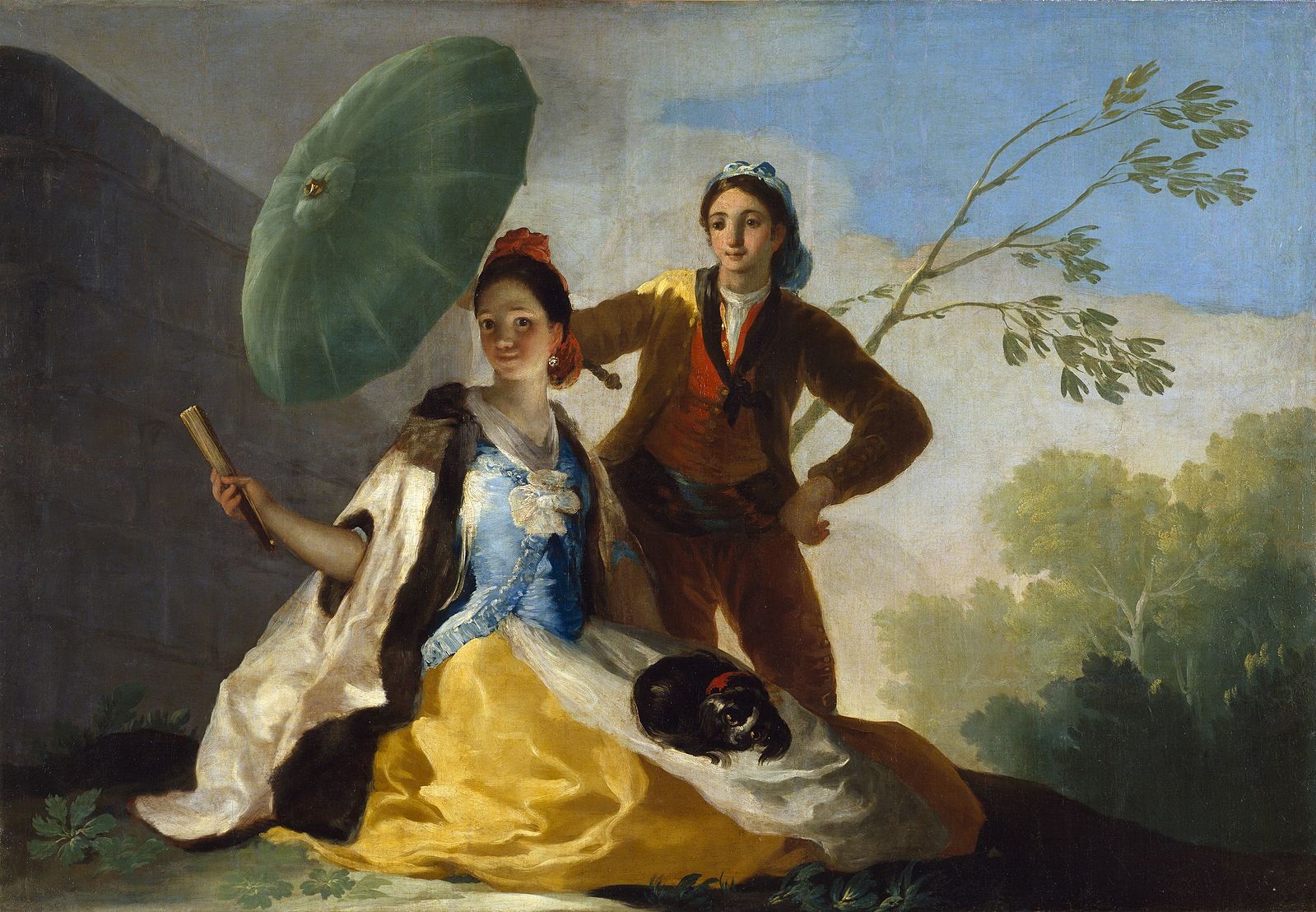
Art: Francisco Goya via Museo del Prado.
The Parasol (also known as El Quitasol) is one of a series of oil on linen paintings made by Francisco Goya. This series was made in order to be transformed into tapestries that would be hung on the walls of the Royal Palace in Madrid.

Companies that last over many generations know how to evolve with the times. There are a few in the US but more in other parts of the world. In Spain, for example, a factory that once converted pieces by the painter Francisco Goya into tapestries for his clients still plays a role in art and design.

Irene Yagüe writes at the Associated Press (AP), “Spain’s Royal Tapestry Factory has been decorating the walls and floors of palaces and institutions for more than 300 years. Located on a quiet, leafy street in central Madrid, its artisans work with painstaking focus on tapestries, carpets and heraldic banners, combining the long wisdom of the craft with new techniques.

“The factory was opened in 1721 by Spain’s King Felipe V. He brought in Catholic craftsmen from Flanders, which had been part of Spain’s empire, to get it started. Threads and wool of all colors, bobbins, tools and spinning wheels are everywhere. Some of the original wooden machines are still in use.

“The general director, Alejandro Klecker de Elizalde, is proud of the factory’s sustainable nature. ‘Here the only products we work with are silk, wool, jute, cotton, linen,’ he said. ‘And these small leftovers that we create, the water from the dyes, or the small pieces of wool, everything is recycled, everything has a double, a second use.’ …

“The factory recently received one of its biggest orders, 32 tapestries for the Palace of Dresden in Germany — worth more than 1 million euros and providing work for up to five years, according to Klecker de Elizalde. …

“Creating a tapestry is a delicate process that takes several weeks or months of work for each square meter. A tapestry begins with ‘cartoons,’ or drawings on sheets of paper or canvas that are later traced onto vertical thread systems called warps, which are then woven over.

“One of the factory’s most illustrious cartoonists was master painter Francisco Goya, who began working there in 1780. Some of the tapestries he designed now hang in the nearby Prado Museum and Madrid’s Royal Collections Gallery.”

Just for fun, see if you recognize any companies on the list of the world’s oldest companies, here. There’s one called Adam & Eve, which you’d expect to be old! It’s a pub in England, founded 1249.

More at AP, here. No paywall. Wonderful pictures!

Read Full Post »

Photo: Richard Saker/Guardian.
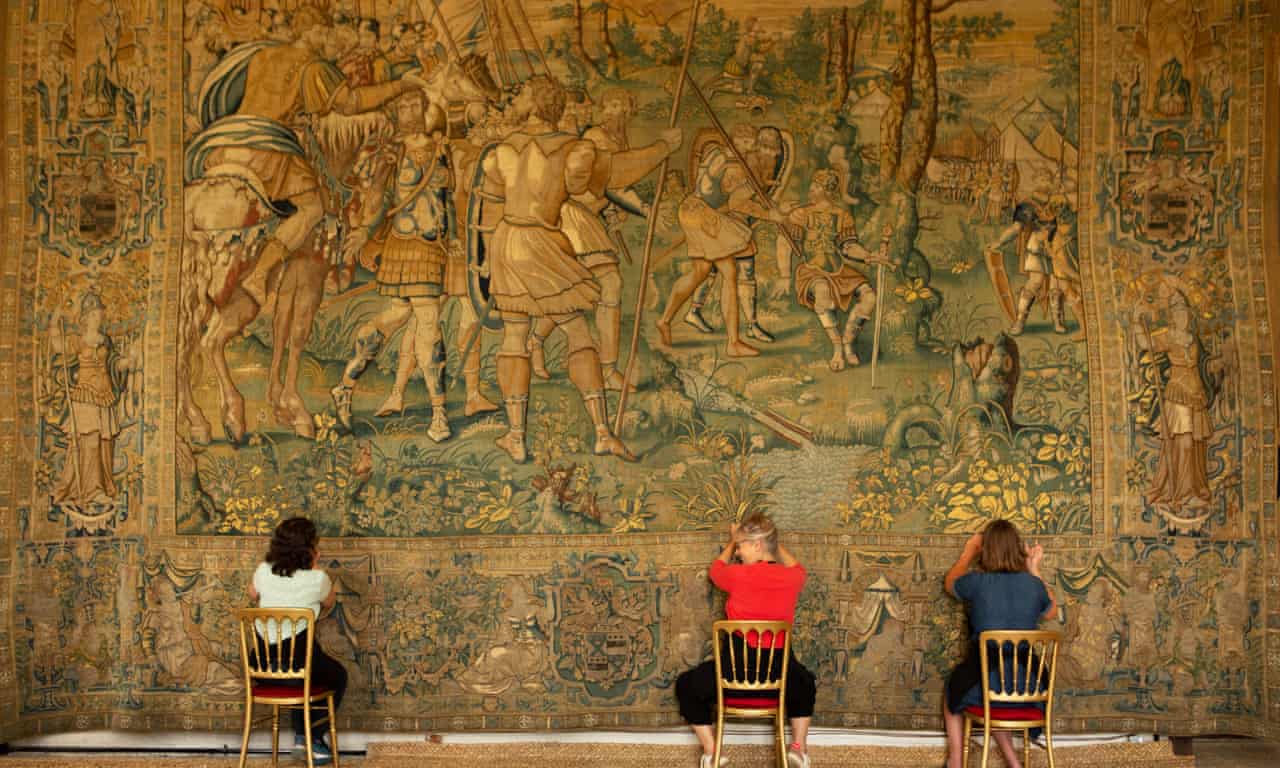
Staff at Hardwick Hall making final adjustments to restored tapestries that Bess of Hardwick bought for £326 15s 9d [~$406] in 1592.

This story is reminding me of childhood visits to the Cloisters before my father had his stroke and how he liked to point out the years of work that went into medieval tapestries.

Jessica Murray, Midlands correspondent of the Guardian, reports on 24 years of work just to do repairs.

“After a 24-year project, the National Trust has finally finished the restoration of a set of 16th-century tapestries at Hardwick Hall in Derbyshire, the longest such endeavor in its history.

“[In July] the final tapestry in the set of 13 Gideon tapestries was unveiled on the wall of the long gallery, the culmination of a painstaking effort to clean and handstitch the huge pieces one at a time, at a cost of £1.7m [~$2,118,718].

“ ‘It has been quite emotional because this is the first time I’ve seen them all on the walls together, and this project was in the background of my every day for so long,’ said Denise Edwards, the former general manager of the estate who retired last year, having overseen the project since 2003.

“ ‘They were supposed to be completed in 2021, the year I was due to retire, but they got delayed because of Covid so I stayed on because I really wanted to see the project through to the end,’ she said. ‘It has taken up a lot of my life for 20 years.’

“The enormous works, 6 metres tall [~20 feet] and more than 70 metres [~230 feet] in length, are considered to be one of the most ambitiously scaled tapestry sets of their time, and were last on display together before the project began in 1999.

“Hardwick Hall, an Elizabethan country house situated on a hilltop between Chesterfield and Mansfield, was at one point surrounded by nine coal mines. ‘You can imagine all the pollution that brought, and with leaky windows they were absolutely filthy,’ Edwards said. ‘And cleaning them is just the beginning of the battle – then it’s repairing all the damage done to the fine silks of the tapestries.’

“The set was bought by Bess of Hardwick, one of the richest women of her time and a friend of Elizabeth I, in 1592 after the death of the lord chancellor Sir Christopher Hatton, who had commissioned them for his estate in Northamptonshire. …

“The set, which depicts the biblical story of Gideon who led an army to save his people from the Midianites, has remained in the long gallery at Hardwick Hall since the end of the 16th century, and unlike many other tapestry sets it has never been moved or cut up. …

“Each tapestry took more than two years to restore, after a process involving a thorough vacuum to remove loose fibers, dust and soot, and a journey to Belgium for specialist wet cleaning.

“National Trust conservators used specialist conservation stitching with hand-dyed yarns to repair damaged areas, with each tapestry taking about 5,000 hours to complete.

“ ‘We work through it slowly … and we use different conservation stitches to bring structure to the tapestry and to fill in the design where it’s missing due to damage,’ said Yoko Hanegreefs, a textile curator, adding that ‘recipe books’ for bespoke dye colors were created to maintain consistency over the life of the project.

” ‘We use wool and stranded cotton to do that because they have faded and no longer have the brightness new silk would have.’ …

“Visitors can see the full Gideon set at Hardwick Hall, and there are plans to remove portraits hanging on some of the tapestries so they can be viewed unrestricted as they would have been 400 years ago.”

More at the Guardian, here. No firewall.

Read Full Post »

1300

Photo: Tuul and Bruno Morandi/Alamy Stock Photo
The Apocalypse Tapestry was “made after war and pestilence had killed millions in medieval Europe,” says the
Guardian. “It is remarkable that the tapestry still exists, given that during the French Revolution it was looted, cut into pieces and used as floor mats and blankets for horses.”

Sometimes we need a reminder that many people in past ages got through pandemics. And we are so much better off. For one thing, most of us believe in germs and know how to protect ourselves. We can get reliable news on the latest science about our plague. We can talk to friends near and far and see how they’re doing. We can have video chats with family. Some of us can even continue our jobs or our volunteer work online.

In the 14th century, it must have been even scarier than now, and it’s no wonder people turned to fanciful interpretations of ancient texts to try to understand. John Kampfner writes at the Guardian about a beautiful tapestry of the Apocalypse that might have reassured some folks that war and pestilence were part of a divine plan.

“In a basement gallery in a French provincial chateau stands the perfect artwork for our chilling times. The Apocalypse Tapestry is by turns grotesque and daunting. It is also mesmerising in its beauty and intricacy. …

“The 90 different scenes tell the story of the Book of Revelation, the Bible’s last gasp of horror, retribution and redemption. It hangs in the city of Angers, in a dimly lit modern gallery at the foot of the castle. …

“In 1373, at the height of the hundred years war and not long after the Black Death, [Louis I, the Duke of Anjou,] instructed Hennequin de Bruges, a Flemish painter to the court of King Charles V, to draw a group of miniatures from the final book of the Bible. His designs were then woven into 100 separate tapestries by the workshops of Nicolas Bataille and Robert Poincon using vivid red, blue and gold woollen thread.

“This epic work – the largest known medieval tapestry in the world – took nine years to complete but was kept in a chest and rarely shown. …

“Revelation was written by Saint John the Divine. … It marks the final battle between good and evil: Satan as a dragon and Christ as a lamb. The tapestry tells the story of the book through the eyes of John, who is present in almost all of the panels. It depicts the seven seals, seven golden candlesticks, seven angels and seven trumpets – and, of course, the four horsemen, who are released by the opening of the first four seals. One of the most beautiful images, after all the blood and fury, is of John on the point of walking up the river of life into the new Jerusalem. …

“So what does Revelation – and what might the tapestry – tell us about our responses to Covid-19? …  Over the past few weeks, as people have had more time to reflect, discussions about human behaviour and causality have adopted a more urgent tone. To put it another way: is this pandemic a dress rehearsal for trials to come, a final warning perhaps?

“When I visited the tapestry in February, none of this was on my mind, even as coronavirus was spreading across China and into South Korea. I was awed by the beauty and horror of the work. Now, in seeking to relate it to our present predicament, I spent a day of isolation reading Revelation.

” ‘And he opened the bottomless pit and there arose a smoke … and there came out of the smoke locusts upon the earth … those which have not the seal of God in their foreheads should be tormented five months; and their torment was as the torment of a scorpion when he striketh a man.’ … Believers are raptured to heaven, and those left behind suffer seven (more) years of torment before the second death arrives. …

“Reformation, revolution, rebellions – the more dangerous the world, the more art fell back on Revelation. Albrecht Dürer’s cycle of 15 woodcuts at the end of the 15th century came at a time of pestilence and peasants’ revolts. The works of William Blake and James Gillray reflected fears that the upheaval of the French Revolution would arrive on British shores.

“It wasn’t just bloodshed that caused artists to turn to Revelation. One of the great works of this genre is John Martin’s The Great Day of His Wrath, painted in 1853. … Martin depicts a pile of rocks collapsing, sending people falling into an abyss. Some eight million people saw Martin’s works, a third of the British population at the time. According to William Feaver, art historian and author of a seminal work on Martin, the artist was reflecting a fear of machines, of lives torn asunder by rapid industrialisation. …

“[Dr Natasha O’Hear, whose book, Picturing the Apocalypse, points out that some are more directly based in Revelation than others. She cites as example the video game Darksiders, released in 2010, which draws on the four horseman of the apocalypse and the evil angel Abaddon for some of its characters. But she insists that nowhere is the story more vividly told than on the tapestry in Angers. …

It is remarkable that the tapestry still exists, given that during the French Revolution it was looted, cut into pieces and used as floor mats and blankets for horses. The pieces were gathered back by a canon of the cathedral and all but 16 were found and restored. …

“The castle is planning to build a new interpretation centre within its grounds. It was scheduled to open in June, but now who knows when?”

More at the Guardian, here.

Read Full Post »