
Feeds:
Posts
Comments

Posts Tagged ‘teachers’

Photo: Earth.com.
In the bad old days, parents were misled about what was good for children. Remember forcing left-handed kids to use their right? Remember that counting on fingers was wrong? Fortunately, humans do learn from mistakes.

Everything old is new again. But you knew that. Here’s new old news from the world of elementary school arithmetic. Stephen Beech wrote the story at TalkerNews and many outlets carried it, including NBC.

“Counting on fingers really does help youngsters improve their math skills, according to a new study. The research is the first to show that children’s performance in arithmetic can show a ‘huge’ improvement through the teaching of a finger-counting method. …

“Swiss and French researchers explored whether finger counting can help primary school-aged children to solve maths problems in a new study, published in the journal Child Development. …

“Young children who use their fingers to solve such problems are recognized as intelligent, probably because they have already reached a level that allows them to understand that a quantity can be represented by different means.

“It is only from the age of eight that using finger counting to solve very simple problems can indicate math difficulties, according to the study.

“The research aimed to determine whether children who don’t count on their fingers can be trained to do so, and whether such training would result in enhanced arithmetic performance.

“The study focused on 328 five- and six-year-old children at kindergarten, mainly living in France, and tested their abilities to solve simple addition problems. Participating children were recruited through their teachers who voluntarily took part in the experiment.

“The study included a pre-test, training held over two weeks, a post-test closely after the training’s end, and a delayed post-test.

“The results showed an ‘important increase’ in performance between pre- and post-test for the trained children who did not count on their fingers originally — from 37% to 77% of correct responses – compared to non-finger users in the control group.

“The research team suggests that since children who use their fingers to help solve math problems outperform those who do not, teaching a finger-counting strategy could help reduce inequity among children in math.

“However, they say whether children who use finger counting are using it as an arithmetic procedure or understand something deeper about numbers will still need to be determined with future research.

“Study leader Dr. Catherine Thevenot said: ‘Our findings are highly valuable because, for the first time, we provide a concrete answer to the long-standing question of whether teachers should explicitly teach children to use their fingers for solving addition problems — especially those who don’t do so naturally. Our study demonstrates that finger calculation training is effective for over 75% of kindergartners.

” ‘The next step is to explore how we can support the remaining 25% of children who didn’t respond as well to the intervention.’

“Dr. Thevenot, of the Institute of Psychology at the University of Lausanne in Switzerland, says the study came about as a result of conversations with primary school teachers.

“She said: ‘They often asked me whether they should encourage or discourage children from using their fingers to solve calculations. Surprisingly, the existing research didn’t offer a clear answer, which left teachers understandably frustrated with my frequent response of “I don’t know.” …

” ‘The best way to provide a meaningful answer was through experimental studies — so that’s exactly what I set out to do.

” ‘When I first saw the results, I was amazed by the huge improvement in performance among children who didn’t initially use their fingers to solve the problems. Before our intervention, these children were only able to solve about one-third of the addition problems at pre-test.

” ‘After training, however, they were solving over three-quarters of them. The difference was striking, especially compared to the control groups, where gains were insignificant. The extent of this improvement truly exceeded my expectations. …

” ‘An important question now is to determine whether what we taught to children goes beyond a mere procedure to solve the problems. In other words, we want to know whether our intervention led to a deeper conceptual understanding of numbers, specifically whether children better grasp how to manipulate the quantities represented by their fingers.

” ‘In fact, we have already started addressing this question and the initial results are very promising. However, we still need to carry out additional experiments to confirm that these improvements are indeed a direct result of our training program.’ “

More at NBC, here, and at Earth.com, here.

Trust those Swiss to figure things out!
Read Full Post »

Photo: Camilla Forte/The Hechinger Report via CSM.
Ivory McCormick (center) attends a math conference July 12, 2023, in Chicago. The Atlanta teacher says her school’s math specialist helped change the way she feels about teaching the subject.

I can identify with the teachers in this story who have a math phobia. I had to teach all subjects to 10-year-olds for a couple years and was relieved that my school offered a math consultant. I had never trusted my math — although that had a lot to do with parental perceptions.

Ariel Gilreath, of the Hechinger Report, researched an interesting program designed to help teachers of young students gain confidence in the critical foundations of math. The story is shared at the Christian Science Monitor.

“In July, in a packed classroom in downtown Chicago, a group composed mostly of early elementary teachers and child care workers read a story about ‘Wendi,’ a fictional preschool teacher who loves reading but struggles in math. 

“Even though Wendi was drawn to early education where ‘math was so easy,’ she still felt unsure of her skills. In the story, she decided to skip math concepts, leaving them for the teachers her students would have next year. 

“Across the room, people nodded their heads as they listened.

“ ‘I am Wendi. Wendi is me,’ said Ivory McCormick, a kindergarten teacher from Atlanta. Several educators in the classroom identified with Wendi, and that was the point. Decades of research shows that math anxiety is a common problem for adults, and surveys show it particularly affects women, who make up nearly 90% of elementary teachers in the United States.

“Put simply, a lot of elementary school educators hate the prospect of teaching math, even when the math concepts are beginner level. 

“Researchers at the Erikson Institute, a child development-focused graduate school in Chicago, started the Early Math Collaborative 16 years ago to provide educators with research-backed professional development to help them better teach young students math. One of the goals of Erikson’s annual four-day summer math conference, where the teachers read Wendi’s story, is to assuage their anxiety by exploring how young children learn math and strategizing activities they can do in the classroom. 

“Because math competencies build on each other, with skills like counting and learning shapes forming the basis of later knowledge, it’s critical that students receive a solid foundation in the subject, education experts say. The U.S. has long trailed many other developed countries in terms of student math performance, and then scores tanked during the pandemic. …

“ ‘If you look at how a child is doing with math when they enter kindergarten, that’s the best way to predict how they’re going to be doing with math later, all the way up through eighth grade,’ says Jennifer McCray, an associate research professor at Erikson. …

“When Ms. McCormick started teaching preschool five years ago, she felt anxious about teaching a subject she didn’t feel confident in. ‘Math was something I always had to work really hard at, and it seemed like I never really got that much better at it,’ she says. 

“Teachers who doubt their math ability often worry they will transfer their math aversion onto impressionable students, educators say. There are studies that validate this fear: First grade students who were taught by teachers with heightened anxiety about math performed worse in the subject than their peers who were taught by less anxious teachers, one study from 2020 found.  

“Math specialists say it is a pervasive issue in elementary classrooms, where educators are typically expected to teach every subject, and it often leads to teachers spending less classroom time on math content. …

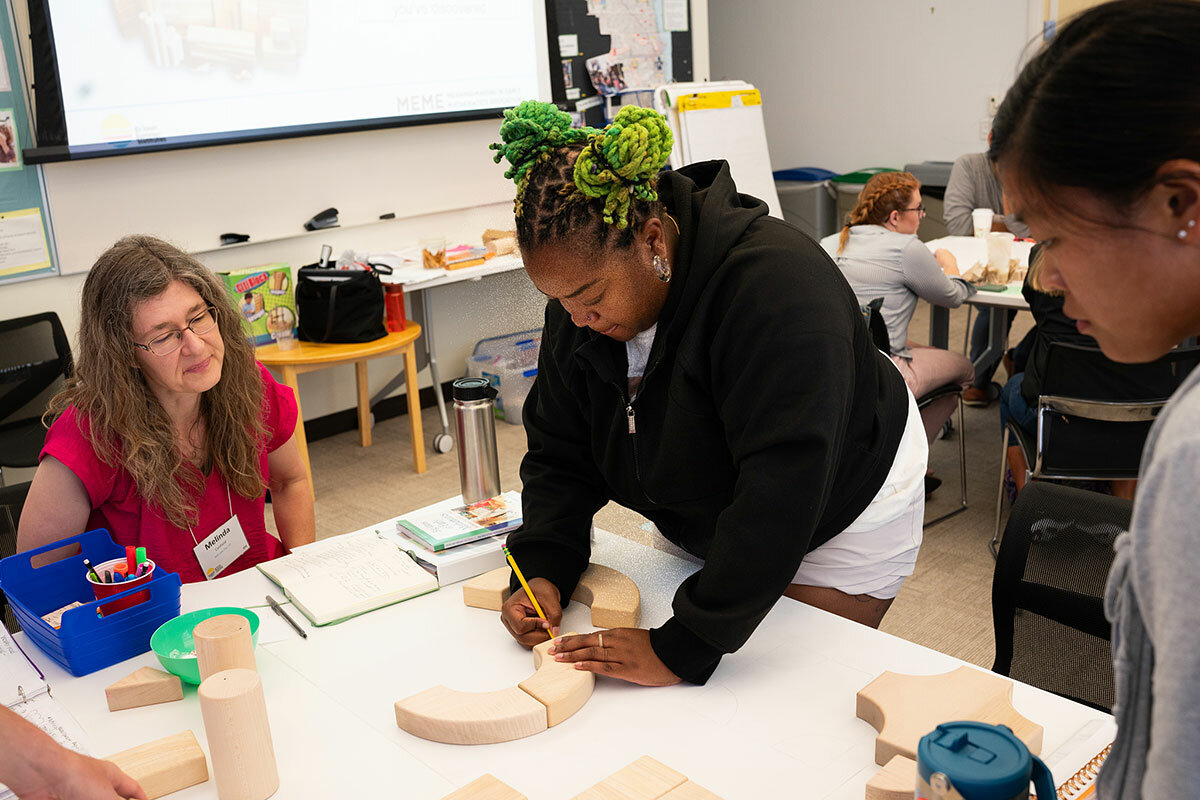
“At the Erikson Institute’s summer conference, teachers gained practice on concepts they’d use in their classrooms. They drew maps to describe directions: Rosie the hen traveled over the fence, and under the tree branch, and through the river, for example. They built large 10-sided shapes out of colorful blocks. The exercises benefited their own math skills, too. 

“ ‘There’s a misbelief that in order to teach early childhood math, you don’t really need to know math well,’ Lauren Solarski, a consultant and coach with the Early Math Collaborative at Erikson, told the group of educators. ‘But having that deep content knowledge, research finds, makes you then able to draw out what’s happening in a child’s play around math – what they’re doing – and know those trajectories, know the math inside and out so that you can be that expert when you’re with the child.’

“That doesn’t necessarily mean early childhood teachers need to be experts in advanced geometry or algebra, says Lisa Ginet, director of program design and operations at Erikson. But it does mean they need to know how different lessons that may not seem to be related to math are connected to mathematical thinking and to topics students will learn as they get older. …

“For Ms. McCormick, the early ed teacher from Atlanta, attending Erikson’s professional development conference was the next step in her journey to building up her math confidence. This year, Ms. McCormick moved up to teaching first grade at the Galloway School in Atlanta after teaching preschool and kindergarten classes at the school for several years. She credits her school’s decision to hire a math specialist last year with helping change the way she feels about teaching the subject. …

“ ‘This past year, I have kind of revamped my thoughts about what math can be and the ways that we teach it in order to make kids want to learn about it and be enthusiastic about it. Because the way we present it to them holds so much more weight than I think I ever realized.’ ”

More at the Monitor, here. No paywall, but your subscription will support good journalism.

Read Full Post »

Having blogged about the troubling documentary “Waiting for Superman” here, I thought you might be interested in hearing about a school district that has found one way to overcome a significant barrier to quality education.

The documentary’s critique of U.S. public education centers on the inadequacy of teacher evaluation and the near impossibility of firing bad teachers.

Montgomery County (MD) doesn’t have that problem. Can you guess why?

Deep, broad collaboration. Critical constituencies are in on the evaluation and the decisions about coaching and firing.

A June 5 NY Times story by Michael Winerip, “Helping Teachers Help Themselves,” explains.

“The Montgomery County Public Schools system here has a highly regarded program for evaluating teachers, providing them extra support if they are performing poorly and getting rid of those who do not improve. The program, Peer Assistance and Review — known as PAR — uses several hundred senior teachers to mentor both newcomers and struggling veterans. If the mentoring does not work, the PAR panel — made up of eight teachers and eight principals — can vote to fire the teacher. … In the 11 years since PAR began, the panels have voted to fire 200 teachers, and 300 more have left rather than go through the PAR process, said Jerry D. Weast, the superintendent of the Montgomery County system, which enrolls 145,000 students, one-third of them from low-income families. In the 10 years before PAR, he said, five teachers were fired. ‘It took three to five years to build the trust to get PAR in place,’ he explained.”  Read more here.

Having started out my work life as a teacher, I feel pretty strongly that teachers have been given a bad rap lately and that most are experienced, creative, and deeply dedicated (and overworked and underpaid). My daughter-in-law is also a teacher.

But there is no doubt that the bad apples are hard to fire and that every year that they get away with bad teaching turns thousands of children off the whole idea of education, to the lasting detriment of the nation. So I hope everyone will think about the PAR program described in the Times and how they might help influence school policy.

I will post comments sent to suzannesmom@lunaandstella.com.

Read Full Post »