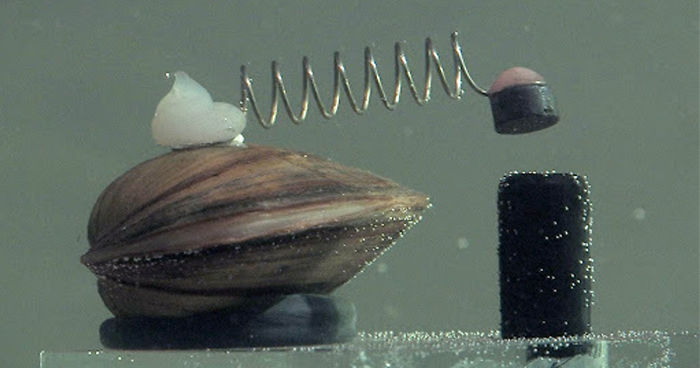
Photo: The documentary Fat Kathy.
In Warsaw, clams are used to test for toxicity in the water supply.
I have blogged before about the role of oysters and oyster shells in cleaning up polluted water (for example, here and here), but today’s story suggests other mollusks are equally hard at work.
Judita K writes at Bored Panda, “Some manmade things are better left to nature. [That’s why parts of] the world have decided to trust clams and mussels to monitor the cleanness of their water. Despite most of us being used to seeing clams on a fancy dinner plate, some of them get a more important mission — monitoring the purity of drinking water. …
“The water quality in Warsaw, the capital city of Poland, is monitored by … well, yes, clams. A Polish Tumblr user who goes by nickname Ftgurdy explained that the city of Warsaw gets its water from a river and ‘the main water pump has 8 clams that have triggers attached to their shells. If the water gets too toxic, they close, and the triggers shut off the city’s water supply automatically.’
“There’s a whole documentary on that, called Fat Kathy, and you can check out its trailer here. It follows how the main scientist-malacologist watches over the system’s operation. …
“Municipal Water and Sewage Enterprise in the Capital City of Warsaw confirms the use of fish and mussels for biomonitoring. They explain that they use biomonitoring at Warsaw Waterworks to increase the safety of the water treatment process. …
“The mollusks first undergo an acclimatization process after being caught and brought to the laboratory. It takes about two weeks. During that time, scientists also determine the natural opening of their shell — clams leave a slight opening and feed by filtrating water. Within one hour, one clam can filter and thus analyze the quality of 1.5 liters of water.
They live only in completely clean waters and shut their shells immediately if they sense any impurity.
“After completing their acclimatization process, clams are placed in a specially designed flow tank. They are connected to the system controller that sends data to a computer which records the degree that the clams’ shells are open all the time. If the water quality deteriorates, the clams close their shells to isolate themselves from the contaminated environment. That automatically triggers an alarm and shuts down water supply while scientists perform laboratory tests.
“In order for the clams not to get used to the water that’s being tested, they only serve for three months. After their service is done, they are transported back to the same water they were taken from and are marked by the scientists so they don’t pick up the same clams again.
“This Polish Waterworks company claims that this biomonitoring method is one of the most effective proven technologies for water quality testing. According to them, mussels monitor water quality for over 8 million people in Poland. Turns out, Minneapolis is using this method as well. Minneapolis Water Treatment and Distribution Services credit 12 mussels for keeping the water clean and safe.
“ ‘They are filter feeders, so they are feeding off of the water that’s in there, pulling the nutrients down,’ said George Kraynick of Minneapolis Water Works. ‘They live for up to 50 years, they are there 24/7 and they are happy in the tank, just feeding. [After they’ve served their time] most likely, we will just set them free in the river. … Minneapolis is currently the only city in the US that uses clams for biomonitoring.”
The writer also includes great comments on this technology from Twitter and elsewhere on the internet.
More at Bored Panda, here. No firewall. If you prefer your sources to be less like Tumblr and more like the Economist, click here.
Hat tip: John.
PS. You might also like to read how Dr. Thabile Ndlovu in Eswatini (formerly Swaziland) is building a national bank of water data to ensure the water is safe to drink: here. She and her team are particularly focused on the danger of heavy metals.








 Suzanne's Mom's Blog