Feeds:
Posts
Comments

Posts Tagged ‘turtle bunbury’


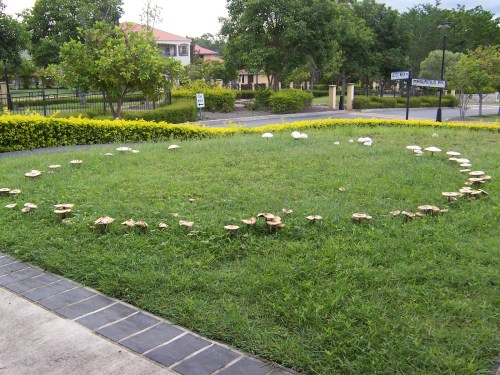
Photo: Irish History
In Ireland and elsewhere, a ring of mushrooms is thought to be a
fairy ring.

Turtle Bunbury posts lots of interesting stories about Ireland on Facebook, and recently he shared an article about the notoriously vengeful Irish fairies.

Michael Fortune, folklorist and filmmaker, writing at an Irish publication called the Journal, says that “there’s not a village in the country that doesn’t have these fairy stories. Our folklore tell us that they inhabit certain places: bushes, stones, corners of fields and especially old enclosures which number 40,000 plus around the country. …

“It’s generally claimed that we have lost some 10,000 since they were first mapped in the 19th century and this is mostly due to mechanisation and developments in agriculture, land reclamation etc.

“Growing up on the coast of Wexford my own late father brought me to every raheen in our area, while in the same breath showed me the spots where others once stood and most importantly, told me who was involved in removing them and the consequences they suffered. …

” ‘It’s not worth the risk,’ I repeatedly hear from farmers. …

“When the landscape changed due to developments in agriculture and field formation over the centuries, these physical spaces were left behind, untouched and this is where your fairy paths come into play. …

“We literally have thousands of stories relating to the consequences of building/interfering on such paths recorded in our archives or alive in the stories of communities around the country. …

“In extreme cases I’ve seen houses abandoned due to the torment brought on by the fairies. And if your DIY skills couldn’t fix it, you’d call for some outside expertise and I’m not talking Dermot Bannon here with his concepts of light and open spaces. No, more along the lines of those those ancient Druid like fellas with their prayers, magic water and long flowing cape ie the local parish priest.

“Although Rome mightn’t have agreed with their actions, there are numerous accounts of priests being brought in to perform exorcisms of sorts on such houses all over the country. In my own village in Wexford one such story still survives of a priest who was brought into a house which the fairies visited every night and after ‘driving the fairies out, he died three weeks later as a result of his efforts.’ Such was the power of the fairies.” More at the Journal, here.

I loved Fortune’s video of two believers. I especially loved their brogue since I failed to record James‘s speech, and now he’s gone.

Film: Michael Fortune
Two men discuss encounters with the fairies in Ireland.
Read Full Post »

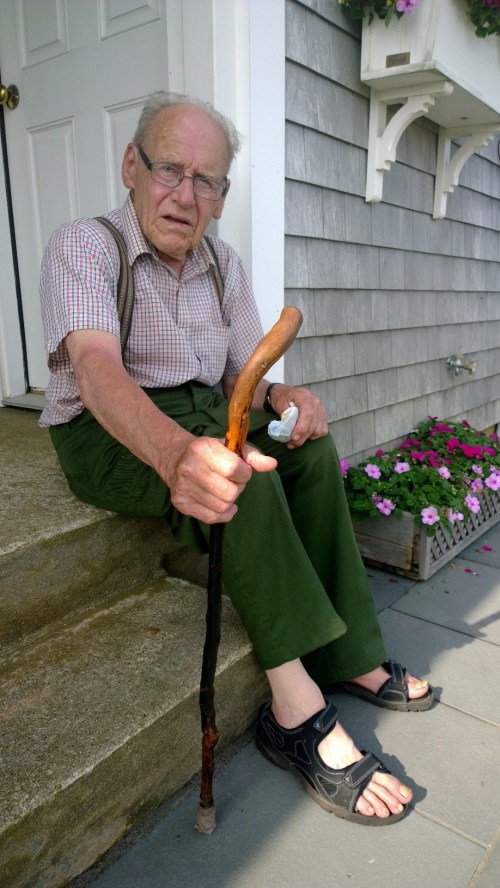
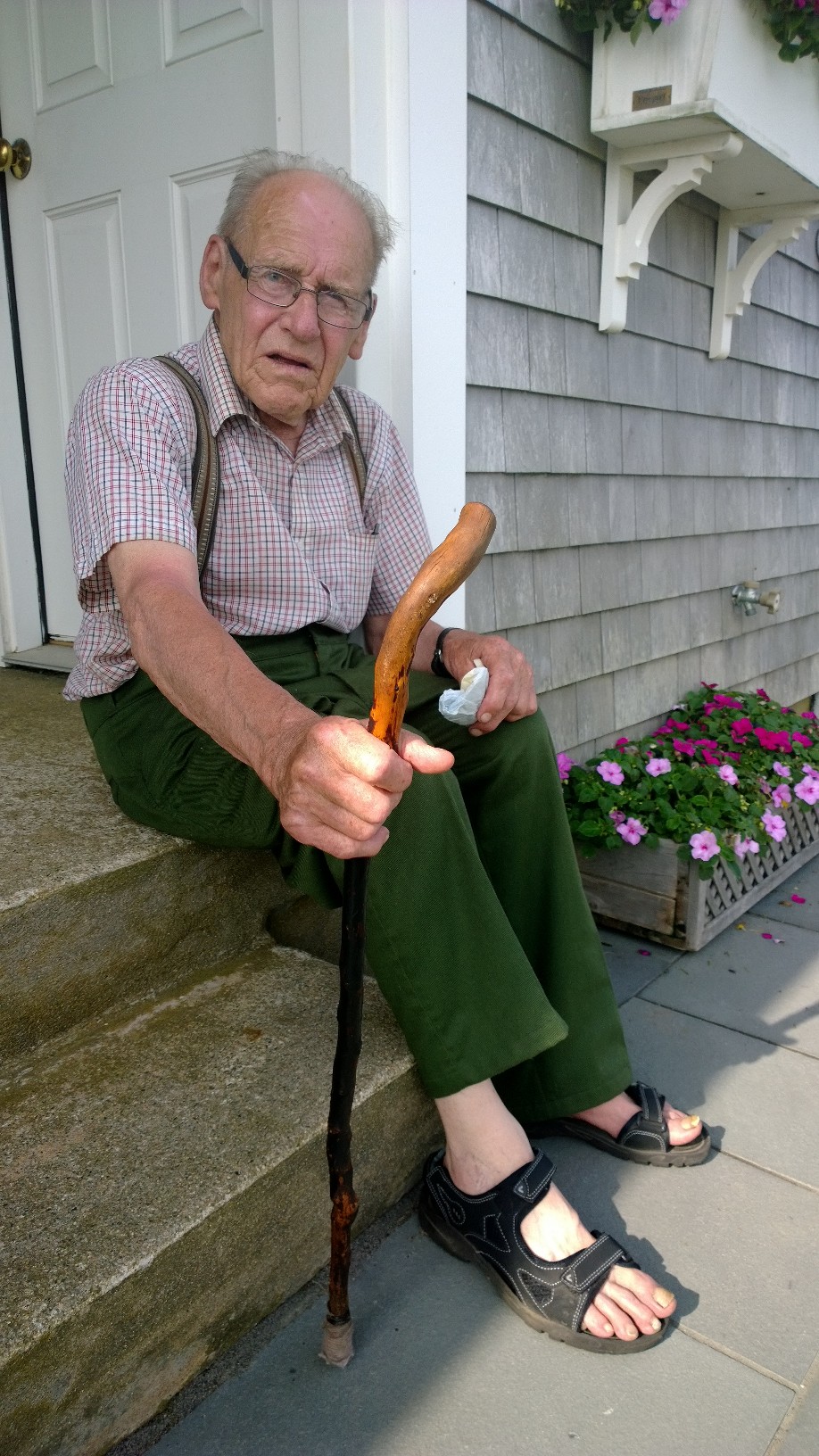
070314-james-hackettJames J. Hackett, storyteller and harness maker, Moate, Ireland, 1937-2017. Seen here visiting his Kelly cousins in Rhode Island.
The late James J. Hackett, quintessential Irish raconteur, did not have an easy life. But the joy he brought to people through his storytelling and kindness leads me to say he led the best kind of life.

I met James through his visits to his Kelly cousins in New Shoreham and wrote about him on the blog.

Turtle Bunbury, co-author with James Fennell of the Vanishing Ireland book series, interviewed James for volume 3, Recollections of Our Changing Times. He put these words on Facebook yesterday.

“Farewell, JJ Hackett (1937-2017), Harness Maker & Poet — Ballinakill, Moate, Co. Westmeath

James Fennell and I are very sad to learn of the passing of James J Hackett last night, 14 September 2017. He was an absolute gentleman and an inspirational man who, perhaps more than anyone we encountered during the Vanishing Ireland project, personified the resilience and generosity of his generation. Here is his story from the third volume of the series, which we post as a tribute to JJ and as a salutation to his brother Michael.

‘There is no doubting that JJ Hackett is one of the more unusual farmers in the parish. He quotes Wordsworth while stoking the Stanley stove.[i] He has a pet crow who can recognise strangers. He is a fan of the philosopher Edmund Burke and he knows plenty about the Abbé Edgeworth from Longford who blessed King Louis XVI as he awaited his execution.[ii] He’s also written his own memoirs, ‘Days Gone By’, for which he is justly acclaimed across the county. His tales are thoughtful but upbeat and give considerable insight into the rough ride he’s had along the way.

‘ “I was born with a deformity,” he says. “My right hip was out and it’s still out. Nurse Brophy, the midwife, didn’t realise. There’s a poem about her. ‘Here comes Nurse Brophy on her new Raleigh bike, out by Mount Temple and home by the Pike’. I didn’t walk until I was seven years of age simply for the reason that I couldn’t walk.[iii] And to this day I do tire easily, especially walking behind a funeral. …

‘Calamity struck in early 1949, the very same dark winter’s night that his younger sister Margaret was born.

“We weren’t long home from school but a tree fell on top of me. It broke the collar-bone, the cranium and it done in the right knee. I was put in a wheelbarrow and taken to Mullingar Hospital, broken up. I never went back to school. I was in hospital for about a year and ten months and I couldn’t walk for about two years.” …

‘Daniel secured his son an apprenticeship as a harness maker with a saddlery and upholstery business in Moate.[xii] His co-workers were an unusual trio whom JJ refers to as “the three deaf mutes.” None of them could speak or hear. And one of them, John Casey from Limerick, was operating with a single eye. “He lost his left eye with a needle when he was making mattresses,” explains JJ. “That taught me to keep the face turned away when I made them. And yet he could turn a collar for a horse, a mule, a donkey or a jennet.”[xiii]

‘They were the elite of harness makers.” ’

For more text, some footnotes, and good photos, see Turtle Bunbury on Facebook. Or buy the book. I wish I had recorded James’s rich brogue. I can almost hear it in Turtle’s interview. Can you?

Read Full Post »

I have decided that if Ireland ever names people as national treasures, it should include James J. Hackett of Moate.

Last night at the Kellys’ party, James clinked the glasses at the table and called everyone to attention. Then he recited Yeats’s poem “The Ballad of Father Gilligan,” preceding it with a little history and acting out all the parts.

The grandson of a man who taught Latin and Greek in a hedgerow school back in the dark days when the English forbade sending Irish children to school, James has taken it upon himself to preserve the culture. His ordinary conversation is a living history, and he is frequently dropping into poetry.

James’s book Days Gone By is written in the way he speaks when talking to friends or taking people on a tour of some ruin. Consider this sample.

“It was long past the witching hour when the poteen revellers came upon Kate resting on the puchann and in a most distressful state.* They took her along to the wake, where she related all her adventures. Great was the wonder and fear that was expressed at hearing this story, and needless to say, many a post mortem was held upon Kate Brambles’s account of the witches’ dance at the half way house in Ballylurkin Bog on the Hallow’een night that Tubbs Lanigan was waked.”

Recent chronicler of Ireland lore and customs Turtle Bunbury discovered James in Moate and has included him in one of his Vanishing Ireland books. Bunbury also features James on a Facebook page, which I hope to access as soon as Turtle accepts my friend request.

[Update: Turtle has just put my post on his page, here.]

You may recall that I blogged about James once before, here, at another time that he was visiting his Rhode Island cousin.

(*James says a “puchann” is a little hill in a bog.)

Photo: Suzanne’s Mom
James J. Hackett in New Shoreham. He made his own shillelagh of blackthorn. He also made one for John and mailed it to him with instructions on how to cure the wood.

070314-james-hackett


Read Full Post »