Feeds:
Posts
Comments

Posts Tagged ‘underwater’

Photo: Alessandra Benini.
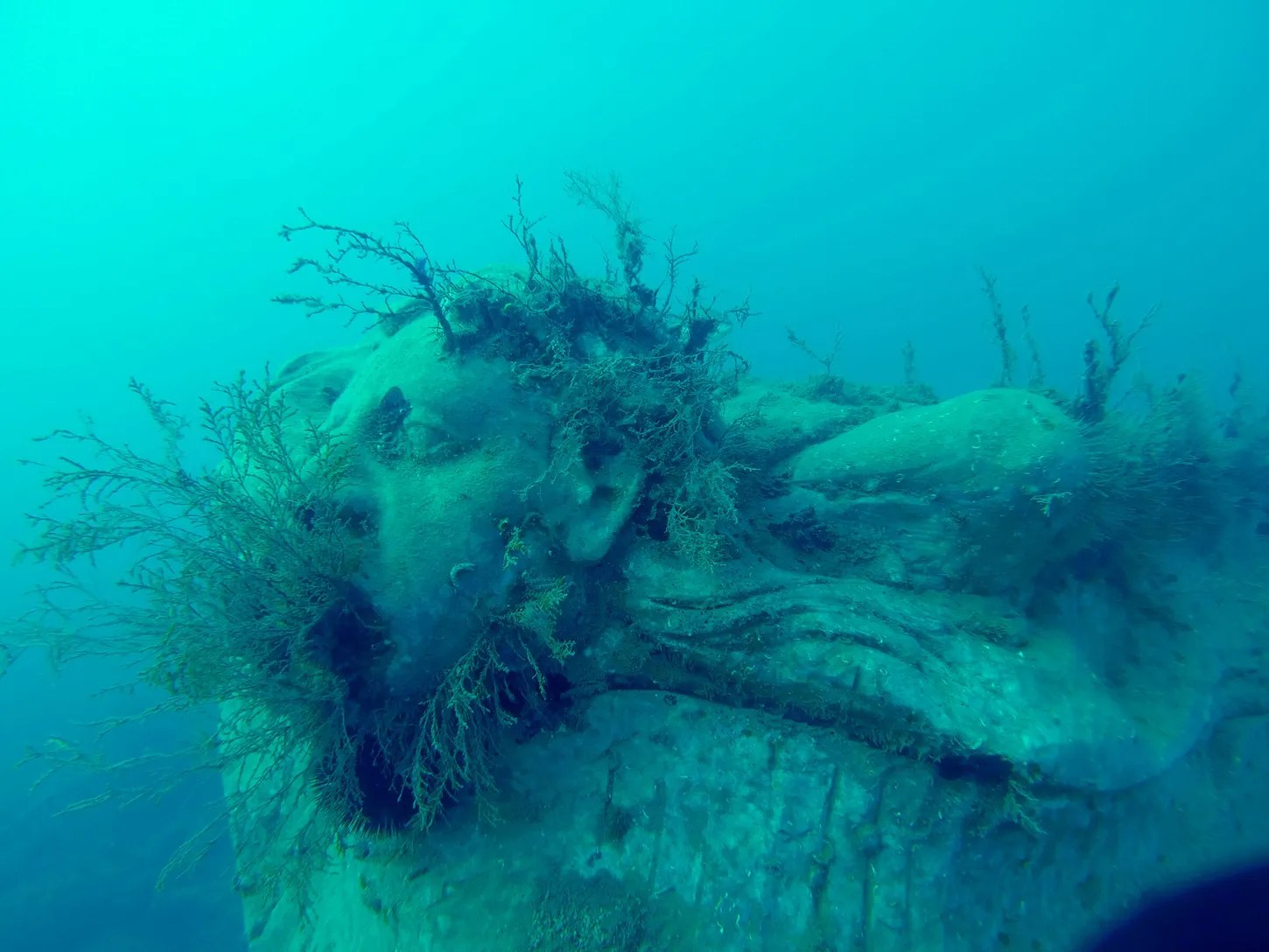
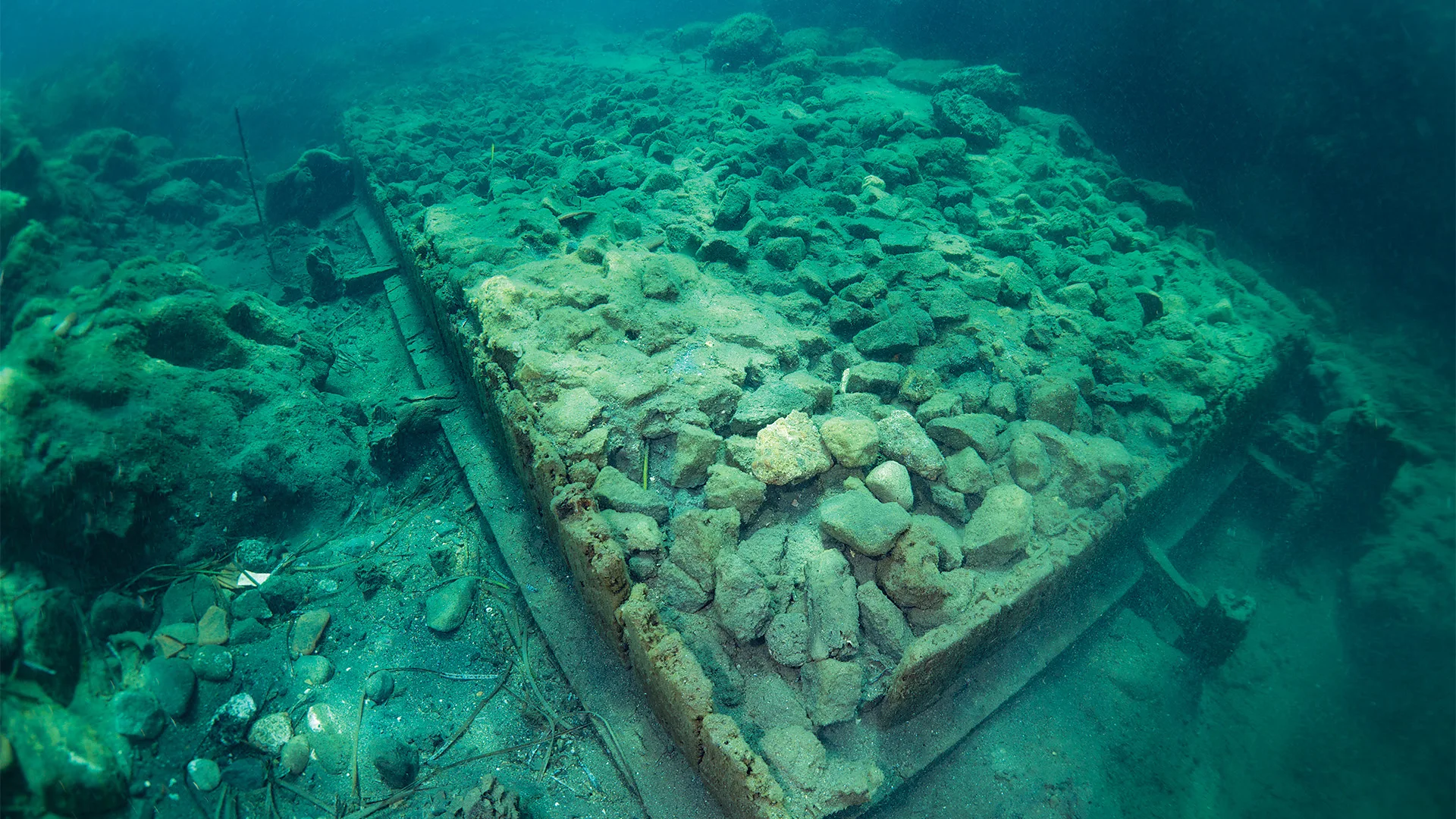
The ruins of Aenaria were buried in the sea for nearly 2,000 years, preserved underneath volcanic sediments.

Today’s story is about finding Aenaria, a Roman port that disappeared under the sea after a volcano erupted. Eva Sandoval at the BBC begins by describing a tour you can take there if you are interested in archaeology.

“As our tour sets sail, the vast Bay of Cartaromana opens up before us. Jagged cliffs shoot up from the waves; sunbathers sprawl on the inlet bridge leading to the 2,500-year-old Aragonese Castle. … After just 10 minutes at sea, we reach a network of buoys marking the ruins below. I press my hands against the vessel’s transparent bottom. Through the turquoise-blue water, between waving fields of seagrass and small striped fish, I glimpse a pile of rocks. Then the seagrass parts and I see that the rocks are arranged into a long rectangular form, its sides encased in wooden planks. This is an ancient city’s quay; buried in the cool dark for centuries and perfectly preserved. …

“I am on the Italian island of Ischia, where sometime around AD180, the Cretaio volcano erupted, and the ensuing shockwaves sank the Roman port city of Aenaria beneath the sea.

“At least, that’s what archaeologists think happened. … There are no records of the explosion, and very little written about the settlement itself. For nearly 2,000 years, there was no physical trace of it either. …

“The first hints of its existence were in 1972, when two scuba divers found Roman-era pottery shards and two lead ingots off Ischia’s eastern shore. The find intrigued archaeologists, but the ensuing investigation, helmed by local priest Don Pietro Monti and archaeologist Giorgio Buchner, yielded nothing. … The case went cold for nearly 40 years.

“Then, in 2011, passionate local sailors reopened the excavation, this time digging into the sea floor. Soon, they were able to confirm that 2meters beneath the bay’s volcanic seabed lay the ruins of a massive Roman-era quay. …

“As far as anyone had ever known, Ischia’s DNA was Greek. The island was renowned as the site of the first Greek colony in the Italian peninsula, established around 750BC in the north of the island. …

“When the Romans seized Pithecusae sometime around 322BC, they renamed the island Aenaria – a name that appears in ancient texts from Pliny the Elder to Strabo, often in relation to military events. But unlike the Greeks, who left behind a necropolis, kilns and troves of pottery, the Romans left only a few modest tombs, engravings and scattered opus reticulatum. …

” ‘The name was documented,’ echoes local resident Giulio Lauro. ‘But no one could find the place.’ Archaeologists had been looking for Roman Ischia on dry land, but it was buried below the sea.

“Lauro is the founder of the Marina di Sant’Anna; the cultural branch of the Ischia Barche sea-tourism cooperative. Along with various affiliated cultural groups – comprised of Ischian seafarers, history enthusiasts and archaeologists – they have self-funded the excavations for the past 15 years.

“Lauro is quick to tell me that he’s no scientist. ‘But I love the sea,’ he said. ‘In 2010, I got the idea to look again.’ …

“There were challenges, recalls Lauro: ‘Getting authorizations, training people, sourcing funds. We started from zero. We were lucky to believe in it. And then to actually find it.’ …

” ‘It was believed that the Romans never built a city on Ischia,’ says [Dr Alessandra Benini, the project’s lead archaeologist]. ‘It was the opposite.’ …

“Each summer, Benini and her team excavate the sea floor. Progress is painstaking due to a perennial shortage of funds. … During the site’s active months, curious visitors can take glass-bottomed boat tours, as well as snorkelling and scuba excursions to get even closer to the ruins. ‘You can see the underwater archaeologists at work, the equipment they use and everything involved,’ says Benini. …

“I ask Benini what she hopes to find this summer.

” ‘My dream is to find the foundations of the residential city,’ she says. ‘If we’ve found the port, then we know there was a city.’  

“The team hopes to introduce Lidar, Georadar and sub-bottom profiler instruments into the digs, but Benini points out, ‘That’s expensive. We need more investors.’ “

Lots more at the BBC, here. No paywall.
Read Full Post »

Photo: Rob Schoenbaum/The Guardian.
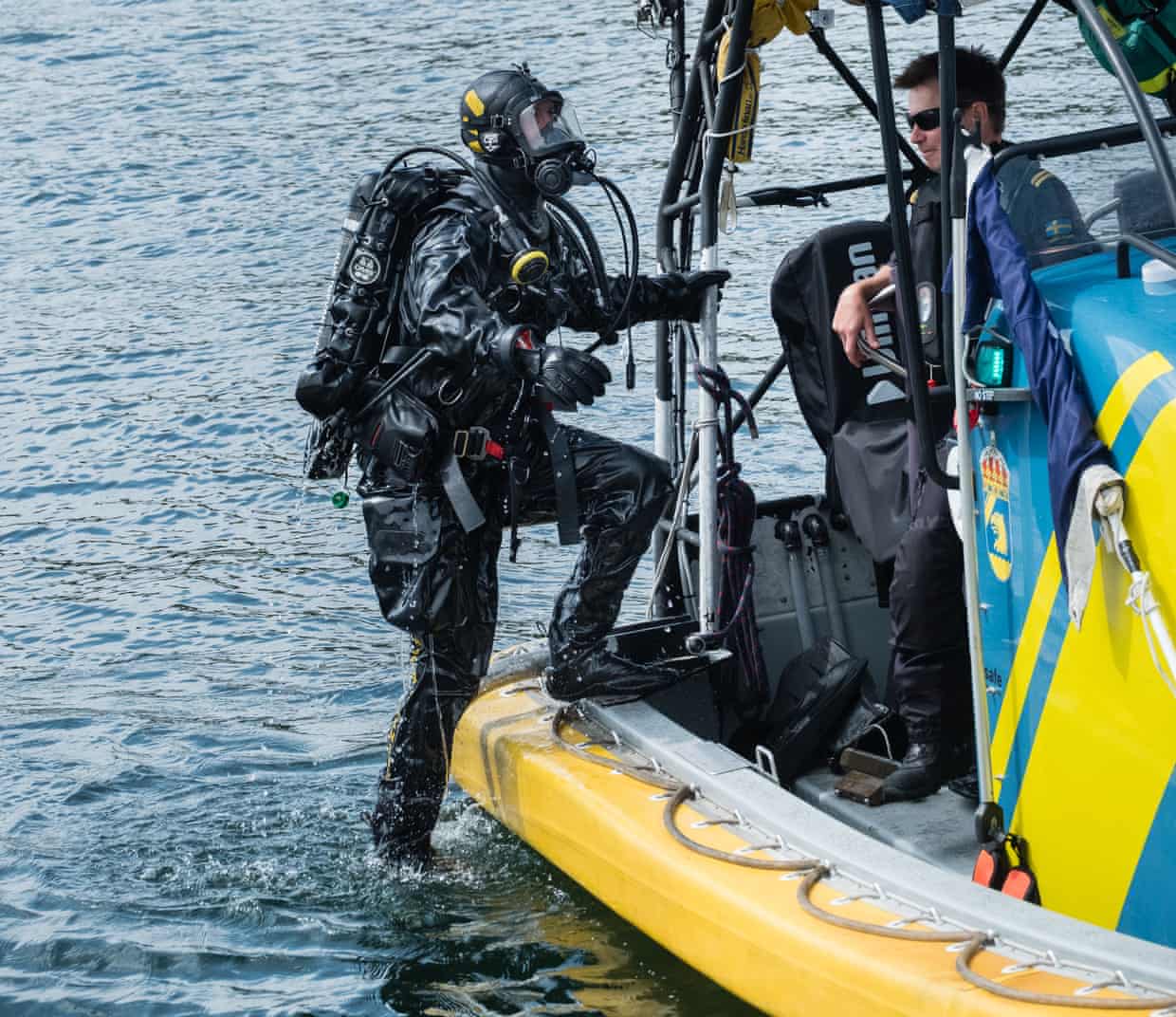
A Swedish coastguard diver exits the water after inspecting a wreck.

So many different kinds of work in the world! Today’s article, from the Guardian, describes an unusual job in Sweden. It involves going underwater to protect old shipwrecks from looters.

Miranda Bryant writes, “Among the rocky shores and wooden summerhouses of Dalarö, an exclusive Swedish summer retreat, there was little to indicate anything other than a typical summertime scene on the Stockholm archipelago.

“It was only as the coastguard boat reached a discreet yellow buoy that there was any suggestion of the 17th-century shipwreck lying, preserved, 30 metres beneath it. ‘STOP,’ read a sign. ‘Marine cultural reserve.’

“Bodekull, built by the English shipbuilder Thomas Day, is believed to have run aground in 1678 and sunk while transporting flour to the Swedish naval fleet in Kalmar, down the coast in south-east Sweden.

“Thanks to the Baltic’s brackish water protecting the wreck from shipworms, the 20-metre-long ship remains on the seabed, upright and largely intact, full of relics that are still being discovered. Two of its three masts poke up towards the sky in their original position.

“But now Bodekull faces a human threat to its existence. Authorities say that it is among thousands of historic wrecks across the Nordics that are at risk from plundering.

“On a monitoring operation last week, experts shared photographs with the Guardian that show that objects are vanishing from shipwrecks.

“Those responsible are believed to be a diverse array of offenders, from light-fingered sport divers in search of souvenirs to criminal gangs looking for high-value objects to sell. Such is the scale of the problem that the coastguard is now regularly sending divers down to monitor at-risk sites.

“ ‘The plundering problem isn’t just a Swedish problem, it’s a Baltic Sea problem,’ said Jim Hansson, a marine archaeologist at Vrak, the museum of wrecks, citing the sea’s low salinity and comparatively shallow average depth of 55 metres.

“These unique conditions, as well as the existence of an estimated 100,000 shipwrecks, make the Baltic a ‘mecca for marine archaeologists,’ he said. But it’s also increasingly attracting looters. Around Stockholm alone, Hansson knows of six wrecks that have been looted by international and Swedish divers. …

“ ‘Sweden has one of Europe’s longest coasts so it’s a lot of water to guard and it isn’t easy,’ said Hansson. …

” Coastguard divers normally work on environmental disasters, inspect ships for drugs and weapons and help police looking for murder weapons. ‘It is very unique for us to be part of this,’ [Patrick Dahlberg, a coastguard commander] said. …

“[On August 1] Coastguard diver Patrik Ågren said he didn’t see any evidence of tampering as he emerged from recording the contents of a tool drawer on the ship containing planes, sledgehammers, a basket and carpentry equipment. … Video footage he recorded during the dive will be compared with previous footage to check for changes.

“But on a later dive they discovered that a wheel on a cannon had been removed, a deck beam collapsed and a wine bottle moved since they last visited in January. While some of the changes may have been caused by nature, Hansson said it was difficult to see how the wheel and wine bottle could have been moved without human intervention. …

“Hansson said removing relics from wrecks prevented them from building a full picture of the type of ship, where it was going and what it was doing.

“ ‘We collect all the puzzle pieces just like a police or coastguard investigation,’ he said. ‘That’s why it is super important that objects are not moved because it is like ripping the pages from a book. In the end all you will have left is an empty shell.’

“Amid heightened tensions with Russia after its invasion of Ukraine, allegations of spying and Sweden’s hopes of imminently joining Nato, it is a critical time for the Baltic.

“But Hansson said that cultural monuments could also be used in war. ‘What happened with Nord Stream [gas pipeline bombings] could similarly happen with national cultural heritage monuments like shipwrecks. The first thing that happens with big conflicts is that you erase a nation’s integrity and history.’ ”

More at the Guardian, here.

Read Full Post »

Photo: Wikipedia.

There are so many things on this beautiful planet that we’ve never given much thought — things that turn out to be important for our future. Insects, for example, fungi, seagrass.

Allyson Chiu , with Michaella Sallu contributing from Sierra Leone, has written about seagrass research for the Washington Post.

“From the deck of a small blue-and-white boat, Bashiru Bangura leaned forward and peered into the ocean, his gaze trained on a large dark patch just beneath the jade-green waves.

“ ‘It’s here! It’s here! It’s here!’ crowed a local fisherman, who led Bangura to this spot roughly 60 miles off the coast of Freetown. ‘It looks black!’

“Bangura, who works for Sierra Leone’s Environment Protection Agency, tempered his excitement. After two unsuccessful attempts to find seagrass in this group of islands, he questioned whether the shadowy blotches were meadows of the critical underwater greenery he and other researchers have spent the past several years trying to locate along the coast of West Africa.

“It was only once he was standing in the waist-high water, marveling at the tuft of scraggly hair-like strands he’d uprooted to collect as a sample, that he allowed himself to smile.

“The wet, reedy plants Bangura held in his hands were unmistakably seagrass, and the green blades stretched past the plastic 12-inch ruler he’d been using to measure specimens. His grin grew even wider.

“The dense grass swaying in the current appeared to be healthy, and the water teemed with schools of small, silvery fish, making it the best site researchers have documented in these islands since the existence of seagrass was first confirmed in Sierra Leone in 2019. …

“Seagrasses — which range from stubby sprout-like vegetation to elongated plants with flat, ribbon-like leaves — are one of the world’s most productive underwater ecosystems. The meadows are vital habitats for a variety of aquatic wildlife.

Sometimes described as ‘the lungs of the sea,’ the grasses produce large amounts of oxygen essential for fish in shallow coastal waters.

“But, long overlooked, these critical ecosystems are vanishing. In fact, researchers don’t know exactly how many exist or have been lost. One recent study estimated that since 1880, about 19 percent of the world’s surveyed seagrass meadows have disappeared — an area larger than Rhode Island — partly as a result of development and fishing.

“ ‘When you lose foundation species like seagrasses … then you lose fisheries really quickly,’ said Jessie Jarvis, a marine ecologist who, until recently, headed the World Seagrass Association. …

“But locating grasses in the world’s vast oceans is a formidable task. While some researchers are using drones and satellite imaging, in countries such as Sierra Leone, where resources are scarce, the search is painstaking and tedious.

“Without these efforts, though, seagrasses would probably be disappearing even faster.

“ ‘What we don’t know, we can’t protect,’ said Marco Vinaccia, a climate change expert with GRID-Arendal, an environmental nonprofit that helped put together West Africa’s first seagrass atlas. …

“Similar to terrestrial plants, seagrasses have roots, leaves, flowers and seeds. Seagrasses have been discovered in the waters off more than 150 countries on six continents. The meadows are estimated to cover more than 300,000 square kilometers, an area the size of Germany. Along with mangroves, kelp forests and coral reefs, these grasses play a vital role in maintaining healthy oceans, Jarvis said. But unlike those other ecosystems, she notes, the meadows can exist in a wider range of ocean environments and tend to be more resilient than most species of seaweed.

“Critters, such as sea horses, crabs and shrimp, along with juvenile fish — some of which are critical species for fishing — often lurk within the thick meadows, seeking refuge beneath the underwater canopy. Other creatures, including sponges, clams and sea anemones, can be found nestled between the blades of grass or in the murky sediment at the base of the plants. And much as mosses coat trees, many species of algae grow directly on the leaves.

“Seagrass beds can in turn attract larger animals, including turtles and manatees, that stop by to munch on the leaves and stems. …

“From the leaves down to the roots, these unassuming plants work as ‘ecosystem engineers.’ Through photosynthesis, they help fill the surrounding water with oxygen. The leaves also absorb nutrients, including those in runoff from land, while their roots stabilize sediment, which helps to reduce erosion and protect coastlines during storms.

“Seagrasses also have the potential to play a significant role in combating climate change. Just as trees pull carbon from the air, seagrasses do the same underwater. Then, as the carbon-filled parts of the plants die, they can wind up buried in the sediment on the seafloor. Over time, this can help create sizable carbon deposits that could remain for millennia.

“But the grasses aren’t showy like coral reefs or immediately recognizable like mangroves, and they’ve become one of the least protected coastal ecosystems.”

Read more about what is being done here, at the Post.

Read Full Post »

Photo: University of South Florida.
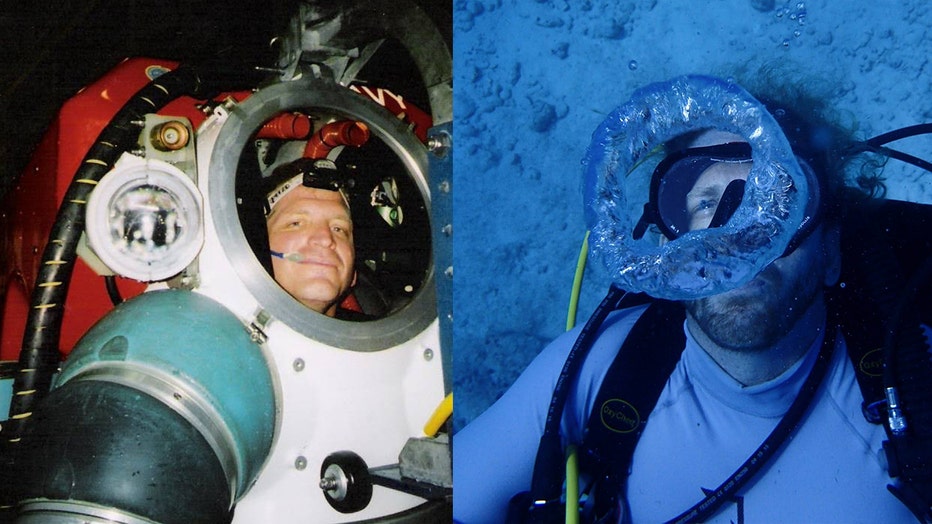
Joseph Dituri retired from the Navy as a commander after 28 years and went back to school. He is now a hyperbaric medicine researcher and associate professor at the University of South Florida.

How much do you love the ocean? Enough to live in it for more than 75 days without coming up? In May, Kyle Melnick at the Washington Post wrote about a guy who did that.

“Joseph Dituri, a hyperbaric medicine researcher and associate professor at the University of South Florida, has been living in an underwater pod in Key Largo, Fla., since March 1. He’s exploring whether living underwater is possible through daily tests on his brain, heart, lungs and blood.

“On [his] 73rd day at Jules’ Undersea Lodge — Dituri believes he broke the world record for the longest stint living underwater. But Dituri, 55, is still determined to live submerged for 100 days to complete his experiment.

“ ‘It’s not about the world record,’ Dituri told the Washington Post. ‘It’s about living underwater and in an isolated, confined, extreme environment. I have 100 days as the mark, but it’s only because I couldn’t afford to spend 200 days.’

“Dituri has long been fascinated with water. He grew up near the Atlantic Ocean in Long Island and served in the U.S. Navy for nearly 28 years before retiring as a commander in December 2012.

“Around that time, Dituri was scuba diving near Orange County, Calif., when he said he saw an 11-inch sea lice. He had believed all sea lice were only a few millimeters long. He wondered what other species he could discover in the sea.

“Dituri knew living underwater was possible. In 2014, two Tennessee professors stayed in Jules’ Undersea Lodge, an underwater hotel in Key Largo, for 73 days. Since watching his military colleagues suffer concussions during the wars in Iraq and Afghanistan, Dituri has studied treatments for traumatic brain injuries. He wondered whether living underwater in a pressurized environment could aid brain injuries. …

“Dituri needed more degrees to become a researcher, so he earned a PhD in biomedical engineering from the University of South Florida in December 2017. In 2019, Dituri and four friends stayed at Jules’ Undersea Lodge for five days to test underwater life. But Dituri wanted to be submerged longer, and by himself, to see how his brain and body would respond. …

“Before Dituri went underwater, doctors recorded his vitals, including blood pressure, cholesterol, calcium levels, muscle inflammation and stem-cell health. He also underwent anxiety and depression exams with psychologists.

“Dituri booked a 100-square-foot pod — similar to a 10-by-10-foot room — that rests 22 feet underwater. The lodge gets electricity, oxygen and water from a cord connected to land. Dituri also attached an ethernet cable to a router on land for internet access. The pod has a small kitchen, toilet, shower and bedroom.

“Every three days, Dituri said his research colleagues swim to his pod to deliver food, including eggs and salmon, in a pressurized container. But Dituri can only cook in a microwave because of the increased pressure in the sea. He also makes Café Bustelo coffee every morning. Dituri still teaches his hyperbaric medicine and biomedical engineering classes virtually three days per week for the University of South Florida.

“He exercises with resistance bands and takes vitamin D supplements. But his main research has come from tests on his body. He frequently takes urine samples and has undergone electrograms, which record brain and heart activity. …

“Dituri said that his cholesterol and stress have dropped, that he spends more of his rest in REM or deep sleep, and that he has produced stem cells at a faster rate. …

“Still, Dituri has missed human touch. He only sees his girlfriend and three daughters virtually. … On Saturday, Dituri’s 80-year-old mother, Mary, will take a scuba-diving course so she can visit her son.”

More at the Post, here.

Read Full Post »

Photo: Casa Dei Pesci.
A sculpture named ‘Acqua’ by Giorgio Butini is one of 39 underwater sculptures helping to deter illegal fishing off the coast of an Italian port.  

Here’s a creative idea to thwart illegal activity: attract enough sightseers to make it too public to pursue. Today’s story shows how environmentalists, artists, and a fishing community in Italy are collaborating on shared goals.

Veronique Mistiaen writes at National Geographic, ” ‘The stone is asking me to give it the right face: it is thoughtful, quiet,’ says British stone sculptor Emily Young. She carves boldly, clad in a thick jacket, leather hat, sturdy boots, face mask and ear plugs, but no gloves because ‘you need to feel what’s happening with the stone through the tool.’ …

“Young, who has been called ‘Britain’s greatest living stone sculptor,’ has work exhibited and collected around the world, but it is the first time that one of her creations reposes at the bottom of the sea.

“Young’s 18-tonne Weeping Guardian and two other colossal faces (The Gentle Guardian and the Young Guardian), which she carved in Carrara marble with the help of two associates over five days, were lowered down on the sea bed off the coast of Tuscany at Talamone, a town between Florence and Rome, in 2015. There, her massive stone guardians are protecting marine life against gangs trawling illegally at night.

“Young’s unusual work is part of an on-going project by local fisherman Paolo Fanciulli and his non-profit Casa dei Pesci to try to protect the sea in a creative way. There are now 39 underwater sculptures and marble blocks at Talamone, placed in 2015 and 2020, and another 12 are ready to join them as soon as necessary funds can be raised.

“Bottom trawlers drag their heavy-weighted nets multiple times over the sea floor, scraping it bare and destroying the Posidonia (Posidonia oceanica), known as Neptune grass, a flowering seagrass endemic to the Mediterranean, which forms large underwater meadows and acts as a nursery and sanctuary for all marine life.

The Posidonia also soaks up 15 times more carbon dioxide annually than a similar sized piece of the Amazon rainforest.

“For these reasons, the Posidonia is a protected species included in the EU’s Habitats Directive and the Marine Strategy Framework Directive, and bottom trawling is illegal within three nautical miles from the coast in Italy. But because it is very profitable, and impossible to police the 8000km of Italian coastline, boats carry on at night regardless. 

“Now in his 60s, Fanciulli has been fishing around Talamone since he was a teenager.  In the 1980s, he started noticing the devastation caused by bottom trawlers and the impact it had on his and other local fishermen’s catch and livelihood. He has been trying to fight them ever since.

“In 2006, he joined force with the municipality of Talamone and a few environmental organizations to drop big concrete bollards on the bottom of the Mediterranean to ‘serve as secret agents under the sea.’ The action received media attention and he became a national hero – but it wasn’t enough to deter the trawlers. The local mafia also retaliated by making sure he couldn’t sell his fish at the market, and threatening him.

“He needed to find another way. ‘He thought: “This is Italy. We do art. If we could put art and conservation together, we might have more impact,” ‘ explains Ippolito Turco, a friend of Fanciulli and president of the non-profit Casa dei Pesci, which they created together for that purpose with the support of several cultural and environmental associations.

“They asked nearby Carrara quarries if they could donate a few stones. Franco Barattini, the president of one of Carrara’s best-known quarries – Michelangelo cave, the very place where the eponymous artist came at the turn of the 16th century to select stones for his iconic David and Pietà statues – promised to donate not a few, but 100 huge blocks of marble.

“Young, along with Italian artists Giorgio Butini and Massimo Lippi, and other artists from four countries, was asked to carve the marble blocks. ‘We all donated our time. I thought it was a brilliant project: it would attract more attention to the problem,’ says Young. …

“The sculptures were placed in a circle, four metres apart around a central obelisk, carved by Massimo Catalani, another Italian artist. A bit further sleeps a mermaid, a collaboration by sculptor Lea Monetti and young artist Aurora Vantaggiato, and a reclining figure by Butini, among other works.

“The marble sculptures create both a physical barrier for the trawlers’ nets and a unique underwater museum, open to anyone either through arranged scuba diving tours or their own dive. “It’s really beautiful and it’s amazing to see how easy it is for nature to recover. …

“The scheme has completely stopped illegal trawling within three miles off shore in front of Talamone as far south as the mouth of the Ombrone river, Turco says. ‘But now the pirate boats have moved north of the Ombrone. Casa dei Pesci plans to protect this stretch of sea as well.’ “

More at the Geographic, here. Needless to say, the photos are wonderful. No firewall.

Read Full Post »

Photo: Kino Lorber.
The film The Village Detective: A Song Cycle, directed by Bill Morrison, is a project that got started after an Icelandic fisherman pulled up an old Soviet movie from the depths.

Remember this post on repurposing 1980s photos of New Orleans street life damaged by Hurricane Katrina in 2005? Today’s story on waterlogged 35mm film found by a fisherman reminds me that creative people keep discovering ways of working with damaged art to convey deeper messages. It’s as if the lost island of Atlantis wants to break through to our modern world.

Dan Schindel reports at Hyperallergic, “In 2016, a fisherman dredged up a case off the coast of Iceland that contained four reels of decades-old 35mm film. It looked like the beginning of an inspirational story about a precious movie rediscovery. But, anti-climactically, he’d merely found pieces of the 1968 Soviet mystery-comedy Derevenskiy Detektiv (‘Village Detective’) — which was, as filmmaker and historian Bill Morrison puts it, ‘not lost, rare, or even, to my mind … particularly good.’

“But such an unusual event still deserved scrutiny. What circumstances led this particular film to this completely unexpected place? Morrison’s investigation resulted in his new film The Village Detective: A Song Cycle.

“Morrison constructs his films — such as Decasia (2002) and The Great Flood (2013) — from raw, unrestored fragments of celluloid. In 2016’s Dawson City: Frozen Time, he told the story of a much more exciting rediscovery, how hundreds of lost films were dug up from under a skating rink in the Yukon. He showcases the images of these movies with every scratch, fade, and blur included.

“Each film print records two stories: the one a crew conjured together however long ago, and the record of everything that’s happened to the strip since its creation. The vagaries of the projection, transportation, and preservation of physical film leave it vulnerable to damage. Many archival projects focus on the first story, but Morrison is interested in both. …

“Finding some reels of Village Detective may not in itself be remarkable, but this specific reel has its own unique story, and Morrison finds value in that. His interrogation of the water-warped images becomes a rumination on mortality.

Village Detective starred Mikhail Zharov. To several 20th-century generations of Russians, he was a vital figure, an acclaimed and popular actor who worked with many of the titans at the forefront of Soviet cinema development, including Sergei Eisenstein. … Morrison was told about the fisherman’s discovery by his friend Jóhann Jóhannsson. …

“Through images of Village Detective and Zharov’s other films, as well as pieces from contemporary Soviet cinema and modern-day interviews with historians and preservationists, Morrison reconstructs the actor’s life and times, tracing the path of his career.

“The discovery of his work entombed at the bottom of the sea precipitates the audience’s own rediscovery of him — through the use of his films, that rediscovery becomes something like a resurrection. He’s dead, he’s gone, and yet there he is again. He may be hard to discern through the haze of distorted colors or the flurry of scratches, but you can appreciate the way he acts. …

“The past is supposed to just be what we remember, and yet in the act of watching a film, we are in communion with it. From what could have merely been a curiosity, Morrison constructs a haunted, haunting meditation.”

Whenever I see an offbeat movie like this (the most recent being Agnes Varda’s The Gleaners and I), I think of my friend Penny, now gone. She used to make offbeat, artsy but messy Super-8 films back in the ’60s, and I helped. Even though we both worked in the mornings, Penny was a great one for dragging me out of my apathy to go to downtown Philadelphia for a Kenneth Anger flic or an Andy Warhol. Sure do miss her.

More at Hyperallergic, here.

Read Full Post »

Art: Diana Beltrán Herrera
The artist makes birds and other wildlife from paper and in recent years has started to use her art to support nonprofits fighting for the environment.

Although it is not new for artists to celebrate nature — a compulsion dating at least to prehistoric cave paintings — there’s a new sense of urgency in the era of global warming.

In a 2018 article in the New York Times, for example, 12 artists described how the crisis is influencing their work.

Here artist Xavier Cortada explains to the Times why he made a work showing residential street numbers underwater. “In response to South Florida’s vulnerability to rising sea levels, the village of Pinecrest, Florida will encourage its 6,000 households to install an ‘Underwater HOA [Homeowner Association]’ yard sign (similar to the 18- by 24-inch ‘Home for Sale’ yard signs used by realtors) on their front lawns during the first week of December. I numbered each yard sign from 0 to 17 feet (the municipality’s land elevation range) to show how many feet of melted glacial water must rise before a particular property is underwater.” Oy.

Art: Xavier Cortada
This painted sign is a marker that someone can plant in their yard showing that the property would be underwater with a sea-level rise of five feet.

Meanwhile, the fascinating website This Is Colossal has for some years been following the amazing paper creations of Diana Beltrán Herrera as she expands from birds she knows to environments she has never seen to helping nonprofits battle climate change.

Grace Ebert writes, “In 2012, Bristol-based artist Diana Beltrán Herrera [began] sculpting impeccably layered paper birds and other wildlife as a way to record her surroundings. Her lifelike pieces continuously have captured nature’s finely detailed and minuscule elements, like the fibrous texture of feathers and the veins running through leaves.

“Today, the artist has expanded the practice to include exotic species and environments she’s never seen up close, developing her paper techniques to express the more nuanced details of the shapes and textures she studies in biology books. Now focusing on the structural elements of fungi, fruit, and florals, Beltrán Herrera shares with Colossal:

‘Paper as a medium for documentation allows me to register and create notions and ideas of subjects that I have not experienced in real life but that I can experience when a sculpture is completed. I like this approach because it is not harmful, and through my work, I can show and tell my viewers about the things I have been learning, of the importance of nature just by researching and making it myself.’

“Much of her work centers on conservation efforts and environmental justice. For example, a recent commission by Greenpeace UK bolstered the organization’s Plastic Free Rivers campaign. ‘I am constantly looking for more subjects that are relevant to the times we are living in, so that through my work I can communicate important information that can educate or just make things more visible.’ …

“Her hope is to merge graphic and digital design with her paper pieces, potentially adding in animation, as well. Ultimately, her goal is to dive into larger projects. ‘I don’t see my work as something I want to know how to make and stay safe, but as a challenge, that will always allow me to wonder how to execute and create things that were never made with paper,’ she says.” More.

Other Colossal articles on the artist’s work can be found here. Follow her on Instagram, @dianabeltranherrera.

A musical composition created from climate-change data is another example of using an art to raise consciousness about the current state of the natural world.  From the website Science News for Students.

Read Full Post »


Image: The Art Newspaper
Alexander Ponomarev’s underwater art project, “Alchemy of Antarctic Albedo (or Washing Pale Moons)” was said to be for the edification of whales.

Quirky art projects in quirky places call for quirky reporters. Adrian Dannatt writes entertainingly at the Art Newspaper about memorable moments experienced on a trip to cover underwater art — in the Antarctic.

“Typical barren beach; Joaquin Fargas putting reflective silver sheets over the rocks to try and help stop global warming whilst the young architect Gustav Düsing was busy with his white cotton tent, sprayed with water to freeze rock-solid like salt or Greek marble drapes. …

“Rather effective photo exhibition using special plastic display boxes on tripods mounted in the water and along the beach, the horizon line in a photograph next to actual horizon on the sea. …

“At 4 pm it had been a week since we first came up the gangplank and boarded this boat, now our dear old friend. All gather on the back deck for Alexander-the-Great, Pon-Pon lui-même to launch his own underwater art project, ‘Alchemy of Antarctic Albedo (or Washing Pale Moons).’

“These submerged lit globes will be lowered into the sea in order ‘to clean the moon ash.’ He happily admits that he is making this work just for the whales, typically generous, ‘they are a better audience than so many others.’ …

“Much masculine labour, heaving and pushing, to get the moon-balls out to sea, a sweaty, rather laborious form of three-dimensional poetry.

We went out in our Zods but of course could not see anything of the project because it was all underwater, made for the fishes rather than mere humans.

“However the two Argentine underwater divers, fantastic moustachioed veterans straight out of Hemingway, who had been very dismissive and suspicious of the whole thing, were actually impressed, touched, transformed by seeing the reality. Which makes it a successful art work by any definition, and the whales apparently surely adored it also.” More here.

It feels both silly and sacred. Like liturgical clowns.

Read Full Post »

My husband pointed me to this story about a British scuba diver who found her camera three years after it was lost, thanks to social media.

The Telegraph reports, “A British scuba diver has been reunited with the camera she lost three years ago after it washed up 600 miles away in Sweden — in full working order.

“Adele Devonshire, 37, was diving off St Abbs in Berwickshire, Scotland, when the clip holding her camera snapped. After a search of the shore in July 2013 she gave up hope of ever seeing the Fuji camera and waterproof case ever again.

“But she was astonished when she saw an online post [in July] by Lars Mossberg, 57, who found it perched on a rock on the shore of a small Swedish island.

“The plastic housing was covered in scratches, but despite having travelled across the North Sea, the camera turned on first time — without even being charged.

“Father-of-two Mr Mossberg tracked down Mrs Devonshire by posting some of her photos — of her father and her husband — to a ‘Lost at Sea’ Facebook group where they were seen by a friend.

“It took just five hours to find Mrs Devonshire, after the pictures were recognised by a pal who had been on the dive when she lost it three years earlier. …

“After listening to the voice on movies on the camera [Mr. Mossberg] thought it must belong to a Briton, so posted a few photos of Mrs Devonshire’s husband Paul and father Roger to Lost At Sea.

“The photos were posted at around 5.30pm on Friday, and remarkably were spotted by Mrs Devonshire’s friend by 10.30pm that night. She had only joined the 2,500 member group that day.

“Mr Mossberg verified Mrs Devonshire was the owner by asking her some questions about the photos, and was set to post it back to her on [the following] Monday.

“Mrs Devonshire added: ‘I never did buy a new one so I’m really looking forward to getting it back. It has been on quite the journey.’ ”

More here.

Photo: Lars Mossberg / SWNS.com
Lars Mossberg found Adele Devonshire’s camera perched on a rock on the shore of the small Swedish island Gullholmen.

Read Full Post »

Over at TreeHugger, Kimberley Mok has a post on an Italian filmmaker’s study of breathtakingly beautiful marine life.

“The ocean is a mysterious place,” she writes, “full of wondrous creatures and hidden delights, waiting to be discovered. The very nature of this massive body of fluid is primordial and seen as a symbol of the subconscious in many cultures. Italian filmmaker Sandro Bocci, also known as Bolidesottomarino, recently released a sneak peak at a ‘non-verbal’ film he’s working on, titled ‘Porgrave.’ Showing captivating scenes of vibrantly coloured underwater organisms, it’s a close-up look at a ‘microworld’ that many of us never get to see — or may never get to see, if ocean acidification, pollution and habitat loss continues at today’s alarming rate.

“According to Bocci’s website, Julia Set Collection, the film is influenced by thinkers like Alan Moore, Jan Hanlo, Don DeLillo, Kurt Vonnegut, Alfred Van Vogt, and is

an experimental film orbiting scientific and philosophical reflections on time and space, and that through various shooting techniques, fields of magnification, and an exciting soundtrack, weaves a web between science and magic.”

Please click here. The photos are extraordinary.

Photo: Sandro Bocci

Read Full Post »

Sindya N. Bhanoo writes at the NY Times about a surprising discovery under the waters of Lake Huron.

“A 9,000-year-old stone structure used to capture caribou has been discovered 120 feet beneath the surface of Lake Huron. Researchers say it is the most complex structure of its kind in the Great Lakes region. …

“The remarkable structure consists of a lane with two parallel lines of stones leading to a cul-de-sac. Within the lines are three circular hunting blinds where prehistoric hunters hid while taking aim at caribou. …

“The site was discovered using sonar technology on the Alpena-Amberley Ridge, 35 miles southeast of Alpena, Mich., which was once a dry land corridor connecting northeastern Michigan to southern Ontario.

“In their paper in the Proceedings of the National Academy of Sciences, the researchers suggest that the hunting structure was used in the spring, when large groups of hunter-gatherers assembled.”

Hard to imagine life 9,000 years ago. Anthropological archaeologists have the best fun. More here.

Photo: University of Michigan via Associated Press

Read Full Post »

The website “This Is Colossal” has a lovely bit on a fish with artistic tendencies.

Japanese photographer Yoji Ookata “obtained his scuba license at the age of 21 and has since spent the last 50 years exploring and documenting his discoveries off the coast of Japan. Recently while on a dive near Amami Oshima at the southern tip of the country, Ookata spotted something he had never encountered before: rippling geometric sand patterns nearly six feet in diameter almost 80 feet below sea level. He soon returned with colleagues and a television crew from the nature program NHK to document the origins what he dubbed the ‘mystery circle.’ …

“The team discovered the artist is a small puffer fish only a few inches in length that swims tirelessly through the day and night to create these vast organic sculptures using the gesture of a single fin. …

“Apparently the female fish are attracted to the hills and valleys within the sand and traverse them carefully to discover the male fish where the pair eventually lay eggs at the circle’s center, the grooves later acting as a natural buffer to ocean currents that protect the delicate offspring.” Read more.

Never imagine that there is nothing left to discover. After all, “According to the National Oceanic and Atmospheric Administration less than five percent of the world’s oceans have been explored,”

Photo: This Is Colossal.
The male puffer fish makes this nest to attract a female.

Read Full Post »