Feeds:
Posts
Comments

Posts Tagged ‘unesco’

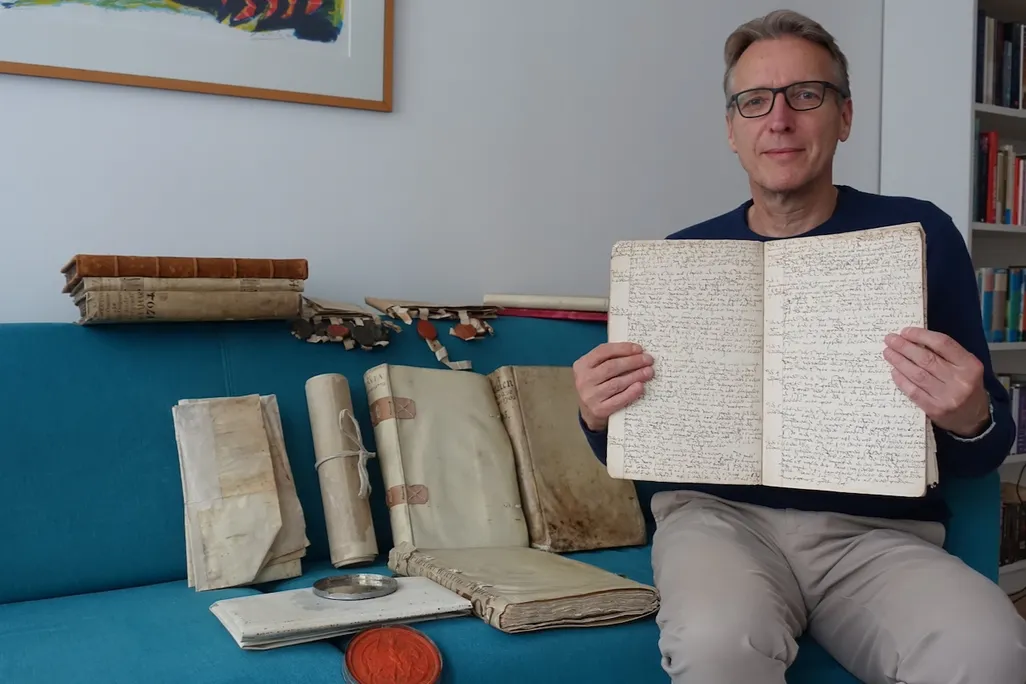
Photo: Arthur Brand.
A box given to art sleuth Arthur Brand contained records from the Dutch East India Company. They had been stolen a decade ago from the Hague in the Netherlands.

Everyone likes a mystery, especially one that gets solved in a satisfactory way. Of course, “satisfactory” is in the eye of the beholder. I myself like to have the perp brought to justice. Other people prefer something brutally realistic.

France 24 reported recently on a mystery solved by Arthur Brand, the “Indiana Jones of the Art World.” In this case, the perp is long gone.

“A Dutch art sleuth has recovered a priceless trove of stolen documents from the 15th to the 19th century, including several UNESCO-listed archives from the world’s first multinational corporation. Arthur Brand [ said] the latest discovery was among his most significant.

” ‘In my career, I have been able to return fantastic stolen art, from Picassos to a Van Gogh … yet this find is one of the highlights of my career,’ Brand told AFP.

“Many of the documents recount the early days of the Dutch East India Company (VOC), whose globetrotting trading and military operations contributed to the Dutch ‘Golden Age,’ when the Netherlands was a global superpower.

“VOC merchants criss-crossed the globe, catapulting the Netherlands to a world trading power but also exploiting and oppressing the colonies it conquered. The company was key to the slave trade during that period, with generations of enslaved people forced to work on Dutch plantations. …

“The company was also a leading diplomatic power and one document relates a visit in 1700 by top VOC officials to the court of the Mughal emperor in India.

” ‘Since the Netherlands was one of the most powerful players in the world at that time in terms of military, trade, shipping, and colonies, these documents are part of world history,’ said Brand.

UNESCO agrees, designating the VOC archives as part of its ‘Memory of the World’ documentary heritage collection.

” ‘The VOC archives make up the most complete and extensive source on early modern world history anywhere,’ says UNESCO on its website.

“The trove also featured early ships logs from one of the world’s most famous admirals, Michiel de Ruyter, whose exploits are studied in naval academies even today. …

“No less enthralling is the ‘who-dunnit’ of how Brand came by the documents.

“Brand received an email from someone who had stumbled across a box of seemingly ancient manuscripts while clearing out the attic of an incapacitated family member.

“This family member occasionally lent money to a friend, who would leave something as collateral – in this case the box of documents. …

“Brand investigated with Dutch police and concluded the documents had been stolen in 2015 from the vast National Archives in The Hague. The main suspect – an employee at the archives who had indeed left the box as collateral but never picked it up – has since died. …

“The art detective said he spent many an evening sifting through the documents, transported back in time.

” ‘Wars at sea, negotiations at imperial courts, distant journeys to barely explored regions, and knights,’ he told AFP.

” ‘I felt like I had stepped into Robert Louis Stevenson’s Treasure Island.’ ” More at France 24, here.

Don’t you love that UNESCO has a category of valuables called “Memory of the World”? Wow, what else belongs to the Memory of the World, and is it being protected for the very reason that we don’t remember it? Is Robert Louis Stevenson in Memory of the World?

Read Full Post »

Photos: Avedis Hadjian.
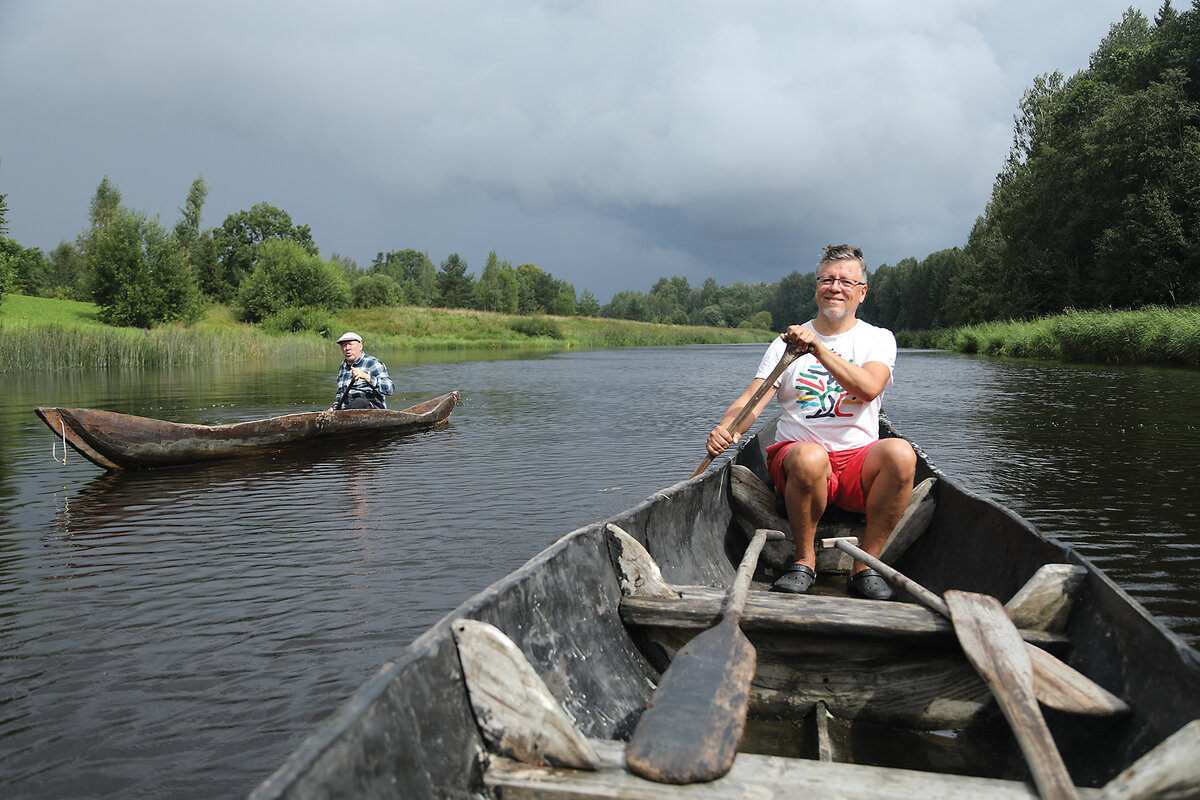
Estonian canoe maker Mr. Ruukel works on his latest dugout canoe outside his barn in Tohera.

Today I want to share a lovely photo essay from the Christian Science Monitor about a canoe maker in Estonia. Be sure to click through and see all the pictures at the Monitor.

Avedis Hadjian writes, “Aivar Ruukel is one of the last five masters in Estonia who make the Baltic country’s traditional dugout canoe, known as a haabjas. Until the 1960s, it was the conventional means of transportation in the Soomaa, or ‘land of bogs,’ region during the spring floods, locally called the fifth season.

“Mr. Ruukel and Priit-Kalev Parts, another haabjas maker, are the most vocal advocates for preserving the tradition, which is threatened by the making of fiberglass or other modern – often motorized – boats.

“Both Mr. Ruukel and Mr. Parts learned their craft from older masters in the early 1990s, shortly after Estonia gained its independence from the Soviet Union, and are now trying to engage the new generation, training young apprentices in haabjas building. …

“On a gray morning, Aivar Ruukel is scouting for the ideal aspen in the Soomaa, a vast wilderness area in southwestern Estonia. The aspen is the preferred tree for making [the] traditional dugout canoe – an art that is now endangered.

“ ‘The ideal tree should have the shape of a pencil, but every tree is perfect in its own way,’ even if only a few can be used to build the boat, says Mr. Ruukel.

“Some of the trees are covered with black canker, a fungal infection. ‘You can’t make a haabjas out of them, but they are used by woodpeckers to make their nests, so they serve a higher purpose,’ he says.

“Mr. Ruukel is one of the last five masters in the Baltic country who make the canoes. Until the 1960s, it was the conventional means of transportation in the Soomaa [during] the spring floods. …

“Both Mr. Ruukel and Mr. Parts [train] apprentices in haabjas building. A skillful wielding of the axe to hollow out the tree is only part of the required expertise and techniques, which also involve expanding the trunk by filling it with water and then hanging it above a carefully controlled fire.

“What was a necessary means of transportation in the past has now become an Estonian identity marker. In 2021, haabjas building was inscribed on UNESCO’s List of Intangible Cultural Heritage in Need of Urgent Safeguarding.”

More at the Monitor, here.

In the “search” box at this blog, you can find several posts about Estonia, a country that’s interesting in more ways than one. (For example here, here, and here.)

Mr. Ruukel (left) and Jari Hyvönen, his brother-in-law visiting from Finland, paddle in canoes on the Pärnu River.

Read Full Post »

Photo: Reuters.
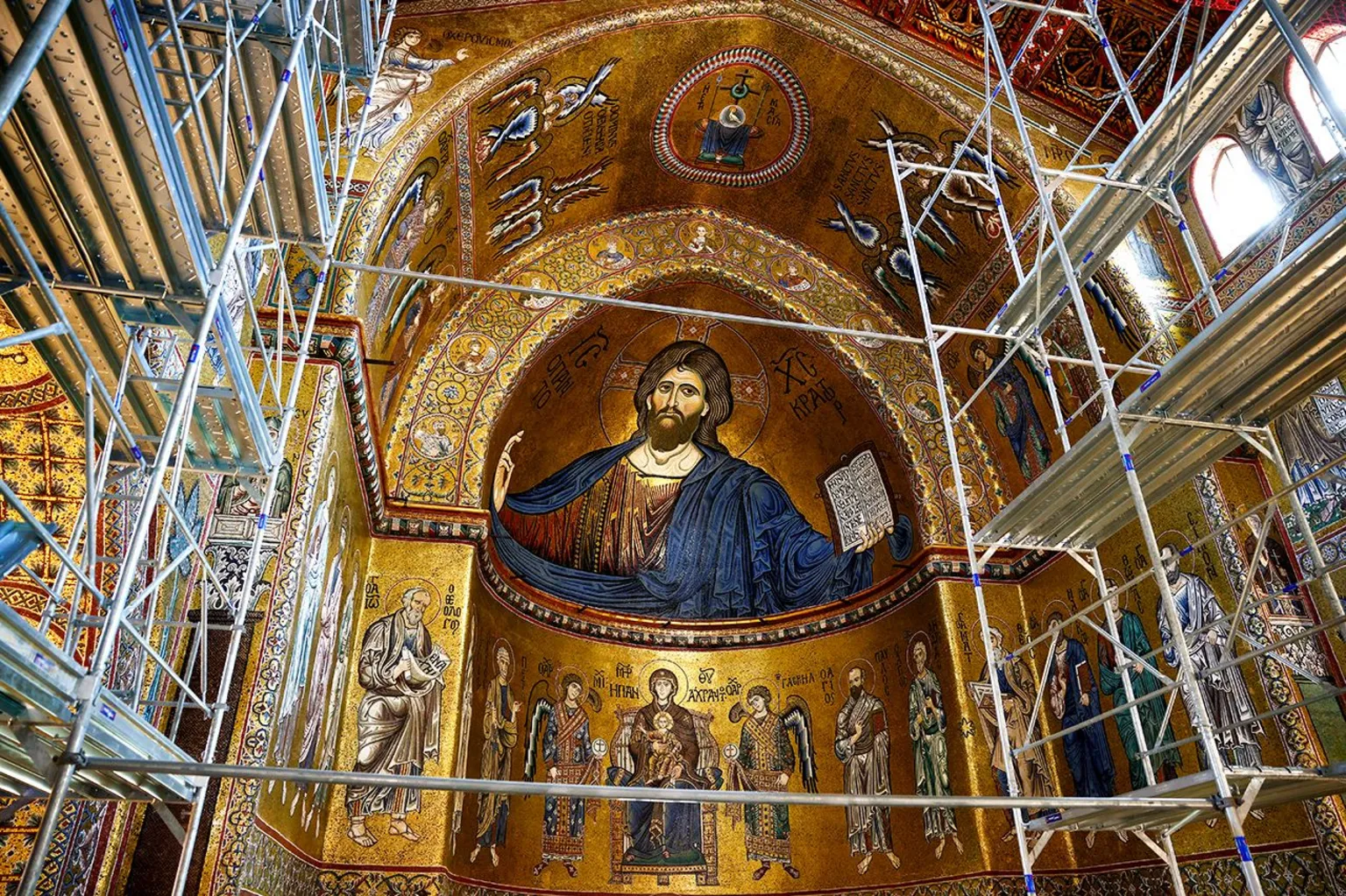
The Monreale cathedral was declared a Unesco World Heritage Site in 2015, and has recently undergone extensive restoration.

Some organized religions eschew signs of wealth and pomp. For others, such things emphasize the value they put on their faith. I always like hearing about the individual stonemasons who gave their heart and soul to carving small corners of the great cathedrals, but I have mixed feelings about covering churches in gold, however beautiful. I was not part of the fundraising for my church’s dome, which one member paid to gild, covering the sky-blue paint.

All to say that an extraordinary amount of gold is now drawing tourists to a cathedral in Sicily, a UNESCO World Heritage site.

The BBC’s Sara Monetta writes, “On a hill overlooking the city of Palermo, in Sicily, sits a lesser-known gem of Italian art: the cathedral of Monreale. Built in the 12th century under Norman rule, it boasts Italy’s largest Byzantine-style mosaics, second in the world only to those of Hagia Sophia in Istanbul.

“Now, this Unesco World Heritage site has undergone an extensive restoration to bring it back to its former glory. The Monreale mosaics were meant to impress, humble and inspire the visitor who walked down the central nave, following the fashion of Constantinople, the capital of the surviving Roman empire in the east.

“They span over [69,000 square feet] and contain about [4.6 pounds] of solid gold. …

“Local experts from the Italian Ministry of Culture led a series of interventions, starting with the removal of a thick layer of dust that had accumulated on the mosaics over the years. Then they repaired some of the tiles that had lost their enamel and gold leaf, making them look like black spots from down below. Finally, they intervened in the areas where the tiles were peeling off the wall and secured them.

“Working on the mosaics was a challenge and a big responsibility, says Father Nicola Gaglio. He has been a priest here for 17 years and has followed the restoration closely, not unlike an apprehensive dad.

” ‘The team approached this work almost on their tiptoes,’ he tells me. ‘At times, there were some unforeseen issues and they had to pause the operations while they found a solution. For example, when they got to the ceiling, they realized that in the past it had been covered with a layer of varnish that had turned yellowish. They had to peel it off, quite literally, like cling film.’

“The mosaics were last partly restored in 1978 , but this time the intervention had a much wider scope and it included replacing the old lighting system.

” ‘There was a very old system. The light was low, the energy costs were through the roof and in no way it made justice to the beauty of the mosaics,’ says Matteo Cundari. He’s the Country Manager of Zumtobel, the firm that was tasked with installing the new lights. …

“I ask Fr Gaglio what it was like to see the scaffolding finally come off and the mosaics shine in their new light. He laughs and shrugs.

” ‘When you see it, you’re overwhelmed with awe and you can’t really think of anything. It’s pure beauty,’ he says. ‘It’s a responsibility to be the keeper of such world heritage. This world needs beauty, because it reminds us of what’s good in humanity, of what it means to be men and women.’ “

More at the BBC, here. No firewall.

Read Full Post »

Photo: Suzanne and John’s Mom.
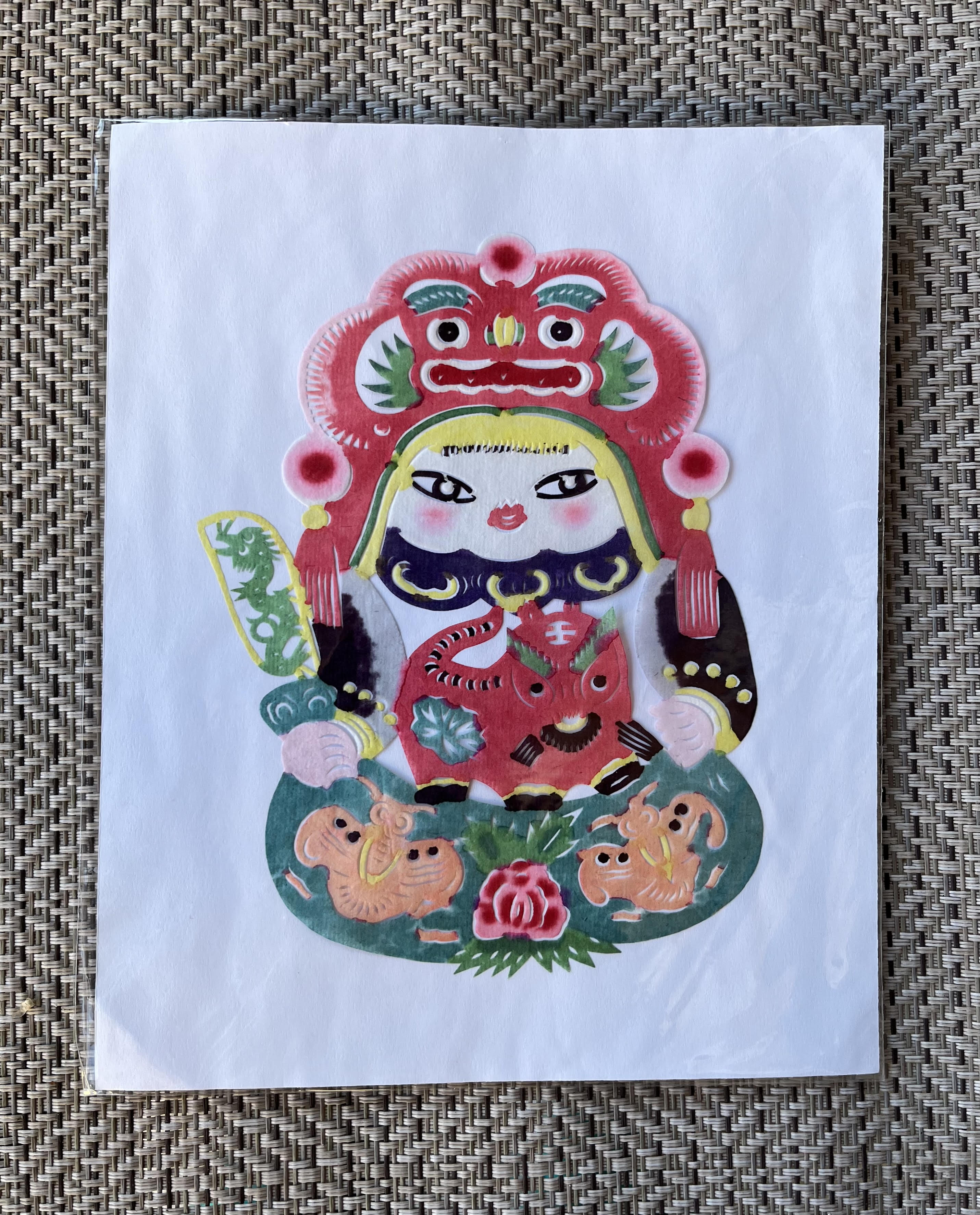
I’ve had this Chinese paper cut-out for years. I no longer remember where it came from.

Happy Year of the Dragon! The Wood Dragon to be specific. (In case you’re wondering, the other Chinese zodiac dragons are Water, Metal, Earth, and Fire.)

As China and much of the world celebrate the traditions of Lunar New Year, I want to share an article about a woman in China who is keeping another ancient tradition alive — paper cutting.

Ann Scott Tyson reports at the Christian Science Monitor, “With uncanny precision and attention to form, Yu Zeling snips away at the thin red paper. Her scissors seem to glide magically into place. After several minutes, she unfolds her creation: a bold and smiling Chinese zodiac pig.

“An award-winning master of the ancient Chinese folk art of paper cutting, Ms. Yu fills her studio with cutouts of animals, people, and scenes so vivid that they seem to leap from the walls. Rich with symbolism, her art embodies village life in Ansai, a rural district in Shaanxi province on China’s rugged Loess Plateau. Ansai is a center of paper cutting – recognized in 2009 by UNESCO as an Intangible Cultural Heritage of Humanity. …

“Ms. Yu and others are working to keep the folk art alive, even as it evolves away from its roots as adornment for farmhouses and local celebrations. Indeed, the Ansai native is serving as a rare bridge between the most skilled paper-cut artists of the 1980s – a golden era in paper cutting – and a new generation of heirs. …

“Growing up in a hamlet deep in an Ansai valley, surrounded by terraced fields, Ms. Yu came to paper cutting in the late 1970s as naturally as she breathed the earthy air. ‘We were very poor, and when it was time to celebrate the [Lunar] New Year, we all put paper-cuts in the windows,’ she says, recalling the holiday at her childhood home – a cave dug from a hillside – where her family of 10 eked out a living growing corn, beans, and sorghum. …

“The art originated in China in the centuries after paper was invented in A.D. 105. … Full of auspicious symbols from peasant life, the decorations heralded good weather, many offspring, long life, wealth, and happiness. …

“Just as Ms. Yu was beginning to learn paper cutting, after she left elementary school in 1978 at the age of 12, China’s shift toward market economics and social opening began allowing for a revival of traditional culture. Using discarded newspaper, Ms. Yu first practiced cutting the image of a Chinese national flag that she saw in a school textbook. She says she ‘cut it 100 times’ before she was satisfied. Then her aunt took over, introducing her to increasingly complicated traditional motifs. …

“Meanwhile, a research scholar named Chen Shanqiao began trekking from Ansai’s county seat into the hills and valleys to rural villages, rediscovering the true meanings embedded in the paper-cuts. Their power astonished him. In the mid-1980s, he recruited a few older village women who were masters in the craft to come teach at Ansai’s Cultural Center.

“Ms. Yu married farmer Jiang Zhicheng, who admired her passion and skill. Inspired, Mr. Jiang took a few of his wife’s works to the local market in 1987, but he couldn’t sell them. So he went farther, riding his bicycle more than 25 miles to Ansai’s Cultural Center. Seeing the fine pieces, Mr. Chen immediately bought the paper-cuts and invited Ms. Yu to come train with the master artists. …

“After years of training, Ms. Yu became a master in her own right, winning one award after another. Her works are on display in museums. But she’s humble about her achievements. ‘I was, and still am, a farmer,’ she says with a smile. … ‘I make paper-cuts based on life,’ she says. ‘Here in northern Shaanxi, we feed the pigs and till the land and care for the children.’

“Hoping to carry on and grow the folk art, Ms. Yu volunteers to teach at free community training sessions. Paper cutting is also taught in Ansai’s public schools. … As Chinese villages empty out and rural rituals fade, Ms. Yu is aware of the need to go beyond perpetuating traditions and embrace new paper-cut experiments. …

“The most elaborate paper-cut in her studio is a large and ornate circular design that weaves together layer upon layer of significance: In the center, a snake (man) encircles a rabbit (woman), symbolizing marriage. Surrounding them is a ring of pomegranates (the seeds of which represent many children), peaches (the Chinese name for ‘peach’ is also the word for ‘longevity’), and Buddha’s hands (a kind of citrus fruit representing bliss). A final outer rim, resembling a woven flower basket, also signifies longevity.”

More at the Monitor, here. Check out photos of the cutting process. No firewall.

Read Full Post »

Photo: Science Norway.
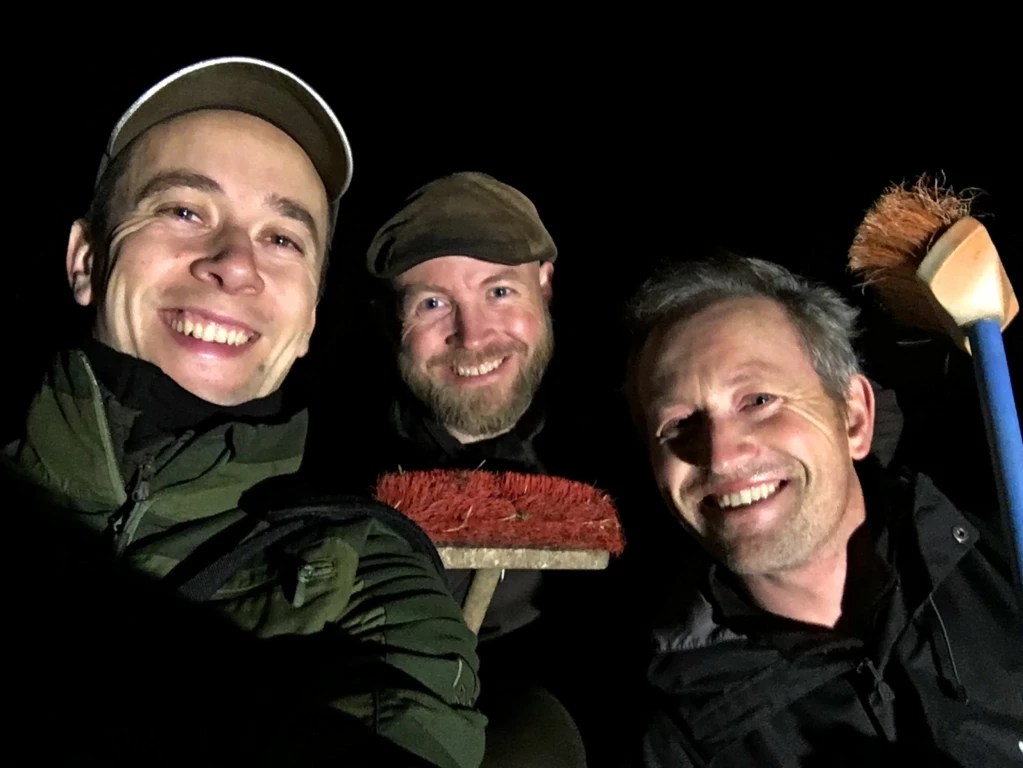
According to Science Norway, all it took was a smart hypothesis and a few brooms. Together, the three friends have discovered hundreds of previously unknown rock carving sites in the Østfold landscape in the last 3-4 years.

Some good buddies hang out in a bar together. Some go bowling together or maybe running. The buddies in today’s story hunt Bronze Age petroglyphs. At night.

Lisa Abend writes at the New York Times, “It was December and the first snow of the season was falling when the three friends set out on their weekly hunt through the fields of Ostfold, in southeastern Norway. … Tromping across the blanketed farmland, the men came to a low outcrop of rock, a few feet wide. With a child-size plastic broom, they brushed away the newly fallen snow from the stone to reveal the outline of a ship, its curved keel carved into the granite roughly 3,000 years ago.

“It was just one of more than 600 Bronze Age rock carvings, known as petroglyphs, that Magnus Tangen, Lars Ole Klavestad and Tormod Fjeld have discovered. Since making petroglyph hunting their collective hobby in 2016, the three enthusiasts have transformed knowledge about prehistoric art in Norway, more than doubling the number of carvings known in their home region. And although they are motivated, in part, by the pleasures of friendship and the outdoors, their findings have also lent serious weight to theories about the mysterious petroglyphs’ meaning.

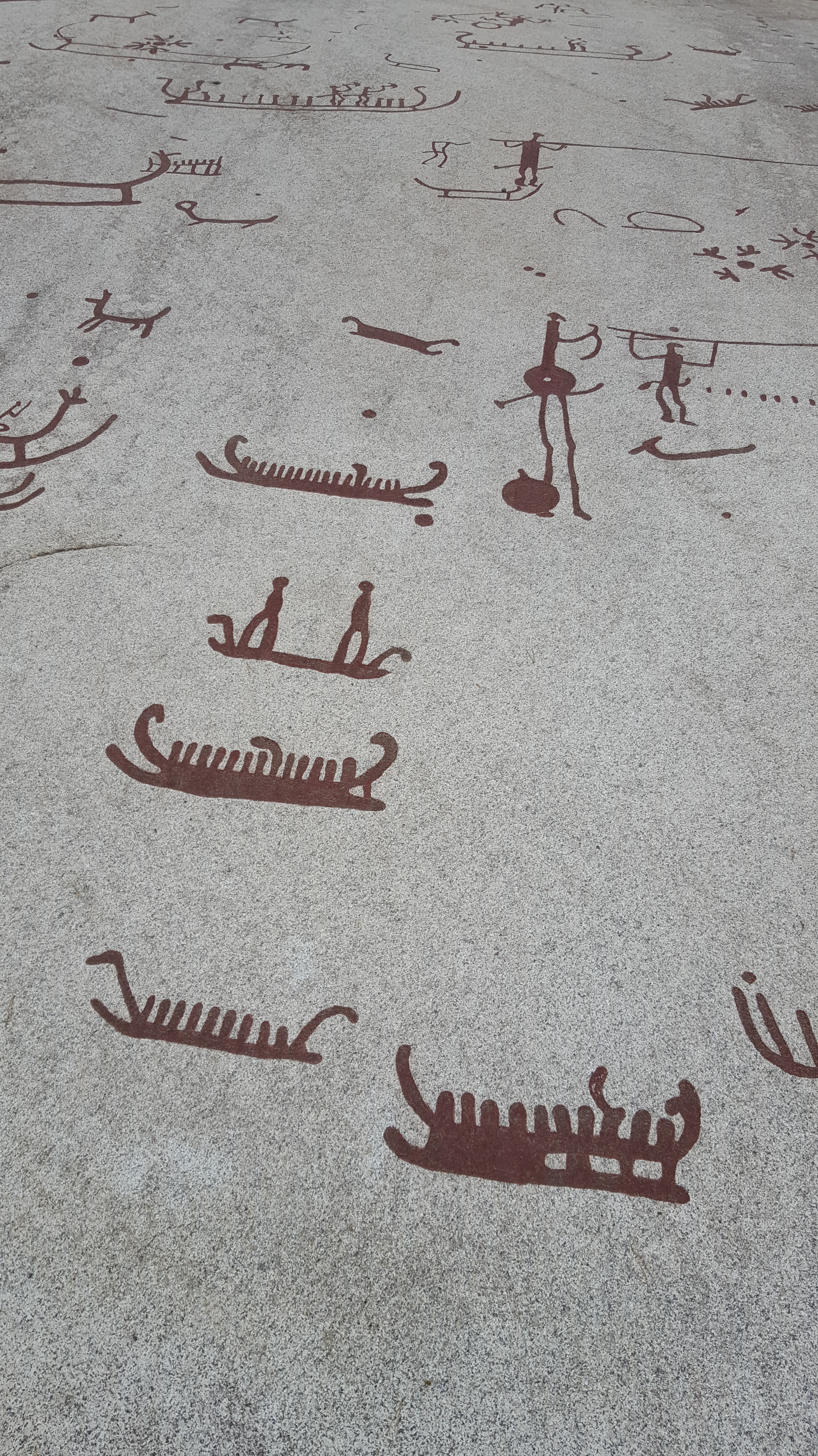
“Rock carvings from the Bronze Age (which in Scandinavia began around 2,000 B.C.) are common in parts of Sweden and Norway. Regions in both countries have been declared UNESCO heritage sites because of the density and the diversity of the images, which include human figures, animals, geometric shapes and, frequently, ships. Yet because they are commonly cut into granite that is low to the ground and easily obscured by leaves or snow, they often go unnoticed.

“Petroglyphs are also easier to see when the sun is not overhead — a realization that has been one of the keys to the three friends’ success. Because the hunt for them is a hobby rather than a career — Tangen is an archaeologist working in a different field, Fjeld a graphic designer, and Klavestad a landscape architect and artist — they make time for it at night. …

“The thrill of the hunt has naturally led them to speculate on the carvings’ meaning. Because the petroglyphs tend to be more visible in the slanted rays of dusk, or with angled artificial lights, Tangen said he believed that their creators had made deliberate use of shadow and light in their work. Thanks to the sun’s changing angle, petroglyphs can look different depending on the hour of the day, or season, he explained. ‘I think the images have to do with the awakening of people’s minds to time,’ he said.

“That is in keeping with findings from professional archaeologists about rock art and stone monuments, in places like British Columbia and Scotland, whose features are visible only at certain times of year. There is also evidence for another one of Tangen’s theories: that some of the images were meant to be seen in flickering light, so that they appeared almost animated.

“Kristin Armstrong-Oma, a professor of archaeology at the University of Stavanger, said that ‘in excavations around some carvings, archaeologists have found signs of burning or charcoal.’ That suggested fire was being used, almost like a movie camera. ‘The living flames give the carvings a feeling of movement,’ she said.

“The petroglyph-hunting trio got their start in 2016, when Fjeld, the graphic designer, was walking his dog in the countryside and found a strange mark in a rock. He wondered if it was made by humans, or nature. Trying to identify it online, he came across a website with photos of petroglyphs, and contacted its owner, Tangen, who suggested Fjeld’s find could be a Bronze Age cup mark — a simple, round carving that is a common motif in prehistoric art.

“His interest piqued, Fjeld started paying better attention on his walks, and soon found a carving that was unmistakably made by human hands: an image of a ship. ‘That was very, very fun,’ Fjeld said. ‘So I started going on a regular basis.’

“Tangen, who had made similar discoveries while walking his own dog, joined him, and before long suggested that they invite Klavestad, a local enthusiast who had found his first carving when he was 10.

“ ‘We didn’t know each other, but I hadn’t met anyone else with so much passion for it,’ said Klavestad. ‘We are, all three, very dedicated.’ “

More at the Times, here.

Petroglyphs I saw in 2017 at a UNESCO-protected World Heritage Site in Sweden. Some have been painted red to make them more visible for tourists, a practice which has drawn criticism.

060217-petroglyphs-by-Stuga40-Sweden

Read Full Post »

Photo: Yamagata University/ via Reuters.
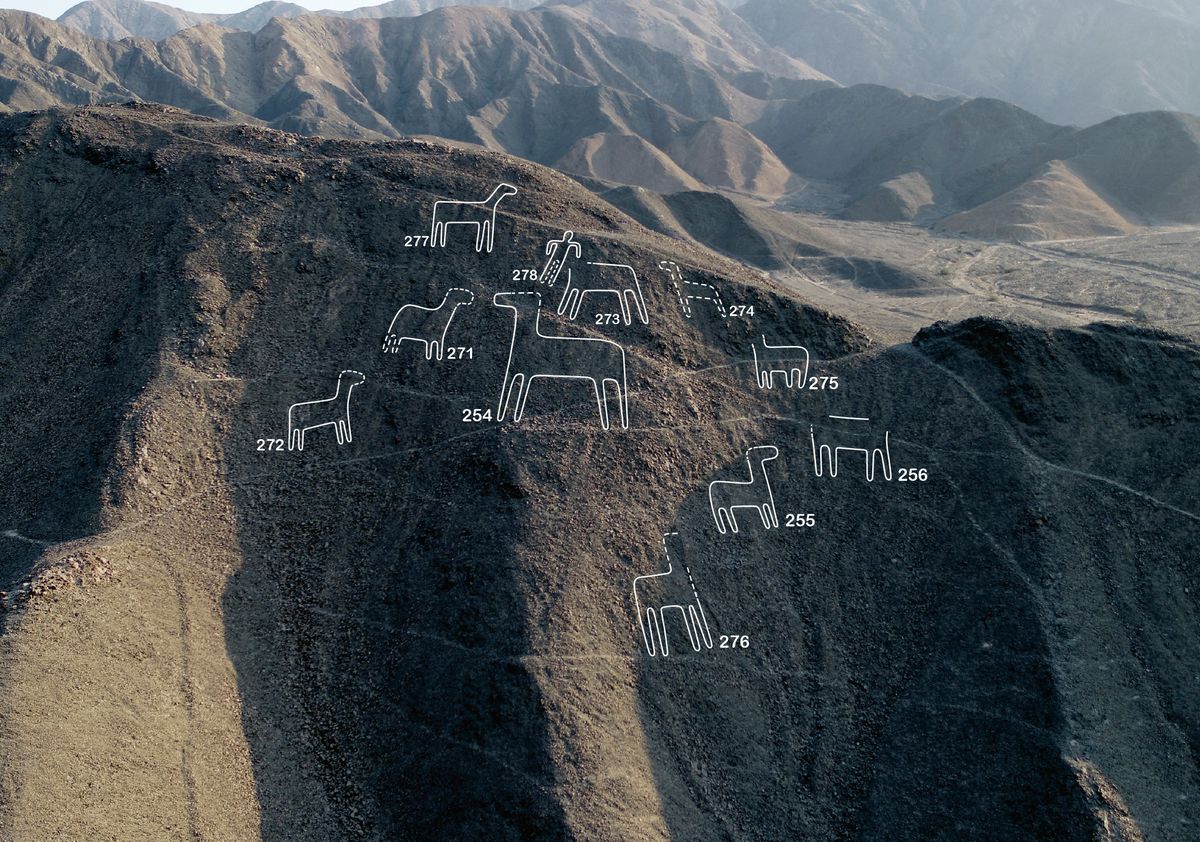
Peruvian and Japanese researchers from Yamagata University recently discovered 168 new designs at the UNESCO World Heritage site, the Nazca, on Peru’s southern Pacific coast.

Although the latest headlines from Peru are all about political upheaval, isn’t it the case that whatever the headlines, there is always more going on in a country than politics?

From today’s story, we learn about the recent discoveries of a team of Peruvian and Japanese archaeologists.

Victoria Bisset writes at the Washington Post, “Researchers have identified more than 150 new designs in Peru’s southern Nazca plain, known for its mysterious large-scale artwork carved into the desert.

“The latest images were discovered by archaeologists from Japan and Peru, who used high-resolution aerial and drone photos taken between June 2019 and February 2020 to identify 168 new geoglyphs of animals and humans, including birds, killer whales and snakes, carved by the region’s pre-Hispanic inhabitants.

“The Nazca Lines, which are part of a UNESCO World Heritage site, cover an area of almost 175 square miles on Peru’s Pacific coast.

“The lines ‘were scratched on the surface of the ground between 500 B.C. and A.D. 500,’ UNESCO says. … Their purpose is still unknown, but UNESCO says they may have served ‘ritual astronomical functions.’

“The latest geoglyphs to be discovered are believed to date back to between 100 B.C. and A.D. 300, researchers from Japan’s Yamagata University said in a statement announcing the find earlier this month.

“While most of the site’s most famous images are so large that they can only be seen from the air, the most recent images are mostly small, measuring less than 10 meters (around 33 feet) in diameter. …

“The findings will be used in shaping future surveys carried out by artificial intelligence to protect the area, according to the university.

“The site faces threats from urban and economic developments, Masato Sakai, the lead researcher and a professor from Japan’s Yamagata University, told Reuters news agency.

‘Some geoglyphs are in danger of being destroyed due to the recent expansion of mining-related workshops in the archaeological park,’ he said.

“The Nazca Lines have also been impacted by smaller-scale incidents: In 2018, a truck driver damaged part of the site after he ignored warning signs and drove over the area.

“In 2014, activists from the environmental group Greenpeace sparked outrage when they left marks at the site while carrying out a protest — although researchers later said that a grant given to help them repair the damage had led to the discovery of 50 new geoglyphs.”

What do you think the indigenous people who made the carvings — before Peru was Peru — intended? What does “ritual astronomical functions” mean? If they were trying to communicate with beings they perceived in the sky, it makes sense: most of the glyphs can be seen only from the sky.

Read more at the Post, here. If you don’t have a Post account, you can see all the carvings at Reuters, here.

Read Full Post »

Photo: Reuters/Albert Gea.
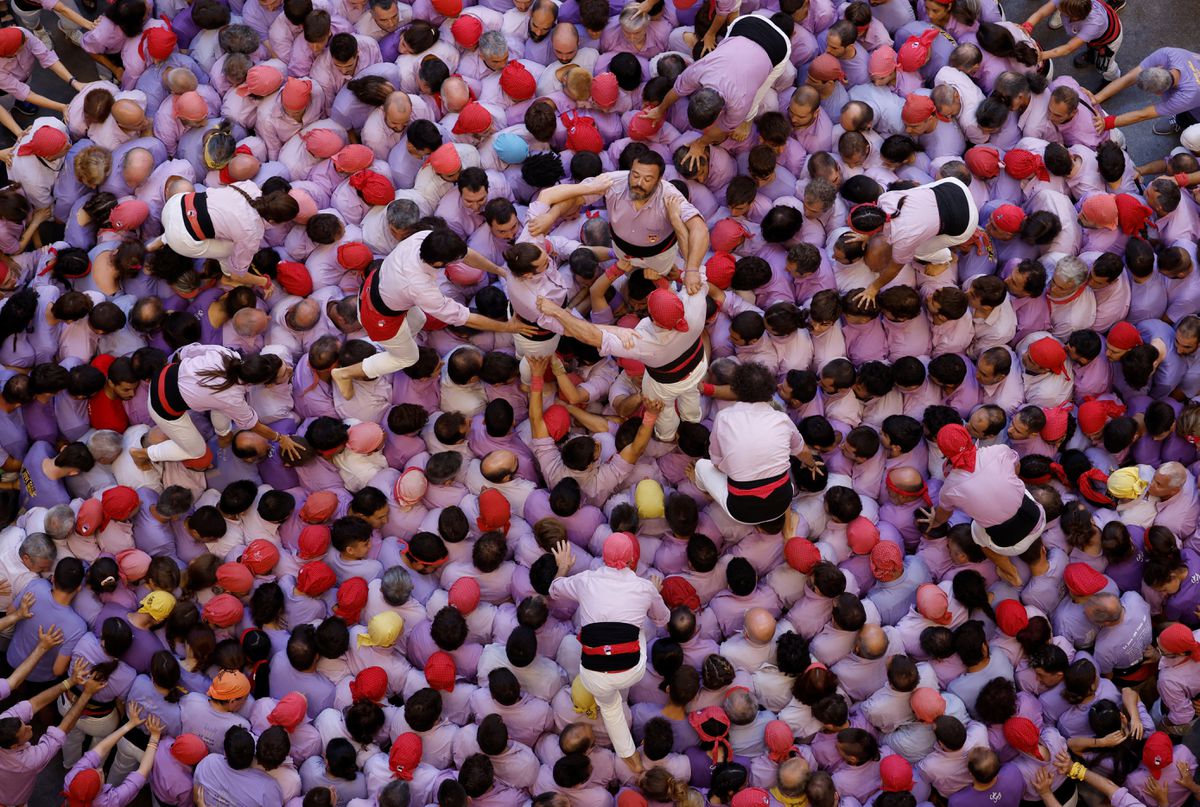
Reuters shows Colla Jove Xiquets de Tarragona starting “to form a human tower called ‘castell’ during a biannual human tower competition in Tarragona, Spain, October 2, 2022.

You don’t have to be a kid to play. Here’s a story on grown-ups having fun like kids. Of course, there are a few kids along with them, setting the proper tone for playtime.

Alan Ruiz Terol reports at Public Radio International’s The World, “A human tower rising higher than 26 feet swung perilously as 7-year-old Mar Mollà reached its top amid cheers from the crowd. 

“ ‘The views were great,’ she said later. ‘I could see all the colors and the arena vibrating.’

“[Recently] the town of Tarragona, in Spain’s northeastern region of Catalonia, hosted a massive tournament featuring the finest teams of human tower builders, or castellers. …

“One of the teams competing on Saturday was the Castellers de la Vila de Gràcia. Mar Mollà was one its youngest members. She also had one of the most difficult tasks. As she made her way up to the top of the castell on Saturday, her father, Daniel Mollà, watched nervously.

“ ‘I was worried,’ he explained, minutes later. ‘But it’s up to her; she’s the one who knows if [the castell] will fall or not.’

“To build a castell, dozens of people must stand at the base pressed against each other to provide stability, and, if things go wrong, a safety net. Others venture upward, climbing and being climbed over; forming one tier, and then another, and another. Finally, a kid crowns the human tower by raising a hand.

“Human towers are graded according to their height and difficulty. To get the full score, crowning the castell is not enough — it must be dismantled without collapsing. While falls are rare, they do occur, and kids wear helmets to avoid severe injuries. …

“Human towers are a centuries-old tradition in Catalonia, and are widely seen as a symbol of its own distinct culture and nationalist aspirations. …

“ ‘The oldest reference to castells dates back to 1791, to a local festival in the town of Valls,’ historian Àlex Cervelló said. 

“Human towers are thought to be a spin-off of a religious dance that featured acrobatic constructions known as Ball de Valencians. According to Cervelló, participants might have competed against each other, building higher and more complex structures, until castells became a separate tradition. …

“Following the Spanish Civil War in the 1930s, the Francisco Franco dictatorship tried to deprive castells of any hint of Catalan nationalism, Cervelló said, as part of its persecution of political dissidence.

“In the 1980s, shortly after Franco’s death, teams of castellers began incorporating women, making it possible to build towers of unprecedented height, and kickstarting a golden era.

“In 2010, the UNESCO recognized castells as Intangible Cultural Heritage of Humanity. …

“Júlia Pozo, who looks after the youngest members of the Castellers de la Vila de Gràcia, praised the bravery of Mollà and other kids climbing to the top of castells. Ultimately, she said, they’re the ones who decide whether a castell is crowned.

“ ‘If they are afraid and don’t want to climb, they let us know, and we either try to find someone else, or we dismantle it,’ Pozo said. 

“But some, she said, will venture upward even if they are afraid, pulled by their ‘casteller spirit.’ ” 

Be sure to click at the World, here, and enjoy the happy grins on faces old and young.

Read Full Post »

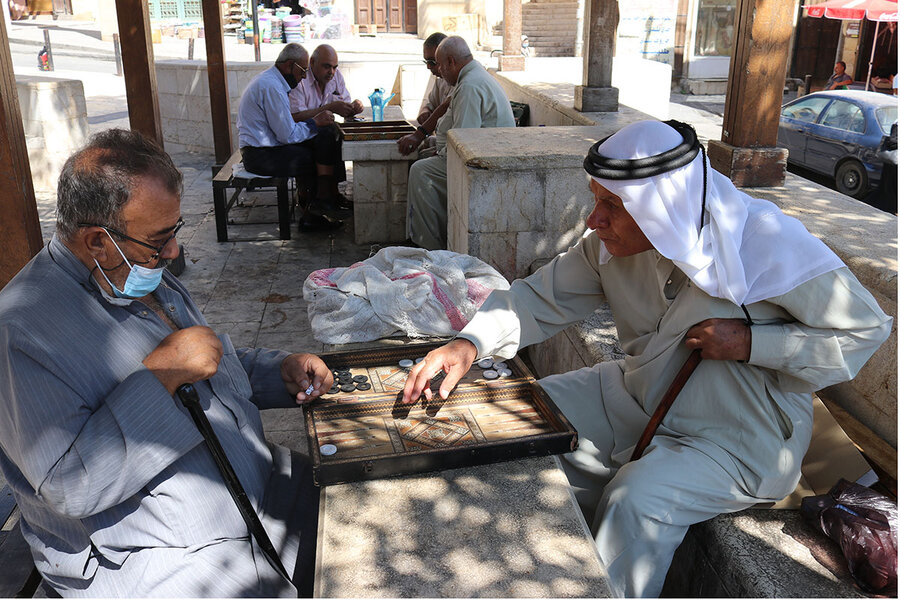
Photo: Taylor Luck.
Elders in Salt, Jordan, play a daily game of backgammon in the town square. Salt is a new UNESCO World Heritage Site. It is known for remarkable hospitality.

Pretty much every religion adjures believers to welcome the stranger, but every day we see that the size of the need overwhelms even those who have not forgotten about that. Except in Salt, Jordan.

Taylor Luck writes at the Christian Science Monitor, “Welcome to the world’s newest UNESCO World Heritage Site, a breezy hillside town perched above the Jordan Valley that is celebrated for, well, its legendary hospitality.

“In Salt, history and economics have helped create a unique mix of cultures and faiths and a harmony of yellow-gold stone buildings and community. Don’t believe it? Simply ask the city’s elders.

“You can find them every day gathered in the Ain Plaza, formerly the site of fresh springs and now the town square in the twin shadows of Salt’s Great Mosque and Anglican Church. They will gladly tell you how their hospitality and way of life were passed from generation to generation – if they have time.

“For most of the day, they huddle around stone tables locked in intense games of backgammon and mancala, exhibiting the steely concentration of professional athletes. They say they welcome the UNESCO designation as a chance to share what they call ‘hospitality and harmony’ with the world.

“ ‘Here we welcome all, and we embrace every person,’ says Abu Ali, awaiting his turn at backgammon. He pointed to his compatriots of different faiths and tribes embroiled in matches. 

‘We don’t see Muslim, Christian, tribes, or urbanites – we see each other’s humanity, and the humanity in all who visit.’

“Dating back to the Iron Age, Salt is located strategically on the trade and pilgrimage routes between Damascus and Jerusalem, and between the Mediterranean Sea and the Arabian Peninsula. The agricultural village grew into a flourishing hillside city in the 17th, 18th, and 19th centuries, attracting residents from across the Levant, Turkey, Arabia, the Caucasus, and west Asia.

“The constant, diverse flow of visitors and merchants created neighborhoods in which each street and hill had a mix of Christians and Muslims – Palestinians, Syrians, Turks, Circassians, Chechens, and members of local tribes all building their homes together.

“For centuries, Salt families would house and feed travelers, including merchants, Christian pilgrims on their way to Jerusalem, or Muslims heading east for the Hajj – offering at least three days of lodging, no questions asked.

“Not a single hotel was built in the town, as it was considered ‘shameful’ not to host a guest in one’s home. Only in the past two years have guest-houses emerged; but the idea of a guest paying for lodging is still highly controversial.

“ ‘Please have lunch with me,’ strangers told Jordanian visitors and a reporter, during a visit in mid-August.

“In its announcement in late July that Salt had been added to the World Heritage list, UNESCO highlighted the city’s unique makeup as a ‘Place of Tolerance and Urban Hospitality.’

“ ‘In Salt, there is not a single area here that is segregated by race, religion, or origin,’ says former Mayor Khaled Al Khashman. ‘This is very rare in this region and, historically, rare in the world.’

“The town’s traditional architecture has long encouraged community. Most of Salt’s yellow sandstone homes consisted of a single room with a domed roof, with two or four homes sharing a communal courtyard, walls, rooftop, and entrance.

“Families would sit in their communal courtyard, cooking or drinking evening tea together while their children played. Neighbors shared food, drink, and supplies, and took part in each other’s celebrations, religious holidays, and family milestones. The layout meant neighbors were often closer than blood relatives. …

“Salt resident Nadia Abu Samen, a Muslim, restored one of these compounds. … She says her mother was raised by her family’s Christian neighbors, and her uncles and aunts were given Christian first names to honor their neighbors.

“For the past decade Ms. Abu Samen has carefully preserved an abandoned compound of four joined rooms – two homes belonging to Christian families, two homes belonging to Muslim families – and turned them into a cultural center, exhibition, and cafe. She traces Salt’s trademark harmony to the ‘uniform simplicity of traditional life.’ ” More at the Monitor, here.

If your ethnicity or religion is not mentioned in the article, I hope you will visit sometime and let us know if you were welcomed. A town that has been given such a high award for hospitality has a reputation to uphold!

Read Full Post »

Chalk up another one for art and culture. According to Lisa Contag at the website Blouin Art Info, a UNESCO study has found evidence that art and culture improve safety in cities, in part by building social cohesion.

She writes, “UNESCO makes a strong case for systematically fostering culture in city planning in its new ‘Global Report, Culture: Urban Future.’ …

“In more than 100 case studies, the survey analyzes the situations, risks, and potentials for cities in a number of regional contexts, with a particular interest also in Africa and Asia, where urbanization is expected to continue increasing rapidly in the next decades.

“ ‘Culture lies at the heart of urban renewal and innovation. This report provides a wealth of insights and concrete evidence showing the power of culture as a strategic asset for creating cities that are more inclusive, creative and sustainable,’ Irina Bokova, Director-General of UNESCO noted in a statement, stressing that ‘culture gives cities social and economic power,’ especially with the help of the creative industries.

“As an example, the report refers to Shanghai, China, which has held the status of a UNESCO Creative City of Design since 2010, and is considered ‘one of the world’s major creative centers, with more than 7.4% of residents employed in the creative industries.’

“Cities in conflict and post-conflict situations, such as Samarra, Iraq, which was confronted with the destruction of a number of invaluable sites such as the Al-Askari Shrine in 2006, are also taken into consideration and seem to benefit similarly. ‘Reconstruction and rehabilitation efforts have demonstrated the ability of culture to restore social cohesion between communities and improve livelihoods, paving the way for dialogue and reconciliation,’ the authors explain.”

The authors observe that culturally diverse, safe, and thriving cities are people-centered and culture-centered and feature policy-making that builds on culture.

More here.

Photo: UNESCO
Screenshot from Reza’s UNESCO video “Culture – the Soul of Cities”

Read Full Post »

As I mentioned the other day in the post about the Latin newscast on Finnish radio, I am interested in endangered languages.

Now a composer who is also interested has melded voices of  threatened languages with his music.

Corinna da Fonseca-Wollheim writes at the NY Times that the “Vanishing Languages” project by Kevin James, “a New York-based trombonist and composer, is a rare hybrid of conservation effort and memorial, new music and ancient languages.

“Prodded by Unesco statistics that predict that by the end of the century half of the world’s 6,000 languages will be extinct, Mr. James spent months in the field tracking down and recording the last remaining speakers of four critically endangered tongues: Hokkaido Ainu, an aboriginal language from northern Japan, the American Indian Quileute from western Washington, and Dalabon and Jawoyn, aboriginal languages from Arnhem Land in Australia.”

Reviewing a concert James gave at a New York venue, da Fonseca-Wollheim says, “ ‘Counting in Quileute,’ which opens with bells struck and bowed and swung in the air and ends with the ring of a Buddhist prayer bowl, had a strong ritualistic feel to it.

“The often puzzling actions of the players — flutists whispering into mouthpieces, a cellist tapping with both hands on the fingerboard as if playing a recorder — appeared like a secret choreography designed to bring forth the voices of the dead filtered through the crackle of old phonographs.

“The imperfections of these old recordings, which Mr. James used alongside those he made recently in the field, show how heavily smudged the window is that we have on these vanishing cultures. And yet at times it seemed as if it were these voices who were willing the performance into existence.” (Isn’t da Fonseca-Wollheim a lovely writer?) More.

For a couple other blog discussions of endangered language, click here or here.

Photo: Ruby Washington/The New York Times
Leah Scholes of Speak Percussion using a double bass bow to play a bowl as part of “Vanishing Languages.”

Read Full Post »