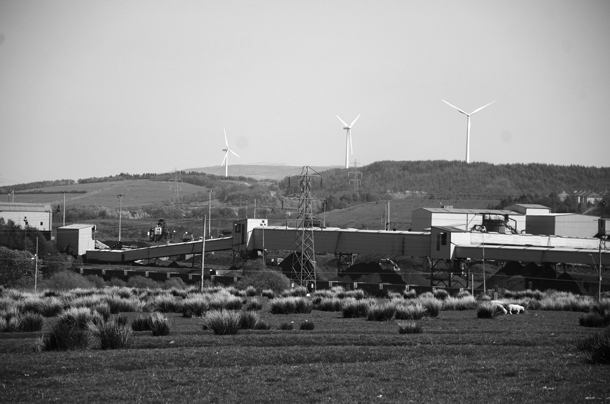
Wind farm in Wales coal country.
It’s possible that a US Senator who makes money off coal hasn’t gotten the message, but there are miners and mining unions getting practical about the future. This Living on Earth story appeared even before the devastation of Covid was added to the troubles of mining communities.
“STEVE CURWOOD: Some of the fiercest opposition to climate action in the US has come from regions that built their economies on fossil fuel extraction. Think Texas and Oklahoma for oil and gas and especially Wyoming, Kentucky, West Virginia, Pennsylvania, and Ohio for coal. Those regions have been hit hard economically as coal production dropped, leaving miners out of work, and their communities with shrunken tax bases and fewer paying customers for local businesses. It’s a story that has also played out in Wales in the UK. The experiences on both sides of the Atlantic are the theme of Tom Hansell’s new book, After Coal: Stories of Survival in Appalachia and Wales. … So, Tom, how did you get involved with the story of After Coal?
“TOM HANSELL: I learned about this long-term exchange that had been started by, through the center for Appalachian studies here and learned that they were bringing students and community members over to South Wales where the coal mines had shut down in the 1980s. And so I thought that would be really interesting to go over, gather stories of how those communities had survived, bring them back to Appalachia, and start an international conversation about how communities can survive the loss of the main industry that they were built around.
“CURWOOD: Now, one of the most interesting parts of your reporting here, Tom, is about the unions. And in both places, unions have been a major part of how these coal communities’ function. And one of the things that’s really interesting about the union phenomenon, it’s like a huge, almost secular society of the people who live in these communities. …
“HANSELL: I was really interested to learn that in Wales, the unions were not just doing these gathering spaces you were talking about and building political power for the miners, but they were also providing continuing education services. There was a whole system of miners’ libraries and free courses after hours so that miners could continue their education and fully participate in civic life. [And] then other kind of cultural aspects of the unions including male voice choirs or brass bands are big things happening in the UK. In Appalachia, union halls also very much community gathering places, places where local foods are celebrated, places where you can hear great traditional music.
“But the difference between the actually complete domination, closed shop and nationalized industry in the UK and the private industry and the lesser power of the unions in the United States was also pretty much a stark contrast. … These cultural spaces, these democratic spaces, for the most part, were built up around this industry, and what is there to take their place when the industry crumbles? [People] are still gathering sometimes in churches or chapels, sometimes around arts projects. There were some interesting arts projects, particularly the higher ground of Harlan County project that I followed in Eastern Kentucky that provided really interesting ways for diverse groups of people to participate in making something new that spoke to their identity and their history and their hopes for the future. [In America, there] is a lot of community life happening, but it’s perhaps a lot more dispersed than it was in the days when union halls were the place that you went to see your neighbors. …
“CURWOOD: How do we support those communities affected by taking the economy greener and climate disruption? …
“HANSELL: The only way to get deep and lasting solutions is to reach out very first to people that have been part of an extractive economy, whether that’s the oil fields, or the gas fields or the coal fields. These places that have been built up around a single industry need other options [and] maybe need some extra support. … For most of the 20th century, there was coal that helped us win world wars, there was coal that helped build the strongest industry and economy in the world.
And very little that wealth was left behind. Most of that wealth went to corporations that were headquartered outside of the coal fields. And there needs to be some system where some of that wealth gets returned. …
“I was actually really impressed at the amount of local farming that’s sprung up really during the time of the After Coal Project. My last project was actually looking at the controversy around a coal-fired power plant in southwestern Virginia. In Wise County, Virginia. That plant eventually was built. … But it was interesting at those forums, people wanted to talk about farming and agriculture and local foods. And it took me a while to listen and to understand that when they were talking about diversifying the economy, that’s where they saw their assets.”
More at Living on Earth, here.

 Suzanne's Mom's Blog