Feeds:
Posts
Comments

Posts Tagged ‘unknown’

Photo: Charlie Rubin/Kasmin, New York.
An example of sculpture by Alma Allen, ‘Not Yet Titled‘ (2024). He is the artist chosen by a conservative art group to represent the US in the 61st Venice Biennale.

With all the sinister goings-on in the world, you might think that something strange in the art world would be the least of our worries. But this creepy story really got under my skin, and I’m wondering what the artists among you have to say about it.

Ben Davis reports at Artnet that the administration “has picked its artist for the 61st Venice Biennale. After months of speculation and much confusion, the artist to represent the U.S. will be Mexico-based sculptor Alma Allen, in a pavilion organized by curator Jeffrey Uslip. The sponsor is the American Arts Conservancy (AAC).

“But what is this organization, now vaulted front and center of the international art conversation, which no one I know has ever heard of? I was perplexed. So I took a spin around the internet to get a sense of what its chops were. Here are some observations.

“If no one has heard of the Tampa-based AAC, this is because it was founded only in July of this year. The press release is so poorly edited that it repeats the same quote by executive director Jenni Parido twice.

“The fact that this gaffe stands, four months later, as AAC takes on the most high-profile job in the arts, might put into question their professionalism in organizing a major international art exhibition. …

“Parido is an enigma on the art scene. According to her LinkedIn, her primary work experience is as the founder of Feed Pet Purveyor, a Tampa vendor specializing in natural foods for pets, which she ran from 2014 to 2023. …

“Frank Bardonaro was named president of the AAC board of directors in late August; he’s the CEO of the Houston-based Brock Group, a conglomerate that provides scaffolding, insulation, and the like for industrial and commercial customers. John Mocker, who serves as board secretary, is head of a pipe distributor, LB Industries.

“Mocker distinguishes himself as arty in this company because his biography identifies him as a collector of ‘American and international art.’ I’m interested! All I was able to find out, though, was that he also had a bit part in the unknown 2024 Abigail Breslin feature Chapter 51 directed by photographer Tyler Shields. …

“Ryan Coyne joined the AAC board as treasurer in September. He is best-known for running Starboard, a digital marketing, media, and government relations business. Among other things, it owns BizPac Review, which promises ‘breaking news and analysis unfiltered by the liberal bias that has eroded the media’s credibility.’ Starboard is probably best known for purchasing Parler, the right-wing Twitter clone, in 2023. Coyne also runs We the People Wine, ‘America’s Favorite Patriotic Wine.’

“Finally, AAC vice president Janet Steinger is a socialite married to superstar Palm Beach personal-injury lawyer Michael Steinger. …

“ ‘The Conservancy brings together a national network of curators, scholars, educators, artists, and patrons who believe in the transformative power of the arts,’ AAC boasted when it launched. Let’s take a look at what that means. The advisory board includes: curator Jeffrey Uslip, who is helming the Alma Allen pavilion in Venice, socialite Mackenzie Brumberg, socialite Nicola Verses … Nicole McGraw, a Palm Beach art dealer and former CEO of Jupiter NFT Group [now] ambassador to Croatia … artist Brendan Murphy, who made a diamond-encrusted spaceman sculpture for a Four Seasons in Riyadh … photographer, artist, and Web3 entrepreneur Brandon Ralph. …

“One name on the advisory board list, Madison Wright, remains an unknown, as the AAC site does not identify or provide links for its advisory board, just names. ‘Mathew Taylor’ and ‘Michelle Taylor’ are also listed. ‘Mathew’ seems to be a misspelling of ‘Matthew.’ It probably refers to a filmmaker who goes by both M.A. Taylor and Matthew Taylor, depending on whether he is directing films about conservative politics or art. He has directed both Marcel Duchamp: The Art of the Possible (2019), about the famed father of conceptual art, and Government Gangsters (2024) [about] Kash Patel‘s book about a deep state conspiracy. …

“The other big initiative AAC is pushing is the ‘Passport to Patriotism: America 250’ exhibition, which it says will happen next year. ‘Children ages 5–15 are invited to submit original works that express what patriotism means to them,’ for possible inclusion. …

“The ‘children’s art’ used to illustrate the contest has the hallmarks of very bland A.I., including [one] where Lady Liberty has six fingers, and the stripes on the flag inexplicably flip colors. …

“A bare-bones official website for the U.S. pavilion now exists. On Instagram and Facebook, AAC posted a short statement about the vision of the show.”

Maybe I read too many murder mysteries, but the thin online presence of these entities sure do suggest the shell companies I’m currently reading about in a novel by Richard Osman.

More at Artnet, here.

Read Full Post »

Photo: Nieman Labs.
Volunteers reading the newspaper for radio listeners who are not able to read for themselves.

I’d like to say a word for radio. Every time a new, shiny technology comes along, we hear that the old ones are dead. Especially radio. Radio is dead more often than than theater.

But I love radio, and I’m not the only one. I love it for news without pictures, because pictures alter the story. I love it for interesting stories that are not news. I can find those online, too, but the human voice is the part that means most to me. I like it better than podcasts, which seem to overdramatize, as if I need scary music to understand the next bit might be important.

In today’s story, from Nieman Labs, Neel Dhanesha reports on a little-known radio service that means the world to a particular audience.

“A few years ago the staff at Aftersight, a nonprofit radio service based in Boulder, Colorado, got an angry call from a man whose child was trying to watch Barney on PBS Kids.

“ ‘All we can hear is you guys reading the paper!’ the man said.

“His child had accidentally switched the audio channel on their TV, and the family had stumbled onto a form of broadcasting that, for the most part, remains hidden away by design: They had discovered a radio reading service.

“When color television arrived in the United States, [it] was the product of many technological breakthroughs, but the one most relevant to our story is the sideband, or subcarrier: a modulated radio wave that can, in essence, carry more information on the same frequency. Color TV worked by sending a black and white picture in the main band of a frequency and a color picture in the sideband, and the two bands would then be recombined in the tubes of a color TV.

“Radio reading services work on the same premise, except instead of pictures they transmit a radio broadcast. Where color TV brought more vibrant pictures to living rooms around the country, radio reading services, which are also called audio information services, have almost the opposite audience: every day, across the country, hundreds of volunteers read newspapers, magazines, and books on the radio for thousands of listeners with blindness or vision loss, bringing them access to local, national, and international news around the clock.

“ ‘I always tell folks we’re on super-secret radio stations,’ said Bekah Jerde, executive director of Radio Talking Books Service, a reading service based in Omaha, Nebraska. She’s also the vice president and treasurer of the International Association of Audio Information Services (IAAIS) a collective of 39 audio information services that are mostly based in the U.S. (and one in Australia). The stations are ‘super-secret’ because they are designed to be used by people with vision impairments and other disabilities that can make reading or turning pages difficult. Thanks to a provision in copyright law, copyrighted materials like books, magazines, and newspapers can be reproduced for free for the sake of accessibility.

“The first radio reading service debuted in Minnesota in 1969 as a side-channel on KSJR — the birthplace of Minnesota Public Radio. That first ‘Radio Talking Book’ schedule included two hours of the Minneapolis Tribune newspaper in the morning and two hours of the Saint Paul Dispatch in the evening, with readings from magazines and books in the intervening hours. More than 50 years later, the live morning newspaper reading — now from the Minnesota Star Tribune and St. Paul Pioneer Press — remains the service’s most popular programming.

“Today there are 79 of the services across the country. … In the past, listeners who wanted to tune into those super-secret stations would have to send in an application for a radio that could pick up their signal or, as the man in Colorado learned, switch their audio language on certain TV channels. But streaming has come for the radio reading services, just as it has for TV.

“ ‘We went online three years ago, which did wonders for our listenership,’ said Michael Benzin, executive director of the Niagara Frontier Radio Reading service in Buffalo, New York. ‘The big restriction we always had was that our listeners needed one of our radios, so we were managing a large inventory of radios, picking them up and dropping them off all the time. But now anybody with an internet connection can play our live feed on a tablet or a cell phone or a computer.’

“The majority of the listeners for these services are over the age of 65 and have aged into vision loss or other disabilities that prevent them from reading the news on their own, Jerde told me. That means they often don’t know how to use technology like screen readers, which don’t play well with many websites anyway. The radio reading services provide their listeners with an experience that’s hard to replicate with a computer: reading a newspaper or magazine from cover to cover, including comics and grocery ads. …

“For many people, especially in rural areas with poor internet access, the reading services’ radio and TV broadcasts are essential lifelines to the outside world. Some of the services even allow people to listen by dialing a phone number.

“ ‘Part of our goal is to go out in different parts of the state, especially the rural areas, and ask how people are getting their information,’ said Kim Ann Wardlow, executive director of Aftersight and president of the IAAIS. ‘We’re trying to figure out if there are other things we should be reading to best serve folks who are seeking hyperlocal information that isn’t necessarily in the traditional newspaper anymore.’ Both Aftersight and the Niagara Frontier Radio Reading Service have started offering programs in Spanish. ….

“Every service in the network is tiny, often run on a shoestring (usually) nonprofit budget: Benzin, in addition to making programming decisions, told me that part of his job as executive director includes mowing the lawn, vacuuming, and washing the windows at the Niagara Frontier service’s office. IAAIS has a program share, similar to the Public Radio Exchange, that allows member stations to share content to help fill the schedule. And while each has its own ways to raise funds, Wardlow, Benzin, and Jerde all told me one thing is the same across the country: the volunteers are incredibly committed to their work.

“ ‘I’ve got volunteers who’ve been coming in every week for thirty years,’ Benzin told me. ‘I’ve been working in the nonprofit world for going on 40 years, and I’ve never had a volunteer base this dedicated.’ ”

I’m thinking of other groups that could benefit: English language learners and people who simply never learned to read. I wish there were more publicity for this service.

More at Nieman Lab, here.

Read Full Post »

Photo: El País.
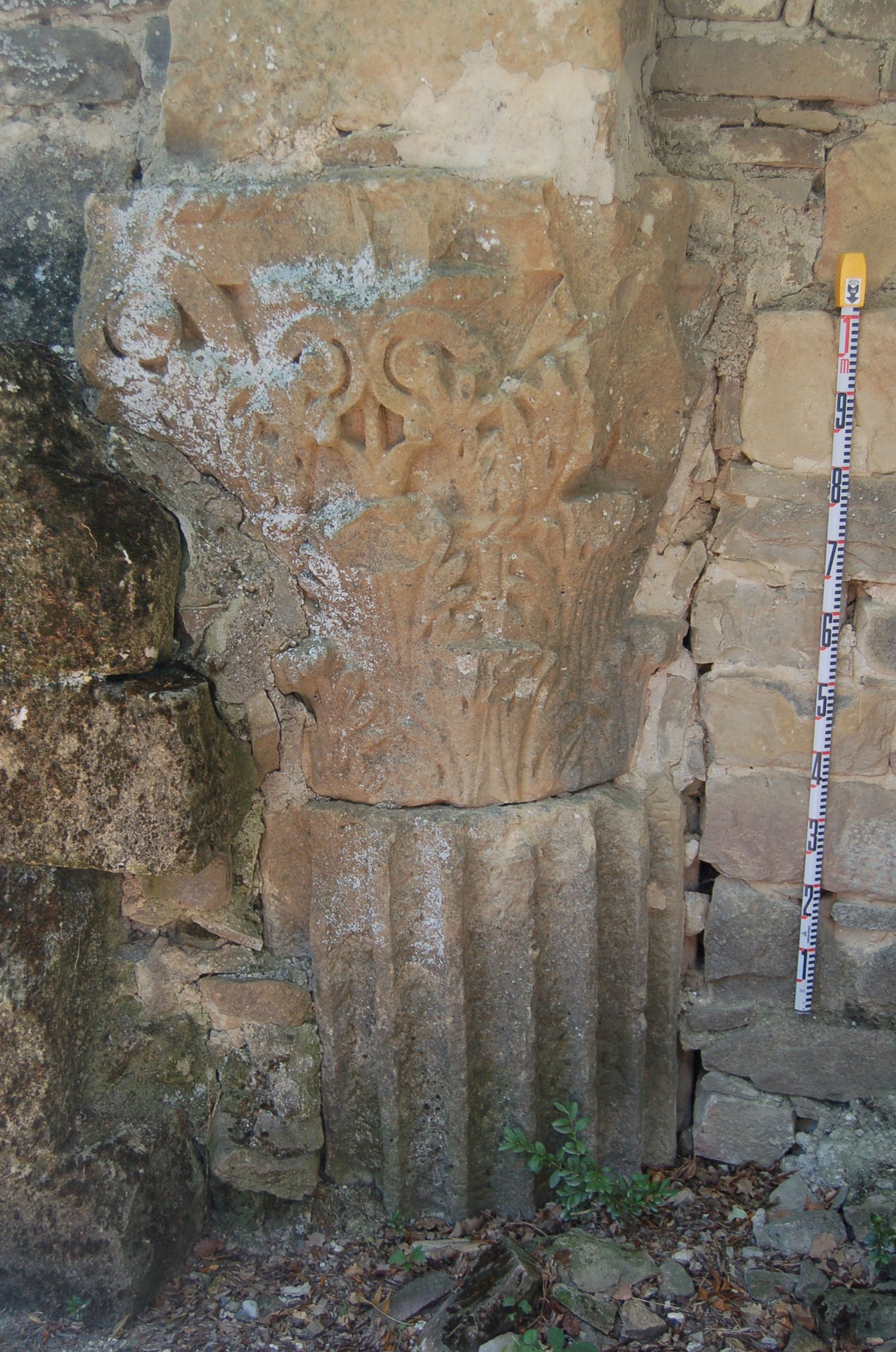
A Corinthian capital and fluted drum with a shaft located in a city discovered at the foot of the Pyrenees in 2018.

Do you ever wonder what sort of report archaeologists of a future civilization would write about your town? What if they had only the location and a few crumbled buildings to go on, no contemporary testimony? That was the plight of a group of archaeologists in Spain who investigated a “new” ancient city.

Vicente G. Olaya says at El País that archaeologists were surprised that they didn’t know the name of a recently unearthed city, but there were simply no historical documents mentioning it.

“In 2018,” he says, “the City Council of Artieda — located in northeastern Spain in the province of Zaragoza, and part of the country’s Aragon region — asked the University of Zaragoza’s Archaeology Department for help in studying some ruins located around the San Pedro hermitage, known variously as El Forau de la Tuta, Campo de la Virgen, or Campo del Royo.

“Three years later, the experts have confirmed that these sites formed a large single archaeological complex, and they detected two phases of occupation on the surface of the site: one during the imperial Roman period (the 1st to 5th centuries) and another during the early-medieval Christian era (the 9th to 13th centuries). Now, the research team has published the results in a reportEl Forau de la Tuta: A Hitherto Unknown Roman Imperial City on the Southern Slopes of the Pyrenees. …

“The report notes that based on important evidence from the ruins preserved in the hermitage, as well as artifacts held in various public and private collections and the findings at the site, the settlement was ‘of urban character — the city’s name is currently unknown — and it developed during the [Roman] imperial period. Later, the same site took on another iteration as a rural habitat during the Visigoth and early Andalusian periods.’

“The specialists have also found that, between the 9th and 13th centuries, another peasant habitat-type town or village was superimposed on top of the Roman settlement. They have identified the village as Artede, Arteda, Artieda or Arteda Ciuitate. The medieval enclave’s ruins include the apse area of the church, which was part of the San Pedro hermitage; numerous silos with circular openings, which were excavated from the subsoil and only perceptible by geo-radar; and an extensive cemetery consistent with Christian burial rites. …

“The El Forau de la Tuta site is located 1.5 kilometers from Artieda’s city center, on the fertile plain of the Aragón River. … It is possible that the site’s dimensions are even larger and that it extends to other — still unexplored — agricultural lands.

“The Roman settlement stood next to the road connecting three northern cities. … Currently known as Camino Real de Ruesta a Mianos (the High Road from Ruesta to Mianos), the road lasted through the Middle Ages as a stretch of the French Route, the Arles Way or the Via Tolosana (Tolouse Route), as part of the Way of St. James (Camino de Santiago). …

“Inside the hermitage, the study’s authors have identified two Corinthian capitals, three Italic Attic bases, a classical Attic base, several flat-edged fluted shaft drums, and a fragment of cornice. The huge dimensions and typology of the artifacts indicate that they came from several early [Roman Empire] public buildings. … 

“The study confirms that these pieces come from at least two different monuments. Their typologies indicate that they were sculpted more than half a century apart, ‘which demonstrates a prolonged period in the process of monumentalizing the city.’

“To the west of El Forau de la Tuta, next to the San Pedro ravine, ‘an impressive set of public works made of opus caementicium (the Romans’ early version of concrete) including at least four sewer outlets, a powerful massive abutment, a foundation, and a series of quadrangular structures,’ possibly supply cisterns, is also preserved. … The presence of these works is typical of urban settlements, where water drainage was a problem that had to be addressed, especially in relation to buildings, such as bath houses, that produced a large amount of water waste. …

“Archaeologists are also currently studying a sculptural fragment that is preserved in an Artieda private collection. The artifact — which was collected near the hermitage — is an incomplete, nearly life-sized left hand that holds a patera umbilicata [an offering bowl], which would have been part of a statue representing an offering figure. …

“In the first round of excavations in 2021, the archaeologists confirmed the existence of an intersection of two roads. ‘On one of the roads, possibly one of the settlement’s main streets, we documented the ruins of a sidewalk and a surface channel for draining water, which pedestrians could circumvent by means of three steppingstones.’ …

“In one of the excavations they performed, the archaeologists found ample remains of black and white mosaics made with tesserae (small cubes of stone or glass) and fragments of rudus (a layer of material placed under the tesserae). …

“Inside this structure, under a large number of slabs that fell in the building’s collapse, archaeologists found a practically complete black-and-white tessellated pavement (with some isolated red and yellow tesserae); it was extraordinarily preserved. Decorated with iconographic motifs in white on a black background, it has shells or scallops in the four corners, while the central emblem features seahorses, ridden by little Cupids, facing each other next to three representations of marine animals, a fish in the upper part and possibly two dolphins in the lower part.

“Thus, the archaeologists are certain that everything they’ve found so far ‘corresponds to a single urban complex from between the first and second centuries, and that the city had infrastructure and public monuments, including baths, a water supply system, regular urban planning, sewers, and possibly a temple.’ ” 

I can’t help thinking about the way early archaeologists (Schliemann, say, at Troy) barged in and dug at random, destroying historical records. Imagine how carefully and boringly the archaeologists in today’s story had to sift every little thing to discover the town built on top of the Roman city — and date both!

More at El País, here.

Read Full Post »