Feeds:
Posts
Comments

Posts Tagged ‘urban forest’

Photo: Suzanne Kreiter/Globe Staff.
Lacey Kohler, Urban Greening Projects co-ordinator and Cristiane Caro, cofounder of Pearl Street Garden Collective, worked in the new microforest in Providence, Rhode Island.

I have posted a lot about Miyawaki urban forests in Massachusetts, thanks to my friend Jean (Biodiversity Builders), who showed me several she’s helped to create. I didn’t know that similar work was afoot in nearby Rhode Island.

These efforts are all about what a dense little forest can give to a city neighborhood where there’s very little nature left. It can remove dangerous carbon from the atmosphere while spreading biodiversity all around, making the city a healthier place for both humans and critters.

Ed Fitzpatrick reports on the Rhode Island venture at the Boston Globe, “The asphalt grid of South Providence is lined with multifamily homes and concrete sidewalks. But along Pearl Street, one lot stands out.

“It’s lush and green, with nearly 270 trees packed into a 1,000-square-foot lot. Officially called the Pearl Street Garden, it contains a tiny forest in the middle of the urban jungle.

“ ‘Microforests’ like this one are cropping up in places ranging from Elizabeth, N.J., to Cambridge, Mass., to Pakistan. South Providence has two, both along Pearl Street, created by Groundwork Rhode Island and the Pearl Street Garden Collective. …

“ ‘This isn’t habitat restoration on the scale that is needed in terms of the world,’ said Jacq Hall, director of special projects at Groundwork Rhode Island … but it is a really great way, especially in a city, for people to become very in close touch with biodiversity and why it’s important and why it’s also beautiful.’

“In May, more than 100 people came out to plant the microforest. …

“The pocket forests adhere to the ‘Miyawaki method’ devised in the 1970s by Japanese botanist Akira Miyawaki, which calls for planting a wide variety of local trees in large numbers and in very tight quarters. …

“Massachusetts now has at least 20 microforests, according to Alexandra Ionescu, a Providence resident who is associate director of regenerative projects at Biodiversity for a Livable Climate, a Cambridge-based nonprofit that promotes ecosystem restoration to address climate change. …

“Rhode Island is the smallest and second most densely populated state in the nation, and a 2022 study found it contains 139 square miles of asphalt, concrete, and other hard surfaces, amounting to 13 percent of its land area. Hall said the benefits of forests and tree-lined streets are not distributed evenly in Rhode Island. …

“[Hall said], ‘We’re trying really hard to go back into those places that have been aggressively paved over and try to work in little bits of nature to bring those benefits to more people.’ …

“Hall said microforests help combat climate change because they grow so quickly. With plants packed close together, they both collaborate and compete for resources, racing to reach the sun first. She said research shows forests grown using the Miyawaki method grow 10 times faster than a traditional landscape planting. …

“Hall said projects such as this received a big boost in funding from the federal Inflation Reduction Act of 2022. ‘It was a historic moment,’ she said. …

“Groundwork Rhode Island and the Pearl Street Garden Collective are now looking for other funding sources” because of federal curbacks.

More at the Globe, here. And if you want to know more, search this site for “Miyawaki.” Or just click here.

Read Full Post »

Photo: Biodiversity for a Livable Climate.
A Miyawaki forest at Danehy Park in North Cambridge, Massachusetts, planted on September 25, 2021 — with the help of enthusiastic volunteers. Other Miyawaki forests don’t look like much in April. But just watch!

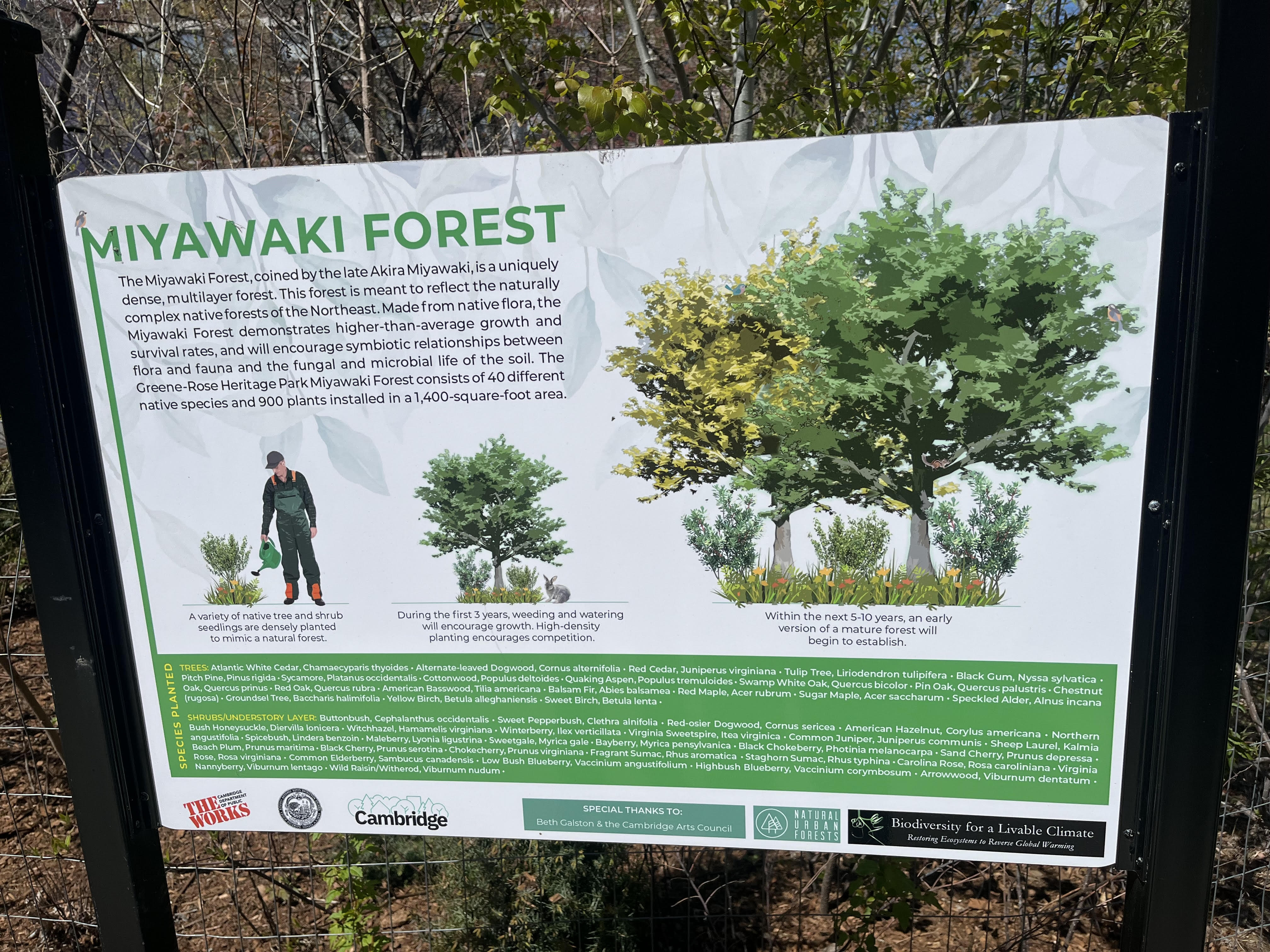
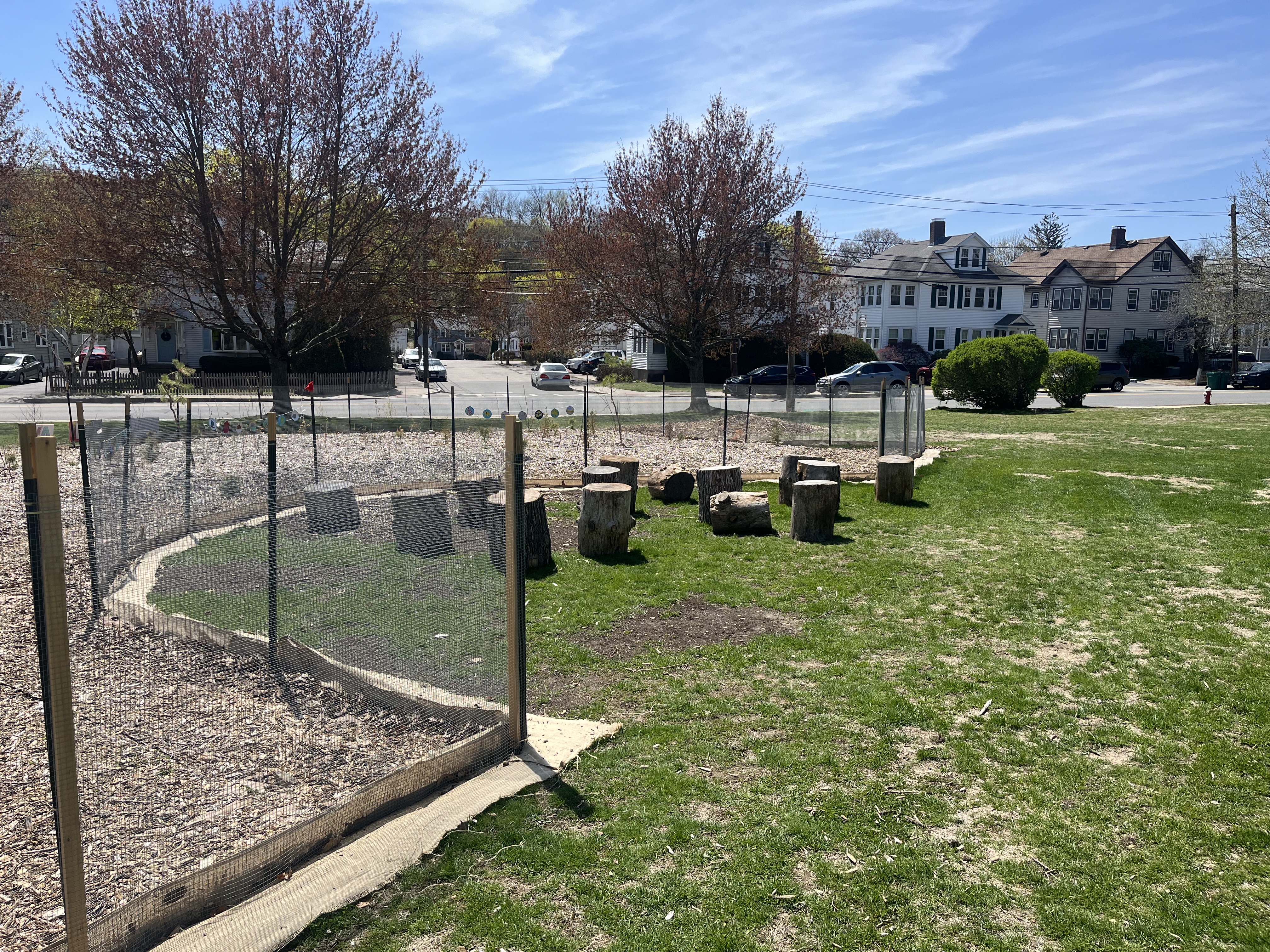
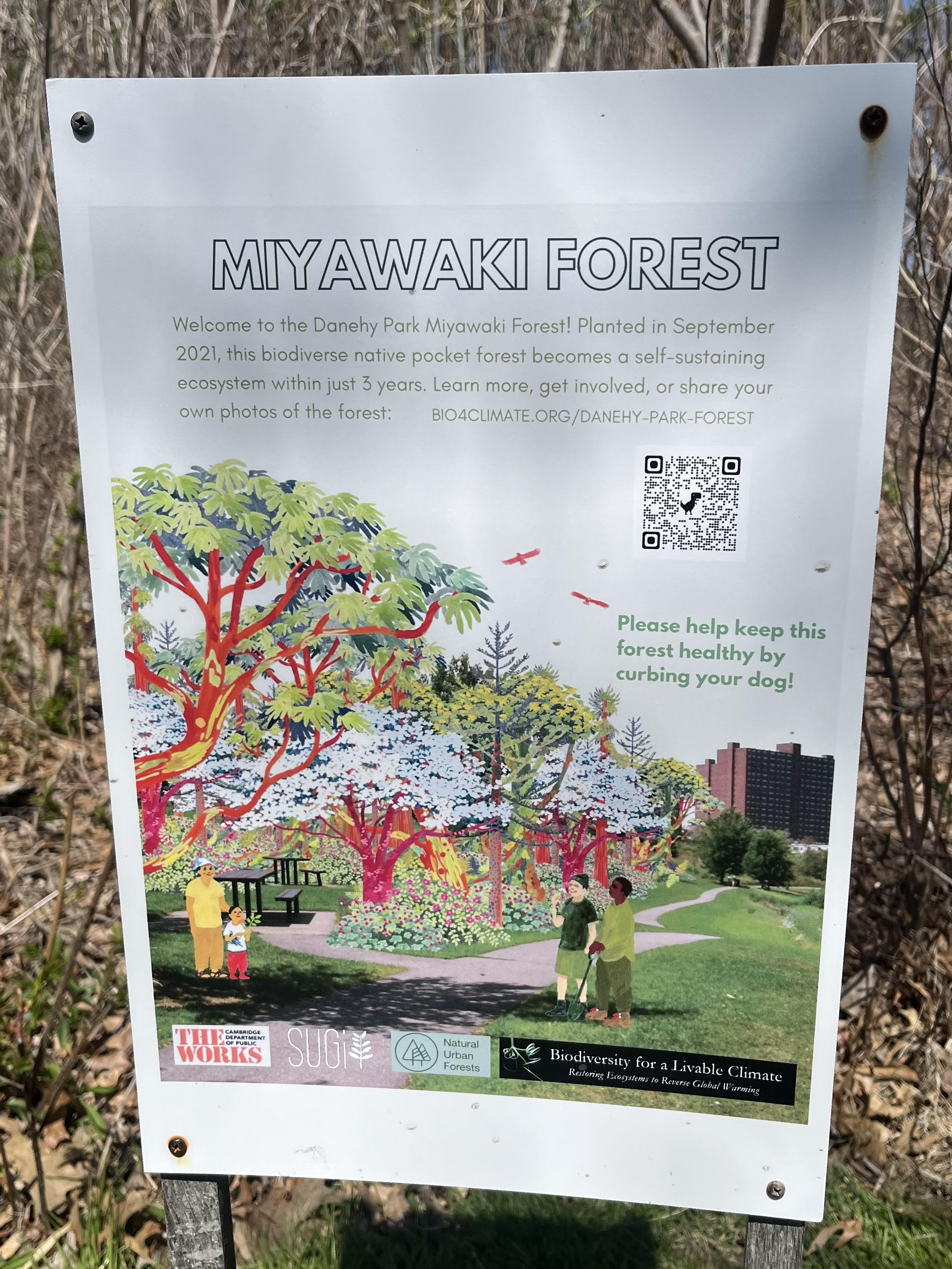
Although I blogged about Miyawaki mini urban forests in 2023, here, and again after a tip from Hannah in Philadelphia, here, I had never seen one in person and didn’t really understand the concept. These are not forests you take a walk in. They are deliberately planted too densely for entering, which is why one elementary school asked for a crescent shape to let kids see the native plants that their teachers were talking about.

On a special day in April, my friend Jean Devine of Biodiversity Builders took two of us on a tour of three Miyawaki Forests and the site for one that she and students at her local high school are building.

Now I think I get it. In order to have a healthy climate, we need a healthy, biodiverse planet. And the effects of even very small sites can spread. Birds, small animals, pollinators, and other critters flourish in these biodiverse pockets.

Biodiversity for a Livable Climate: Restoring Ecosystems to Reverse Global Warming says, “The Miyawaki Forest is an ultra dense, biodiverse pocket forest that recreates the complexity of natural forests and the relationships and processes that help them grow strong and resilient. By giving home to a vast array of native species, they boost the biodiversity of the area and nurture pollinators, supporting and restoring ecosystems. They sequester carbon in the soil, reduce air pollution and soil contamination, improve water absorption to buffer against flooding and erosion, and cool the surrounding area to mitigate the urban heat island effect. They also create a living classroom for people and communities to learn about native ecology, engage in stewardship, and experience the interconnectedness of the natural world.”

GBH tv provides a forum on the concept, asking, “What can hold more than 500 species, sequester more than 500 lbs. CO2/year, be 10F cooler than its surroundings, soak up lots of rainwater, and be made by and for children in a space no bigger than a tennis court? A ‘mini-forest’ planted using the Miyawaki Method, of course!

“Biodiversity for a Livable Climate hosts Miyawaki-Method advocates Hannah Lewis (Bio4Climate Compendium editor) and Daan Bleichrodt (The Netherlands’ Tiny Forest initiative leader), as they talk about mini-/tiny-forests and their role in climate resilience, urban beautification, and connecting all of us to nature.” More here.

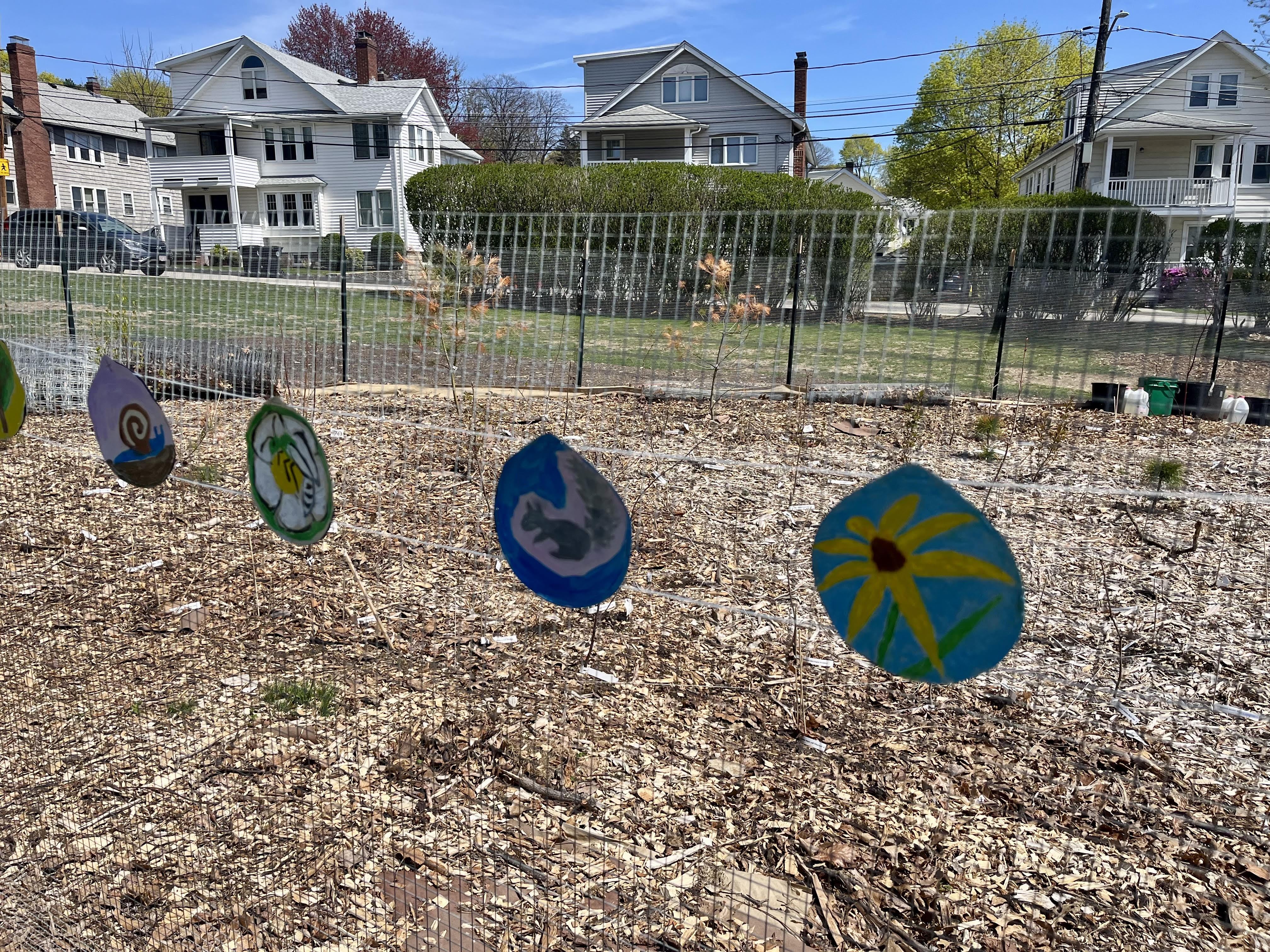
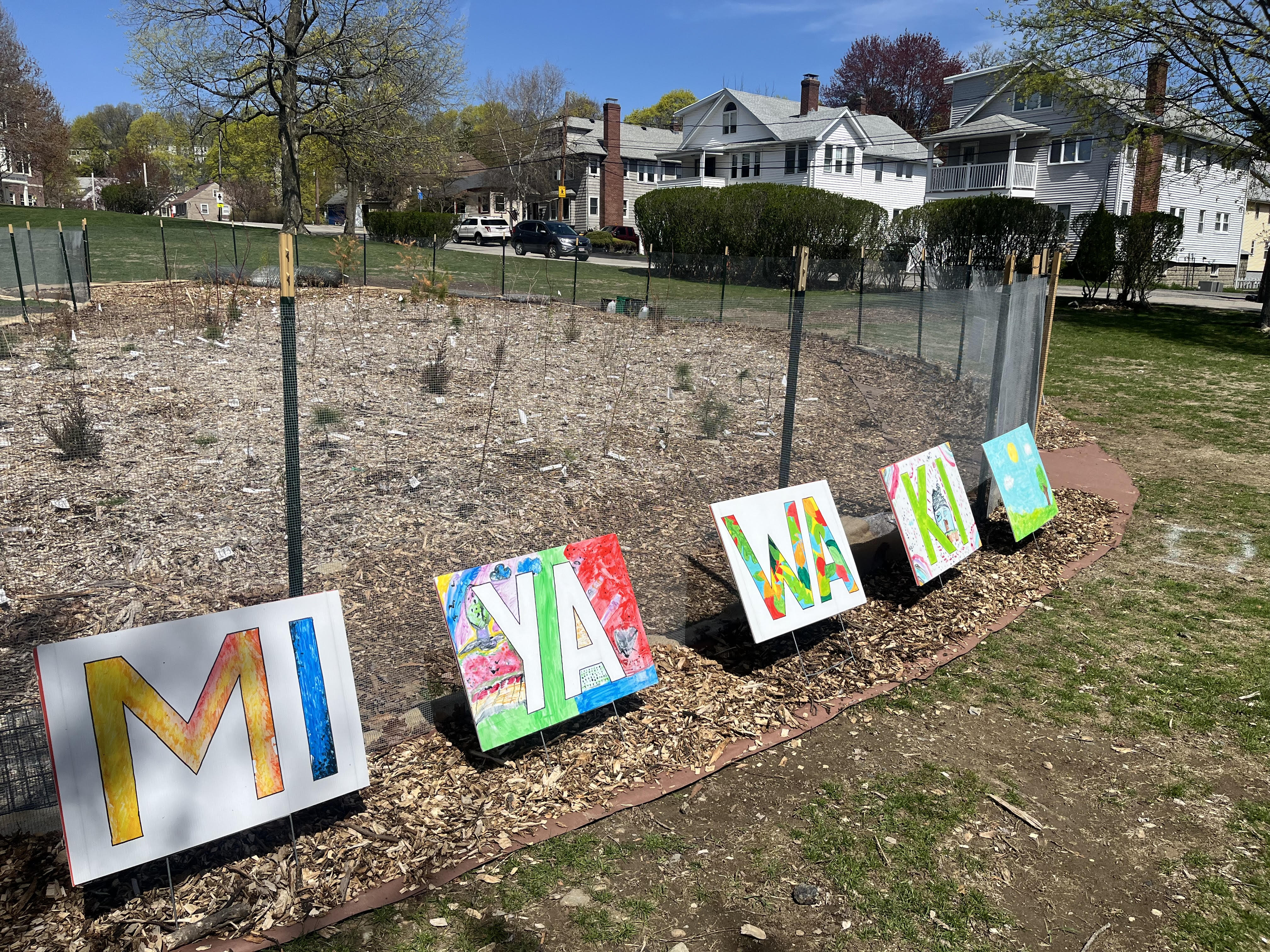
My photos are from mini forests Massachusetts, one in a large park in Cambridge, one in a Cambridge neighborhood’s pocket park, and one at an elementary school in Watertown. At the latter, the children sit on tree stumps for classes. Note the art they created for their forest, too. The forest doesn’t look like much in April, but just wait!

More at Biodiversity for a Livable Climate, here, and here.

Read Full Post »

Illustration: Elara Tanguy.
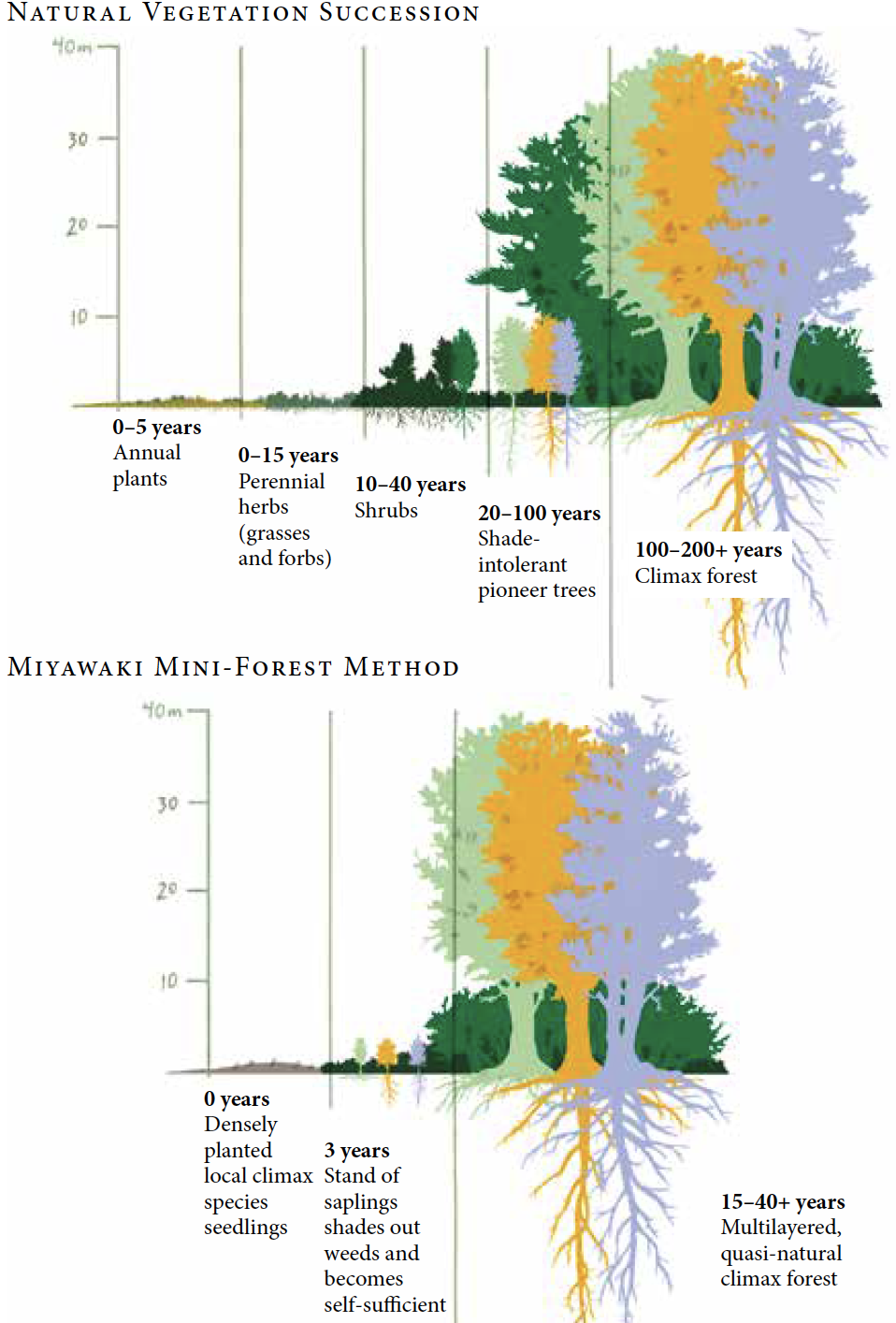
The Miyawaki Method (bottom) speeds up the process of natural ecological succession (top) through the planting of “climax species.”

Ideas on combating climate change through the planting of sustainable forests come today from an employee-owned publishing company called Chelsea Green. Here they focus on a book by Hannah Lewis about the Miyawaki Method.

“Author Hannah Lewis is the forest maker transforming empty lots, backyards, and degraded land into mini-forests and restoring biodiversity in our cities and towns to save the planet. …

“Most of us know the term old-growth forest, which refers to natural forests that are still mostly free of human disturbance (though not necessarily free of human presence). These forests have reached maturity and beyond — a process that often takes centuries. As a result, they host incredible biodiversity and sustain a complex array of ecosystem functions.

“The Miyawaki Method is unique in that it re-creates the conditions for a mature natural forest to arise within decades rather than centuries. 

At the heart of the method is the identification of a combination of native plant species best suited to the specific conditions at any given planting site.

“As we’ll see, determining this combination of special plants is not always so straightforward.

“More than just the species selection, the Miyawaki Method depends on a small collection of core techniques to ensure the success of each planting. These include improving the site’s soil quality and planting the trees densely to mimic a mature natural forest. It’s also necessary to lightly maintain the site over the first three years — which can include weeding and watering. Amazingly, though, if the simple guidelines are followed, after that point, a Miyawaki-style forest is self-sustaining.

“The trees grow quickly (as much as 3 ft per year), survive at very high rates (upward of 90 percent), and sequester carbon more readily than single-species plantations. The Miyawaki Method is also special for its emphasis on engaging entire communities in the process of dreaming up and planting a forest. Whether you are three years old or eighty-three, chances are you can place a knee-high seedling into a small hole in the ground. At the very least you can appreciate and cherish the return of quasi-wilderness to a space that was once vacant.

“The Miyawaki Method calls for planting native species, but not just any natives. In particular, the method involves a careful investigation of what’s known as potential natural vegetation (PNV). This unusual term refers to the hypothetical ecological potential of a piece of land. Or another way to say it is that potential natural vegetation is ‘the kind of natural vegetation that could become established if human impacts were completely removed from a site’ over an extended period of time. A site’s PNV depends on many factors, including current climate conditions, soil, and topography.

“How is potential natural vegetation different from the plants we see growing around us in towns and cities? For starters, in almost all developed landscapes, many of the plants are not native to the area, and as such may require maintenance to survive or reproduce.

“Given that most of Earth’s land surface is significantly altered by urbanization, agriculture, road construction, mining, and the like, it is far from obvious what the original vegetation of any given location would have been. (Original vegetation and potential natural vegetation are not necessarily exactly the same, but they are closely related.) Unraveling this mystery takes curiosity, patience, and persistence.

“However, thinking about land in terms of its potential natural vegetation is a powerful angle from which to approach ecosystem restoration, because it reveals which species and groups of species are best adapted to a particular environment and therefore more likely to thrive and to support a wider web of wildlife. …

“If left alone, previously forested land can grow back into mature forest via a process known as ecological succession, wherein the biological components of the ecosystem change over time as larger and longer-lived plant communities colonize the land. As mentioned, this process can take centuries to unfold. A foundational aspect of the Miyawaki Method is that it sidesteps the slow and capricious march of natural succession, instead focusing on those plants that mark the theoretical endpoint of succession.

“In nature, the successional process begins when lightweight seeds drift in and germinate on bare ground. Hardy, fast-growing plants — what scientists call pioneer species — such as clover, plantain, and dandelion take advantage of ample sunlight and space. They live short lives, produce a lot of seeds, and shelter the ground in the process. Next to show up are larger perennial herbs and grasses, followed by shrubs and pioneer trees, such as birch, poplar, or pine.

“ ‘Each new group of species arrives because the environmental conditions, especially the soil, have been improved; each new species becomes established because it is more shade tolerant than the previous species and can grow up under their existing foliage,’ Miyawaki wrote. He explains that just when a community of plants appears to be reaching its fullest potential, the seeds of the succeeding community are already germinating in its shade. The species making up each new successional stage tend to be bigger, more shade-tolerant, and longer living than those of the previous stage.

“ ‘The plant community and the physical environment continue to interact,’ Miyawaki explained, ‘until the final community most appropriate for the environment comes into being, one that cannot be replaced by other plant types. In regions with sufficient precipitation and soil, the final community is a forest.’

“Theoretically, this final community of plants, known as the climax community, is not easily superseded. Big trees that are considered climax species in their respective environments live for hundreds or thousands of years, forming canopies that shade the interior of the forest, keeping it cool and moist. Climax species shade out pioneer species and dominate the forest.

“ ‘In the absence of major environmental change, the climax is normally the strongest form of biological society and is stable in the sense that its dynamic changes are constrained within limits,’ Miyawaki wrote. Partly on account of the microclimate they create, such ecosystems tend to be more resistant to external conditions, such as heat or drought.”

More at Chelsea Green, here. No firewall.

Read Full Post »

Photo: Shahzad Qureshi
Shahzad Qureshi, founder of Urban Forest, in Karachi, Pakistan.

Today most people have come to realize the importance of trees for everything from reducing global warming to improving life in neighborhoods. The Amazon rain forest (currently in grave danger from Brazil’s government) is known to cool the planet by soaking up carbon in the atmosphere, and urban forests give city residents a chance to cool off — and calm down.

Sometimes it takes a tragedy, but around the world, more people are feeling they better do something themselves to protect trees.

Anna Kusmer reports at PRI’s The World, “Extreme heat often hovers over Karachi, Pakistan’s largest city, creating insufferable conditions for its 16 million inhabitants. But each time Karachi resident Shahzad Qureshi transforms a barren patch of land into a dense, urban forest, he helps his city adapt to extreme urban heat that has become inevitable under climate change. Over the last four years, Qureshi’s organization, Urban Forest, has planted 14 urban forests in parks, schools, people’s yards and outside of a mosque.

“Qureshi’s quest to plant urban forests started in 2015, when temperatures reached over 120 degrees Fahrenheit in Karachi. About 2,000 people in the region died from dehydration and heatstroke. It was devastating.

‘It was just too hot,’ Qureshi said. …’ And one of the things everybody was talking about is that there’s not enough green cover.’

“Around that time, Qureshi saw a TED Talk that changed his life. He listened to a man named Shubhendu Sharma sharing a method to quickly grow dense urban forests. Qureshi was amazed. …

“Qureshi decided to learn Sharma’s technique and bring it to Karachi, joining a growing global community of urban foresters who want to help their cities adapt to extreme urban heat events created by rapid climate change. …

“Sharma’s organization Afforestt has now helped plant 150 mini-forests in 13 countries.

“ ‘So, there is a quite strong global community right now,’ Sharma said. ‘I am very keen on taking this method to every single country of the world.’

“Sharma’s special technique is known as the Miyawaki method. It involves the close placement of a variety of trees with different growing speeds and light requirements to prevent competition for the same resources. The approach specifically uses native species, allowing trees to thrive in their original climates and environments while supporting native bird and insect populations.

“ ‘Most of the city is roads and buildings and built-up urban area,’ said Nadeem Mirbahar, an ecologist with the Swiss International Union for Conservation of Nature Commission (IUCN) on Ecosystem Management, based in Karachi. His organization did a survey and found that only 7% of Karachi had green cover.

“This contributes to an ‘urban heat island’ effect, Mirbahar said. The phenomenon causes cities to be significantly hotter than the surrounding countryside. He thinks Karachi should strive for at least 25% green cover to avoid catastrophic heat events in the future.

“Qureshi’s oldest urban forest is four years old and already has towering, 35-foot-tall Acacia trees full of big, thorny branches and birds’ nests.

“ ‘I have seen bird species in this park, which I have not seen in my life,’ he said. ‘It’s a habitat for them.’ …

“Policymakers in Pakistan have started to look at planting trees as a solution to the urban heat threat, said Umer Akhlaq Malik, a policy analyst at the United Nations Development Program (UNDP) in Pakistan.

“In 2016, the government launched a plan to plant hundreds of millions of trees as part of a project called ‘the Billion Tree Tsunami,’ in response to the fact that the country had fallen to a mere 2% forest cover.

“Malik said … ‘To take it to scale, you need more practitioners who invest their time and energy into this.’

“Malik said the biggest barriers are cost and space. Each forest can cost hundreds of thousands of dollars to establish.

“But Qureshi remains hopeful that the project can scale up. He is working with the UNDP to form a coalition that aims to bring urban forests to every park in the city. He thinks Karachi could look fundamentally different.”

More at PRI, here.

Read Full Post »

urban20tree2020lead20image

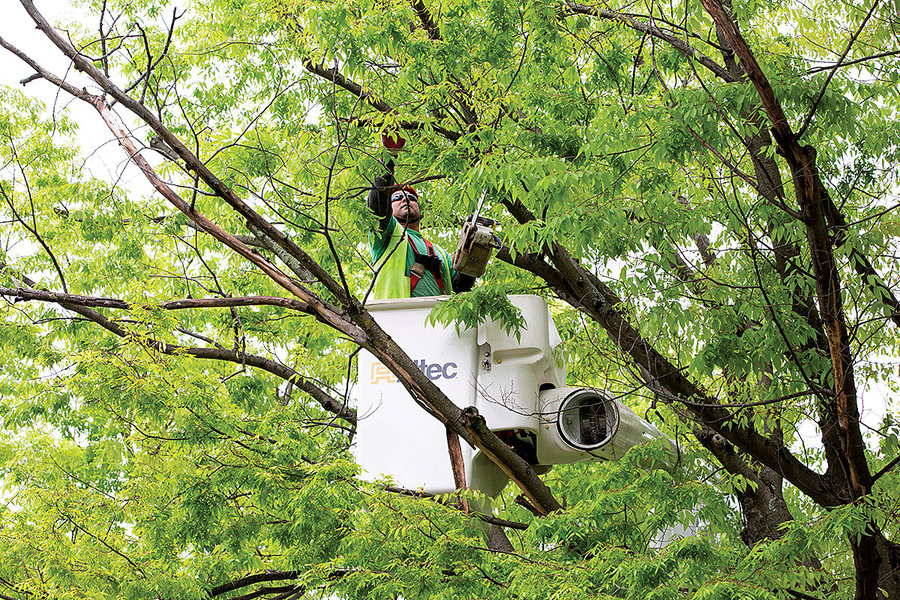
Photo: Melanie Stetson Freeman/ Christian Science Monitor
Pruning trees in Baltimore helps to keep them healthy. “We are making a difference,” says Erik Dihle, arborist for the city of Baltimore. … “It ties into social equity, into climate adaption, everything.”

The value of tree canopies in cities is not a new topic at this blog. I’ve written often about efforts around the world to capture the physical- and mental-health benefits of urban forests (for example, in 2014, 2017, and last summer).

I’m not sure, though, that I ever knew how forward-thinking Baltimore has been, a city that was recently disparaged by a kind of leader unfamiliar with actual leadership.

Stephanie Hanes writes at the Christian Science Monitor, “From his headquarters office, Erik Dihle drives into what has become one of the most monitored forests in the United States.

“He begins to point out the trees: There is a tulip poplar, as big as the ones George Washington planted at Mount Vernon. There are the blossoming cherries, with a cotton-candy display that rivals their famous compatriots down the road at the Tidal Basin in Washington, D.C. And there is a white oak, Maryland’s state tree, with its branches gnarling horizontally for yards.

“ ‘This is a good-size one,’ he says, getting out of his truck to pace the area of shade created by the tree’s canopy. ‘I’d be surprised if it was less than 150 years old.’ …

“Mr. Dihle’s forest is in the city. He is the arborist and the head of forestry for the city of Baltimore, which means he monitors all the trees here – those growing in shady parks, in metal grates along busy streets, in backyards, and in relatively untouched forest patches dotting the municipality. Together, these trees make up what is called the city’s ‘urban forest.’ …

“With concern growing about climate change and rapid worldwide urbanization, city forests have emerged as one widely touted solution to a host of social and environmental challenges. Municipalities from Barcelona, Spain; to Melbourne, Australia; to Chicago have put urban canopy coverage at the center of their long-term strategic plans. Community groups focusing on planting, maintaining, and saving trees have blossomed across the U.S. In 2015, the World Economic Forum’s Global Agenda Council on the Future of Cities named increasing green canopy coverage as one of its top 10 urban initiatives.

“Yet at the same time, the U.S. Forest Service, which in the past decade has also upped its focus on urban forests, has found that American cities are losing trees – and quickly. … Urban regions showed a particular decline, along with an increase in what the researchers call ‘impervious surfaces’ – in other words, concrete.

“But not, it turns out, in Baltimore.

“Here, the net tree canopy coverage has increased. Not by a lot, Mr. Dihle is quick to point out – only from 27% of the city’s land coverage to 28% – and not because Baltimore hasn’t lost trees. It has. But overall the tree canopy here has grown, which means that Mr. Dihle has found himself presiding over one of the more successful efforts in the U.S. to preserve and improve the urban forest. …

“New technology has let researchers better understand the urban ecosystem – not just how trees thrive or fail in a city, but how they intersect with humans.

‘[Trees] impact work productivity, wildlife habitats, air pollution removal, carbon sequestration, energy use,’ says David Nowak, senior scientist with the U.S. Forest Service who authored the recent national report on tree canopy loss. … ‘We should be smart about this whole process and use nature to make our lives better.’

Much of the understanding of how, exactly, trees affect everything from climate to criminal justice stems from a technological breakthrough pioneered in Baltimore. …

“By the 1990s, satellite imagery allowed governmental agencies such as NASA to produce visible images of Earth and to show on various scales where trees existed. But there was a limit to those pictures, explains Morgan Grove, a scientist with the U.S. Forest Service who has worked in Baltimore since 1999. Because the data were recorded in pixels, not physical parcels, it was difficult to identify, say, the owner of a particular tree, or to compare what was happening from one city block to another.

“In 2006, though, the Forest Service, working with researchers from the University of Vermont’s spatial analysis lab, put together a new type of land cover map in Baltimore using a combination of aerial imagery, light-reflecting technology, and high-resolution landowner data. This novel approach not only allowed a closer look at trees, it also let scientists synchronize forest maps with other information that was also newly computerized and manipulable – everything from health records to census figures, crime statistics to property values.”

Learn about the amazing array of data they were able to collect, how data helped the city prevent nascent problems like storm sewer overflow, and how the community has organized to protect and expand urban forest benefits, here.

By the way, I thought the photographer on this story, Melanie Stetson Freeman, did an especially good job capturing the faces of these tree huggers. It helps one understand that the individual and the things an individual cares about are what improve the world.

Read Full Post »

a514c2fcd

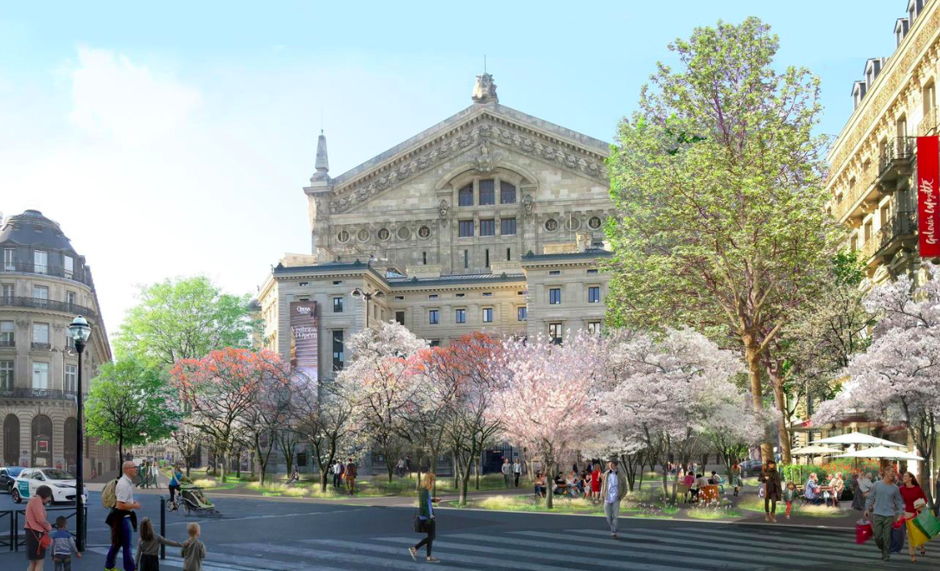
Photo: Ville de Paris/Apur/Céline Orsingher
The trees in this rendering of Paris’s Opera Garnier would take the place of an existing bus-parking area. Big ideas are necessary if the city is to meet its ambitious greening goals, part of the international Paris Agreement to tackle global warming.

A January article by Feargus O’Sullivan at CityLab, showed artist renderings like the one above as part of a plan to bring more trees into Paris. The announcement came before Notre Dame burned, so I hope plans are still going forward. Here is the concept.

“Some of Paris’s most treasured landmarks are set to host the city’s new ‘urban forests,’ ” writes O’Sullivan.

“Thickets of trees will soon appear in what today are pockets of concrete next to landmark locations, including the Hôtel de Ville, Paris’s city hall; the Opera Garnier, Paris’s main opera house; the Gare de Lyon; and along the Seine quayside.

“The new plantings are part of a plan to create ‘islands of freshness’—green spaces that moderate the city’s heat island effect. It also falls into an overall drive to convert Paris’s surface ‘from mineral to vegetal,’ introducing soil into architectural set-piece locations that have been kept bare historically. As a result, the plan will not just increase greenery, but may also provoke some modest rethinking of the way Paris frames its architectural heritage. …

“[Such plans] are necessary if Paris is to meet its ambitious greening goals. By 2030, city hall wants to have 50 percent of the city covered by fully porous, planted areas, a category that can include anything from new parkland to green roofs. ..

“The city imagines turning the square in front of city hall into a pine grove, while future springtimes will see the opera house’s back elevation emerge from a sea of cherry blossom. The paved plaza at the side of the Gare de Lyon will become a woodland garden, while one of the two former car lanes running along the now pedestrianized Seine quays will be taken over by grass and shrubs.

“Such plans will require more than sticking saplings in the ground. Creating the new opera house cherry orchard will mean displacing a current parking lot used by tourist buses, a process that the city plans to repeat elsewhere. …

“Intriguingly, the urban forest plans are a slightly different take on the classic Parisian aesthetic. Sites like the areas around the opera and Hôtel de Ville don’t need beautifying — they are already grand, charismatic showcases for the elaborate, even fanciful historic buildings that they host.

“In the past, however, they have been left bare, or at most … fringed with small lines of trees that have been rigorously pruned and trained until they form a narrow, wall-like rampart. …

“Given how charming the designs appear, this seems unlikely to be controversial, but it does suggest a more rustic, quasi-natural approach to greenery than has previously been the rule in Paris.”

There is more information here. And maybe when blogger A Pierman Sister returns to Paris, we will get an eye-witness account of the city’s progress on its plans.


Read Full Post »

I’ve mentioned before that John is active on the Arlington Tree Committee. He’s been behind a major push to inventory the town’s trees, aided by local government support and the legwork of many residents.

Other members of the committee have been using Facebook to link to interesting research on the value of trees to communities.

Science Daily, for example, reported on a study by Adam Dale et al. of the University of Florida Institute of Food and Agricultural Sciences (UF/IFAS) suggesting the best ways to keep trees healthy and sustain their economic value.

“Heat from city sidewalks, streets, and parking lots, along with insect pests, can damage trees planted in urban landscapes. Thus, it is critical to plant trees in the right places so they will do well in harsh urban environments, a University of Florida Institute of Food and Agricultural Sciences researcher says.

“More than half the world’s people and 80 percent of the U.S. population live in urban areas. Trees benefit these residents by filtering the air, reducing temperatures and beautifying landscapes. According to a new study led by Adam Dale, a UF/IFAS assistant professor of entomology, these benefits are reduced when trees are planted in unsuitable urban landscapes. However, guidelines can be developed to lead urban tree- planting decisions in a more sustainable direction.” Check out the researchers’ “Pace to Plant” technique here.

At the Toronto Star,

“Using data from Toronto, a team of researchers has found that having 10 more trees on your block has self-reported health benefits akin to a $10,000 salary raise or moving to a neighbourhood with a $10,000 higher median income or being seven years younger.

“By comparing satellite imagery of Toronto, an inventory of trees on public land and general health surveys, the team, led by University of Chicago psychologist Marc Berman, found that people who live on a tree-lined block are less likely to report conditions such as high blood pressure, obesity, heart disease or diabetes.

‘Their findings appeared [in 2015] in the open-access journal Scientific Reports.” More at the Star here.

And I’d be remiss if I didn’t mention that research social scientist Kathleen L. Wolf has written extensively on the value of trees: for example, in this Communities & Banking article on how “the urban forest” benefits local businesses.

Photo: Tyler Jones, UF/IFAS
Numerous studies show trees improve health and quality of life in communities and make shopping at local businesses more appealing.

Read Full Post »

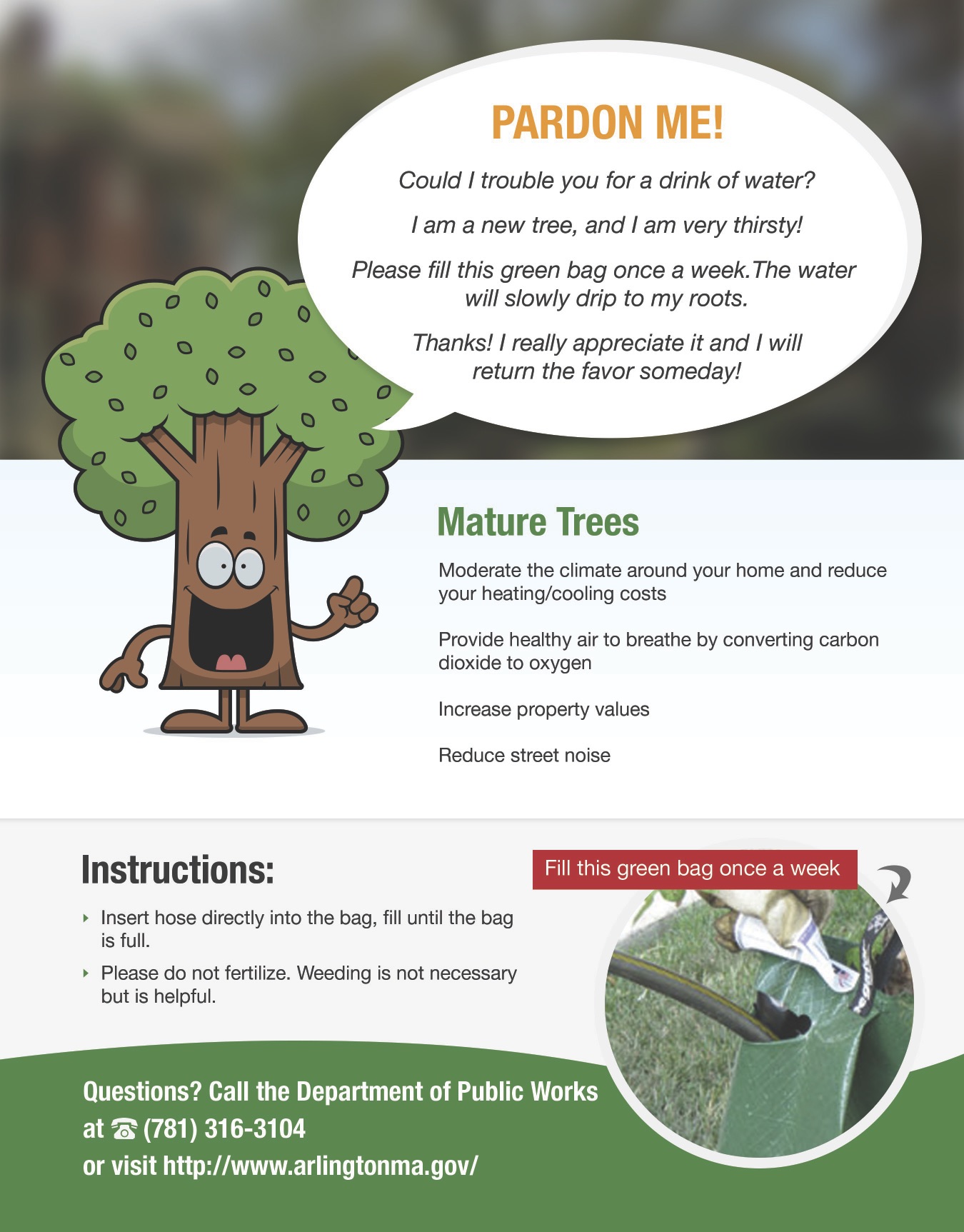
John (founder of www.mistersmartyplants.com) is a member of Arlington Tree Committee. He figured out a way to use Google Maps to identify heritage trees in town and got a sign made to encourage residents to adopt a thirsty tree.

Now that so many urban and suburban areas have taken down their trees to make construction projects easier, people are realizing what they’re missing.

Many have noted that trees play a role in residents’ mental and physical health.

University of Washington research social scientist Kathy Wolf has studied the health aspects and also has economic arguments. She has shown that an “urban canopy”  makes local shopping more agreeable for customers and lends vitality to downtown business districts. Read what she has learned, here.

Chris Mooney at the Washington Post notes other research. “In a new paper published Thursday, a team of researchers present a compelling case for why urban neighborhoods filled with trees are better for your physical health. The research appeared in the open access journal Scientific Reports.

“The large study builds on a body of prior research showing the cognitive and psychological benefits of nature scenery — but also goes farther in actually beginning to quantify just how much an addition of trees in a neighborhood enhances health outcomes. The researchers, led by psychologist Omid Kardan of the University of Chicago, were able to do so because they were working with a vast dataset of public, urban trees kept by the city of Toronto — some 530,000 of them, categorized by species, location, and tree diameter — supplemented by satellite measurements of non-public green space (for instance, trees in a person’s back yard). …

“Controlling for income, age and education, we found a significant independent effect of trees on the street on health,” said Marc Berman, a co-author of the study and also a psychologist at the University of Chicago. “It seemed like the effect was strongest for the public [trees]. Not to say the other trees don’t have an impact, but we found stronger effects for the trees on the street.”

Thank you to my high school classmate, Susie from Cleveland, for putting the Washington Post article on Facebook.

071115-Arlington-Tree-Watering

Read Full Post »