Feeds:
Posts
Comments

Posts Tagged ‘volcano’

Photo: Alessandra Benini.
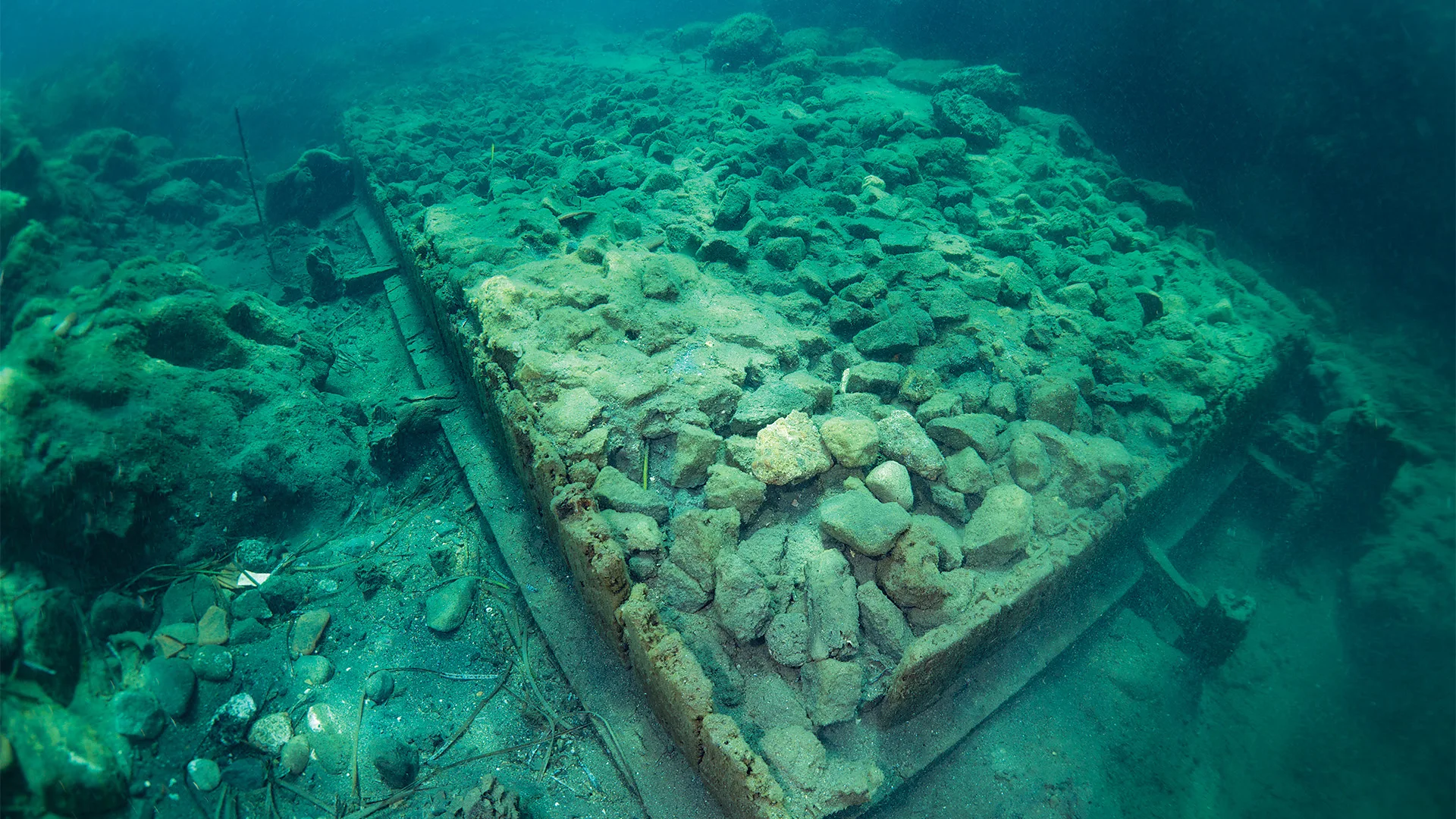
The ruins of Aenaria were buried in the sea for nearly 2,000 years, preserved underneath volcanic sediments.

Today’s story is about finding Aenaria, a Roman port that disappeared under the sea after a volcano erupted. Eva Sandoval at the BBC begins by describing a tour you can take there if you are interested in archaeology.

“As our tour sets sail, the vast Bay of Cartaromana opens up before us. Jagged cliffs shoot up from the waves; sunbathers sprawl on the inlet bridge leading to the 2,500-year-old Aragonese Castle. … After just 10 minutes at sea, we reach a network of buoys marking the ruins below. I press my hands against the vessel’s transparent bottom. Through the turquoise-blue water, between waving fields of seagrass and small striped fish, I glimpse a pile of rocks. Then the seagrass parts and I see that the rocks are arranged into a long rectangular form, its sides encased in wooden planks. This is an ancient city’s quay; buried in the cool dark for centuries and perfectly preserved. …

“I am on the Italian island of Ischia, where sometime around AD180, the Cretaio volcano erupted, and the ensuing shockwaves sank the Roman port city of Aenaria beneath the sea.

“At least, that’s what archaeologists think happened. … There are no records of the explosion, and very little written about the settlement itself. For nearly 2,000 years, there was no physical trace of it either. …

“The first hints of its existence were in 1972, when two scuba divers found Roman-era pottery shards and two lead ingots off Ischia’s eastern shore. The find intrigued archaeologists, but the ensuing investigation, helmed by local priest Don Pietro Monti and archaeologist Giorgio Buchner, yielded nothing. … The case went cold for nearly 40 years.

“Then, in 2011, passionate local sailors reopened the excavation, this time digging into the sea floor. Soon, they were able to confirm that 2meters beneath the bay’s volcanic seabed lay the ruins of a massive Roman-era quay. …

“As far as anyone had ever known, Ischia’s DNA was Greek. The island was renowned as the site of the first Greek colony in the Italian peninsula, established around 750BC in the north of the island. …

“When the Romans seized Pithecusae sometime around 322BC, they renamed the island Aenaria – a name that appears in ancient texts from Pliny the Elder to Strabo, often in relation to military events. But unlike the Greeks, who left behind a necropolis, kilns and troves of pottery, the Romans left only a few modest tombs, engravings and scattered opus reticulatum. …

” ‘The name was documented,’ echoes local resident Giulio Lauro. ‘But no one could find the place.’ Archaeologists had been looking for Roman Ischia on dry land, but it was buried below the sea.

“Lauro is the founder of the Marina di Sant’Anna; the cultural branch of the Ischia Barche sea-tourism cooperative. Along with various affiliated cultural groups – comprised of Ischian seafarers, history enthusiasts and archaeologists – they have self-funded the excavations for the past 15 years.

“Lauro is quick to tell me that he’s no scientist. ‘But I love the sea,’ he said. ‘In 2010, I got the idea to look again.’ …

“There were challenges, recalls Lauro: ‘Getting authorizations, training people, sourcing funds. We started from zero. We were lucky to believe in it. And then to actually find it.’ …

” ‘It was believed that the Romans never built a city on Ischia,’ says [Dr Alessandra Benini, the project’s lead archaeologist]. ‘It was the opposite.’ …

“Each summer, Benini and her team excavate the sea floor. Progress is painstaking due to a perennial shortage of funds. … During the site’s active months, curious visitors can take glass-bottomed boat tours, as well as snorkelling and scuba excursions to get even closer to the ruins. ‘You can see the underwater archaeologists at work, the equipment they use and everything involved,’ says Benini. …

“I ask Benini what she hopes to find this summer.

” ‘My dream is to find the foundations of the residential city,’ she says. ‘If we’ve found the port, then we know there was a city.’  

“The team hopes to introduce Lidar, Georadar and sub-bottom profiler instruments into the digs, but Benini points out, ‘That’s expensive. We need more investors.’ “

Lots more at the BBC, here. No paywall.

Read Full Post »

Photo: Archaeological Park of Pompeii.
A well-preserved fresco depicting the myth of Phrixus and Helle was recently uncovered at Pompeii, a city buried in 79 CE.

Have you ever felt curious about a Greek myth? Once you start digging in, you find there’s always another story behind the story. Consider the Golden Fleece of Jason and the Argonauts‘ quest. That’s a tale stirred up anew by a discovery at Pompeii.

As Rhea Nayyar reports at Hyperallergic, “Archaeologists in Italy recently uncovered a 2,000-year-old fresco in remarkable condition on the walls of the House of Leda, a Pompeii mansion under excavation since 2018 that’s recognized for its exquisite art. Painted as if it were a framed artwork on a yellow wall, the fresco depicts the Greek mythological tale of Phrixus and Helle with vibrant pigments and crisp dimensions that have been preserved beneath volcanic ash since 79 CE, after the eruption of Mount Vesuvius.

“According to the tale, Phrixus and Helle were twin children born to the Boeotian king Athamas and a nymph named Nephele. Athamas remarried to a mortal woman named Ino who hated her step-children and devised a plan to have Phrixus sacrificed by the order of an oracle so she could secure her own son’s right to the throne. Phrixus [the boy] and Helle [the girl] escaped from Boeotia with the help of the Golden Ram that flew them across the sea, but Helle sadly fell off of its back mid-flight and drowned in the ocean. Phrixus found safety with King Aeëtes of Colchis, and later married his daughter Chalciope. The fresco depicts the frequently referenced scene of Helle drowning while reaching out for her brother’s hand as the Golden Ram prepares to soar away.

“Gabriel Zuchtriegel, the director of the Pompeii Archaeological Park [says] ‘history has repeated itself’ … Phrixus and Helle were ‘two refugees at sea.’ …

“The discovery came along during the conclusion of the Great Pompeii Project that was spearheaded by the Italian government in 2012 to further excavate, stabilize, and restore structures across the ancient city amidst research efforts, climate emergencies, and increased tourism. Earlier this month, Zuchtriegel shared in an official statement that the next phase for Pompeii was to develop it from an urban planning standpoint that engages surrounding towns and cities and promotes further educational opportunities for history and culture.”

More at Hyperallergic, here. No paywall. Subscriptions welcomed.

More on the Greek myth from Greek: “Helle, for unknown reasons, fell off the ram and drowned in the strait between Europe and Asia, which was named after her the Hellespont, meaning the sea of Helle (now Dardanelles). Phrixus survived all the way to Colchis, where King Aeëtes, the son of the sun god Helios, took him in and treated him kindly, giving Phrixus his daughter, Chalciope, in marriage. In gratitude, Phrixus sacrificed the ram to Poseidon and gave the king the Golden Fleece of the ram, which Aeëtes hung in a tree in the holy grove of Ares in his kingdom, guarded by a dragon that never slept. Phrixus and Chalciope had four sons, who later joined forces with the Argonauts.”

See what I mean about the way each myth makes you want to research another myth? I’m quite intrigued by a “dragon that never slept.” Even Smaug sleeps, for goodness’ sake!

Read Full Post »

Photo: Volcano Discovery

I love stories about volcanoes that change the flow of history. The really big ones, you know, darken the skies for months — even years — and disrupt the sea like a tsunami.

As Katherine Kornei reports at the New York Times, there are other effects that researchers are just beginning to discover.

“Chaos and conflict roiled the Mediterranean in the first century B.C.,” she reports. “Against a backdrop of famine, disease and the assassinations of Julius Caesar and other political leaders, the Roman Republic collapsed, and the Roman Empire rose in its place. Tumultuous social unrest no doubt contributed to that transition — politics can unhinge a society. But so can something arguably more powerful.

Scientists [in June] announced evidence that a volcanic eruption in the remote Aleutian Islands, 6,000 miles away from the Italian peninsula, contributed to the demise of the Roman Republic.

“That eruption — and others before it and since — played a role in changing the course of history.

“In recent years, geoscientists, historians and archaeologists have joined forces to investigate the societal impacts of large volcanic eruptions. They rely on an amalgam of records — including ice cores, historical chronicles and climate modeling — to pinpoint how volcanism affected civilizations ranging from the Roman Republic to Ptolemaic Egypt to pre-Columbian Mesoamerica.

“There’s nuance to this kind of work, said Joseph Manning, a historian at Yale University who has studied the falls of Egyptian dynasties. ‘It’s not “a volcano erupts and a society goes to hell.” ‘ But the challenge is worth it, he said. ‘We hope in the end that we get better history out of it, but also a better understanding of what’s happening to the Earth right now.’ …

“Joseph McConnell, a climate scientist at the [Desert Research Institute in Reno, Nev.], and his collaborators are in the business of looking for debris [from long ago eruptions]. …

“Volcanic ash, more generally known as tephra, sometimes hides in ice. It’s a special find because it can be geochemically tied to a specific volcano. … The ice also carries a time stamp. Dr. McConnell and his colleagues look for variations in elements like sodium, which is found in sea spray that’s seasonally blown inland. By simply counting annual variations in these elements, it’s possible to trace the passage of time, Dr. McConnell said. ‘It’s like a tree-ring record.’

“Dr. McConnell and his collaborators recently analyzed six ice cores drilled in the Arctic. In layers of ice corresponding to the early months of 43 B.C., they spotted large upticks in sulfur and, crucially, bits of material that were probably tephra. The timing caught the scientists’ attention. Researchers have previously hypothesized that an environmental trigger may have helped set in motion the crop failures, famines and social unrest that plagued the Mediterranean region at that time. …

“Gill Plunkett, a paleoecologist at Queen’s University Belfast, set out sleuthing. After extracting 35 pieces of tephra from the ice, she pored over the rock chemistry of likely volcanic suspects. Nicaragua’s Apoyeque. Italy’s Mount Etna. Russia’s Shiveluch.

“But it was Okmok, a volcano in Alaska’s Aleutian Islands, that turned out to be the best match, at least on paper. Sealing the deal would require testing two tephra samples — one from the ice and one from Okmok — on the same instrument.

“Dr. Plunkett arranged for a tephra handoff at a conference in Dublin. A colleague from the Alaska Volcano Observatory, Kristi Wallace, packed four bags of Okmok tephra in her carry-on luggage. The match was spot on, Dr. Plunkett said. …

“This eruption was one of the largest of the last few millenniums, Dr. McConnell and his collaborators concluded, and the sulfate aerosols it created remained in the stratosphere for several years. These tiny particles are particularly good at reflecting sunlight, which means they can temporarily alter Earth’s climate. …

“There’s good evidence that the Northern Hemisphere was colder than normal around 43 B.C. Trees across Europe grew more slowly that year, and a pine forest in North America experienced an unusually early autumn freeze. Using climate models to simulate the impact of an Okmok eruption, Dr. McConnell and his collaborators estimated that parts of the Mediterranean, roughly 6,000 miles away, would have cooled by as much as 13.3 degrees Fahrenheit. … Rain patterns changed as well — some regions would have been drenched by 400 percent more precipitation than normal, the modeling revealed.

“That climate shock came at precisely the wrong time, Dr. [Jessica Clark, a historian of the Roman Republic at Florida State University] said. ‘This was a period of Mediterranean-wide political, social and economic upheaval.’

“These cold, wet conditions would have almost certainly decimated crops, Dr. McConnell and his colleagues said. Historical records compiled by Roman writers and philosophers note food shortages and famines. … For a society already reeling from the assassination of Julius Caesar the year before, such trying conditions might have exacerbated social unrest, the researchers concluded. They might even have kick-started transfers of political power that led to the rise of the Roman Empire.

“ ‘It’s an incredible coincidence that it happened exactly in the waning years of the Roman Republic when things were falling apart,’ said Dr. McConnell, who published the team’s results in Proceedings of the National Academy of Sciences.”

This was a long, fascinating article. For additional details, including details about the effects of distant volcanic eruptions on the Nile River in Egypt, click here.

Read Full Post »

4196

Photo: Diamond Light Source Ltd
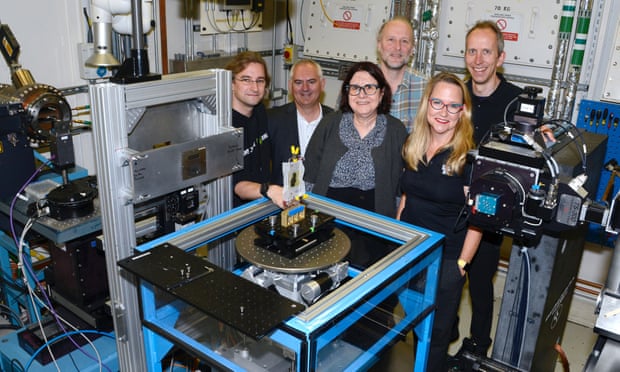
Here’s the team taking on the challenge of reading scrolls charred by the eruption of Vesuvius in AD 79. Recent technology is making the impossible possible.

In the always-new-angles-in-archaeology department, here’s a recent story about using advanced technology to read ancient scrolls once thought beyond deciphering.

Nicola Davis writes at the Guardian, “When Mount Vesuvius erupted in AD79 it destroyed the towns of Pompeii and Herculaneum, their inhabitants and their prized possessions – among them a fine library of scrolls that were carbonised by the searing heat of ash and gas.

‘But scientists say there may still be hope that the fragile documents can once more be read thanks to an innovative approach involving high-energy x-rays and artificial intelligence.

“ ‘Although you can see on every flake of papyrus that there is writing, to open it up would require that papyrus to be really limber and flexible – and it is not any more,’ said Prof Brent Seales, chair of computer science at the University of Kentucky, who is leading the research.

“The two unopened scrolls that will be probed belong to the Institut de France in Paris and are part of an astonishing collection of about 1,800 scrolls that was first discovered in 1752 during excavations of Herculaneum. Together they make up the only known intact library from antiquity, with the majority of the collection now preserved in a museum in Naples.

The villa in which they were found is thought to have been owned by the father-in-law of Julius Caesar, the Roman dictator who was assassinated in 44BC.

“Experts have attempted to unroll about half of the scrolls through various methods over the years, although some have been destroyed in the process and experts say unrolling and exposing the writing to the air results in the ink fading.

“Seales and his team have previously used high-energy x-rays to ‘virtually unravel’ a 1,700 year old Hebrew parchment found in the holy ark of a synagogue in En-Gedi in Israel, revealing it to contain text from the biblical book of Leviticus.

“However, while the En-Gedi scroll contained a metal-based ink which shows up in x-ray data, the inks used on the Herculaneum scrolls are thought to be carbon-based, made using charcoal or soot, meaning there is no obvious contrast between the writing and the papyrus in x-ray scans. …

“As a result the team have come up with a new approach that uses high-energy x-rays together with a type of artificial intelligence known as machine learning. The method uses photographs of scroll fragments with writing visible to the naked eye. These are used to teach machine learning algorithms where ink is expected to be in x-ray scans of the same fragments, collected using a number of techniques.

“The idea is that the system will pick out and learn subtle differences between inked and blank areas in the x-ray scans, such as differences in the structure of papyrus fibres. Once trained on the fragments, it is hoped the system can be used with data from the intact scrolls to reveal the text within. …

“As for what the scrolls contain, the researchers say they are excited.

“ ‘For the most part the writings [in opened scrolls] are Greek philosophy around Epicureanism, which was a prevailing philosophy of the day,’ said Seales. Another possibility is that the scrolls might contain Latin text. While classical libraries are believed to have had a Greek section and a Latin section, only a small proportion of scrolls from Herculaneum have so far been found to be in Latin, with the possibility there is a Latin section within the villa yet to be excavated.

“Dr Dirk Obbink, a papyrologist and classicist at the University of Oxford who has been involved in training the team’s algorithms, … is hoping the scrolls might even contain lost works, such as poems by Sappho or the treatise Mark Antony wrote on his own drunkenness. ‘I would very much like to be able to read that one,’ he said.”

More here.

Hmmm, the scrolls are from the home of Caesar’s father-in-law? I never heard mention of him, and now all I can think about is he must not have raised his daughter to be “above suspicion.” Or was she falsely accused?

Read Full Post »

2048

Photo: Erika Fish/QUT/AAP 
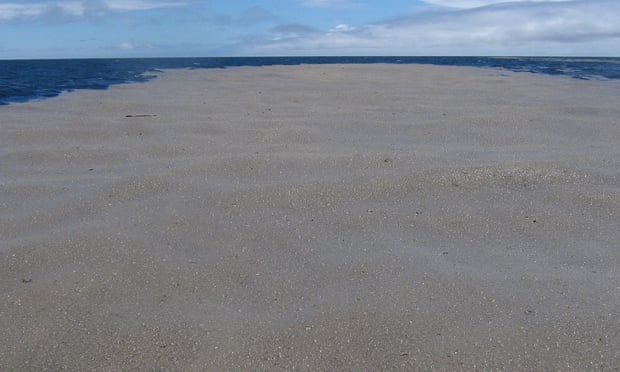
A pumice raft in the southwest Pacific in 2012. It is similar to the one now floating toward Australia. Pumice is a porous rock extruded by volcanoes. It can carry marine life, including coral, across the ocean and can help to replenish reefs.

Sometimes Nature works miracles that can leave a person breathless. So I feel a need to reach into Greek mythology for an explanation of the following.

The Great Barrier Reef suffered an 89% collapse in new coral after bleaching incidents in 2016 and 2017, according to the Guardian. But now from the sea bottom comes a repair kit. A message must have been sent through some mysterious channel to Poseidon, and he responded with roughly 37,000 acres of floating pumice carrying help.

Reports the Guardian, “A giant raft of pumice, which was spotted in the Pacific and is expected to make its way towards Australia, could help the recovery of the Great Barrier Reef from its bleaching episode by restocking millions of tiny marine organisms, including coral.

“The pumice raft, which is about 150 sq km, was produced by an underwater volcano near Tonga. It was first reported by Australian couple Michael Hoult and Larissa Brill, who were sailing a catamaran to Fiji, on 16 August.

” ‘We entered a total rock rubble slick made up of pumice stones from marble to basketball size,’ the couple said in a Facebook post. ‘The waves were knocked back to almost calm and the boat was slowed to 1 knot. The rubble slick went as far as we could see in the moonlight and with our spotlight.’ …

“Since then, the pair have been working with Queensland University of Technology geologist Scott Bryan by providing pictures and samples of the volcanic rock.

“Bryan said the raft will be the temporary home for billions of marine organisms. Marine life including barnacles, corals, crabs, snails and worms will tag along as it travels toward Australia and become a ‘potential mechanism for restocking the Great Barrier Reef. … Based on past pumice raft events we have studied over the last 20 years, it’s going to bring new healthy corals and other reef dwellers to the Great Barrier Reef.’ …

“Pumice forms when frothy molten rock cools rapidly and forms a lightweight bubble-rich rock that can float. The pumice raft comes from an unnamed but only recently discovered underwater volcano that satellite images reveal erupted about 7 August.

“[It] should begin to hit Australian shores in about seven months’ time, passing by New Caledonia, Vanuatu and reefs in the eastern Coral Sea along the way as coral begins to spawn. …

“Bryan said, ‘Each piece of pumice is a rafting vehicle. It’s a home and a vehicle for marine organisms to attach and hitch a ride across the deep ocean to get to Australia.’ ”

More here.


Read Full Post »

Photos: Ciro Fusco / Pompeii Parco Archeologico
Frescoes in Pompeii’s newly discovered “Enchanted Garden” room. The ashes of Mount Vesuvius left the ancient city remarkably intact after the volcano erupted in 79 AD.

When my younger grandson told me about a volcano in Guadalupe, where Suzanne’s family spent the holiday, he hastened to reassure me that it didn’t erupt. He’s six, and a stickler for fact.

Whether young or old, we are all fascinated by the extraordinary power of volcanoes and the way they change the world very suddenly, sometimes with no warning at all.

The complete destruction of Pompeii by the volcano Vesuvius in Italy is one of the reasons eruptions have such a hold over the collective imagination.

Interestingly, Pompeii continues to yield previously unseen beauty to archaeologists even after all these years.

As Sarah Cascone reported in October at ArtNetNews, “Pompeii is the city that keeps on giving. More than two hundred and fifty years after the ancient Roman town was discovered buried under a heap of volcanic ash, the archeological finds show no sign of abating. Now, archaeologists for the Great Pompei Project have uncovered yet another impressive discovery: an ancient shrine, or lararium, covered in gorgeously preserved frescoes, in a 16-by-12-foot room containing an altar, a garden, and a small pool.

“The Italian media has dubbed the new room, which would have been partially covered by a tile roof, ‘the Enchanted Garden.’ The figures in the paintings include two serpents, a wild boar fighting unidentified creatures against a blood-red backdrop, and a mysterious man with the head of a dog that may have been inspired by the Egyptian god Anubis. In front of a painted peacock, strolling through the plants, there would have been a planted flower bed, extending the illusionistic decorative design into the real world.

“ ‘It is the first time that such complex decoration has been found in a space dedicated to worship inside a house,’ Massimo Osanna, the director of the Parco Archeologico di Pompei, told the Wall Street Journal, praising the find as exceptional.

“ ‘Every house had a lararium of some kind,’ Ingrid Rowland, a professor at the University of Notre Dame and the author of From Pompeii: The Afterlife of a Roman Town, told the New York Times. But ‘only the wealthiest people could have afforded a lararium inside a special chamber with a raised pool and sumptuous decorations.’

“After clearing out the volcanic rock fragments, or lapili, that had buried the room for almost two millennia, archaeologists found an altar decorated with eggs, a symbol of fertility. There are burnt remains, which archaeologists believe may have contained food offerings, such as eggs, figs, or nuts, to fertility deities. The altar is flanked by paintings of the Roman gods of household rituals. …

“New excavations are much more careful than the original explorations of the site, which began in 1748. Without modern technology and techniques to aid their excavations, early archaeologists could be quite destructive. The new discovery helps provide a better understanding of what the early excavations would have looked like when first uncovered. …

“Since 2011, Italy has been carrying out much-needed preservation and restoration work to preserve the UNESCO World Heritage Site. The Great Pompeii Project, an initiative aimed at stemming the deterioration of the ancient structures, had an initial budget of €105 million ($140 million). … The discovery of the ‘Enchanted Garden’ represents perhaps the project’s greatest success thus far.”

More here.

In Pompeii, a recently uncovered household shrine, or lararium, features two serpents among its beautifully preserved frescoes.

Read Full Post »

Red sky at night, sailors’ delight.
Red sky at morning, sailors take warning.
Volcano in Indonesia, Turner sunsets for years.

OK, I made that last part up. But there really is a connection between volcanoes and sunsets half a world away.

Writes Sindya Bhanoo at the NY Times, “Sunsets painted by the great masters are now providing a type of information their creators could never have imagined: important clues about air pollution.

“Polluted skies result in redder sunsets, and artists captured this redness on the canvas, said Andreas Kazantzidis, an atmospheric physicist at the University of Patras in Greece who was involved in the research.

“He and his colleagues analyzed hundreds of high-quality digital photographs of paintings done between 1500 and 2000. The period included more than 50 large volcanic eruptions around the globe.

“In each painting, they looked at the red-to-green ratio along the horizon of each sunset to estimate the amount of aerosols in the atmosphere at the time.

“When the Tambora volcano in Indonesia erupted in 1815, ash and gas spewed into the atmosphere, producing bright red and orange sunsets in Europe for several years. This is evident in the paintings of the British master J. M. W. Turner.” More.

 At the NY Times, an 1829 landscape by J. M. W. Turner that researchers analyzed for its sunset.

Read Full Post »