Feeds:
Posts
Comments

Posts Tagged ‘wetlands’

Photo: Navajo Natural Heritage Program via Natural Resources Defense Council.
Diné Native Plants Program members work to restore a headwater stream impacted by livestock grazing.

The more that the US endangers its wetlands, the more we rely on the work that tribes do to protect them. Perhaps today’s article can help us see what the rest of us can do.

At the website for the Natural Resources Defense Council, or NRDC, Claudia Blanco Nuñez and Giulia CS Good Stefani describe how “Tribal Nations protect and manage millions of acres of wetlands, which help improve water quality, curb the risk of floods, recharge groundwater, and store large amounts of carbon.”

“Two years ago,” they report, “the U.S. Supreme Court slashed federal Clean Water Act protection of wetlands [with] harmful repercussions for droughts, wildfires, flooding, wildlife, and the drinking water supply. 

“In the absence of federal protection, the imperative to defend our shared waters falls increasingly on individuals, states, and Native American Tribal Nations. … Tribal Nations protect and manage millions of acres of wetlands in the United States, and with commitments made by the U.S. government to Tribal co-management and co-stewardship of federal lands, the amount of clean water safeguarded by Tribal Nations is growing.

“NRDC’s Science Office mapped the wetlands found within and intersecting the boundaries of Tribal reservation lands in the contiguous United States. Across the 294 federally recognized Tribal reservations mapped in this analysis, our scientists found that Tribes steward more than 3 million acres of wetlands. Even typically arid regions like the American Southwest have significant wetlands on Indigenous reservations. …

“In addition to the 56.2 million acres that are part of the Tribal reservation system, many Tribes have reserved or treaty rights on lands outside reservation boundaries, and most Tribes and their members maintain ongoing physical, cultural, spiritual, and economic relationships with their ancestral homelands. These reciprocal land and water relationships extend far beyond the political boundary of any designated reservation.

“This analysis is limited to federally recognized Tribes in the Lower 48 due to the complex Tribal governance systems in Alaska and Hawai’i. For example, the Alaska Native Claims Settlement Act of 1971 altered the previous Tribal ownership system to one led by Alaska Native Corporations. This system differs from federally recognized Tribes, which have a government-to-government relationship with the United States that includes eligibility for funding and services from the Bureau of Indian Affairs. That is to say, NRDC’s analysis looked at just a fraction of the total wetlands stewarded by and connected to the lives and well-being of Native peoples today.

“To learn more about Tribal wetland conservation, we spoke with leaders in the wetland management programs of the Navajo Nation and Red Lake Band of Ojibwe. …

“Navajo Nation agency staff are engaged in numerous projects to help restore and protect this essential resource. The Diné Native Plants Program recently submitted a grant application to remove invasive plant species along the Little Colorado’s riverbank. This will make space for native vegetation to grow and help with groundwater recharge for nearby Navajo farmers and families. The Diné Native Plants’ seed program also provides seed mixes for restoration projects that are solely sourced from Navajo plants. 

“Jesse Mike, the Diné Native Plants program coordinator, stepped out of the greenhouse to speak with us. He shared about the history of livestock grazing, trampling, and erosion that have impacted not only the health of the headwater streams on Navajo lands but also the underlying water table. His team is currently working to increase groundwater infiltration and improve the overall ecosystem health of three degraded streams in the Chuska Mountains. …

“The Red Lake Band of Ojibwe’s reservation is in northern Minnesota and has the greatest area of wetlands of any reservation in the contiguous United States. Across the Tribe’s more than 835,000 acres of land — all held in common by the Tribe — the Red Lake Band manages an astonishing 541,000 acres of wetlands. ‘So many wetlands,’ says Tyler Orgon, a biologist and the lead wetland specialist for the Red Lake Band Department of Natural Resources, ‘and we’re very fortunate for that.’ 

“A sizable portion of the Tribe’s wetland acreage north of Upper Red Lake is part of the largest expanse of peatlands in the continental United States. Peatlands cover about 3 percent of the earth and store more carbon than all of the planet’s other types of vegetation, including the world’s forests, combined. 

“One of the most important wetland-dependent plant species for the Red Lake Band — as well as other Anishinaabe and Dakota peoples across the Great Lakes region — is manoomin (Zizania palustris and Z. aquatica), the only wild rice native to Turtle Island. According to an Ojibwe prophecy, their ancestors were instructed to move west to the place where ‘the food floats on water.’

“The University of Minnesota research team We Must First Consider Manoomin (Kawe Gidaa-naanaagadawendaamin Manoomin) works to help protect this essential wetland-dependent plant by combining Western science with Indigenous science and learning from Ojibwe stewardship.

“The scientists have found that an increase in extreme weather conditions (like flooding events and record-breaking snowfall) negatively impact manoomin growth by uprooting the plant or drowning it out in its sensitive early stages. These weather events compound the already present settler-colonial impacts on wetlands in the region, including deforestation and conversion of wetlands into agricultural land use.

“Orgon hopes to restore some of the Red Lake Band’s wetlands that have been impacted by past agriculture.” More at NRDC, here.

Read Full Post »

Photo: Charles Krupa/AP.
Workers harvest cranberries at the Rocky Meadow bog in Middleborough, Massachusetts, ahead of Thanksgiving. 

Recently, I read about a federal program paying “farmers to convert the land of bogs that is not efficient for growing” into wetlands that can alleviate climate change consequences. Whether or not the federal program will continue, Massachusetts is on the case, helping its own farmers with restoration.

Gloria Oladipo wrote at the Guardian last November, “As millions of cranberries were being harvested for Thursday’s US Thanksgiving holiday, Massachusetts farmers were working to convert defunct cranberry bogs back to wild wetlands, amid climate crisis woes. Several restoration projects were awarded $6m in grants to carry out such initiatives, state officials announced this week.

“The grants, provided by the New England state’s department of fish and game division of ecological restoration (DER), will ‘increase resilience to climate change for people and nature, restore crucial wildlife habitat, and improve water quality’ in 12 communities, said the Massachusetts governor, Maura Healey, in a statement. …

“ ‘These initiatives will enhance our ability to store and sequester carbon with nature and help us meet our net zero goals,’ said Rebecca Tepper, secretary of the state’s office of energy and environmental affairs. …

“The grants are being awarded through two state programs: the DER’s wetland restoration program and the DER’s cranberry bog restoration program, which converts defunct cranberry bogs into wetlands and streams.

“To date, scientists and government officials have converted 400 acres of retired cranberry bogs into wetlands, the Washington Post reported. State officials have said they hope to restore an additional 1,000 acres of bogs within the next decade. …

“As sea levels rise in Massachusetts because of the climate crisis caused by humans burning fossil fuels, scientists are looking to develop bogs into wetlands to improve coastal resilience and slow down erosion.

“Wetlands can hold more water and filter out pollutants amid increased storms that bring potential flooding. They also have other environmental benefits, acting as wildlife habitats and storing carbon dioxide from the atmosphere in their soil.

“More farmers have been drawn to the prospect of transitioning their former cranberry bogs into wetlands. The climate crisis and economic factors, including the high cost of modernizing bogs, can make cranberry farming more difficult. …

“ ‘We are in an upward trend in terms of interest in retiring cranberry bogs,’ said Brian Wick, executive director of the Cape Cod Cranberry Growers Association, to the Post. … But getting land for restoration remains a competitive process, as other businesses – such as housing developers – vie for undeveloped coastal land.

“ ‘This opportunity won’t be here in 25 years,’ said Christopher Neill, a senior scientist at the Woodwell Climate Research Center and an expert in restored bogs, to the Post. ‘These growers are not going to hang on, they’re going to make decisions and the land won’t be available forever.’

“While conservation projects have steadily increased in southeastern Massachusetts, restoration initiatives are still relatively new. The majority of finished projects are only a few years old, with 14 restoration initiatives still being designed and implemented, the Post reported.”

In addition to benefits like carbon storage and habitat for wildlife, converted cranberry bogs can be lovely for walkers.

More at the Guardian, here. Nice photos. No firewall.

Read Full Post »

Photo: Gabrielle Canon/The Guardian.
Lakeside Farms, near Oregon’s Upper Clamath Lake, now features a wetland drawing harmful pollutants out of the soil. It also serves as a sanctuary for birds.

This may sound strange, but one of the things I most want to be able to do as an old person is to relearn things. I have a lot of preconceptions and outdated information that I’ve relied on, and I don’t want my feet to stay stuck in mud.

In today’s story, an Oregon farmer shows he was capable of relearning.

Gabrielle Canon reports at the Guardian that he once allowed his land to leak “pollution into a nearby lake. Now, 70 acres are home to waterfowl, turtles and endangered fish.”

Canon continues, “Birdsong hums over the rumble of Karl Wenner’s truck as it bounces along the dusty trails that weave through his property. For almost 100 years, this farm in southern Oregon grew barley, but now, amid the sprawling fields, there lies a wetland teeming with life.

“Wenner installed the wetland on 70 of the farm’s 400 acres to help deal with phosphorus pollution that leaked into the adjacent Upper Klamath Lake after his land flooded each winter. With support from a team of scientists and advocates, the project has become a welcome sanctuary for migrating and native birds that are disappearing from the area.

“Today, this corner of Lakeside Farms looks far different from a typical American farm. Waterfowl nest among the vegetation, joining pond turtles and even endangered native fish near rows of sprouting barley.

“Looking out at the swaying cattails and wocus plants peeking through the water on an afternoon in June, Wenner beams:

‘This place wanted to be a wetland.’

“It’s a remarkable transformation and a promising example of a symbiotic solution to one of the world’s most pressing environmental problems.

“The stakes are high. Considered ‘among the most productive ecosystems in the world,’ wetlands are disappearing rapidly. Roughly 80% around the world have already vanished. In the expansive Klamath basin that straddles the California-Oregon border, once described as the ‘Everglades of the west,’ more than 95% of wetlands have been drained, diverted or dried.

“Wenner, a co-owner of the land, hopes the farm won’t be unique for long. With an unprecedented amount of federal funding available through the Biden administration’s Inflation Reduction Act and other government programs, Wenner and his partners are encouraging more farmers and ranchers to follow in their footsteps. …

“The Lakeside Farms wetland broke ground in 2021, flattening the barley fields and carving dikes and channels for water flows that would leave small artificial nesting islands. The water, produced from a natural spring on the property, quickly germinated seeds for marsh plants that had been dropped by birds and long left dormant.

“By the summer of 2022, the vegetation began to do its work, feeding fowl and cleaning the farm’s runoff, pumped within its banks rather than into the lake. … Wenner says his costs have largely been covered with government funds, and there’s a lot more to go around. …

“The benefits, Wenner says, have been almost immediate. Wetlands serve as a natural sponge, soaking up harmful minerals and pollution before they seep into the watershed. …

“ ‘You set the stage and Mother Nature takes over,’ Wenner said. ‘It’s just a magical thing to see.’

“Wenner is convinced the move has been a boon to business. The farm is no longer running afoul of regulations, while a plan to add a rotating wetland on other parts of its land will enable it to go organic, yielding ‘a much higher price for the crop.’ …

“The climate crisis is making the Klamath basin hotter and drier, creating stress for farmers and wildlife alike. Populations of migrating birds have plummeted, falling from roughly 5.8 million observed in 1958 to a peak of just 93,000 counted last year.

“Many are finding hope in plans to demolish four dams along the Klamath River – the largest dam removal project in US history – bringing the ecosystem one step closer to recovery. But more solutions will be needed. …

“The work is not without obstacles. ‘Our biggest challenge is where water is available to manage wetlands,’ said Ed Contreras, a coordinator of the Intermountain West Joint Venture, an organization dedicated to building public-private partnerships to support bird habitats. He added that the Lakeside Farms project was an important case study. …

“Thousands of miles away, Paul Botts is confronting the same challenges. As the executive director of the Wetlands Initiative, a non-profit conservation organization in Chicago, he is determined to expand the use of what he calls ‘smart wetlands’ across productive farm belts. …

“ ‘The ultimate goal here is that one day my children or grandchildren are driving around the midwest and every other farm field has one of these wetlands,’ he said. …

“These natural systems help blunt climate catastrophes, holding water for dry times and slowing the speed of floods. ‘We view smart wetlands as an excellent example of a big-picture climate adaptation solution,’ Botts added.”

More at the Guardian, here. No paywall but donations keep it free.

Read Full Post »

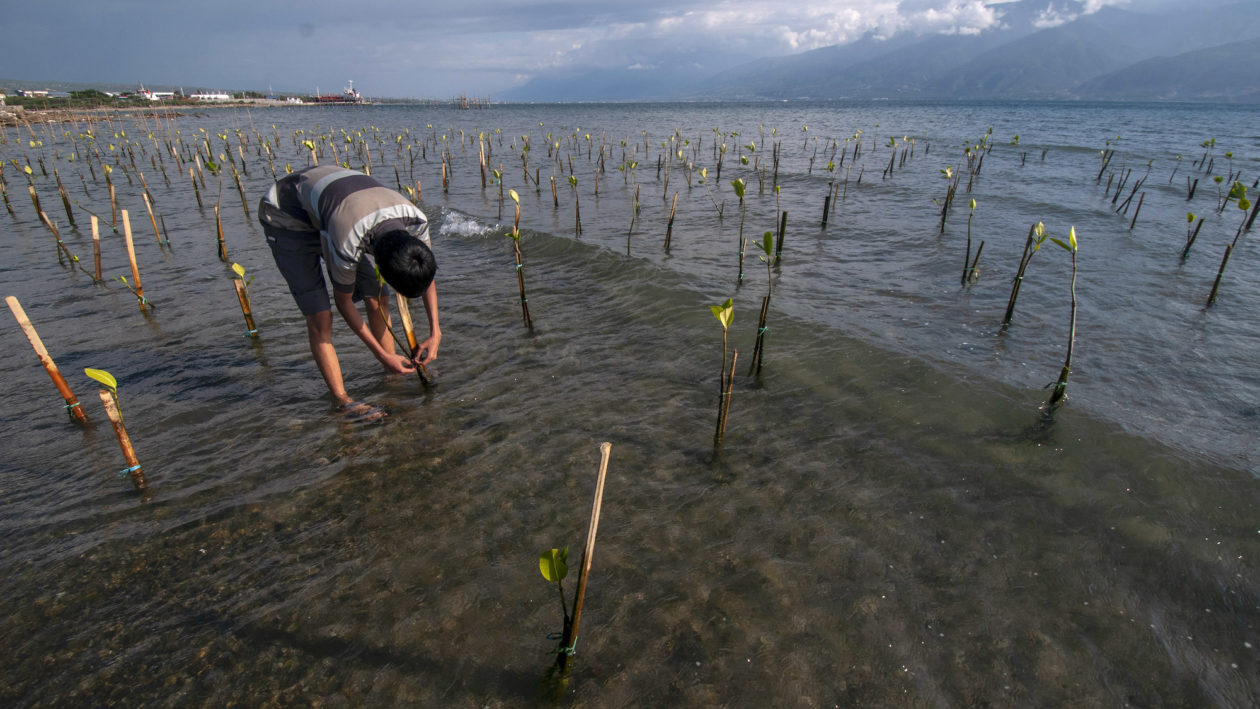
Photo: Basri Marzuki/Nurphoto via Getty Images.
A volunteer ties a newly-grown mangrove to a stake on Teluk Palu Beach, Indonesia. A science writer asks, Is international funding shortchanging nature-based climate solutions like this?

Here’s something to think about. As we try to remedy damage to the environment, are we overlooking the power of small steps that add up and instead favoring big-deal engineering approaches?

Fred Pearce at YaleEnvironment360 suggests we are indeed. “On the low-lying northern shore of the Indonesian island of Java,” he writes, “the sea has invaded a kilometer inland in places in recent years, engulfing whole communities and vast expanses of rice paddy. But villagers are fighting back against further advances by erecting brushwood barriers in the mud to help the natural regeneration of mangroves.

“This innovative nature-based response to rising sea levels and worsening storms, sponsored by the Indonesian government and the Dutch-based environmental group Wetlands International, could be scaled up across Asia. Within a decade it could be helping at least 10 million people in similar situations to protect and restore their denuded coastlines — all at a fraction of the cost of sea walls, says Jane Madgwick, CEO of Wetlands International.

“But it can do that only if local projects are developed and the financing secured. And so far, she says, progress has been slow. …

“There are a ‘growing number of analyses and reviews of the effectiveness of habitats as natural defenses,’ writes Siddharth Narayan, now of East Carolina University. Hundreds of local projects to restore ecosystems on coastlines and mountains, in river valleys, forests, and grassy plains, have proved their worth in using restored nature to boost the resilience of millions of people to the ravages of onrushing climate change. Most are cheaper and more effective than any engineering alternatives, with more spinoff benefits for ecosystems and fewer downsides.

But the political will and funding that could turn pilot projects for nature-based climate adaptation into policy norms benefitting hundreds of millions more people are still largely absent.

“Most nature-climate activities ‘are currently not funded,’ says Ebony Holland, climate researcher at the London-based International Institute for Environment and Development. …

“Nature-based climate adaptation remains the poor relation of climate finance. First, that’s because private investors, philanthropists, aid agencies, and development banks are usually happier to pay for climate ‘mitigation’ projects that curb emissions of planet-warming gases than for helping communities adapt to climate change. Overall, adaptation of all kinds has so far attracted less than a quarter, and by some measures only 5 percent, of international climate funding, according to Barbara Buchner of the Climate Policy Initiative, a San Francisco-based think tank.

“And second because policymakers and funders still mostly prefer engineering solutions. Holland found that less than 10 percent of funding for climate adaptation in the least-developed nations — which are usually the most vulnerable — went into projects that harnessed nature. The remaining 90 percent ‘poured concrete.’ …

“Overall, the UN Environment Programme and the Global Commission on Adaptation, an international body set up by the Dutch government, both estimate that about 1 percent of total climate finance has so far gone toward such nature-based adaptation projects.

“Governments in Glasgow promised to close the funding gap between adaptation and mitigation by doubling adaptation funding. [In April] climate finance chiefs from leading funding governments met in Lahti, Finland, to discuss how to achieve this. But official reports of the meeting record little discussion of the need for more nature-based projects. Instead, the main topic was to ‘seek ways to give the private sector a bigger role in adaptation finance.’

“This could be a step back for nature since, in the past, private financiers have been even less keen on nature-based solutions than public-sector donors, says Madgwick.

“The casebook of successful nature-based adaptation is growing fast. Perhaps best documented are the benefits from restoring coastal ecosystems such as mangroves to protect coastal communities from storm waves, tidal surges, and rising sea levels, which are all increasing as climate change gathers pace.

“The world has lost half its mangroves along shorelines, but those that remain are protecting some 18 million people and several tens of billion dollars’ worth of property from flooding every year, says Michael Beck, a marine scientist at the University of California Santa Cruz. Their importance can only grow. Unlike sea walls, mangroves appear to keep pace with rising sea levels, self-seeding inland to maintain their barriers against storms and tidal surges and nurturing marine fisheries.

“The island nations and river deltas of Asia would benefit most from their restoration, but a study by the World Bank and The Nature Conservancy found great potential too in African countries, including Guinea, Mozambique, Sierra Leone, Madagascar, and Guinea-Bissau.

“The restoration of other coastal ecosystems can be equally effective. A review by Narayan of 52 such projects around the world found that salt marshes, sea grasses, and coral reefs all reduced the height of storm waves at typically between a half and one-fifth of the cost of sea walls. Yet scaling up is failing to keep pace with the success of pilot projects. …

“In parts of the Panchase mountain region of Nepal, a favorite with foreign trekkers, the restoration of wetlands and community ponds is protecting local communities against both worsening floods and droughts, while improving soils, revitalizing biodiversity, and encouraging tourism. It is part of a three-nation project known as the Mountain Ecosystems-based Adaptation Program devised over a decade ago by UN agencies and implemented in remote corners of Nepal, Uganda, and Peru.

“But despite ambitious plans for new projects in neighboring Bhutan, Kenya, and Colombia, scaling up remains elusive. Communities in most mountain regions stressed by climate change are plagued by dam projects that extract their water for use downstream, rather than being helped to conserve their water and improve their climate resilience. …

“[Nathalie Seddon of the Nature-Based Solutions Initiative, an interdisciplinary research center at the University of Oxford] says nature-based adaptation can simultaneously help meet the three great challenges of our time: responding to climate change, protecting biodiversity, and ensuring human well-being. But right now, the opportunities for delivering these synergies are still going begging.” 

More at YaleEnvironment360, here. No firewall.

Read Full Post »

Photo: Emmett FitzGerald.
Dean Wilson
, protector of Louisiana swampland.

Now that we know how important wetlands are for the environment and for protecting us from the worst effects of hurricanes, it doesn’t seem like a fringe occupation to be a protector of swamps. Among those who take Louisiana’s wetlands seriously is the scrappy nonprofit Louisiana Bucket Brigade. Another defender is Dean Wilson. Emmett FitzGerald at Living on Earth [LOE] interviewed him recently.

“LOE: Once, cypress swamps covered hundreds of thousands of acres across the American South. Logging, oil and gas extraction and swamp drainage transformed the landscape. But over recent years, Dean Wilson has worked to protect the remaining cypress swamps of Louisiana’s Atchafalaya Basin from illegal loggers and oil prospectors. Recently, the European biomass industry has set up shop in the state, and conservationists are concerned for the future. Living on Earth’s Emmett FitzGerald reports. …

“EMMETT FITZGERALD: Dean Wilson doesn’t sound like a Cajun, but he’s been living in the swamps of Southern Louisiana for 30 years now.

“DEAN WILSON: I remember the first time I saw the swamp I fell in love with it. You know you see the beautiful green trees, with the Spanish moss, over water, and those egrets flying around like angels. Uh, I just really fell in love with that.

“FITZGERALD: Dean grew up outside of Madrid, in Spain, but he came to Louisiana in his early twenties on his way to South America. He wanted to get used to the humidity and the mosquitoes before doing scientific research in the Amazon. But he never left the Bayou State.

“WILSON: When I realized I could actually make a living off the land, I decided to stay. I was a commercial fisherman for 16 years, full-time. So I made my living hunting and fishing the swamps in the Atchafalaya Basin for 16 years.

“FITZGERALD: Dean says people call all kinds of marshy wetlands swamps, but true swamps are actually pretty rare, and the Atchafalaya Basin is the largest in the United States.

“WILSON: And the difference between a swamp and a marsh is that a swamp is a flooded forest. So you actually go in the springtime when the waters high you go with a boat through the forest and you can see the birds and the animals the otters minks alligators all the things that live in the swamp. It’s a magnificent place. One of the most beautiful places on earth. The Cypress trees grows to different shapes; they can live to up to 4000 years old. So the Cypresses are incredibly beautiful.

The difference between a swamp and a marsh is that a swamp is a flooded forest.

“FITZGERALD: A few years ago, Dean gave up commercial fishing and turned his attention to protecting the ancient Cypress forest he calls home. Now, Dean patrols the swamp in his little motorboat as the head of the conservation organization Atchafalaya Basinkeeper. Today Dean and I are joined in his boat by his German Shepherd Shanka, and a fellow conservationist.

“PAUL ORR: I’m Paul Orr and I’m Lower Mississippi Riverkeeper. …

“FITZGERALD: Dean pulls the boat through the undergrowth into a clearing in the forest, and suddenly hundreds of giant cypress trees are all around us. Their trunks flare out at the bottom like grass skirts. Dean says this cypress forest is teeming with life.

“WILSON: The swamps of the Atchafalaya are considered by scientists the most productive in the entire world. You can go to the Amazon and you may have more biodiversity, but if you get an acre of the Atchafalaya Basin and you’re supposed to get more pounds of fish and crawfish than any other wetlands in the world.

“FITZGERALD: Full-grown cypress trees have nooks and cavities that birds love to nest in.

“WILSON: Nearly half of the waterfowl population in North America come at one time or another through the Atchafalaya basin. So it is a critically important ecosystem not only for North America but the whole western hemisphere.

“FITZGERALD: As we float between the trunks, Dean says swamps like this one once covered much of the American South.

“WILSON: Most people have seen the Amazon river flooding millions of acres of rainforest. The Mississippi used to do the same thing, used to flood 24 million acres of forest. For somebody to picture how big is 24 million acres, there was a time when you could get in a boat, right now this time of year and through this water, could go through this forest, and never leave the forest all the way to Missouri.

“FITZGERALD: But that five-hundred-mile waterway didn’t last. A lucrative timber industry developed in Louisiana around 1700. And then in the 19th century new steamship technology allowed companies to log southern cypress forests quickly and efficiently.

“WILSON: By the year 1900 it was the largest industry in coastal Louisiana, was the cypress logging industry. Uh, and people thought it would last forever. By 1920, it was all over. They logged every single forest in this state. Didn’t leave a single acre standing.

“FITZGERALD: In 1927, the Mississippi River spilled its banks, killing hundreds of people and displacing hundreds of thousands in the most destructive flood in US history. The Army Corps of Engineers responded to the crisis by building levees all up and down the Mississippi to control the flow of the river. The levees were designed to protect cities like New Orleans, but they straight-jacketed the river and prevented the natural flooding of Louisiana’s cypress swamps.

“WILSON: It drained all those forests. Farmers came in, they cut those trees down and today it’s mainly farmland. When people drive through Arkansas, Northern Louisiana, Mississippi through what is called the Delta area, it’s all farmland but it used to be like the Atchafalaya Basin.

“FITZGERALD: Today although the Atchafalaya Basin is smaller than it once was, it’s still one of last great cypress swamps left in the United States. Like all swamps it’s protected under the federal Wetlands Protection Act, and Dean Wilson and Paul Orr want to do everything in their power to preserve it. In 2008, they noticed an uptick in illegal logging in the Atchafalaya. They followed the supply chain all the way to the garden mulch aisle.

“ORR: We realized pretty quickly from following the logs and then finding bags of cypress mulch and following those to Wal-Mart, Lowes and Home Depot that there was this tremendous push to try and build a cypress mulch industry.

“FITZGERALD: But Dean says the companies that supplied the mulch weren’t clear about where it came from.

“WILSON: Home Depot, Lowes and Wal-Mart were selling the mulch as environmentally harvested. The bags would say ‘Made with environmentally-harvested cypress, from Florida’ – you have a Florida address, so they were actually deceiving the public into buying their mulch.

“ORR: And deceiving the retailers — I think that some of the retailers were not very happy that that was not what they said it was.

“FITZGERALD: So when Paul and Dean brought this issue to the attention of the retailers in 2008, the stores agreed to stop selling Louisiana Cypress mulch. But Dean’s still worried about illegal logging. He says the problem is enforcement.

“WILSON: We have laws to protect wetlands, the problem is those laws are not being enforced, and the government isn’t even putting in the resources to enforce them, they don’t even have a boat, so they can’t be enforced.

“FITZGERALD: And Paul Orr believes that problem starts with the cozy relationship between big business and the state government.

“ORR: I guess it was like the late 90s, early 2000s, the Louisiana Department of Economic Development put an ad in a lot of national publications and it was like a guy in a suit doing a back bend and it said, ‘Louisiana bends over backwards for business.’ And that’s really been the culture in Louisiana — the wealthy business people just give away all of our natural resources and our tax monies and everything for business.”

Oh, Homeowners, here’s a simple thing you can do: don’t buy mulch.

More at Living on Earth, here. There is no firewall, but donations are encouraged.

Read Full Post »

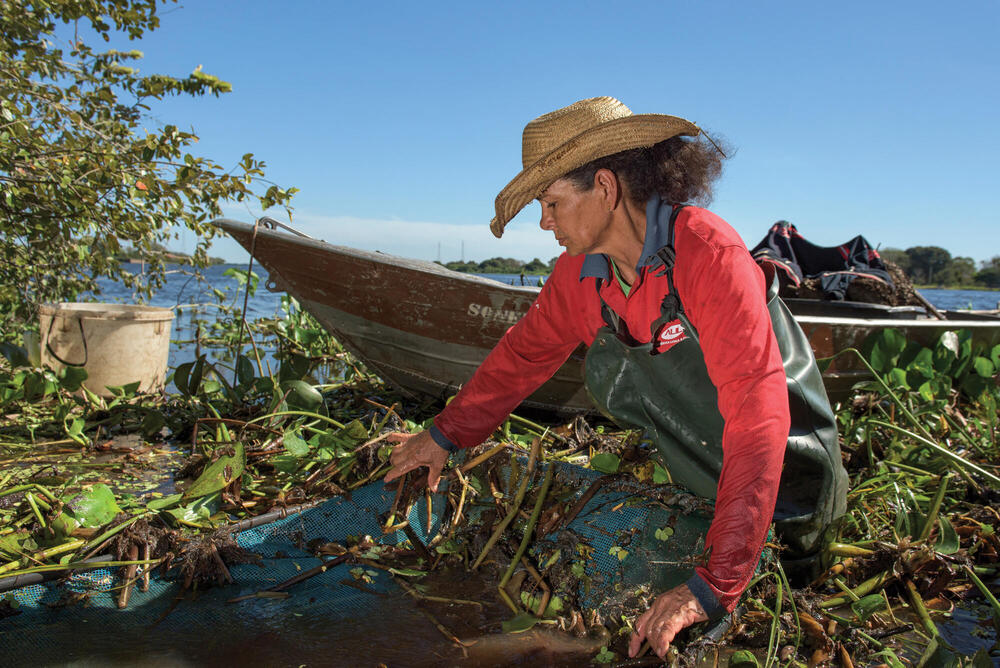
Photo: Jaime Rojo/WorldWildlife.org.
“Life here for us is very fulfilling,” says Elizete Garciada Costa Soares about the Brazilian wetland. “We have fish to eat; we have bait to sell to make money for other necessities. Even if we don’t have money for meat, we can go out on the river to fish and bring back a piranha to eat with manioc flour.”

Without actually realizing it, we’ve accepted the message over the centuries that subsistence living is undesirable. But back before capitalism, having enough for food and shelter — and something to sell if a few extras were needed — could make a pleasant life. In some parts of the world it still does.

Jill Langlois writes at World Wildlife Magazine about people who build good lives from South America’s huge wetlands.

“By the time Elizete Garciada Costa Soares wades into the deep, warm waters of the Paraguay River, the sky is usually black. The tiny crabs and bait fish called tuvira, which she captures with a metal screen, come out at night, long after the hot sun that washes over the Brazilian Pantanal has set.

“It takes Soares at least an hour to reach the best spots to fish for bait, where the tuvira and crabs hide under the thick green leaves of the water hyacinths that float on the river’s surface. She’ll be gone for at least three or four days, so she brings a tent to pitch along the riverbank. Later, she will sell the bait to other fishers, usually in the nearby town of Miranda.

“Soares is well aware of the dangers of her profession — she’s had her fair share of run-ins with jaguars and anacondas in the 26 years she’s been heading out on the river to fish. But she wouldn’t have it any other way.

“ ‘Life here for us is very fulfilling,’ says Soares of herself and her husband. ‘We have fish to eat; we have bait to sell to make money for other necessities. Even if we don’t have money for meat, we can go out on the river to fish and bring back a piranha to eat with manioc flour. Here, we never go hungry.’

“At just over 42 million acres, the Pantanal is the world’s largest tropical wetland, created by the convergence of more than 1,200 rivers and streams rushing down from the eastern Andes and the high plateaus of the Cerrado, the vast tropical savanna to the east. More than 10 times the size of Florida’s Everglades, it stretches across the borders of Brazil, Bolivia, and Paraguay. Its primary waterway is the Paraguay River, which meanders through the three countries before joining the Paraná River and flowing into Argentina.

“The Pantanal is a landscape of extremes. Acting like a giant sponge, the upper part of the basin retains floodwaters from October to March, providing natural flood protection for the millions of people who live downstream. It then slowly drains between April and September, leaving discrete pools teeming with wildlife and providing life-giving water long after the rains have gone.

“This seasonal rise and fall, the pulsing of water in and out of the surrounding landscapes, is responsible for the wetland’s significant biodiversity. Though often overshadowed by the Amazon, its neighbor to the north, the Pantanal is home to more than 4,700 plant and animal species, including fig and ipê trees, jabiru storks, capybaras, and caiman. …

“In addition to being an environmental jewel, the Pantanal is also a tremendous resource for people, says Lucy Aquino, director of WWF-Paraguay: ‘The Pantanal is one of the most important regions in the world, in terms of services provided to humanity, and one of those regions that supplies food to the world.’

“For now, the Pantanal is relatively intact, sustaining more than 270 communities — 1.5 million people — in addition to its flora and fauna, and helping to stabilize the climate throughout the region and beyond.

“But while much of the Bolivian Pantanal is protected, the overwhelming majority of the wetland, lying in Paraguay and Brazil, is not. In all, conservation areas represent just 4.6% of the Pantanal, and its headwaters in the Cerrado are at particularly high risk.

“In recent years, roads, water management systems, hydroelectric dams, large-scale mines, farms, and cattle ranches have begun to change the dynamics of the wetland, threatening the region’s integrity. In addition to poorly planned infrastructure, mining, and agricultural development, the region faces other threats, including the lack of basic sanitation and the construction of canals for navigation.

“Moreover, by the end of the century the Pantanal is expected to be much drier and hotter, with potentially devastating results, including extreme droughts and floods, and the possible shrinking of the wetland as a whole. In the absence of a holistic vision, unsustainable development threatens to limit the Pantanal’s ability to function and to adapt to climate change, putting homes and habitats at risk.

“There is a tension between communities’ needs for development — for sanitation services and clean drinking water, for example, along with roads and hydropower dams — and the costs of such development to the ecosystem and people alike. But development done right, well-designed and sustainable, would contribute to the wetland’s conservation, says Julio Cesar Sampaio da Silva, who leads WWF-Brazil’s work in the Cerrado and Pantanal. …

“ ‘Considering the Pantanal as a shared territory and developing strategies for shared management — creating a truly shared vision for the region — is fundamental to having effective conservation of these natural resources,’ he says. …

“In 2018, the three countries formally signaled their shared commitment to sustaining those resources when they signed a landmark trilateral agreement known as the Pantanal Declaration. …

“Citing the importance of the wetland to those well beyond its boundaries, WWF-Bolivia director Samuel Sangueza-Pardo calls the agreement

‘a decisive step in integrating Bolivia, Brazil, and Paraguay’s joint commitment to maintain this ecosystem, which is fundamental for the welfare of more than 10 million people.’ …

“For Pantanal residents like Elizete Soares, that kind of commitment provides hope for the future of the only home they know. ‘The Pantanal, for us,’ says Soares, ‘is everything.’ ”

More at the World Wildlife, here.

Read Full Post »

Photo: Australia Nuclear Science and Technology Organisation
Australian wetlands researchers behind the Feather Map invite citizen scientists to send feathers and include an explanation of where the feathers were found.

I recently saw a great quote on twitter from a Rhode Islander about what he learned years ago when he visited post-apartheid South Africa: “I learned that the power that you have to change big things is entirely about how strong of a community you can form.”

That quote came to mind as I was reading about how researchers in Australia are enlisting the enthusiasm of citizen scientists to address the challenges of wetlands protection. That may not sound as important as ending apartheid, but wetlands are expected to play a big role in the fight against global warming.

Livia Albeck-Ripka had a report at the New York Times.

“One day in April 2016, Kate Brandis opened a weathered envelope, mailed to her from suburban Sydney. Instead of a letter inside, she found the feathers of an Australian white ibis. A day or so later, another envelope arrived, stuffed with more feathers. In the days following, more began to come.

“Soon, Dr. Brandis, who is a research fellow at the University of New South Wales’s Center for Ecosystem Science, was receiving three to four envelopes a day containing the feathers of birds from across Australia, including those of pelicans, wood ducks, cormorants, herons and spoonbills. …

“Two years before, she had put out a call to the public to send her fallen feathers of wetland birds so she could analyze where they came from, in an effort to map how the birds are moving between the country’s disappearing wetlands. …

“Wetlands — which include swamps, marshes, lakes, mud flats and bogs — are biodiverse ecosystems that can improve the quality of water and mitigate damage from flooding and pollution. But since the beginning of the 20th century, some estimates say, more than half the world’s wetlands have been lost, largely because of human activities. …

“Now, the impacts of climate change — which can include less rainfall in some areas, changing river flows and flood patterns, and potential saltwater intrusion into inland bodies of water — are further threatening some of Australia’s wetlands, and the birds that rely on them for breeding. …

“ ‘When our floodplains flood, which is only every couple of years, these birds come together in the hundreds of thousands to breed,’ Dr. Brandis said. But when the water recedes, the birds disband. …

“Where do the birds come from, and where do they go afterward? ‘Because we don’t track our birds, we have no idea,’ she said.

“Traditional tracking methods, like banding birds, have not fared well in Australia. … Many birds, like the ibis, have a high mortality rate. Another factor is simply Australia’s size: Inland birds often go to places where people do not.

“For that reason, Corrie Kemp, a 73-year-old retiree from Queanbeyan, New South Wales, made a special effort to collect feathers for Dr. Brandis’s project from among the most remote corners of Australia, in western Queensland. ‘We made a point of going places where no other people where going,’ Mrs. Kemp said, adding that she and her husband, Peter, had devoted an entire three-month trip to collecting feathers, during which she kept a diary of her discoveries and often corresponded with Dr. Brandis. …

“Bird feathers, like human hair and nails, are made of a protein called keratin. As the feathers grow, the keratin keeps a record of the bird’s diet, much like the rings of a tree. By analyzing a section of a feather, Dr. Brandis and her team can get a snapshot of the bird’s diet while the feather was developing.

“Feathers from chicks — which have spent their entire lives at one wetland — are particularly useful to researchers, providing what Dr. Brandis and her team call a ‘fingerprint’ of each place. By comparing the diet record of adult feathers against this information, researchers hope to map which wetlands the birds have been using, and how healthy those wetlands are. …

“Dr. Brandis said the possibilities were endless when studying animals’ tissue for clues about their environments, their habits and their origins. ‘It’s like the tip of the iceberg.’ ”

Read more about the Feather Map of Australia here and here.

Read Full Post »

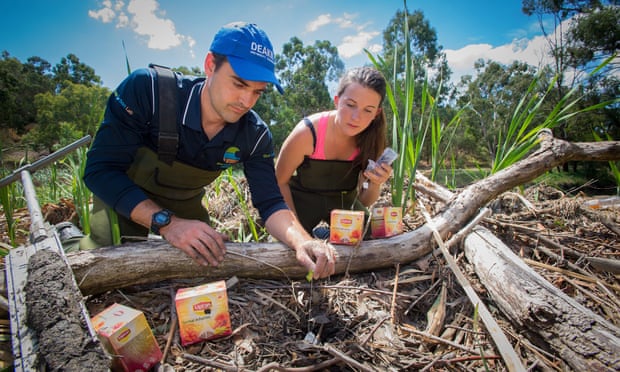
Photo: Simon Peter Fox 
Deakin University researchers bury the first of 50,000 teabags to be placed in wetlands around the globe as part of a project to monitor which wetlands do best at soaking up the carbon that causes global warming.

It’s reassuring to know that people will keep doing whatever they can for the environment no matter what. The increased carbon dioxide that contributes to global warming will not go away by itself. One approach to breaking it down could come from preserving wetlands.

Melissa Davey writes at the Guardian about Australian scientists who are using Lipton green tea bags and red tea “rooibos” bags to study how wetlands capture carbon and make it harmless.

“Australian scientists have launched a project to bury tens of thousands of teabags in wetlands around the world. …

“Lipton green tea and red tea ‘rooibos’ varieties will be used in the project, which already involves more than 500 scientists in every continent except Antarctica.

“Leader of the project, Peter Macreadie from Deakin University’s Blue Carbon Lab, said wetlands were important for carbon capture and storage, a process known as carbon sequestration, holding up to 50 times as much carbon by area as rainforests.

” ‘But some wetlands are much better at carbon storage than others, and some are in fact carbon emitters, so they’re not all fantastic,’ Macreadie said.

“ ‘We need to find out the best wetland environments for carbon sequestration so we know where we should invest our energy.’

“That’s where scientists have come up against barriers in the past. There are hundreds of thousands of wetlands around the world. A standardised technique for monitoring the carbon is needed for accurate comparison, and monitoring devices can cost thousands of dollars to install.

“But Macreadie had been reading scientific research about teabags being buried and used to measure the rate at which carbon was being released from soil into the atmosphere.

“Fast decay of the tea inside the bag meant more carbon was being released into the atmosphere, while slower decay meant the soil was holding the carbon.

“ ‘I thought, “Jeez this is a bloody good idea. Why aren’t we using it in wetlands?” ‘ Macreadie said.

“ ‘People think of innovation as involving fancy new technology, but sometimes the best ideas are the most simple ones.’ ” More here.

I wonder if this property of tea relates to another thing I’ve noticed. Loose tea seems to absorb the aroma of whatever is around it. I’ve often thought that if you wanted to remove, say, a burned smell from upholstery or clothing, tea (not brewed) could do the trick.

Read Full Post »