Feeds:
Posts
Comments

Posts Tagged ‘ww I’

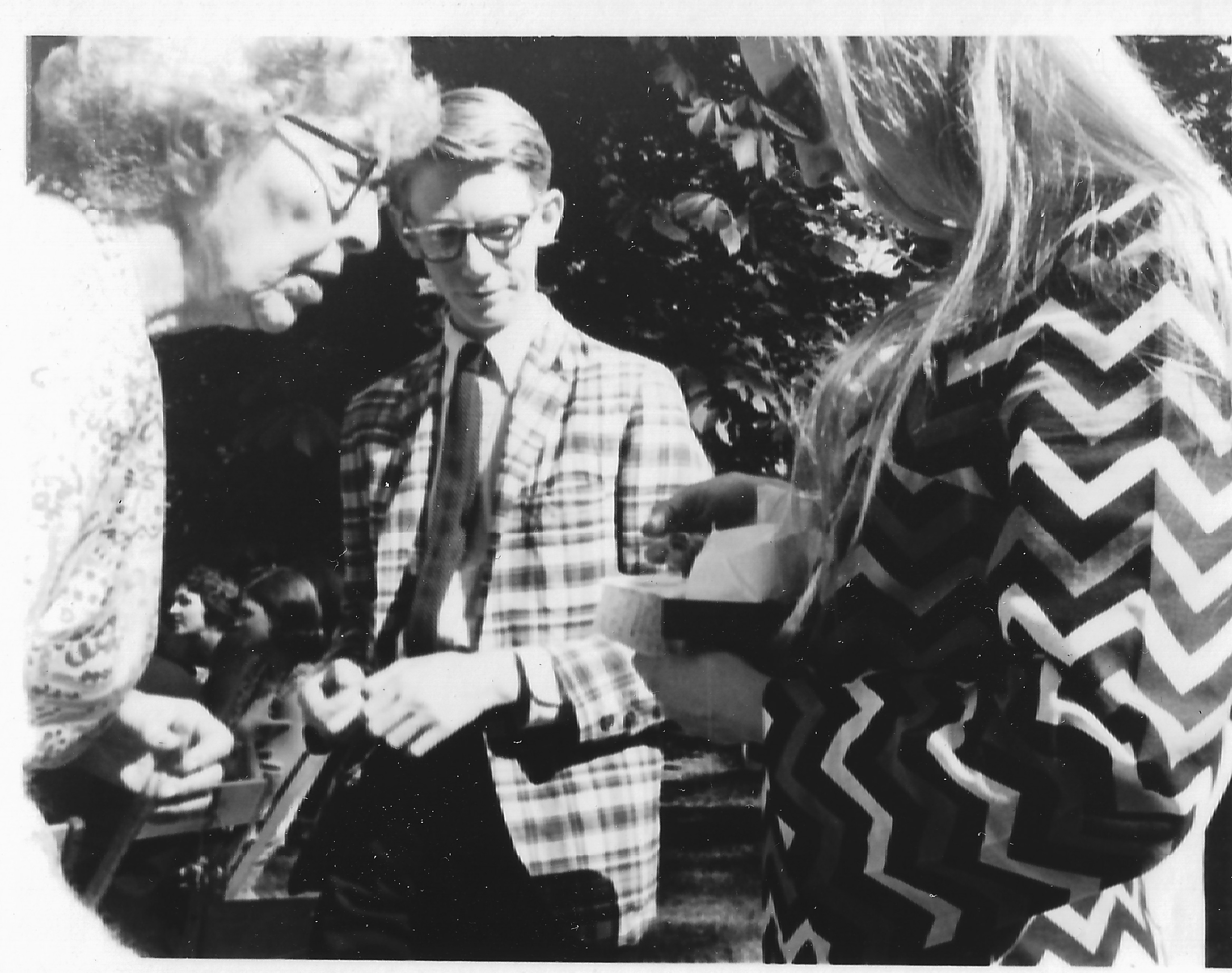
Photo: Kyle Cummings/Randolph-Macon College.
Kayla Smith, left, and Hannah Winton help Andy Valero try on an Eisenhower jacket from the World War II era at his Virginia home.

Although in the US we tend to move national holidays to a Monday, Veterans Day is always November 11. This year the 11th just happens to land on a Monday. The holiday was established in commemoration of the Allies and Germany signing an armistice on Nov. 11, 1918, to end WW I. (One historian says this was unfortunately “a peace to end all peace” because the eventual agreement contained the seeds not only of WW II but of endless conflicts in the Middle East.)

In honor of Veterans Day, Cathy Free shared a WW II veteran story at the Washington Post.

“Kayla Smith was looking forward to taking a World War II history class in college two years ago when she learned on the first day of school that the class had been canceled with no explanation.

“ ‘I was so disappointed, because I’d really been looking forward to learning what the Greatest Generation went through,’ said Smith, 23, a history and archaeology major at Randolph-Macon College in Ashland, Va. …

“ ‘I started thinking, “There must be some World War II veterans who are still alive,” ‘ she said. …

“She enlisted the help of a friend, Hannah Winton, and the two of them began calling veterans organizations in central Virginia.

“ ‘We were told that most of the World War II veterans were gone, but we decided to keep looking,’ Smith said. …

“That year, she and Winton were at the Virginia State Fair when they noticed a woman running a booth with information about Veterans of Foreign Wars. The woman put them in touch with a veterans support group in Norfolk, and that’s how Smith and Winton met Andy Valero and Leo Dormon, who are 99 and 100, respectively.

“Valero, a U.S. Army veteran who survived the Battle of the Bulge, and Dormon, an aviator who served in the U.S. Navy, invited the college students to their homes in the Tidewater, Va., area to chat.

“ ‘Something unexpected happened,’ Winton said. ‘We enjoyed talking to them so much that we wanted to keep going back.’

“She and Smith now visit the men several times a month — often with freshly baked brownies — to talk or have lunch. They also accompany them to veterans events, funerals and World War II commemorations.

“ ‘I never thought that at 21, some of my best friends would be 99 and 100,’ Winton said. ‘You can read about war and study it, but these guys actually lived it. I feel honored to be their friend.’ …

“Dormon is recovering from a recent stroke, Winton said, which has given her a deeper appreciation for the visits she has had with him and Valero.

“ ‘We savor every minute, because you never know when it might be the last time you see them,’ she said. ‘When they are gone, their history goes with them.’

“She and Smith said they spent hours asking the two veterans about their war experiences and looking through photos. …

“ ‘I feel really bonded with Leo, and I love to listen to him,” Winton said. “Since his stroke, he has slower recall, but just being with him is important to me. We don’t always have to talk.’

“Dormon, who was a Navy flight instructor, flew more than 35 different aircraft and trained more than 300 pilots during World War II. He also flew during the Korean and Vietnam wars.

“ ‘I’m an aviation nerd, and he’s a fighter pilot with more than 10,000 flight hours,’ said Winton, who hopes to become a Navy pilot someday. ‘We took him and Andy to an air show in June, and Leo was thrilled to go up in one of the vintage planes.’ …

“Dormon said he always looks forward to spending time with Winton and Smith.

“ ‘Hannah and Kayla have been regular visitors, and I have been so thankful to see both,’ he told the Washington Post in a written statement. ‘Taking the time to visit an aging person takes courage and patience, and they’ve made my life much happier. Bless them both.’ …

“[In December 1944] ‘it was the worst winter in 25 years, and we had frozen fingers and trench foot,’ he said, referring to the painful condition that results from standing for a lengthy time in a cold and wet environment.

“Valero lost several of his close comrades in the battle.

“ ‘I didn’t talk about it for many years, but I felt comfortable talking about it with Kayla and Hannah,’ he said. ‘They’re very caring and they feel like family to me. They’re like angels who came out of nowhere.’ ”

More at the Post, here.
Read Full Post »

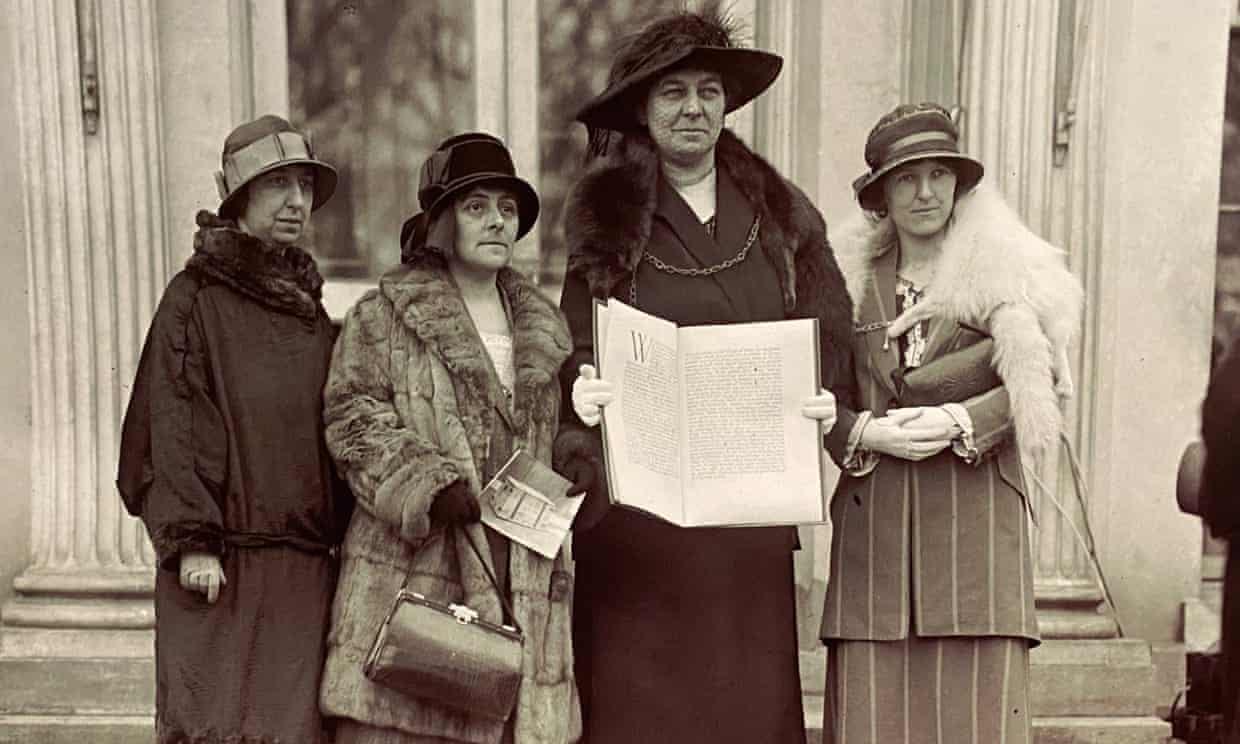
Photo: WCIA [Welsh Centre for International Affairs].
Annie Hughes-Griffiths holds the women’s peace appeal outside the White House in 1924 after a meeting with President Coolidge, with (from left) Gladys Thomas, Mary Ellis and Elined Prys. 

There are so many great initiatives by women that take years to get broad recognition because, at the time, they weren’t highly valued. That’s why I love sharing them now.

Steven Morris covered today’s example for the Guardian.

“There were tears of joy, speeches of hope and sighs of relief that all had gone smoothly after an extraordinary century-old document – reputedly seven miles long – completed its transatlantic trip back to Wales.

“The peace petition, signed by almost three-quarters of all Welsh women in the 1920s but forgotten until the last few years, arrived at the National Library of Wales [in April] after being gifted to the country by the National Museum of American History in Washington.

“Over the coming weeks and months, the reams of sheets will be taken carefully out of the hefty oak chest where they are stored, then digitized at the library in Aberystwyth, before a crowd-sourcing exercise takes place to transcribe all 390,296 signatures and addresses.

Prof Mererid Hopwood, the chair of the Peace Petition Partnership, said she was so excited she could hardly breathe and, though it was an overcast day in Wales, quoted the Welsh phrase mae’r haul yn gwenu – the sun smiles.

” ‘Actually, I think the sun’s practically chuckling with joy in Aberystwyth today. We are so very delighted,’ she said.

“In 1923, galvanized by the horrors of the first world war, a group of Welsh women decided to organize a campaign for world peace.

“During a Welsh League of Nations Union (WLNU) conference at Aberystwyth University, they agreed that the best way would be to appeal to the women of the US to work with them for a world without war. Two paid officers and 400 local organizers set about collecting names from every community in Wales.

“In 1924 the Welsh delegation, led by Annie Hughes-Griffiths, the chair of the WLNU, crossed the Atlantic with the petition and worked with American women such as the women’s rights campaigner Carrie Chapman Catt to disseminate their message.

“They received an enthusiastic welcome and travelled through the US addressing audiences. The US press claimed that if the signature sheets were laid end to end they would go on for 7 miles.

“However, over the years the petition was forgotten, until a mysterious plaque mentioning it was uncovered at the time of the centenary of the first world war in Cardiff’s Temple of Peace.

“ ‘It was a lost story, a hidden story,’ said Hopwood, a poet and the chair of Welsh and Celtic studies at Aberystwyth University. She said the idea of returning the petition to Wales was both to remind people of its amazing story and to inspire people today to campaign for peace.

“Hopwood pointed out that Wales has a history of its citizens working for peace, including … the women who marched from Wales to Greenham Common in Berkshire in 1981 to protest against nuclear weapons. …

“The Welsh deputy minister for arts and sport, Dawn Bowden, said it was an inspiring document: ‘I hope that the return of the petition to Wales will inspire and motivate a new generation of advocates for peace.’

“Dafydd Tudur, the head of digital services at the National Library of Wales, called it an ‘historic’ day.

“He said he hoped a pilot of the crowd-sourcing exercise would take place in the autumn, before fully beginning next year. An exhibition will be organized to present the chest and petition at three locations – Aberystwyth, St Fagans in south Wales, and Wrexham in the north.

“Tudur studied modern Welsh history but had not heard of the petition until the plaque was found. ‘It was forgotten. People are amazed when they hear about it,’ he said.” More at the Guardian, here. No firewall.

For more on the peace agenda, click here on an article co-authored by my friend Ann Tickner. The article examines “feminism in international relations from the emergence of women’s peace pragmatism during WW I to the development of the United Nations (UN) Women, Peace, and Security (WPS) agenda a century later. … We show how the principles articulated by women peace activists at the 1915 Hague Conference represent distinct contributions to the discipline.”

Read Full Post »

Photo of Gertrude Ely: Bryn Mawr College Collection

I was on the brink of unsubscribing to the American Academy of Poets poem-a-day e-mail because I let so many pile up and then have to slog through all sorts of contemporary brain twisters.

But as I was working my way through the poems today, I came across the one below. I thought, “Oh, I know exactly what this is about” and was carried back to my college days and hanging out at the home of my great aunt’s friend Gertrude Ely.

Gertrude Ely was quite elderly at that time but really interesting to be around. She knew all sorts of movers and shakers and was an awesome storyteller. I happened to be staying at her house one weekend when she received an unusual letter.

An elderly Philadelphia gentleman wrote that he had read in the Bulletin that she had received some civic award, and he just had to write and tell her a memory he had from his service in WW I in Europe. The Army was sending over carloads of friendly, proper young volunteers to chat with and cheer soldiers and bring a breath of home. The man wrote he would never forget a load of girls pulling up in an open car and Gertrude Ely calling out, “Any of you boys from Philadelphia?” He said, “At that moment, I believe every soldier there was wishing he was from Philadelphia.”

Gertrude Ely at my college graduation.

1966-GS-ELY-AT-CB-GRADUATION

***

American Boys, Hello! by Ella Wheeler Wilcox

Oh! we love all the French, and we speak in French
As along through France we go.
But the moments to us that are keen and sweet
Are the ones when our khaki boys we meet,
Stalwart and handsome and trim and neat;
And we call to them—“Boys, hello!”
“Hello, American boys,
Luck to you, and life’s best joys!
American boys, hello!”

We couldn’t do that if we were at home—
It never would do, you know!
For there you must wait till you’re told who’s who,
And to meet in the way that nice folks do.
Though you knew his name, and your name he knew—
You never would say “Hello, hello, American boy!”
But here it’s just a joy,
As we pass along in the stranger throng,
To call out, “Boys, hello!”

For each is a brother away from home;
And this we are sure is so,
There’s a lonesome spot in his heart somewhere,
And we want him to feel there are friends
right there

In this foreign land, and so we dare
To call out “Boys, hello!”
“Hello, American boys,
Luck to you, and life’s best joys!
American boys, hello!”

[Ella Wheeler Wilcox wrote “American Boys, Hello!” while visiting France during the latter stages of World War I as entertainment for the American soldiers stationed there.]

Photo of Ella Wheeler Wilcox: American Academy of Poets, here.

Read Full Post »

Photo of Patricia McCarthy: Agenda

The editor of a small poetry journal in England was desperate for money to keep the magazine going, so she entered a poem of her own in a contest — and won.

The poem came straight from her mother’s memories of World War I. WW I poems — mostly written by young men in service who never came home — are some of the saddest ever composed.

At the Guardian, Alison Flood has the story on Agenda editor Patricia McCarthy’s win.

“McCarthy, who has published several poetry collections of her own, beat 13,040 other entries to win the anonymously-judged prize. Her winning poem, ‘Clothes that escaped the Great War,’ tells of the plodding carthorse who would take boys away to war, and then return, later, with just their clothes. ‘These were the most scary, my mother recalled: clothes / piled high on the wobbly cart, their wearers gone,’ writes McCarthy. …

“McCarthy said winning the £5,000 prize was ‘just extraordinary.’ “I’ve never even won a raffle. I don’t go in for competitions – the only other time I did was decades back, when I got runner-up,’ she said. ‘But I’m really down on my finances – I edit Agenda, and was really struggling, and thought this was probably better than a gamble on the horses.’ ”

More.

Read Full Post »