Feeds:
Posts
Comments

Posts Tagged ‘zambia’

Photo: Vanessa Chisakula.
Vanessa Chisakula of Zambia wrote her first spoken word poem in her early 20s and “didn’t want to stop.”

It’s a universal human need: to have people listen to you, to be heard. How often do you find yourself talking to someone who is only waiting for you to pause so they can say their own thing? Well, that’s not being heard.

Recently in Africa, young people are finding that poetry events can be an outlet where other people are really trying to listen. It feels good.

Sarah Johns has written at the Guardian about poetry slams in Zambia.

“After giving birth, Vanessa Chisakula started writing poetry as a way of processing the changes and struggles she was experiencing as a new mother. ‘I was in my early 20s. I had just become a mum and didn’t understand it,’ she says. …

“Chisakula wanted to share her stories. She was inspired to do spoken-word poetry – a genre written to be read out loud and performed – when she heard I Will Wait For You by Janette…ikz, an American spoken-word poet.

“Now, she is spearheading efforts to expand the spoken-word scene in Zambia, where she is from. In 2017, she co-founded Word Smash Poetry, a movement for young creative activists across southern Africa. In her own award-winning work, she uses poetry as a tool for activism, focusing on issues including women’s rights, youth, African identity and mental health. …

” ‘Art is a form of protest that leaves no blood. It can be peacefully done but a strong message can be communicated artistically. … Poetry is just so beautiful,’ she says. ‘It can be a short but inspiring piece; it leaves you thinking and wanting more. I didn’t want to stop.’

“One of her first poems, ‘Her Place,’ was an examination of womanhood. She explains: ‘I wanted to tell my truth. What exactly is womanhood?’ … In 2020, Chisakula released a short collection of poems, Africana, written to embrace her identity as a black African.

“ ‘I always wanted to relocate to the US when I was young,’ she says. ‘I thought the American dream was the dream. There’s no African dream.’ She no longer believes this; now she wants to celebrate her home continent. …

“Over the past five years, Chisakula has seen the spoken-word scene grow in popularity in her home country. It is already well established across southern Africa, she says. From September to December there are poetry festivals ‘nonstop’ across countries including South Africa, Botswana, Zimbabwe and Zambia. In 2022, the winner of the World Poetry Slam, held in Brussels, was Xabiso Vili from South Africa.

“This year, the competition will be held in Togo. … ‘There’s a poet on every corner now,’ she says. ‘Back then, it was a bit uncommon; now people are doing it on a larger scale. I see poets at almost every event.’

“Male poets still outnumber female poets, however. Chisakula believes women struggle to get a foothold in the arts in Zambia. … Last month, the Word Smash Poetry movement hosted its second all-female national poetry slam in Lusaka, which took place during the 16 Days of Activism Against Gender-based Violence, an annual international campaign that kicks off in late November.

“There were 12 performers in total; four had returned after performing last year and there were eight new faces, which was a huge achievement, according to Chisakula.”

More at the Guardian, here.
Read Full Post »

Photo: Goldman Environmental Prize.
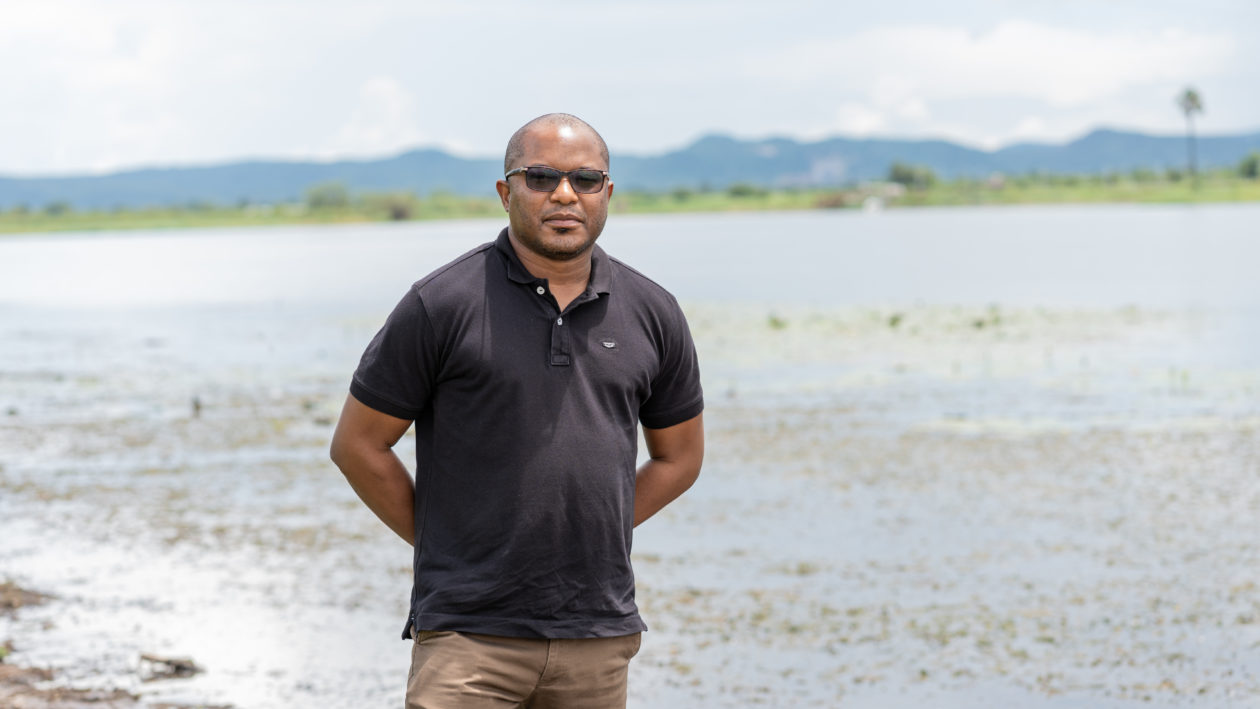
Chilekwa Mumba took on a UK mining giant that was polluting Zambia — and won.

Today’s story shows how one person can make a difference, even when the goal is considered impossible. It’s also a cautionary tale, because you can win the battle and not the war. The irony is that powerful entities can excuse polluting a region in order to meet “green economy” needs.

Jocelyn C. Zuckerman reported at Yale Environment 360, “The southern African nation of Zambia is home to a wealth of minerals — in particular, lots of the copper and cobalt that the world will require to power a green economy. Among its largest operations is the Konkola Copper Mines (KCM), located in the country’s Copperbelt Province.

“In 2004, U.K.-based Vedanta Resources acquired the controlling stake in KCM, whose operations span 11 square miles along the Kafue River. Soon after, residents noticed that the Kafue was emitting foul odors. Fish began dying. Crops began to wither.

Livestock fell ill. And villagers came down with mysterious headaches, nose bleeds, rashes, and burns.

“Chilekwa Mumba, who had grown up in the region but since moved to the Zambian capital, Lusaka, learned of the problem and vowed to do something about it. In an interview with Yale Environment 360, he talks about how he spent the next several years facilitating meetings between the communities and British lawyers, gathering water samples, and convincing former mine workers to provide evidence for a lawsuit that made its way through the British court system. Finally, in 2019, its Supreme Court found that KCM’s parent company could be held accountable in the U.K. for environmental damage from the mine’s operations.

“Not only had Mumba, 38, who was awarded a Goldman Environmental Prize [in April], helped win significant financial compensation for the 2,000 villagers involved, but his case set a legal precedent that British companies can be held accountable for the environmental fallout of their operations overseas. …

Yale Environment 360: KCM was already a presence when you were growing up in the town of Chingola. … You did your primary schooling in Chingola, so you got a good education in part thanks to the mine, which funded the schools? …

Mumba: They had excellent schools. We moved to Lusaka when I was 15, but I still went to school under the mine system. I went to a boarding school that was supported by the mines, including KCM.

e360: In 2004, Vedanta Resources, which is headquartered in the U.K., acquired a controlling stake in KCM. What happened after that?

Mumba: When they took over, there was too much collusion with government. They were not being held to account on many different issues. Based on what I was reading in the media, I started talking to residents in Chingola. We’ve got family and friends there, and my parents still maintain a home there. I used to go back occasionally, but it became almost a permanent home when I started to find out about the reports [of pollution]. I began realizing that what I’d been hearing was correct. And I started to do my own investigation. …

“I went to the same spot I used to go to as a child to fish. … There were basically no fish, and the smell of chemicals was quite evident. The soil makeup was different from what I remembered when I was young.

e360: Did you confront the company? …

Mumba: I had a couple of meetings with a local lawyer representing the villagers, and he was telling me that nothing would happen, that I shouldn’t waste my time. But he did give me quite a bit of information, and I put it in my file.

e360: You wrote letters to something like 100 law firms?

Mumba: A combination of law firms and environmental NGOs, all over the world. I was just randomly sending them out from my Yahoo address. I got a lot of automatic replies. And then there was an automatic reply from [British law firm] Leigh Day, followed up with an actual email from a person, Katie Gonzalez. I can never forget that name. I happened to find it in my email and was surprised. They told me they would be there in two weeks.

e360: How did the community respond to this British lawyer coming in? Did they trust him?

Mumba: Not immediately. But the way he is — Oliver Holland, I have to absolutely mention him — he was a white guy in a remote village, but he has this aura about him where he is very friendly, so they warmed up to him.

e360: What sort of evidence did you bring to court?

Mumba: We gathered water samples and soil samples and found that copper, iron, cobalt, and dissolved sulfates were present far beyond legal limits. We also took in — though we did not put that to the court — blood tests for various clients, to test for the presence of heavy metals. We already had overwhelming evidence from the water and the soil.

e360: Did you have help from anybody inside the company?

Mumba: A former mine manager, who knew the whole process and how there was gross negligence on the part of pollution control, gave us a lot of documents. He, of course, did not want to be named, so we videoed his testimony using certain means where his identity could be withheld. …

“Because of my connection to the case, I would get random calls and they would say, ‘Can we meet you? We want to help you. But protect our identity.’ So I would meet as many as possible. I would talk to everyone. It was part of the investigation, to get all that evidence together. …

“At the time, funnily enough, I was working for a local law firm, as a business development consultant. But I abandoned that work and decided to do this. I honestly didn’t even think that I was doing an investigation per se. It all came together when I was just simply inquiring into all these issues. …

e360: We know that copper and cobalt will be critical to the new green economy. Lots of people, including in the United States, want Zambia’s minerals. How does that help or hinder your position?

Mumba: I see it as a very dangerous position, especially the thirst for cobalt. I feel like the communities around the mines have never gotten a fair share of the deal. America says the end game of mining is they want clean energy. Cobalt is one of the components for that. So right now we need to be more watchful about how these mining operations are taking place and what benefit goes to the community.”

More at Yale Environment 360, here. No firewall.

Read Full Post »

Photo: Chimfunshi Wildlife Orphanage.
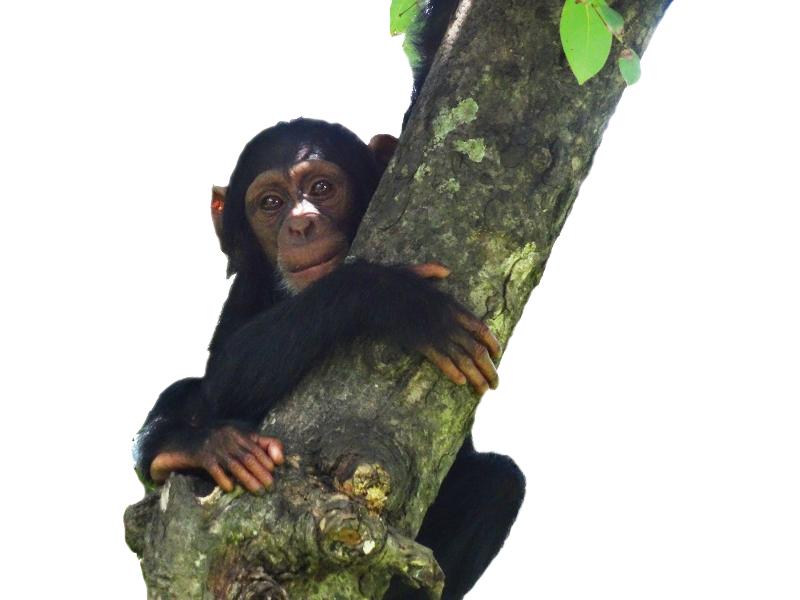
Above is a chimpanzee in the Chimfunshi wildlife sanctuary in Zambia, where an influencer chimp began a tradition of wearing a blade of grass in the ear, a style that continued after her death.

I’ve been thinking about social influencers and whether I can identify contemporary influences that have affected what I do. I know that if someone describes a book in a way that makes it sound like my kind of thing, I go immediately to my library’s website and reserve it. In another example, my behavior is hugely influenced by articles on the latest Covid research. And I’m always joining boycotts to help a worthy cause someone is promoting.

So I thought it was interesting to learn how creatures other than humans do influencing — from silly behaviors to life-and-death behaviors.

Natalie Angier at the New York Times begins with a chimpanzee. “Julia, her friends and family agreed, had style. When, out of the blue, the 18-year-old chimpanzee began inserting long, stiff blades of grass into one or both ears and then went about her day with her new statement accessories clearly visible to the world, the other chimpanzees at the Chimfunshi wildlife sanctuary in Zambia were dazzled.

“Pretty soon, they were trying it, too: first her son, then her two closest female friends, then a male friend, out to eight of the 10 chimps in the group, all of them struggling, in front of Julia the Influencer — and hidden video cameras — to get the grass-in-the-ear routine just right.

” ‘It was quite funny to see,’ said Edwin van Leeuwen of the University of Antwerp, who studies animal culture. ‘They tried again and again without success. They shivered through their whole bodies.’ …

“Julia died more than two years ago, yet her grassy-ear routine — a tradition that arose spontaneously, spread through social networks and skirts uncomfortably close to a human meme or fad — lives on among her followers in the sanctuary. The behavior is just one of many surprising examples of animal culture that researchers have lately divulged, as a vivid summary makes clear in a recent issue of Science. …

“ ‘If you define culture as a set of behaviors shared by a group and transmitted through the group by social learning, then you find that it’s widespread in the animal kingdom,’ said Andrew Whiten, a psychologist and neuroscientist at the University of St. Andrews, in Scotland, and the author of the Science review. ‘You see it from primates and cetaceans, to birds and fish, and now we even find it in insects.’

“Culture ‘is another inheritance mechanism, like genes,’ Hal Whitehead of Dalhousie University, who studies culture in whales, said. ‘It’s another way that information can flow through a population.’ … Genes lumber, but culture soars. In 1980, for example, an observant humpback whale discovered that by smacking its tail hard against the water, the tiny fish on which it preyed were prompted to ball up into tidy packages fit for comparatively easy capture and consumption. The enhanced hunting technique, called lobtail feeding, quickly spread along known lines of humpback social groups, aided, researchers suspect, by the cetacean talent for acrobatic mimicry among members of a pod. Today, more than 600 humpbacks are lobtail feeders. …

“Sperm whales likewise used crowdsourcing to outwit Ahab. In a new study examining whaling logs from the 19th century, Dr. Whitehead and his colleagues determined that when New England whalers first started hunting a naïve population of sperm whales in the north Pacific, they were essentially harpooning fish in a barrel, harvesting untold gallons of the fine spermaceti oil contained in the whale’s distinctive top hat of an acoustical organ. In just three to five years, however, long before the whalers had made a dent in the whale population, their hunting success rate had plunged by nearly 60 percent. …

“Some differences between animal tribes make sense only if viewed through a cultural lens. Liran Samuni, a postdoctoral fellow at Harvard, and her colleagues have been following two neighboring groups of bonobos in the Democratic Republic of Congo. The home ranges of the chimpanzee-like apes overlap considerably … but there is a salient distinction between them. Once or twice a month, bonobos supplement their vegetarian diet with meat, and when these two troops turn carnivorous, they seek out different prey. One group goes after anomalures, which resemble flying squirrels, while the other hunts small antelopes called duikers. ‘No matter where they are, even when the group is together, they maintain the preference,’ Dr. Samuni said. …

“Peter Richerson of the University of California at Davis, who studies the coevolution of genes and culture in humans … is particularly impressed by recent research showing that animal migrations, long considered the essence of mindless instinct in motion, are, in fact, culturally determined. ‘Mountain sheep have to learn their migrations from other sheep,’ he said. Whooping cranes are long-distance migrators, and when their numbers declined so precipitously that there were no adult birds to teach young birds the route, conservationists stepped in and used ultralight airplanes as whooping crane tutors. Even farm animals can be repositories of cultural wisdom, as ranchers discover when they precipitously sell off their entire herd.”

More at the Times, here.

Read Full Post »

Photo: Travel PR.
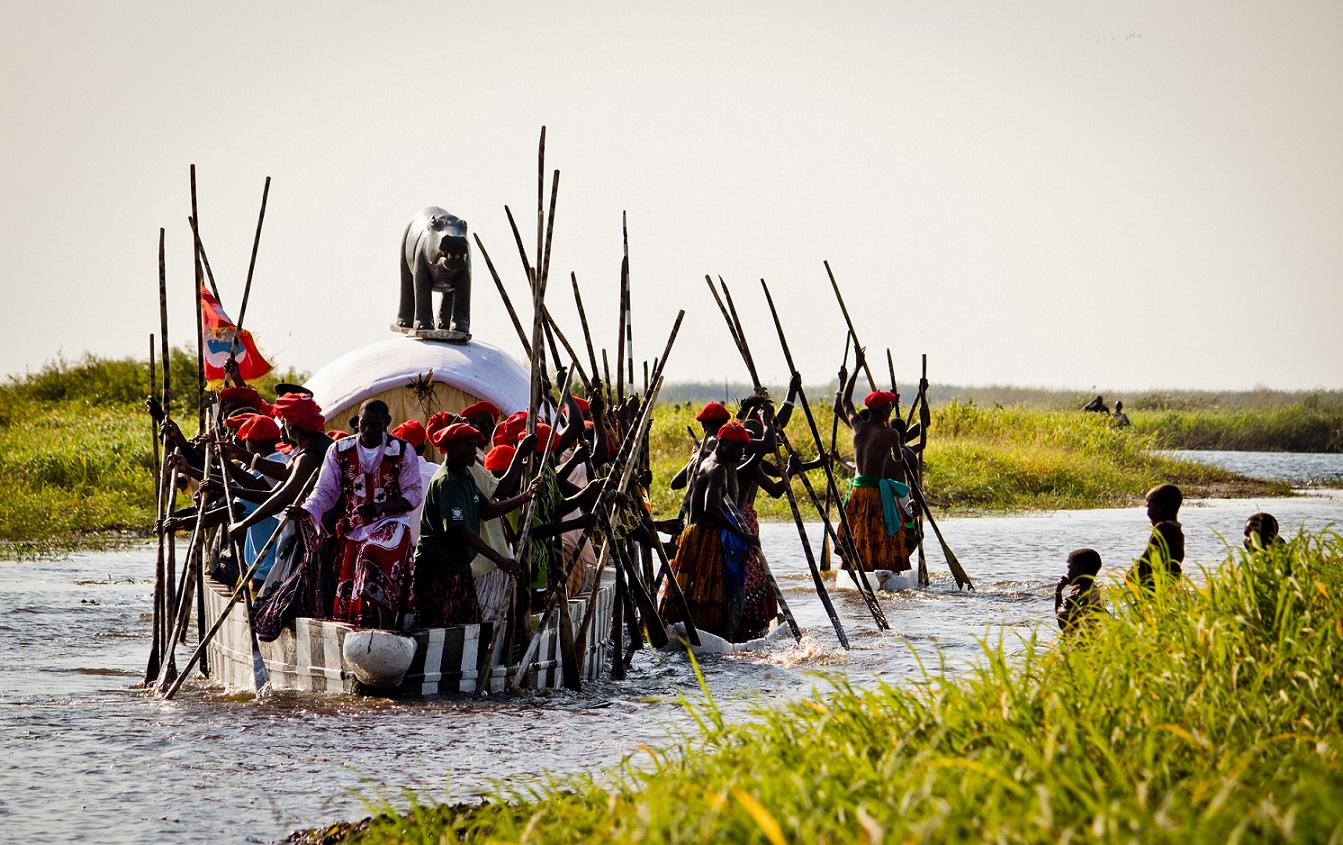
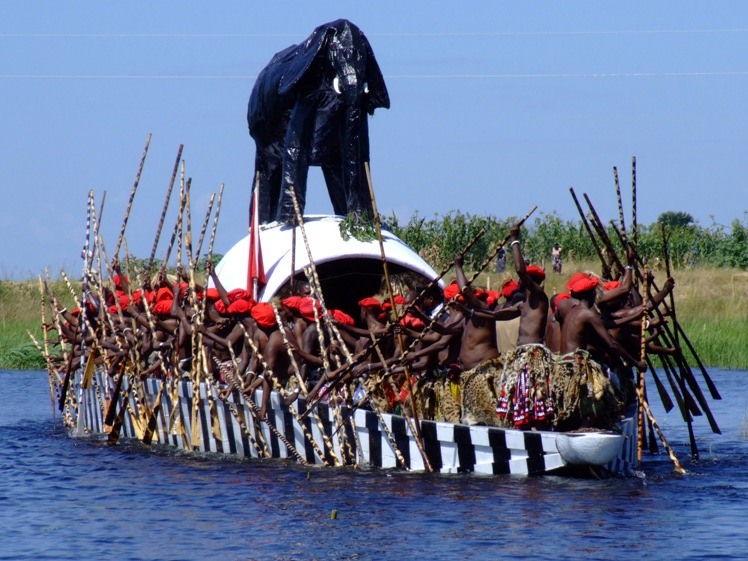
The Kuomboka, celebrated at this time of year if the conditions are right, marks the arrival of the wet season in Zambia. (The elephant’s ears are removable.)

According to my little book of holidays, a celebration called Kuomboka should take place in Zambia today to mark the change of seasons. Several websites, however, say the date is flexible.

GoWhereWhen, which says that coronavirus is an issue this year, describes the event: “This annual procession marks the transition of the Litunga (king) from his summer to winter residence, which is located on higher ground, away from the seasonal flood plains. This ceremony dates back more than 300 years when the Lozi people broke away from the great Lunda Empire to come and settle in the upper regions of the Zambezi.” 

Wikipedia adds, “Kuomboka is a word in the Lozi language; it literally means ‘to get out of water.’ In today’s Zambia it is applied to a traditional ceremony that takes place at the end of the rain season, when the upper Zambezi River floods the plains of the Western Province. …

“Historians claim that before the time of the first known male Lozi chief Mboo, there came a great flood called Meyi-a-Lungwangwa meaning ‘the waters that swallowed everything.’ The vast plain was covered in the deluge, all animals died and every farm was swept away.

“People were afraid to escape the flood in their little dugout canoes. So it was that the high god, Nyambe, ordered a man called Nakambela to build the first great canoe, Nalikwanda, which means ‘for the people,’ to escape the flood. Thus the start of what is known today as the Kuomboka ceremony.

“The ceremony is preceded by heavy drumming of the royal Maoma drums, which echoes around the royal capital the day before Kuomboka, announcing the event. … The ceremony begins with two white scout canoes that are sent to check the depth of the water and for the presence of any enemies. Once the scouts signal the ‘all clear,’ the journey to the highland begins. … The journey to Limulunga normally takes about 6–8 hours. Drums beat throughout to coordinate and energise those paddling the barge. …

“On the barge is a replica of a huge black elephant, the ears of which can be moved from inside the barge. There is also a fire on board, the smoke from which tells the people that the king is alive and well. The Nalikwanda is large enough to carry his possessions, his attendants, his musicians, his 100 paddlers. It is considered a great honour to be one of the hundred or so paddlers on the nalikwanda and each paddler wears a headdress of a scarlet beret with a piece of a lion’s mane and a knee-length skirt of animal skins.

“For his wife there is a second barge. This one has a huge cattle egret (Nalwange) on top. The wings move like the ears of the elephant, up and down.”

Lonely Planet points out that the dates are not fixed: “They’re dependent on the rains. In fact, the Kuomboka does not happen every year and is not infrequently cancelled because of insufficient flood waters; the 2012 ceremony was called off because it’s against Lozi tradition to hold the Kuomboka under a full moon.”

More at GoWhereWhen, here, at Wikipedia, here, and at Lonely Planet, here.

Photo: Dietmar Hatzenbichler
Legend has it that an African god told a man called Nakambela to build a great canoe to escape the floods. The boat was called Nalikwanda.

Read Full Post »


080616-vision-of-hope-zambia-apron

The first booth I encountered at the Art and Artisan fair Saturday was promoting a charity called Vision of Hope Zambia.

Co-founder Meg O’Brien had been a student at Berklee College of Music when a missionary friend in Zambia asked her to lend her musical talent to uplifting girls who lived on the streets.

When she visited Africa, Meg must have been shocked by what she saw: young girls, often orphaned, often HIV positive, who had no place to get a meal or even take a shower. She flew into action, co-founding Vision of Hope Zambia with Chitalu Chishimba.

Meg’s mother and aunt also flew into action, creating a craft initiative that donates 100 percent of proceeds to the cause.

The two artisans not only sew with skill — baby bibs, changing blankets, aprons and the like — they also are good at selling, promoting Meg’s charity while highlighting various features of their products.

Meg’s aunt saw me talking to my grandchildren and immediately pointed out the colorful array of child-size aprons. In the end, though, I bought an adult-sized apron for myself.

From humble beginnings in 2009 (“weekly meetings in the backyard of the Girl Scouts building underneath a tree”), the organization is now able to provide housing and education for many girls as it continues to grow.

Photo: Vision of Hope Zambia
Girls at Vision of Hope proudly show off their hard work in rug making.


Read Full Post »

At work we have partnered with an urban high school for 35 years. Tomorrow a group of 15-year-olds from the school will come into the office for Job Shadow Day.

The students fill out a form in advance to let their assigned mentor know something about them — favorite subject, least favorite, hobbies, career ambitions.

My student has an unusual ambition for a 15-year-old. She wants to be a philanthropist.

Perhaps I will tell her what I read recently about how many of today’s top philanthropists are active in their causes. They don’t just give money.

“The global face of philanthropy is changing,” writes the Christian Science Monitor. “Donors no longer just open their wallets. They’re actively involved in causes, use savvy business practices, and leverage what they give to achieve more good.”

One such philanthropist is F.K. Day. Read how his work has benefited people in Zambia and beyond.

“Life in rural Zambia has improved dramatically for dairy farmer Cecil Hankambe. He has doubled his milk sales, purchased a farm, and earned enough money to send his children to school. He still milks the same cow and travels the same rugged roads to the local dairy co-op. The only difference now: Instead of lugging a heavy jug on foot, he pedals a bicycle.

“Mr. Hankambe rides a Buffalo, a bike so sturdy and basic that its steel frame can carry up to 220 pounds and be repaired with a rock. Instead of delivering only seven to 10 liters of milk a day, Hankambe can now transport 15 to 20 liters to a chilling station before it spoils, boosting his profit.

” ‘A reliable bike can create reliability in a dairy farmer’s income,’ says F.K. Day, founder of World Bicycle Relief, a foundation based in Chicago that produces the Buffalo and provides two-wheeled aid to people in developing nations. ‘You forget how important transportation is.’ ”

Day started young, as young as the girl who will visit me at work tomorrow.

“As a teenager, he flew – on his own initiative – from Chicago to Brazil to knock on the door of Irish priests who were building schools in São Paulo‘s poorest neighborhoods. They hadn’t responded to his letters. But when he showed up on their doorstep, they had no choice but to put him to work.

“That experience laid the groundwork for what followed three decades later. On Dec. 26, 2004, horrific images of tsunami-swept Southeast Asia flickered on TV screens in the United States. Day, now a successful cofounder of SRAM, an elite bicycle-parts manufacturer, wanted to do more than just fund relief efforts. …

“So he and his wife, Leah, boarded a plane to Sri Lanka. Within weeks, Day had partnered with World Vision; he eventually oversaw the distribution of 24,000 bicycles that gave thousands of people affected by the tsunami the ability to reach their jobs, schools, and health-care centers.” His bikes are now in many countries were transportation needs are great.

” ‘If you can enter something new, open and honestly with beginner’s eyes, something good is bound to happen,’ says Day.”

How does one come by that core impulse to help? Probably it shows itself at a very young age. Even at 15.

Read about seven additional innovative philanthropists in the Monitor.

Photograph: Leah Missbach Day
F.K. Day, President of World Bicycle Relief & Executive Vice President of SRAM Corporation, pictured in downtown Chicago.

other innovative philanthropists

Read Full Post »