Photo: Milwaukee Public Schools
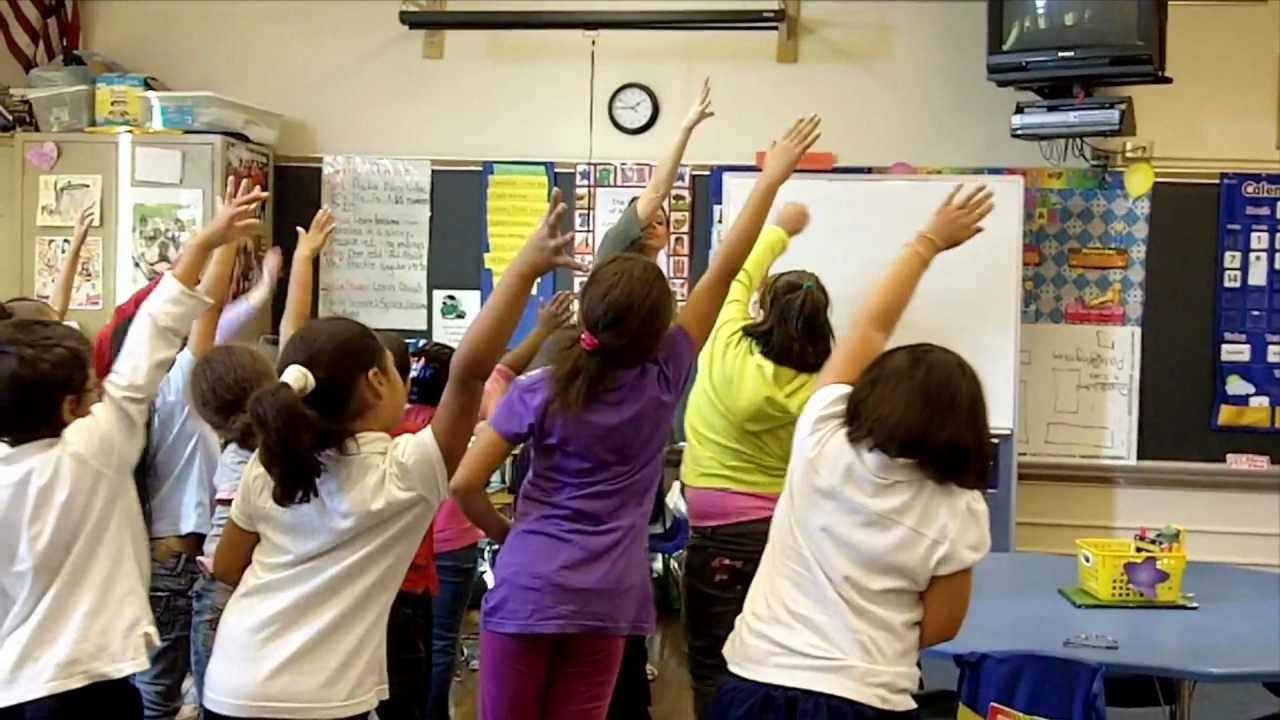
Sarah Wenzel and her class at Forest Home Elementary demonstrate a series of poses from the YogaKids cards, http://www.yogakids.com.
When I was in kindergarten, someone would come to play the piano and we children would walk in a circle pretending to be giraffes (re-e-eaching!) and elephants (swinging gently while bent over).
Just the other day, I realized that those kindergarten stretches were the same as stretches I’ve been doing for my back.
Decades ago, schools like mine were helping kids exercise for health. Now an increasing number of studies suggest that moving while in class helps children’s brains learn better, too.
Donna de la Cruz writes at the NY Times, “Sit still. It’s the mantra of every classroom. But that is changing as evidence builds that taking brief activity breaks during the day helps children learn and be more attentive in class, and a growing number of programs designed to promote movement are being adopted in schools. …
“A 2013 report from the Institute of Medicine concluded that children who are more active ‘show greater attention, have faster cognitive processing speed and perform better on standardized academic tests than children who are less active.’ And a study released in January by Lund University in Sweden shows that students, especially boys, who had daily physical education, did better in school.
“ ‘Daily physical activity is an opportunity for the average school to become a high-performing school,’ said Jesper Fritz, a doctoral student at Lund University and physician at the Skane University Hospital in Malmo, who was the study’s lead author. …
“ ‘Kids aren’t meant to sit still all day and take in information,’ said Steve Boyle, one of the co-founders of the National Association of Physical Literacy, which aims to bring movement into schools. ‘Adults aren’t wired that way either.’
“Mr. Boyle’s association has introduced a series of three- to five-minute videos called ‘BrainErgizers‘ that are being used in schools and Boys and Girls Clubs in 15 states and in Canada, Mexico, Ireland and Australia, he said. A version of the program is available to schools at no charge. …
“ ‘At the end of the week, kids have gotten an hour or more worth of movement, and it’s all done in the classroom with no special equipment,’ Mr. Boyle said. ‘We’re not looking to replace gym classes, we’re aiming to give kids more minutes of movement per week. And by introducing sports into the videos, giving kids a chance to try sports they may not have ever tried before.’ ”
To read more at the NY Times, click here.









 Suzanne's Mom's Blog