Feeds:
Posts
Comments

Archive for May, 2017

We all know that chestnut trees were wiped out by disease, right? Well, maybe not.

Susan Sharon at the Maine Public Broadcasting Network has a hopeful story.

“A century ago American chestnut trees dominated the eastern woodlands from Georgia to Maine. Growing straight and tall they were prized for timber. Wildlife depended on the nuts they provided every year.

“People ate the chestnuts, too, scooping them up by the sackful every Fall. Then came an exotic blight accidentally introduced from Asia and the species was virtually wiped out.

“That’s why scientists are excited by a recent find in western Maine, a record-breaking find that is raising their hopes for the future.

“The unusual discovery was made from the air. Dr. Brian Roth, a forest scientist with the University of Maine was surveying areas most likely to have habitat conditions favorable for chestnut trees and – voila! Flying over some woods in Lovell he saw a telltale sign.

” ‘In July, when nothing else is blooming, this tree will have a large amount of white flowers in its crown,’ says Roth. …

“This is not just any tree. This is an American chestnut tree worthy of the record books. …

“As girth goes, this chestnut tree is not so impressive. It’s on the skinny side. And most people wouldn’t pick it out as distinctive in a forest lineup. But when it comes to height, this American chestnut reigns supreme.

” ‘We think it’s around one hundred years old,’ says Roth. ‘It’s over 100 feet tall, which makes it the tallest [chestnut] that we know of in North America.’ …

” ‘We’re quite interested in these native trees, one for getting them into the population, our breeding program, as well as where do these trees grow?’ Roth says.

“The North Carolina-based American Chestnut Foundation is devoted to restoration of the American chestnut to its historic range. … Dr. Jared Westbrook is the American Chestnut Foundation’s geneticist. …

“He says more than 60,000 chestnut trees have been planted so far. To help them out, the group is using a virus that infects the chestnut fungus and makes it weaker. But Westbrook says only 500 trees, the toughest and the best of the bunch, will ultimately be selected for reintroduction to the wild.” Listen to the story here.

The poet Marianne Moore once wrote, “I rejoice that there are owls.” Today I rejoice that there are chestnut trees.

Photo: MPBN/Susan Sharon
Here’s the evidence. People are excited about finding a 100-year-old chestnut tree that survived blight in Maine. Other chestnuts are being nurtured in the South.

Read Full Post »

How did we get halfway through May already? It’s time to mention I’ll be taking my first break in six years between May 26 and June 6. We’ll be in Sweden. I’ll try to blog, but you never know.

It sure will feel strange not to post. I have put something up on this site every day since May 2011!

But before I leave, I have other things to share, including today’s photos. The first two are from the giant mural in Dewey Square, Boston — the latest in the Greenway’s ongoing series. The featured artist this time is Mehdi Ghadyanloo from Iran, where he is known for upbeat murals.

The next photo shows a WPA mural in the Arlington, Mass., post office. John pointed me to it after he saw my recent post “Hunting Down WPA Art.”

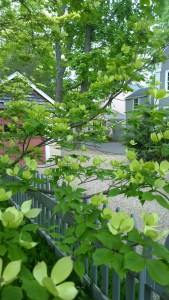
Then comes another of my shadow photos. Can’t resist shadows. That one is followed by tree-stump mushrooms and dogwood. Can’t resist mushrooms either.

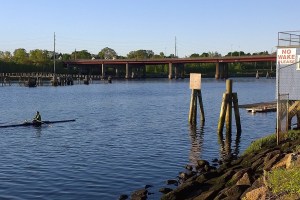
The four Providence photos that follow attest to the fact that the city finally experienced a sunny Tuesday morning (the first since February). Blackstone Park is the location of the Indian shelter and the fallen birch tree with the mysterious yellow plastic strips (art?). Nearby was a wondrous carpet of pink petals and an early rower on the Seekonk River.

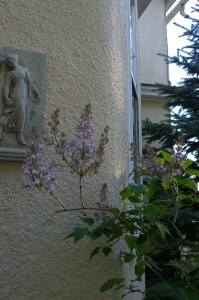
Finally, I wanted to show you my lilac progression. With muse.

042817-Greenway-mural-Boston

042817-Iranian-artist-Mehdi-Ghadyanloo


042917-WPA-mural-in-ArlingtonMA-PO

051117-can't-resist-sun-and-shadow


043017-mushrooms-on-stump

051217-feathery-dogwood-and-garage


051217-feathery-dogwood-and-garage

051617-fallen-birch-art


051617-carpet-of-petals-Providence

051617-sculling-on-the-Seekonk


042617-lilac-and-lady-1

050317-lilac-and-lady-2


050617-lilac-and-lady-


Read Full Post »

Photo: Getty Images
Wynton Marsalis performing in New York City in April 2016.

John was in Belarus for work last week but wasn’t too distracted to forward another good blog topic. It’s about a very busy celebrity who took a day out to surprise student musicians and a high school music director who was retiring.

Johanna Seltz writes at the Boston Globe, “Jazz great Wynton Marsalis took the stage at the Foxborough High School Pops concert last weekend — much to the surprise of retiring music director Stephen Massey, who was running the event.

“Massey was just introducing a piece by the Foxborough High School Jazz Ensemble — and explaining that the band had been chosen as one of 15 nationally to play at the Essentially Ellington High School Jazz Festival in New York’s Lincoln Center where Marsalis runs the jazz program — when Marsalis stepped out from behind a tuba, playing ‘Joe Avery’s Blues’ on his trumpet.

“ ‘My reaction was shock, total shock, and disbelief,’ Massey said later, although he calmly announced, ‘Wynton Marsalis, ladies and gentlemen,’ to the crowd of family and friends sitting at tables at the high school.

“ ‘The generosity of that man to drive four hours up, visit us for half an hour, and drive four hours back — with his schedule and his life — is beyond my comprehension,’ Massey said.

“Marsalis improvised with the student musicians and then gave a moving tribute to Massey, who is retiring after 37 years in Foxborough and 46 years as a music educator. …

“Massey has brought Foxborough high school jazz bands to the elite Essentially Ellington festival 17 times over the years and gotten to know the Pulitzer Prize and Grammy-winning Marsalis, who judges the event, in the process. …

“ ‘There’s kind of this simpatico communication that we have without many hours of talking to each other, just mutual respect for the things we do,’ Massey said. ‘Music is powerful, very powerful.’

“A video of the surprise appearance is available at www.facebook.com.”

More at the Globe, here.

Read Full Post »

Photo: British Pie Awards
One of Britain’s most traditional pies is the Melton Mowbray pork pie. It was granted protected European Union status. (Can that protection last post-Brexit? The Law of Unforeseen Consequences strikes again.)

My husband loves learning about the origins of language. He recently sent me an article about English pies and pie-related expressions.

Norman Miller at the BBC explained, “Every March, St Mary’s church in the Leicestershire town of Melton Mowbray becomes a cathedral of pies: it fills with tables bearing more than 800 pastries.

“Some recipes are particularly offbeat. While the quirkiest entry in this year’s Speciality Meat category was a cricket pie, one celebrated past winner was Phil Walmsley’s squirrel pie in 2014. Walmsley told me that it has medieval origins, but still sells out at Market Harborough’s twice-monthly farmers’ market. ‘They’re also a great way to deal with a pest,’ he laughs. …

“Even in their early days, pies served different purposes for the rich and poor: as show-off delicacies for the former and portable food for the latter.

“So while wealthy feasts might include pies containing anything from game birds to mussels, the less well-off used simpler pies as a way to have food while doing outdoor work or travelling – the crust both carried and preserved the tasty filling. …

“Pies have been adding rich flavour to the English language for centuries. Even Shakespeare got in on the act, writing in his 1613 play Henry VIII that ‘No man’s pie is freed from his ambitious finger’, giving English the phrase ‘a finger in every pie’. …

‘Eating humble pie’, meanwhile, comes from medieval deer hunting, when meat from a successful hunt was shared out on the basis of social status.

“While the finest cuts of venison went to the rich and powerful, the lower orders made do with the ‘nombles’: a Norman French word for deer offal. Anglicisation saw ‘nombles’ pie become ‘humble’ pie. …

“One gigantic 16th-Century royal pie concealed a gaggle of musicians who began playing when the pie was cut, while another trick saw people burst out of a pie to recite poetry. Concealing live birds was also popular – hence the ‘four and twenty blackbirds’ in the nursery rhyme Sing a Song of Sixpence.”

Be sure to read about some great English pastries here, especially the traditional pie with sardines gazing up from the crust that commemorates a 17th century fisherman who saved his village from starvation.

As for squirrel pie, if Erik doesn’t find a way to keep a local squirrel from getting into the bird feeder, I fear that scalawag’s fate is sealed. Hungry, anyone?

Photo: Aubrey K. Huggins

Read Full Post »

051417-Mother's-Walk-for-Peace-2


Suzanne’s Mom is far left, wearing a winter hat and purple rain poncho.

Well, we did it. Nothing like a cold rain to make you walk fast. But it was touching how many walkers wanted to protest violence and offer support to victims even when Mother’s Day isn’t warm and sunny.

The Mother’s Day Walk for Peace is a fundraiser for the Louis D. Brown Peace Institute, which was founded by the heartbroken parents of a son who was already working for peace at a young age.

“Louis was an avid reader a total book worm,” says the website. “He was caring and compassionate. He loved Chinese food and hated doing the dishes. At fifteen, he was committed to making his community a more peaceful and just place through the Teens Against Gang Violence group he was part of.

“Louis believed that all young people had the potential to be peacemakers — regardless of what side of the streets they come from. He had the long-term goal of becoming the first Black president of the United States. Louis was killed in the cross-fire of a shootout in 1993.

“Louis’ parents, Joseph and Clementina (Tina) Chéry founded the Peace Institute in 1994 to carry out the peacemaking work that Louis started.  Their goal was to teach young people the value of peace, focus on the assets in community, and transform society’s response to homicide.”

At today’s walk, many people carried banners and posters honoring a friend or family member. A young man gave me a button to wear for Jorge Fuentes. Here is what the Episcopal Diocese of Massachusetts has to say about Jorge.

“In September 2012, violence struck at the heart of our diocesan community when 19-year-old Jorge Fuentes was murdered while walking his dog outside his home in Dorchester.  He was an exuberant, remarkable young man and natural leader, adored by the children he mentored at St. Stephen’s Church and St. Mary’s Church in Boston and respected by his peers.  Many in our diocese knew him because he grew up and worked in the B-SAFE summer and B-READY afterschool programs and the Barbara C. Harris Camp of our diocese.” More.

I attended the event with a group from a different denomination. It was a stalwart bunch — dressed, unlike me, in real hiking boats and rain-repellent pants.

A couple people carried a sign for the United States Department of Peace, an initiative I hadn’t heard about. Wikipedia says, “The Department of Peace is a proposed cabinet-level department of the executive branch of the U.S. government.” More.

I marched because I think the walk is a great celebration of solidarity and of the lives that are missed. It’s moving to see the variety among the marchers. I also like that the Louis D. Brown Peace Institute is innovative in recognizing the suffering of all parties, even the families of the perpetrators.

A lot of old folks in this world may have come to believe that violence is part of the human character and will always be with us, but when you see the many young people who march, you have to believe that someday things could change.

Read Full Post »

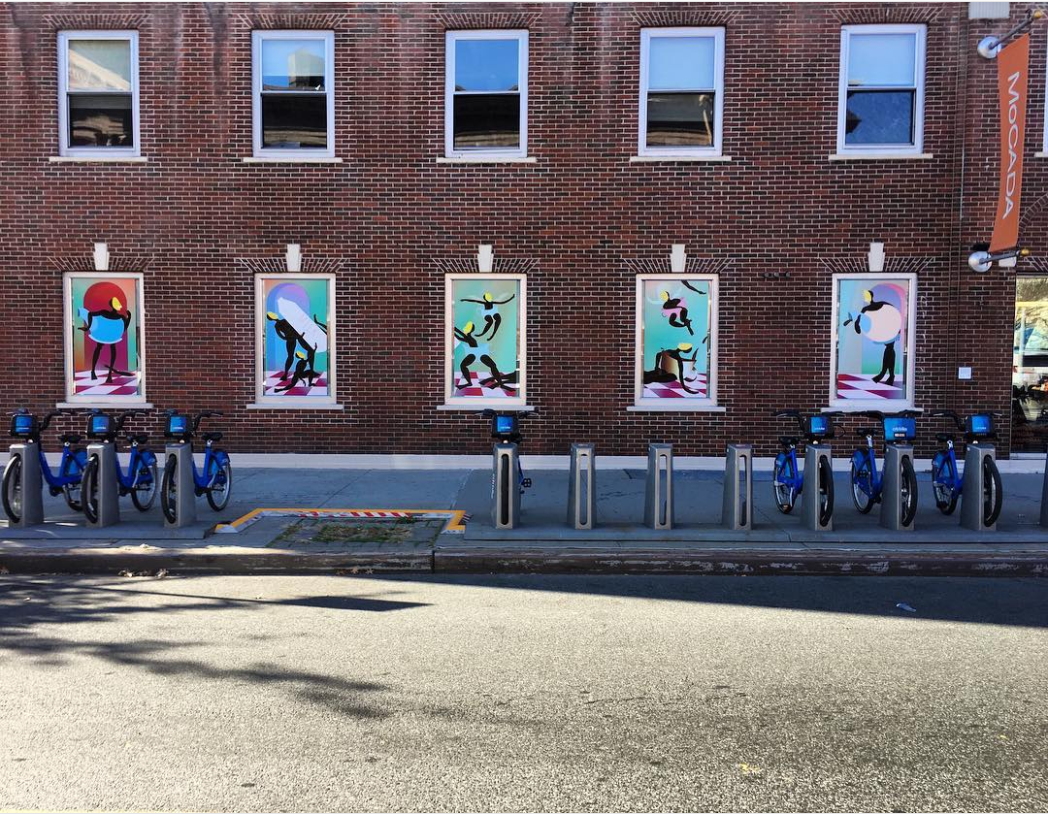
Photo: @elliott.jerome, via Instagram
Installation view of Theresa Chromati’s
Tea Time, with audio accompaniment by Pangelica, at Museum of Contemporary African Diaspora Arts in Brooklyn.

For ten years, I was the editor of a magazine focused lower-income communities, and like this blog, it reflected a lot of my interests. One of the topics I was always on the hunt for was the role of the arts in community development. This study would have fit perfectly.

Isaac Kaplan writes at Artsy, “Arts advocates have long extolled the benefits of culture to personal and neighborhood welfare. While the contention is broadly accepted within the field, the existence of the link has largely been argued without an abundance of data and taken a backseat to economic justifications for arts funding.

“But a two-year study released this month by researchers from the School of Social Policy & Practice at the University of Pennsylvania has revealed a quantitative relationship between the presence of cultural resources in a neighborhood and key aspects of social well-being, particularly in less advantaged neighborhoods. The research was part of the school’s ongoing Social Impact of the Arts Project (SIAP).

“Professor Mark J. Stern and SIAP director Susan C. Seifert found that low- and middle-income residents across New York City with more access to cultural resources experience better education, security, and health outcomes compared to residents of neighborhoods with similar economic profiles but with fewer cultural resources. …

“The relative higher presence of cultural resources in lower-income neighborhoods is linked with several health, safety, and education benefits. These include a 14% decrease in indicted investigations of child abuse and neglect, an 18% decrease in felony crime rate and also a 17–18% increase in the number of students scoring at the highest level on standardized Math and English tests. …

“While the report is careful to note that such findings do not mean the arts are causing these outcomes, the link is nonetheless significant within a broader picture. …

“To reach their conclusions, the researchers compiled a ‘cultural asset index’ — an accounting of thousands of nonprofits, for-profits, employed artists, and cultural participants across New York City, drawing on numerous sources, including tax, grant, and administrative data.

“The study complements this data with interviews and discussions with individuals engaged with cultural enterprises across the entire city. …

“The study says that economically disadvantaged areas generally have fewer cultural resources than wealthier parts of the city. But less advantaged communities also had a stronger correlation between the prevalence of cultural resources and social well-being.”

Read more at Artsy, here.

Read Full Post »

On twitter a while ago, Liz Devlin (@FLUXboston) highlighted a Vox video presenting an explanation of why snails appear in the margins of many medieval illuminated texts.

Vox reports that a Germanic people called Lombards, who had invaded Italy, were roundly scorned in the 1200s. Over time they became less warrior-like and more usurious. That is, they were money lenders, which gave them another kind of power. The theory is that the snail represents both the the hated Lombards’ lack of fighting ability and their power.

A group of librarians in the UK also looked into the research. They report as follows: “There has been much scholarly debate about the significance of these depictions of snail combat. As early as 1850, the magnificently-named bibliophile the Comte de Bastard theorised that a particular marginal image of a snail was intended to represent the Resurrection, since he discovered it in two manuscripts close to miniatures of the Raising of Lazarus.

“In her famous survey of the subject, Lilian Randall proposed that the snail was a symbol of the Lombards, a group vilified in the early middle ages for treasonous behaviour, the sin of usury, and ‘non-chivalrous comportment in general.’

“This interpretation accounts for why the snail is so frequently seen antagonising a knight in armour, but does not explain why the knight is often depicted on the losing end of this battle, or why this particular image became so popular in the margins of non-historical texts such as Psalters or Books of Hours.

“Other scholars have variously described the ‘knight v snail’ motif as a representation of the struggles of the poor against an oppressive aristocracy, a straightforward statement of the snail’s troublesome reputation as a garden pest, a commentary on social climbers, or even as a saucy symbol of female sexuality. It is possible that these images could have meant all these things and more at one time or another; it is important to remember, as Michael Camille, who devoted a number of pages to this subject, once wrote: ‘marginal imagery lacks the iconographic stability of a religious narrative or icon.’ “

Read more at the British Library website, here. Lilian M.C. Randall’s study “The Snail in Gothic Marginal Warfare” can be found here, at the University of Chicago Press journals site. Watch the video, too. It’s quite fun.

Read Full Post »


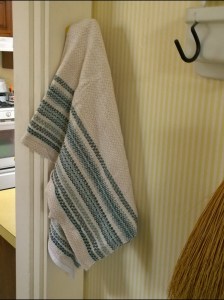
011217-Kerry-Sanger-dishtowell


Did you ever see a finer dishtowel? The blogger KerryCan wove it for me after I won a drawing at “Love Those Hands at Home,” her site. I cherish it.

This is how it came about. Back in October, KerryCan asked readers, many of whom are experienced artisans, whether they were more process-oriented or product-oriented. She had recently decided that what she herself loved most about her creative endeavors — which include quilting, weaving, chocolate making, and collecting vintage linens for her Etsy shop — was the process. I said the same about my past jobs working on magazines.

She put all commenters into a drawing for a handwoven dishtowel that she would make to the winner’s color specifications.

Now, KerryCan is a person who regularly makes thoughtful comments on other people’s blogs, so she attracts an impressive number of thoughtful commenters herself. I encourage you to read their responses to the process/product challenge, here.

Another fun KerryCan post asks readers if they are get-it-done Focusers or Flitterers, as she claims to be. She seems wistful that Flitterers like herself, who like to have numerous projects going at once, don’t get to check much off their lists. But I think people should embrace their own style.

I myself am probably more of a Time Waster than a Focuser or Flitterer — except on days when I schedule myself up. But then, some of the people whose creative output I admire most have been notorious Time Wasters, so maybe something of value is going on beneath the surface.

I hope you will check out “Love Those Hands at Home” — maybe even answer the latest challenge. You will be in the company of people who really think about things.

Read Full Post »

Photo: White Wolf Pack
A plaque acknowledging the contribution of the Choctaw people to the one million Irish people starving during Black ’47 is mounted in Dublin’s Mansion House and reads, “Their humanity calls us to remember the millions of human beings throughout our world today who die of hunger and hunger-related illness in a world of plenty.”

This is a story of compassion reaching across borders and cultures. Apparently, a Native American tribe, moved by the desperation of the Irish famine in the 19th century, donated money to help the hungry.

And Ireland did not forget.

According to the website White Wolf Pack, “In 2015, a statue was commissioned to be built in Midleton, County Cork, Ireland, to honor the kindness of the Choctaws. But the story begins in 1831, when the Choctaw people were forcibly removed from their ancestral lands in Mississippi.

“A few years later, Choctaws learned of people starving in Ireland. Only sixteen years had passed since the Choctaws had faced hunger and death on the first Trail of Tears and a great empathy was felt when they heard such a similar tale coming from across the ocean. Individual Choctaws collected and donated $170 in 1847 to assist the Irish people.

“Jump ahead a century and a half. It took a year for artist Alex Pentek to create Kindred Spirits. With its nine eagle feathers reaching 20 feet into the air, the statue represents ‘this great moment of compassion, strength, and unity,’ said Pentek. …

“This is not the first time that the Choctaw nation has been honored in Ireland. In 1990, Choctaw leaders traveled to County Mayo to take part in a reenactment of the desperate walk undertaken by locals to their landlord in 1848. The gesture was returned in 1992, when Irish commemoration leaders took part in a 500 mile trek from Oklahoma to Mississippi. Former Irish President Mary Robinson has also been named an honorary Choctaw chief.”

More here and at Wikipedia, here.

I keep thinking that if ordinary folks like those Choctaws — and the Irish who remained grateful — would keep doing what they do in ever increasing numbers, the combined strength of multiple acts of empathy would erode the wrongdoing of the powerful.

Read Full Post »

Famed physicist Stephen Hawking has ALS and has to talk using an electronic voice substitute. Recently, as part of a skit for the antipoverty charity Comic Relief’s Red Nose Day fundraiser, he pretended to audition a bunch of well-known actors to be his newest voice.

Erin Jensen reports at USA Today, “A new, highly sought after role might not win actors any Oscars or BAFTAs, but that’s not stopping Hollywood’s elite from auditioning.

“In the clip, Hawking, who has ALS and communicates with synthesized speech, reviewed tapes from the self-described ‘intelligent … kind of’ Anna Kendrick and Rebel Wilson, who got a hard no from the physicist. Hawking also wasn’t persuaded by The Theory of Everything stars Felicity Jones and Eddie Redmayne or the ‘soothing, calming voice’ of Gordon Ramsay.

“Hawking wasn’t Taken with Liam Neeson’s voice either, despite the actor’s opinion that it possessed ‘a tinge of … physics.’ ” More.

For the true story behind Hawking’s voice, read this Wired article. Joao Medeiros details the many iterations of the technology underlying Hawking’s ability to communicate, but he notes Hawking likes his original “voice” and has stuck with it.

“His voice had been created in the early ’80s by MIT engineer Dennis Klatt, a pioneer of text-to-speech algorithms. He invented the DECtalk, one of the first devices to translate text into speech. He initially made three voices, from recordings of his wife, daughter and himself. The female’s voice was called ‘Beautiful Betty’ the child’s ‘Kit the Kid’, and the male voice, based on his own, “’Perfect Paul.’ Perfect Paul is Hawking’s voice.”

Photo: http://www.hawking.org.uk/

Read Full Post »


Photo: Alan Berner/The Seattle Times
Neurologist and musician Thomas Deuel, wearing a wired-up electrode cap, is researching brain activity in musicians and developing the encephalophone for people with limited motor ability so they can play by thinking.

Imagine being able to play music just by thinking about it! That day is coming, according to Brendan Kiley at the Seattle Times.

He writes, “In April of 2016, Seattle choir director and fifth-grade teacher Margaret Haney checked into the emergency room with an unusual problem — suddenly, she couldn’t sing.

“Haney had been in the classroom, trying to lead her students through George Gershwin’s ‘Summertime’ when, as she put it, ‘I failed miserably, like I never have.’ …

“The physicians ordered some brain scans and discovered she was suffering from ‘amusia’ — the inability to make music — due to a viral encephalitis infection in one section of her brain.

“After the tests, she was referred to Dr. Thomas Deuel, a Swedish neurologist who plays trumpet and guitar, studied musical composition and molecular biology at Princeton University, and then jazz at New England Conservatory in Boston. …

“Deuel had been working with DXARTS, a University of Washington program that incubates collaborations between scientists and artists. DXARTS was launched in 2001, with an emphasis on projects that boldly crisscross borders: video, performance, music, virtual reality, robotics and all-around tech-art hacking.

“Lately, Deuel had advised DXARTS on building a lab, with state-of-the-art technology to study the relationship between neurology and art (particularly music), and explore deep connections between the body and the brain. Deuel had also teamed up with UW-based physicist Felix Darvas on a neuro-musical invention: the encephalophone (pronounced ‘en-sef-ah-lo-fone’), an instrument you can play simply by thinking. …

“To play the encephalophone, a musician wears an electroencephalogram (EEG) cap fitted with electrodes that read brain waves and transmit them to a synthesizer. The EEG caps looks like a beanie without the propeller but protrudes a cluster of wires hooked up to amplifiers and computers. The instrument is a kind of ‘brain-computer interface,’ and sounds like an electric piano, electric strings, or whatever other kind of music the connected synthesizer can produce. …

“[DXARTS co-founder Juan] Pampin hopes the encephalophone will be developed enough to host a public concert of ‘brain performers’ by late 2018. …

“And Margaret Haney? Doctors … treated her with antiviral medication to halt the spread of the infection — and the instrument helped relieve her amusia.

“[Deuel says] learning to play the encephalophone ‘helped her make pitch. We weren’t able to completely cure her, but she was able to get back to singing again. We can’t prove that we’ve done a lot with just one patient, but it was a promising start.’ ”

More here.

Read Full Post »

I want to share a few more examples of Luna & Stella jewelry and let you know that Suzanne is offering free shipping for everything in stock if you order today.

After today, you can still get a gift to your mother in time for Mother’s Day if you order by Thursday, May 11, 2017, and use FedEx Overnight delivery.

Check out these beautiful pieces. Think about mixing modern and antique stacking birthstone rings for a uniquely personalized gift. The mother and daughter necklaces are another great Mother’s Day idea: for example, the smaller and larger suns below.

And do remember to sign up for Luna & Stella’s antique locket giveaway by tomorrow, May 8. My fingers are crossed for a blog reader to win.

Luna-and-Stella-says-Try-stacking-old-and-new-rings

LunaStella031016-you-are-my-sunshine


Keep-your-secrets-in-a-Luna-and-Stella-locket

modern-and-antique-stacking-rings-luna-and-stella


old-locket-new-charms-Luna-and-Stella

May-2017-Luna-and-Stella-locket-giveaway


Read Full Post »

Photo: Phil Halper/visitjersey.com
Bioluminescence on the Island of Jersey is caused by Caulleriella bioculata glowworms.

Back in the day, John was the World’s Number One Fan of naturalist Gerald Durrell, who wrote hilarious books about his family and how they handled his early infatuation with animals.

Durrell left his mark on the world with entertaining books, lemur conservation efforts, the Durrell Wildlife Park in Jersey, and more.

In March, Lizzy Dening wrote for the Guardian about a visit to the island, and in particular, about her amazement at the bioluminescence there.

“It is only 7pm, but already it’s dark and our Jersey Walk Adventures guide points to a daisy anemone that glows brightly in the beam of a UV torch. It may be pitch black, but suddenly there’s a firework display at our feet.

“We’re here to see bioluminescence on an unassuming beach in Jersey’s La Rocque Harbour, at the south-east tip of the island. This magical effect is provided by elusive small brown worms. They are rare in most parts of Britain, but you can see them in Jersey all year round, as long as it’s dark and the moon isn’t full. The less light, the better. It helps that there are no street lights close by.

Caulleriella bioculata might not look like much in daylight, but by night, when you turn off your torch, the transformation is dazzling. …

“The worms are about 4mm long and are easy to miss when they are not emitting their strange greenish glow. When disturbed, they light up and continue to glow for up to 20 seconds before switching off to recharge. The glow is the result of chemi-luminescence, a chemical reaction in their bodies. Scientists still aren’t quite sure why the worms glow, but suspect it is for communication or defence. …

“As we walk, [our guides, Derek Hairon and Trudie Hairon-Trox,] explain about the vital work of the glowworms, which churn through the sand in the same way that earthworms work the soil, keeping it aerated and soft in texture. British beaches wouldn’t be the same without these hardworking creatures. …

“The couple were, they believe, the first people to officially identify these glowworms on Jersey. Before their discovery, the creatures were almost unknown to anyone except the local fishermen. …

“There are plenty of other attractions on the island, too. … The Durrell Wildlife Park was established by Gerald Durrell, and I’ve longed to visit ever since reading Menagerie Manor, which is all about his life on Jersey.

“Designed to act as an ark, protecting and breeding endangered species from around the world, it’s now run by Lee Durrell, Gerry’s widow, who shares his fierce passion for all creatures, no matter how strange (among other treasures, he famously gifted her four tarantulas for their 10th anniversary).” More here.

See also my related post on synchronous fireflies in Tennessee, here.

Read Full Post »

Photo: Oklahoma City Public Schools
Drawings and script on 1917 school chalkboards were recently uncovered in Oklahoma.

In June 2015, student drawings and script from 1917 were uncovered on Oklahoma blackboards.

Elahe Izadi wrote at the Washington Post, “Teachers and students scribbled the lessons — multiplication tables, pilgrim history, how to be clean —  nearly 100 years ago. And they haven’t been touched since. …

“Contractors removing old chalkboards at Emerson High School in Oklahoma City made a startling discovery: Underneath them rested another set of chalkboards, untouched since 1917.

“ ‘The penmanship blows me away, because you don’t see a lot of that anymore,’ Emerson High School Principal Sherry Kishore told the Oklahoman. ‘Some of the handwriting in some of these rooms is beautiful.’ …

“A spokeswoman said the district is working with the city to ‘preserve the “chalk” work of the teachers that has been captured in time.’

“A wheel that apparently was used to teach multiplication tables appears on one board. ‘I have never seen that technique in my life,’ Kishore told the Oklahoman.

“The boards carry not just teachers’ work, but also that of students, and every room has a lesson on pilgrims, according to the district.” More here.

The principal’s comment on the penmanship was interesting to me because just a few weeks ago, my husband unearthed his mother’s student chapbooks from around the same period. All she did was copy Chaucer. Not only was there no analysis, there was nothing about whether she even liked what she read. Not required.

I’d like to think that today’s loss of elegant penmanship signifies that teachers are spending time on more important learning.

Read Full Post »

Dear Readers, this is just a reminder that I’m Suzanne’s Mom (John’s Mom, too), and Suzanne is the founder of the contemporary birthstone-jewelry company Luna & Stella, which hosts this blog.

Mother’s Day is a big season for Suzanne, and you will be seeing her moon and stars charms and her antique lockets in magazines such as Marie Claire and on websites such as CoolMomPicks.com.

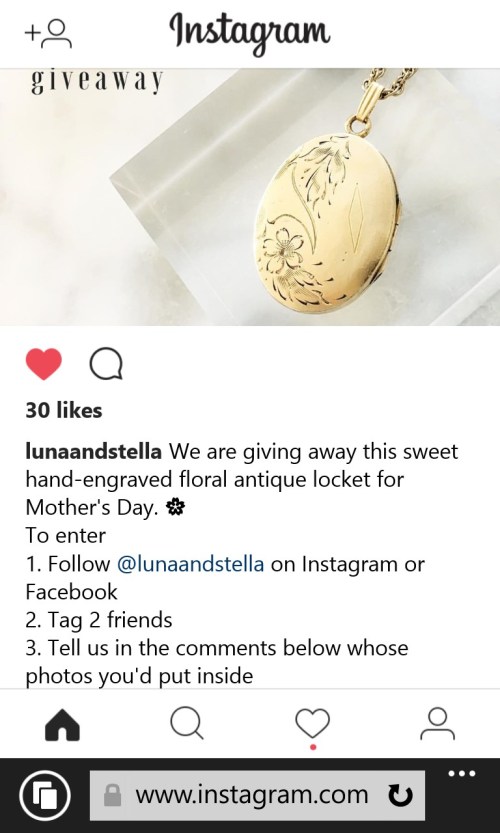
Suzanne is also giving away one of her beautiful antique lockets. Here are the rules for entering the drawing, as seen on instagram @lunaandstella:

We are giving away this sweet hand-engraved floral antique locket for Mother’s Day. 🌸
To enter
1. Follow @lunaandstella on Instagram or Facebook
2. Tag 2 friends
3. Tell us in the comments portion of this instagram post whose photos you’d put inside
Giveaway ends Monday May 8 at 3 pm EST.

for-MothersDay-antique-locket-giveaway

I have to say, I’d be thrilled if the winner turned out to be a reader of Suzanne’s Mom’s Blog. Do consider entering the Luna & Stella drawing on Facebook or instagram.

Read Full Post »

« Newer Posts - Older Posts »