Feeds:
Posts
Comments

Archive for December, 2018

Photo: Colin Mandlin
Ubuntu Theater Project in Oakland, California, is using a pay-as-you-can model to expand their audience. Their production of
Othello, pictured above, was presented in a rug shop.

I have posted about finding unusual venues, like rug shops, for artistic performances (click here) and also about establishing pay-as-you-can models for a range of purposes (for example, the food business). Today’s post is about a California theater company that does both.

Ashley Lee reports at the American Theatre website, “Amid the dense arts scene of California’s Bay Area, Ubuntu Theater Project has proudly distinguished itself with a mission statement of being ‘radically inclusive.’

“Founded in 2012 as a handful of summer theatre festivals, Ubuntu — named after a Zulu proverb that means ‘I am because we are’ — now programs year-round shows at various venues throughout Oakland, Calif., one of America’s most diverse cities. They often stage American classics with predominantly casts of color, a majority of whom are Oakland natives. Though a seat at each performance costs between $15 and $45, the company has regularly drawn a percentage of patrons from low-income communities through pay-as-you-can tickets sold at the door, and has offset those costs with a bucket donation ask after the curtain call.

“But all that wasn’t inclusive — or radical — enough for Ubuntu. So last summer, the theatre adopted a pay-as-you-can subscription model, guaranteeing tickets to its seven shows for a single amount named by the ticketholder. …

“ ‘There was a financial risk — we had no idea what people were gonna pay,’ concedes Simone Finney, the organization’s marketing director. … ‘This is a way to invite someone into a continued conversation, rather than just an affordable experience of one show. It’s not just transactional; it’s saying, “I want to be part of this community.” ‘ …

“It was a huge gamble — and it’s paid off surprisingly well, both in terms of cash flow and feedback. Ubuntu’s subscriber base grew from just 25 devoted patrons to around 300 and counting. … Finney attributes the generosity of their higher-end subscribers to word of mouth, since her marketing budget didn’t suddenly multiply over the past season. ‘We’re trying to do a lot on not a lot,’ she admits.

“Leigh Rondon-Davis, Ubuntu’s executive associate, [says] ‘A lot of the feedback we’ve gotten is, “Thank you, I can finally afford to see theatre.” ‘ …

“As with any first-time initiative, the program had its share of hitches. … Their online ticketing platform, Vendini, doesn’t allow buyers to input their own prices; the current two-step work-around involves making a donation via the Square Cash app, waiting for a manually sent email from Rondon-Davis, and then booking tickets with a coupon code. …

“If their expanded subscriber base returns for next season, the organization hopes to offer shows that reflect their audience even more.

“ ‘Our bread and butter for a while was classics or established works, and humanitarian world premieres of new works,’ says Rondon-Davis. ‘Now, edgier works.’ …

“Adds Finney: ‘People don’t just come to things because they’re free. … You still want to earn people’s time, interest, and enthusiasm.’ …

“While other theatre companies might be hesitant to make this drastic leap, no one needs to jump into the deep end immediately. Instead Finney and Rondon-Davis suggest following in Ubuntu’s footsteps and experimenting with PAYC tickets at the door for each performance. Most important, they suggest, talk to your audiences to identify what their primary challenges are when it comes to seeing theatre. …

“ ‘It’s not always cost — it can be location, the type of work, not having people to go with, not feeling welcome in a theatre space,’ notes Finney. “These are conversations we will continue to have. … This hasn’t made us take a financial hit and has been, in fact, very beneficial to us. I hope that makes more companies consider accessible pricing, not just as a sacrifice you make, but something that could be a viable part in the life of a company.’ ” More.

Read Full Post »

Photos: Beit HaGefen Arab-Jewish Cultural Center
People dance in the streets of the mostly Arab neighborhood of Wadi Nisnas in Haifa, Israel, for the 25th Holiday of Holidays festival, which celebrates religious diversity.

Most days, I find news about Israel completely depressing. Then along comes a story about an annual three-religion celebration there, and I’m reminded that not everyone associated with the 70-year-old nation and its neighbors is keen on in endless war.

Dina Kraft writes at the Christian Science Monitor. “In the port city of Haifa, two young art curators, one Jewish and one a Palestinian citizen of Israel, are dealing with something decidedly less fraught [than the daily news]: They are planning the logistics of an art installation that will include 88 pounds of white pepper, za’atar, sumac, and ginger.

“The piece is an exploration of what notions of ‘home’ mean, a loaded concept in a land claimed by two peoples. It is planned as a centerpiece of a new art exhibition for the Holiday of Holidays, the only event of its kind in Israel and a rare celebration of religious and cultural diversity in the fractious Middle East. The festival honors Christmas, Hanukkah, and Muslim traditions over three weekends in December in a gathering that is part block party, part intercultural artistic extravaganza. …

“Every year there is a different theme and this one is ‘the third dimension,’ an invitation to look at what happens when different cultures and identities influence each other to create something new – a hybrid space – as Yael Messer describes it. Ms. Messer is curator of the art gallery run by the Beit HaGefen Arab-Jewish Cultural Center. Messer, who is Jewish, is going over plans with Haneen Abed, her deputy, a Palestinian Israeli, in their shared office. The staff of the center is made up of both Arab and Jewish citizens of Israel.

“The story of the Holiday of Holidays is also the story of Haifa, Israel’s third-largest city. Haifa likes to bill itself – though not without criticism – as the country’s capital of coexistence, a place where Jewish and Arab residents live more integrated lives.

“Across the country, most Jews and Arabs live separately even in so-called mixed towns and cities, such as Haifa, where the two groups usually inhabit different neighborhoods. Social interaction is especially rare.

“But the festival brings together people from both sides of the demographic divide to dance to music performed on outdoor stages, on streets festooned with holiday lights. Arabs and Jews together follow the path of food and literary tours through the alleyways and streets of the mostly Arab neighborhood of Wadi Nisnas, eating local offerings like hummus and baklava at food stalls and attending concerts of liturgical music at churches. The massive undertaking is organized by Beit HaGefen and funded by the city of Haifa.

“Upstairs from Messer and Ms. Abed, their colleague Hila Goshen, the cultural director of Beit HaGefen, has her laptop open to a color-coded schedule of the festival’s events.

“ ‘It seems like every year there is some war, or military operation, or suicide bombing that happens [during the planning season] and we ask, “What are we doing, bringing people together to hear music and hear each other?” ‘ says Ms. Goshen. ‘And then the festival happens and this place looks like the most normal place on earth. The magic happens.’ …

“She says the example of the gathering, brief as it is, shows this concept of shared society, a place where Arabs and Jews can live together and lead equal lives.

“ ‘I know all our issues are not being solved in this festival,’ she says. ‘But even having this kind of exposure to thinking a little bit differently is a seed we have to plant.’

“Some critics believe this is gauzy naiveté. They argue that people really come to the festival for the food, not the message of unity. But [Asaf Ron, the director of Beit HaGefen,] disagrees.

“ ‘I don’t think people come for the hummus or the knafeh,’ he says. ‘I think they come for the hope.’ ”

More at the Christian Science Monitor, here. Check out past posts about the three religions interacting as the Daughters of Abraham, here, and in the pliable time of youth, here.

And for extra inspiration, click here to learn about the Parents Circle Family Forum, a beacon of light in Israel that brings together the bereaved on both sides of the conflict who understand that ending it can only come from the ground up.

Read Full Post »

Photo:  Svt Nyheter
Saga Vanecek, an 8-year-old Swedish-American girl, pulled a 1,500-year-old sword from a lake in southern Sweden last July, prompting comparisons to Arthurian legends about the Sword in the Stone and the Lady of the Lake.

You never know when wonders will appear. This little girl was not out helping archaeologists on a dig like the 13-year-old boy in this earlier post. She was just dawdling in a lake while her father was calling her to hurry so he could watch the World Cup on television. And then — a miracle.

Jon Henley writes at the Guardian, “An eight-year-old girl has pulled a 1,500-year-old sword from a lake in southern Sweden.

“ ‘I felt something with my hand and at first I thought it was a stick,’ Saga Vanecek told the local Värnamo Nyheter [VN] newspaper. ‘Then it had a handle that looked like it was a sword, and then I lifted it up and shouted: “Daddy, I found a sword!” ‘

“The find, made in July but announced only [in October] for fear it would trigger a summer stampede to the site at Tånnö on the shore of Lake Vidöstern, felt ‘pretty cool and a bit exciting,’ she told the Swedish public broadcaster Sveriges Radio. …

“Her father, Andrew, said in a Facebook post that the sword, estimated by experts from the nearby Jönköping county museum to date to the 5th or 6th century AD, before the Viking era, was still in the remains of its wood and leather scabbard.

“He told VN he had been waiting impatiently for his daughter to come in from the water because the football World Cup final was about to start, but she was busy skimming stones. Then she stooped and held up the ancient weapon.

“Neighbours confirmed to the Swedish-American family, who moved to Sweden from Minnesota last year, that the rusted artefact did indeed look old, and Nevecek called an archaeologist the next day.

“Annie Rosén, from the museum, said: ‘I was on holiday, but when I saw the pictures I went straight away. You cannot imagine such a sword – so well preserved.’

“Another expert at the museum, Mikael Nordström, [said] they were exploring the possibility it could have been a place of sacrifice. … Subsequent searches by museum staff and local council workers uncovered a brooch from roughly the same period but there were no other significant finds.”

More at the Guardian, here. And you can read Saga Vanecek’s own report here.

May 2019 be the year that girls everywhere pull miracles from lakes and stones.

Read Full Post »

5760

Photo: RMIT University/Nature Communications
Australian university researchers have developed an ultraviolet (UV) active ink that changes color when exposed to UV rays to help sunbathers see when they’ve had enough sun exposure.

My kids expect that every spring I’ll trot out the latest skin-cancer articles to scare them about sun exposure. Well, after all, getting skin cancer is something to worry about. I have a number of people in my family who have had dangerous melanomas. I myself had what they call a melanoma in situ. I had it removed in the 1990s and still get checked every six months.

Given winter vacations to sunny climes, spring and summer are not the only times to be wary. You might be interested in reading about a new way to protect yourself.

According to Nicola Davis at the Guardian, “A simple paper sensor featuring smiley and frowny faces drawn in UV-sensitive ink has been produced by researchers in a bid to keep us safe in the sun.

“Scientists say the different expressions appear in sequence as UV exposure increases, offering a low-tech way for people to gauge when it is time to cover up.

“The team add that they have produced different versions of the wristband for different skin tones – something they say is important given that darker skin can tolerate greater UV exposure before damage occurs, and more exposure is needed to produce vitamin D.

“Further, the sensor can respond to varying levels of the different components of UV radiation: while UVA is thought to cause skin ageing and wrinkles, it’s mainly UVB that causes sunburn and leads to skin cancer. …

“Writing in the journal Nature Communications, [Prof Vipul Bansal, lead author of the study from RMIT University in Australia,] and colleagues describe how they sought to tackle the issue by creating a cheap device based on phosphomolybdic acid, or PMA. This substance turns from colourless to blue in the presence of lactic acid and UV radiation.

“The team then used this mixture of lactic acid and PMA as an ink to draw four invisible faces on paper, and used transparent sheets of the sort used for overhead projectors to create filters that they put on top of them. This allowed the researchers to tweak the intensity of UV radiation reaching the ink so that the faces changed colour in sequence as exposure to UV radiation rose from 25% to 50%, then 75%, and finally 100% of a ‘safe’ dose.

“The team found that the PMA-based ink turns a darker blue colour under UVB than UVA over the same period of time, meaning that the higher the proportion of UVB in the sunlight an individual is exposed to, the quicker the sensor will indicate a 100% dose of UV radiation.

“By further adjusting the number of filters for each of the four faces, the team were able to adjust the system to produce different sensors to work for six different skin tones.

“Bansal said that while devices were designed using UV light in the laboratory, they are currently being tested in outdoor conditions. The team hope that the sensors will be on the market in a year, costing about a 1AUD [$0.71] a piece.

“Matthew Gass of the British Association of Dermatologists, who was not involved in the research, said said the product does ‘have the potential to be another tool that helps people avoid excessive sun exposure, but they are not a replacement for actual sun protection in the form of sunscreen, protective clothing, and making use of shade.’ ”

My dermatologist insists that sunscreens should include zinc and be waterproof. Just FYI.

More at the Guardian, here.

Read Full Post »

Photo: Newshub
Sans Forgetica is a typeface meant to aid memory. It was invented by researchers at RMIT in Melbourne, Australia.

There’s a new memory-boosting font that you can download for free and use for short texts. The inventors say you wouldn’t want to use it for long texts like a novel because it would give you a headache. But I say, what good is a typeface if you can’t read novels with it?

Lisa Martin writes at the Guardian, “Australian researchers say they have developed a new tool that could help students cramming for exams – a font that helps the reader remember information.

“Melbourne-based RMIT University’s behavioural business lab and design school teamed up to create ‘Sans Forgetica,’ which they say uses psychological and design theories to aid memory retention.

“About 400 university students have been involved in a study that found a small increase in the amount participants remembered – 57% of text written in Sans Forgetica compared with 50% in a plain Arial.

“Typography lecturer Stephen Banham said the font had an unusual seven-degree back slant to the left and gaps in each letter.

“ ‘The mind will naturally seek to complete those shapes and so by doing that it slows the reading and triggers memory,’ Banham told the Guardian.

“Senior marketing lecturer Janneke Blijlevens said the concept of ‘desirable difficulty’ underpinned the font’s design. …

“The font was designed with year 12 students cramming for exams in mind but could also be used to help people studying foreign languages and elderly people grappling with memory loss.” More at the Guardian, here.

I can see that having to work harder to read something may cause memory to fire on more burners, but when I was a kid, a friend who purported to analyze handwriting told me that broken letters like this indicated a criminal mind!

Read Full Post »

Photo: Michael Falero
Seventh graders Daelyn Brown and Elaina Grady with their teacher, Justin Parmenter, at Waddell Language Academy in Charlotte, NC. After a traumatizing shooting at a nearby school, Parmenter launched an activity called Undercover Agents of Kindness. The results speak for themselves.

Like you and me, the folks of WNYC radio have noticed a certain lack of emphasis on kindness in the public sphere. Recognizing that there are always people reaching out to others somewhere, they decided to track down those obscure acts of kindness and feature them on the air. The station’s series taps the knowledge of listeners, who provide leads.

From WNYC: “We expect schools to prepare students by teaching them math and science and reading and writing. But what about teaching kindness?

“Justin Parmenter, who teaches Language Arts to seventh graders at Waddell Language Academy in Charlotte, North Carolina, decided to try. After a deadly school shooting at a nearby high school rocked the campus, he launched Undercover Agents of Kindness, an activity designed to gets his students out of their social bubbles and doing good deeds for each other.”

He writes at his blog: “I’d already been thinking a lot about the decline in positive interactions in our society and how we might more effectively teach character in our schools. … An adult simply talking about character or modelling positive behavior does not often lead to the changes we want to see in our children. There had to be a more impactful approach. …

“To increase interaction between students who did not normally talk to each other, I had students draw a random classmate’s name from a bowl.  After they drew names, I was shocked to hear some of them had no idea who the other person was –- even after being in class together for two months and in many cases attending the same school for years. Students had two weeks to perform an unexpected act of kindness for the other person and complete a written ‘mission report’ detailing what they did and how it went.

“Soon I began to see encouraging sticky notes on lockers in the hallway. Batches of homemade cupcakes and bags of leftover Halloween candy made their way onto desks in my classroom, as did origami, inspirational quotes, and hand-drawn portraits.  I heard compliments exchanged about all kinds of things. Students I’d never seen together started offering to carry each other’s books and musical instruments to the next class.  As the mission reports started trickling in, I read accounts of children studying together, inviting others to sit together at lunch, helping others put football equipment on at practice.

“However, it was my students’ reflections on the kindness activity that revealed its impact most.

Again and again they acknowledged that it was difficult and felt awkward to approach someone they didn’t know well and do something for them.  But almost every time they added that they were proud of themselves for doing it anyway and felt the power in brightening someone else’s day.”

WNYC interviewed the teacher with two of those students.

” ‘I always thought that people would just reject me if I ever started talking to them, but the truth is if you branch out, you’d be surprised at how nice people can be,’ Waddell student Daelyn Brown, 12, says of the kindness activity.

” ‘When someone does something kind for you or you do something kind for a person, it’s just like wow, I can do this so much and I can make so many friends and everybody would be so happy,’ adds fellow classmate Elaina Grady, 13.”

Listen to the radio report here. And please treat yourself to the wonderful student notes at the teacher’s blog, here.

Read Full Post »

No Christmas Snow

122318-Ukrainian-erector-set

A handful of snowflakes came down on Christmas Eve Day, but not enough for me to shoot a snowy picture. Although I was mighty tired of snow last March, I would have liked to see some this week.

A fresh snowfall is pretty, but I guess I’m glad the roads are dry. Our plan for Christmas is to watch John’s children open presents early, then come home and get ready for our Christmas dinner, which shouldn’t be hard as two of the world’s best cooks are bringing more than half the meal.

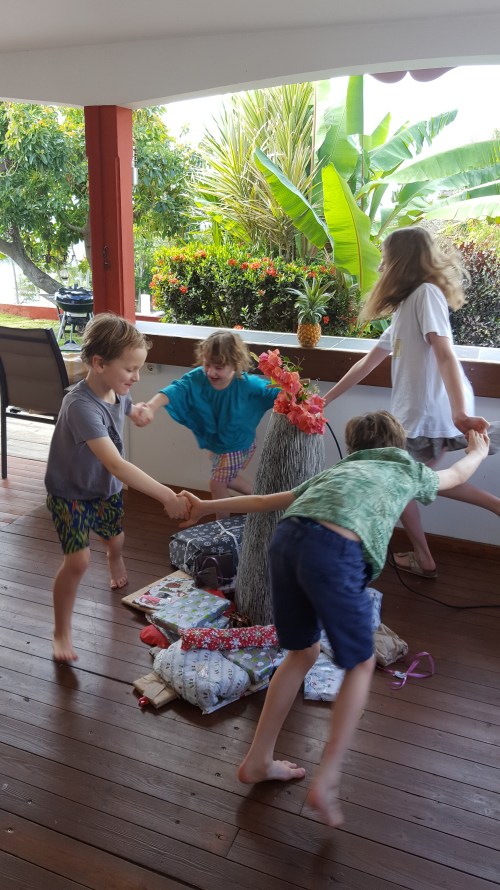
Suzanne, meanwhile, is in the Caribbean with the Swedish side of the family. Note the photo of her kids learning a traditional song from their Swedish-Danish cousins while dancing around the tree (actually, it’s a lamp this year) on an island that probably never sees snow.

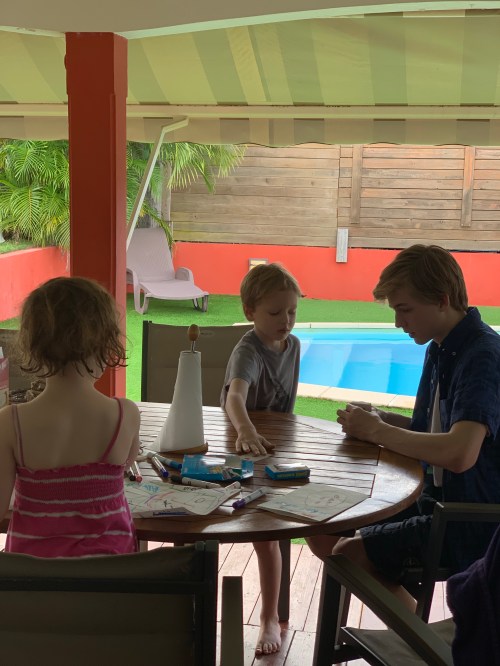
In other December photos: John’s children getting creative with an erector set (who needs to know what the Ukrainian directions say?), an Amaryllis on Erik’s piano as well as his Santa Lucia and Swedish creche, early Christmas gift-opening before the trip to the Caribbean, and family members enjoying 80-degree weather. Finally, the Swedish tomtens that my husband and I received in time for Christmas.

I hope that those who celebrate this holiday have a merry one, and I send warm wishes to everyone. See you tomorrow.

121718-amaryllis

122018-Swedish-creche-and-Lucia

122018-ripping-thru-the-presents

122018-ripping-thru-the-presents-at-breakneck-speed

122418-Christmas-in-Guadalupe

20181224-cousins-teach-Swedish-tradition

121118-tomtens-and-Christmas-tree

Read Full Post »

Photo: Henrik Montgomery / TT

The history of the Christmas market at Gamla Stan in Stockholm is described in a newspaper’s Swedish Advent calendar series.

This year I started following on twitter a newspaper called The Local. It covers Sweden, which is nice for me because my son-in-law is Swedish. Today’s post is on a series the paper has featured this month.

“Every day until Christmas Eve, The Local explains the unique history behind Swedish Christmas traditions in our own Advent calendar. …

“For centuries, Swedish Christmas markets have brought warmth and light to the darkest time of the year. Visiting a Swedish Christmas market (julmarknad) isn’t just a great way of becoming truly immersed in Sweden’s Christmas traditions, it may also be one of the best ways, short of a time machine, to experience what life was like in the past.

“The history of the festive markets goes back to 14th century Germany, and Sweden appears to have adopted the Christmas market not long afterward. Much like today, the earliest Christmas markets were typically held in town squares throughout the month of December, and featured small stalls where merchants and craftspeople could sell their wares.

“At Stortorget, Stockholm’s oldest square located in what is now known as Gamla Stan, markets were held at different times throughout the year as early as the 1300s, and there is evidence that one of these was held in connection with the feast day of St. Thomas the Apostle on December 21st.

“In 1523, during the first year of his reign, King Gustav Vasa established a permanent Christmas market at Stortorget. Though there have been periods over the centuries when the Stortorget julmarknad has not operated, it is still the oldest such market in Sweden and one of the oldest in Europe.

“When the Stortorget julmarknad was established, the king took care to stipulate that only Swedish goods were sold, a tradition carried on today by Stockholms-Gillet, which has organized the market since 1915. …

“Scents from traditional Swedish favourites like warm glögg, brända mandlar (candied almonds), and julgodis like knäck permeate the air just as they have in the past.

“The traditional foods and handicrafts offered for sale give a glimpse of life in the past, as well as the opportunity to incorporate them into modern life. The sense of stepping back in time is enhanced when attending a julmarknad at a historic location, or at one of Sweden’s fantastic open-air museums, such as Skansen in Stockholm. …

“Each day until Christmas Eve, we’re looking at the story behind one Swedish festive tradition. Find the rest of our #SwedishChristmas series here.”

Other topics covered: How one Swedish woman influenced the candy cane, Sweden’s favourite Christmas film, how a folklore tomte became Sweden’s Santa, and how glögg sends Swedish wine consumption through the roof.

Erik has been known to warm our insides with glögg at Christmas. But not this year: the Swedish side of the family is celebrating in Guadalupe and keeping warm by the swimming pool.

Read Full Post »

Photo: Paige Pfleger/The World
Puerto Rican farmer Daniella Rodríguez Besosa says Hurricane Maria “was also a call to action. Nobody else is going to help us. We need to help ourselves.”

Americans expect and deserve government help when there is a natural disaster, and often they get it. But Puerto Rico was pretty much out of sight, out of mind after Hurricane Maria. I do know someone who went there to help with logistics as part of a Federal Emergency Management team, but I also know several someones who lost everything and came to the mainland with their children.

Puerto Ricans who stayed behind have been managing as best they can. I was impressed with Paige Pfleger’s story at Public Radio International (PRI) about women farmers working together to build resilience.

“High in the mountains of Puerto Rico,” Pfleger writes, “a group of women struggles to keep their balance as they drive pickaxes deep into the earth of a hillside guava orchard. They’re digging a narrow trench called a swale on the steep terrain of this 7-acre farm. It’s a low-cost, low-impact way to retain rain water and reduce erosion in a place where both can be a challenge.

“With a swale ‘you end up storing most of your water in the soil itself, so the plants can access it whenever they need it,’ said Daniella Rodríguez Besosa, who has her own farm nearby. Besosa is part of a group called the Circuito Agroecológico Aiboniteño — all farmers, mostly women — who’ve been working together since Hurricane Maria hit Puerto Rico in 2017 to help each other’s farms recover and become more sustainable

Maria ‘was an eye-opener for a lot of people,’ Besosa said. ‘It was also a call to action. Nobody else is going to help us; we need to help ourselves.’

“Farms in Puerto Rico were devastated during Hurricane Maria. It’s been estimated that 80 percent of the crops on the island were destroyed, and $1.8 billion of damage was done to agricultural infrastructure.

“ ‘The best part from this hurricane crisis was this, that we get to organize to help each other recover,’ said Janette Gavillan, the owner of the guava orchard the Circuito is working on.

“Gavillan is a retired chemistry professor and is relatively new to farming. But she says working with the Circuito has taught her ways to be more sustainable. …

“Since Maria, the Circuito’s members have come to see sustainability as synonymous with resilience and independence. They hope that if they’re able to rely only on themselves, they’ll be better prepared for the next big storm, or at least be better able to recover. …

“A few miles from Gavillan’s farm, Jessica Collazo works a small plot dotted with baby chicks and thin beds of fruits and vegetables. … Collazo and her husband support their family by selling their produce at local markets, but she says after Maria, they had to start from zero.

“ ‘We were left with nothing,’ Collazo said. The storm washed her crops, seeds and soil over the side of the mountain.

“The brigade of local farmers helped her clear fallen trees and get new seeds. Circuito members also built banks on the edges of the mountain and dug swales that Collazo hopes will reduce the damage from the next hurricane.

“ ‘On my own, that would take me months,’ Collazo said. ‘But with help, it took only a few hours.’

“Collazo hopes the expertise and extra hands of the Circuito members will help her family reach its goal of building a completely self-sustaining farm. She says she wants to dig her own well so she doesn’t have to depend on the government for water, and install solar panels so she doesn’t have to rely on the local electric utility.” More at PRI, here.

I can’t help thinking of the Little Red Hen (“All right, then, I’ll do it myself!”) and wondering if it’s unfair to say that this is more likely to be a woman’s experience than a man’s. In any case, it’s the women farmers arming themselves against a sea of troubles here. I hope that like the Little Red Hen, they reward themselves.

Read Full Post »

Photo: Christy Sommers
People who raise goats in India, Bangladesh, and elsewhere, think it’s obvious you’d put sweaters on your goats in cold weather. It takes an outsider to be surprised — and make a calendar.

Got your 2019 calendar yet? We have way too many at our house because my husband donates to so many nature organizations. I wish that nonprofits would forget about free gifts and just spend donations where the money is most needed.

Today I have a story about a charity calendar that is not a giveaway. You have to buy it. But I hereby make an exception to my grumpiness about charity calendars.

Danielle Preiss writes at National Public Radio (NPR), “When we came across pictures of ‘Sweateredgoats‘ on Instagram, we wanted to know more. …

“The caprine fashionistas are featured on a calendar, the sales of which have benefited local organizations in Varanasi, India, where most of the images were taken.

“Christy Sommers, who takes the photos, first noticed the cuteness that is clothed goats in 2010, while living in a village in northwestern Bangladesh as a Fulbright scholar studying rural primary education. …

” ‘It blends my love of cute things with India and this desire that I have for people to understand the rest of the world better,’ Sommers says.

“Originally from Des Moines, Iowa, Sommers has spent much of the last five years working in northern India as an instructor and administrator for a high school and college travel abroad program called Where There Be Dragons. She started to notice goats, particularly in lower-income urban areas, decked out in winter gear. Varanasi doesn’t actually get too cold — typically not dropping below a January average of 60 degrees.

Sommers says when she asks families why the goats are clothed, they usually tell her it’s because they’re cold — and look surprised that she’s asking something so obvious.

“And it turns out to be a good idea. Jagdip Singh Sohal, assistant professor of microbiology and microbial genomics at Amity University in Jaipur and organizer of the Asian Regional Conference on Goats, confirmed that goats can get cold. …

“Extra insulation, whether from a sweater, a discarded track suit or a burlap sack, allows the goat to divert more energy to productive purposes, like getting meatier and birthing more kids. …

“[Sommers] gives about half the profits to Asha Deep, a school for underprivileged kids in Varanasi. (The rest of the money she views as compensation for her labor.) The $4,500 donation from 2018 calendar sales provided the funds the school needed to operate for one month. Asha Deep is a vetted charity on Global Giving, a U.S.-based nonprofit that crowd funds donations for local NGOs around the world. …

“Meanwhile, the goat owners aren’t that impressed. To them, dressing a goat in a sweater is no big deal. ‘They generally think I’m crazy,’ she says.”

More at NPR, here.

Read Full Post »

Photos: Demetrius Freeman for The New York Times
Annette Phuvan (left, with Janet Victors) said that
Amahl and the Night Visitors spoke to her of “miracles. Blessings. Generosity. Community.” She and others who have struggled with homelessness are performing the touching opera about poverty and hope.

In today’s story, two organizations that do good works all year-round have chosen an especially appropriate way to enhance the “comfort and joy” they deliver to others.

Tim Teeman writes at the Daily Beast, “The rich, collective sound of a choir warming their voices up filled the 15th-floor rehearsal room, Broadway and Times Square, a rainy, fogged-up blur outside the windows. Standing in a circle, and accompanied by a pianist, the group of tenors, basses, altos and sopranos practiced their scales, and then, as if in an urgent incantation, spoke the words of the score they would next sing.

“ ‘Free the body,’ instructed Michael A. Ciavaglia, the chorus master, eliciting much loose-limbed waving of arms, as the choir and soloists continued their preparations for On Site Opera’s production of Gian Carlo Menotti’s 45-minute Christmas Nativity opera Amahl and the Night Visitors, written for television and first performed on NBC in 1951.

“The show will be presented in the Holy Apostles Soup Kitchen in Chelsea, and will feature professional musicians and vocalists alongside a chorus made up of people who have experienced homelessness and who now live at the 43rd Street site of Breaking Ground, New York City’s largest provider of permanent supportive housing for the homeless. …

” ‘The object is to find that perfect intersection of piece and place that speaks to us as producing artists and what we want to do in the greater arc of the company and then find the right place to do it in,’ said Eric Einhorn, the general and artistic director of On Site Opera. …

“They all sang in rousing unison: ‘How cold is the night, how icy is the wind.’ As formerly homeless people, they would know the meaning of those words more powerfully, and literally, than many.

“One of the choir, soprano Christine Flood, told The Daily Beast she had been a resident at Breaking Ground since New Year’s Eve 2016. She said she suffered from PTSD, resulting from ‘terrifying and violent’ childhood abuse while growing up in southern Ohio. She had been homeless in her late teenage years, and then suffered from drug and alcohol addiction. She has been sober for 12 years. …

“The opera was an excellent way to bring members of Breaking Ground together, she said, and had inspired Flood to suggest to those that run the community that she begin classes in teaching English to non-English speaking residents. ‘Language is both a big barrier, and a big invitation,’ the former teacher and dancer said.

“ ‘I’m much better than I was a year ago,’ Flood said of her general health. ‘Two years ago I couldn’t have done this opera. Last year at this time I wouldn’t have had the confidence to do it even, or this interview.’ Next, Flood wants to finish her master’s degree, and use her passion for theater and acting to ‘build positive change in my city and community.’ ”

More at the Daily Beast, here. At the New York Times, here, you can find some nice pictures of singers rehearsing for the production.

Menotti’s Amahl and the Night Visitors is my all-time favorite — guaranteed to get me in the Christmas spirit.

From left: Kristine Flood, Wanda Ferrerias, Maya Lehmann, and Annette Phuvan join On Site Opera’s production of Amahl, thanks to Breaking Ground, a homeless-support organization in New York.

Read Full Post »

Photo: Jeremy Copeland
Patrick Torres, Erik Miron, Bergen Moore, of the band Vignes Rooftop Revival, on the way to a gig in downtown Los Angeles.

Around the time Suzanne and Erik were planning their wedding, I met a musician’s mother in what I called my Cancer Dance Class. He and his band mates were Berklee grads, and they had a group called Shamus, which I can no longer find on the web. Suzanne loved their music as much as I did and even asked the band to play at her wedding.

Oh, ha, ha. You can just imagine how much they would have charged to bring all their instruments and band members by plane from California! (Suzanne settled on a local band called the Booze Beggars.)

I’m thinking that a band that travels by bicycle like the one in the following story might have been cheaper to hire than Shamus, although I admit I can’t see them bicycling from California to the East Coast.

Lisa Napoli wrote about the bicycling band at National Public Radio (NPR).

“Some musicians arrive at their gigs in a tricked out tour bus. Others, if they’re lucky, in a limo. But there’s a popular band based in downtown Los Angeles that relies on a lower-key, low-carbon form of transportation.

“In car-crazy L.A., the band members either bike, walk or skateboard to all of their gigs.

“The lively acoustic group, the Vignes Rooftop Revival, began by accident five years ago, on a rooftop of a loft building on Vignes Street in rapidly gentrifying downtown Los Angeles.

“A group of neighbors, including musician Erik Miron, would enjoy meals with other building residents, as the dramatic city skyline shimmered in the background.

” ‘After awhile the instruments would come out,’ said Miron, who came to Los Angeles to study music at the University of Southern California. ‘We’d start goofing around and it evolved into something where we decided to take it down from the roof to the bars and restaurants.’ …

“One gig led to another, and accompanied by a rotating cast of musical friends, the band now play 200 shows a year. …

” ‘It’s funny. We’re almost like an Amish jazz band,’ said Miron, who has a full, wiry beard that makes him look right out of Pennsylvania Dutch country. ‘We don’t use cars or electricity so much.’

“Miron said the Vignes Revival didn’t set out to be so green. He and the core members of the group just found it easier to get around without the use of a car. …

“Driving a car leaves him ‘mildly grumpy,’ while arriving by bicycle, he said, is a refreshing way to indulge his love of being outdoors.

” ‘It’s nice to move under your own power,’ he said, as he loaded up his guitar, banjo and trumpet in a trailer he hitches up to his bicycle. He also adds in a few succulents in pots adorned with the band’s logo for good measure. At each show, they give them away. …

“Bass player Bergen Moore uses different wheels to get to the show: a hand-made, hand-painted skateboard. That has been his preferred mode of transportation for a while, even when he lived in hilly San Francisco. Now, he’s got his instrument affixed with wheels, too. …

“Nary a pothole, nor the occasional motorist agitated at their speed, daunts these musicians. For a gig that was ten miles away, they made their way via a combo of human-powered transit and the Los Angeles Metro system.

“They do enjoy playing the tavern around the corner. Then, they get to indulge in an even simpler commute: walking.”

More at NPR, here.

Read Full Post »

Photos: AFP/THOMAS COEX
Renovated mosaics and columns inside the Church of the Nativity in the occupied West Bank biblical city of Bethlehem.

Do you like mosaics? I relate to arts such as mosaics or collage because I love putting pieces of things together to make something new. As quilters do. And editors. And activists who change the world one by one.

This is a story from Bethlehem, in the Palestinian Territories, where restoration work has tapped the artistry of workers who can envision how small pieces together make a whole.

Clothilde Mraffko writes at Yahoo News, “Masked for centuries by the soot of candles and lately by scaffolding, the mosaics of Bethlehem’s Church of the Nativity have been restored. …

“Over the past 15 months, experts have cleaned and repaired surviving fragments of the 12th century masterworks, preserving 1,345 square feet (125 square metres) of what was once 21,528 square feet (2,000 square metres) of glittering gold and glass. The rest has been eaten away by wear, humidity, wars and earthquakes.

“Now the restored remains shine against the white walls above the heads of visitors to the church in the Israeli-occupied West Bank city of Bethlehem that marks the traditional birthplace of Jesus.

“Overlooking the nave are seven angels framed in gold who appear to have landed on a carpet of vivid green grass. …

” ‘These mosaics are made of gold leaf placed between two glass plates,’ Marcello Piacenti, who supervises the work on behalf of his Italian family restoration firm Piacenti, told AFP [Agence France-Presse]. ‘Only faces and limbs are drawn with small pieces of stone.’

“One of the partially destroyed angel figures was restored using different materials to the original so as not to mislead future archaeologists. [!]

“Ibrahim Abed Rabbo, a Palestinian Authority (PA) engineer said the transformation caused by the restoration is striking. ‘When you entered the church before, you could not even make out that there were mosaics, it was so black,’ he said.

“In a rarity for the period, the works were signed by the craftsmen responsible, Abed Rabbo said. …

“Father Asbed Balian is the senior cleric of the Armenian church at the basilica, where property rights are shared with the Roman Catholic and Greek Orthodox faiths. After seeing the completed restoration, he said, he was ‘stunned. … Spiritually, we feel more exalted.’ …

“When the Palestinian Authority began renovations in 2013, ‘the basilica was in danger,’ PA restoration consultant Afif Tweme said. …

” ‘It’s very special, because of the location,’ said Piacenti. ‘Sometimes I have to force them (workers) to leave’ at the end of the day.” More here.

Read Full Post »

Photo: Thomas Stanley
Hadi Jasim was an Iraqi translator for the US military. Now he’s a “global guide” at the Penn Museum in Philadelphia.

As you know, I’m a fan of immigration and of welcoming refugees to this immigrant-built country. It’s not usually easy for immigrants once they get here. They are required to find a way to support themselves within a few months, and, if language is a barrier, they must learn English as soon as possible.

Some immigrants start their own business. Some — even if they are highly skilled — take jobs that don’t need English. I know a Haitian immigrant who, for example, was a physician with years of experience who nevertheless took a kitchen job and was grateful to find work.

Once in a while I read a story like the following, in which some wise boss or institution finds a really creative way to employ an immigrant.

Emma Jacobs reports at Public Radio International (PRI), “At the University of Pennsylvania Museum of Archaeology and Anthropology, Moumena Saradar directs a group of visitors to a glass case containing an enormous gold headdress and beaded shirt — the burial garments of Queen Puabi, who died around 2550 BCE. They’re a highlight of the museum’s Middle East gallery, reopened in April after a $5 million renovation.

“ ‘Queen Puabi’s burial jewelry is one of my favorite objects in the gallery,’ says Saradar, who goes on to explain that in Syria today, people still save up for gold jewelry for their wedding. She shows pictures of packed jewelry shops in Damascus, walls glittering from floor to ceiling.

“Saradar is among the museum’s new tour guides — immigrants and refugees from Syria and Iraq who can make connections between the ancient artifacts and the present-day cultures.

“Saradar and her family arrived in Philadelphia as refugees in 2016, and she now works as a medical interpreter during the week and gives tours of at the gallery on weekends. …

“As a guide, Saradar went through intensive training to prepare her to give detailed historical tours and respond to visitors’ questions. She says she practiced on her five children.

“According to Kevin Schott, the Penn Museum’s education programs manager, Saradar and the other guides offer something local docents can’t.

“ ‘At some point in almost every tour somebody will say, “What about today? Do they still eat these things today?” Or, “Is this place still a place people go?” And I’m like, “I don’t know. I can’t answer your question.” ‘

“These guides are expressly trained to weave their own personal stories and memories into their tours — things they would feel comfortable talking about over and over again.

“Another guide, Hadi Jasim, spent his summers as a child at his grandfather’s house in southern Iraq, near the source of many of the objects in the gallery: the ruins of the ancient city of Ur.

“ ‘Sometimes we used to take the soccer balls and play’ because it was an open area, Jasim says. ‘Sometimes we used to play like other games like seek and hide, you know, kids’ games.’ …

“Fresh out of college near the beginning of the Iraq War, Jasim became an interpreter for the US-led coalition forces in 2004. He went on to work for the UN in Iraq doing communications and anti-trafficking work. In 2017, he finally received permission to come to the United States on a Special Immigrant Visa for Iraqis who worked with the US military.

“Now, Jasim has a job in food service at a local hospital. He says the museum work has become more than a second income.

“ ‘Sometimes, even if I don’t have tours here, I just show up to work, go through the Middle East gallery, go and see the clay tablets and see the carvings,’ he says. ‘It just brings my memories back.’ …

“ ‘Being close to your heritage is something that makes you feel like okay, now I’m back. You know, I don’t feel like I’m a stranger [any] more.’

“Jasim will have more colleagues joining him at the museum in the future. The Penn Museum plans to hire guides for all of its global galleries.” More at PRI, here.

I find many things to love about this story, but if I had to choose one thing, do you know what it would be? It would be the look on these two guides’ faces. A look of peace.

Photo: Idil Demirdag
Penn Museum global guide Moumena Saradar came to the US as a Syrian refugee two years ago.

Read Full Post »

When you want to bring a small token of your esteem to a party and you are not sure of people’s interests, you can start by making a list of things pretty much everyone likes.

Candy, flowers, wine, specialty coffee, exotic tea, unusual soaps, fancy olive oils, and candles. If it’s a Christmas party, maybe Christmas cookies, a tree ornament, or holiday napkins would be good. I know you’d rather not see your present regifted all around town, but be sure you’d like it for yourself in case it comes back to you.

Next: How about finding a gift that serves a second important purpose? My first thought was to get something at a retail shop in town whose business has been hurt by a chain that just moved in. But I was also thinking about buying from a nonprofit that helps the needy. Then by chance I ran into a charity representative on the street and was delighted with the soaps pictured above. I hope my friends like and use these soaps, but if they regift them, I’m fine with having them land back at my house. I hardly ever entertain, though, so seeing them again is unlikely.

Meanwhile, if you want a really special gift for someone you adore, you’ll check out Luna & Stella — the business this blog is connected to — because Suzanne sells meaningful contemporary birthstone jewelry and amazing vintage lockets. Of course, each locket is one of a kind. (Men can wear lockets, too, you know.) If you want your locket delivered by Christmas with your digital photos sized and placed, then December 17, 2018, is your deadline. That’s today! (Click now.)

For other occasions, such as birthdays, weddings, and Valentine’s Day, you have more time, so what would it hurt just to take a look?

Read Full Post »

Older Posts »