Feeds:
Posts
Comments

Archive for December, 2018

Photo: Library of Congress
This powerful image symbolizes the awakening of the nation’s women to the desire for suffrage. The torch bearer is striding across the western states, where women already had the right to vote, toward the east where women are reaching out.

This month I’ve been enjoying a different tea every day after my daughter-in-law had the kind thought of giving me a teabag-a-day Advent calendar. I do like trying new teas. Today I’m thinking about the role tea has played in American history. No, not just when men threw tea into Boston Harbor to protest “taxation without representation,” but when women urged people to buy Equality Tea.

Janelle Peters writes at the Atlantic, “Access to daily necessities has long been a priority for social-reform movements. … When it came time for women to get the vote, tea played a role, too. Women such as the wealthy Alva Vanderbilt-Belmont held ‘suffrage teas,’ where support for the cause was proclaimed. The tea parties also served as fund-raisers, a practice that extended to the teas themselves.

“In California, suffragist women showed how both tea and the national movement of women’s suffrage could be democratized at the state level. Two suffrage teas generated revenue for political organizing in the run-up to the 1911 election. … Equality Tea sprang up in Northern California and spread throughout the state. In Southern California, Nancy Tuttle Craig used her position as one of the only female grocers in the state to package a ‘Votes for Women’ tea. …

“By the late 19th century, the suffragette cause had stalled in the Golden State. … It took a decade and a half for California women to prove that they had a broad base of support to gain the right to vote in state elections. The 1911 vote was hard-fought. Suffrage leagues and reform-minded women organized feverishly, but women’s suffrage still did not pass in San Francisco. This time, the rest of the state made up the difference. Tea smoothed over the gap between San Francisco, Los Angeles, and San Diego in supporting women’s suffrage.

“Equality Tea was based in Northern California. Distributed by the Woman’s Suffrage Party, it spread through the state. San Francisco storerooms served the tea in tearooms decorated with a Chinese theme. Suffrage-minded consumers could purchase Equality Tea in half-pound, whole-pound, and five-pound boxes. Varieties included Ceylon, English breakfast, young hyson, gunpowder, and oolong. Some suffrage organizations, like the Club Women’s Franchise League, served Equality Tea at their headquarters in the St. Francis Hotel on Saturday afternoons.

“[Equality Tea] was also sold at regional fairs and by mail order. Ads appeared in venues ranging from local newspapers to medical journals. Some grocers carried the tea, and

there were women who refused to pay their grocery bills if their grocer did not carry Equality Tea.

“The ability to order by mail assured that the tea’s purveyors did not discriminate against rural or lower-class residents, groups of the population with stronger support for women’s suffrage.

“Tea became a central feature of the political strategy of San Francisco suffragists. On August 22, 1911, The San Francisco Call reported that the Votes for Women club had prepared a ‘suffrage special’ train that would carry feminist speakers to the state fair in order to be heard by people from all parts of the state. … By emphasizing tea on the suffrage train, the Votes for Women club focused on how accessible the basic civic right could be.”

Read more at the Atlantic, here, while I head off for tea at Pamela’s home.

Read Full Post »

Photo: Yuri Cortez/AFP/Getty Images
Miguel Francisco Macias was inspired to replicate Michelangelo’s frescoes not just because it is a stunning work of art, but because he realized the Sistine Chapel ceiling has almost the same dimensions as his church in Mexico. It took 18 years.

Don’t you admire people with big ambitions who see an implausible project through to its conclusion? This designer sought to replicate the Sistine Chapel frescoes on the ceiling of his church in Mexico. He thought it might take six years.

Sarah Stocking writes at Lonely Planet, “For the last 18 years, a retired graphic designer has been quietly painting a replica of Michelangelo’s Sistine Chapel at his local church in Mexico City. Miguel Francisco Macias began his opus in an attempt to offer people who cannot travel a glimpse at one of the most shining examples of European art, Macias told Aljazeera.

“The project, which is now displayed on the ceiling at Perpetuo Socorro Church in Colonia Moctezuma, was largely self-funded with small donations from parishioners. Macias worked on the weekends with two assistants. The work was divided into 14 canvases each of which is 45-feet wide. Macias knew from the beginning that he would not be able to paint facing up, the way Michelangelo did, so he painted the canvases first and then affixed them to the ceiling afterwards.

“Macias said he was inspired to replicate Michelangelo’s frescoes not just because it is a stunning work of art, but because he realised the Sistine Chapel ceiling has almost the same dimensions as his local church, reported Splinter.

“The realisation came to Macias on a trip to Rome with a friend in 1999. The artist spent hours in the chapel admiring the frescos. ‘I stayed until the guard made me leave,’ Macias remembers. He also measured the length and width of the Sistine Chapel with footsteps. He wrote the dimensions on a small sheet of paper and presented his idea to the pastor on his return. …

“Macias didn’t think the project would take him nearly as long as it did. ‘I said it would be a maximum of six years,’ he told Newsbeezer. While the project suffered many setbacks, including falls, floods and robberies, none was so potentially insulting as when the Mexico City government used taxpayer money to temporarily recreate the Sistine Chapel in the Zocolo in 2016 ahead of a visit from the Pope.

“Although the community rallied behind Macias and wrote letters requesting that the Pope visit Macias’ work in progress in addition to the government’s pop-up, they didn’t get the holy visit they were hoping for. Macias didn’t let it bother him and kept a sign in his make-shift studio that read, ‘do not give up Miguelito.’ ”

More at Lonely Planet, here.

Read Full Post »

Photo: Susan Bryant
The Night-Blooming Cereus blooms at night once a year. Be there when it happens.

In the same way that the sun shines on the keyhole to Smaug’s lair only once a generation — or through Suzanne’s fence and onto the stonewall only twice a year — the lovely Night-Blooming Cereus has its own moment in time, and it’s worth planning your life around it.

Margaret Renkl writes at the New York Times, “For decades, my grandmother was the caretaker of a gangly, disorganized houseplant with nothing, so far as I could see, to recommend it. The plant was ugly. … It was less a plant than something out of a nightmare. As a little girl, I thought it might bite me.

“When the evenings began to cool in early autumn, my grandmother would bring the plant indoors, set it on a table next to the fireplace, and wait hopefully for it to bloom. She called it her ‘night-blooming series.’

“It was years before I understood that the scary plant in my grandparents’ house was actually a night-blooming cereus, a catchall term for several varieties of cactus that bloom at night — often for only one night each year. That’s if it blooms at all: My grandmother’s ‘series’ apparently bloomed only once in all the decades she had it. There are just two pictures of it in full flower, and they were taken on the same night sometime during the 1960s. …

“My cutting came from my brother and sister-in-law’s plant, a proven bloomer, but it has never formed a single bud under my care.

“[In September], my brother texted a photo of the bud he’d discovered on his plant. ‘It might bloom tonight!’ he wrote. ‘I looked in my garden journal, and it was fully open by 8 p.m. in 2014.’ … So I got in the car and drove straight to his house in Clarksville, more than 50 miles from here [Nashville], stopping only for gas. With a night-blooming cereus, the transformation from bud to blossom can take less than an hour. …

“I recognize the irony: There I was, driving through a parched landscape with a full tank of gas, on a pilgrimage to do nothing more than watch a flower bloom, while the hot winds from the 18-wheelers shook my whole car as they passed.

“I am only one generation removed from the farm, and I spent much of my childhood in the very world where my mother grew up, the same one where my grandmother grew up, and my great-grandmother before her, going back farther than anyone could remember. …

“Today only 2 percent of Americans live on farms or ranches, but we have not lost our need to be among green things. Which may explain why friends and neighbors were already hurrying to my brother and sister-in-law’s house by the time I got to Clarksville, and why we all gathered together in their living room to wait for the miraculous event to unfold. The plant’s single bud, which spanned the full length of my hand, was clearly in no hurry to open, pink filaments still tightly ribbing it from stem to tip an hour after we arrived.

‘It’s like counting contractions, waiting for a baby to be born,’ someone said.

“Then, finally, the bud began to open, at first just one tiny aperture at the very end. The pink filaments began to loosen and lift. As the aperture widened, a star-shaped structure unfolded within it — a white star inside a white flower — and the translucent petals unlayered and arrayed themselves around the star. The flower was nine inches across fully opened, and its perfume filled the whole room with sweetness. It was not a nightmare plant at all. It was the flower of dreams. It would be gone by morning, not to return for another year. If then. …

“That night-blooming cereus brought my grandmother back to me in her halo of white hair. It brought back, too, her plum tree, long since cut down, and the feeling of red dirt between my toes. In a time of great cultural dislocation and environmental despair, for an hour it made me remember what it feels like when the world is exactly as it must be, and I am exactly where I belong.”

More at the New York Times, here.

Read Full Post »

Photo: History Today
This bronze relief panel from the Gutenberg Monument in Mainz, Germany, was created by sculptor David d’Angers in 1840.

When you make knowledge available to everyone, good things happen. That was one of the attractions of helping to teach English as a Second Language to refugees and other immigrants. Although I decided to take time off to make regular visits to my sister during her cancer treatments, I hope to go back to volunteering before long. Imagine that some of our students couldn’t even read and write in their own language! Opening up doors sure felt important.

Back in the 15th century, reading in Europe was limited to a chosen few. If you wanted to know what was in the Bible, for example, you had to take the word of a Latin scholar who had access to handmade manuscripts. There were no books in circulation for ordinary people. Then Johannes Gutenberg had an idea for moveable metal type, and that led eventually to the printing of Bibles in the vernacular.

Justin Champion writes at History Today, “In 1454, in the Rhineland town of Mainz, three friends formed a legal arrangement to produce an epochal object. An inventor, Johannes Gutenberg, a printer, Peter Schöffer, and a financier, Johann Fūrst, collaborated to publish a Bible – the Gutenberg, as it is now known – widely regarded as a transformative moment in the history of European culture. …

“It heralded a step change in printing technique: whereas earlier forms of printing relied on woodblock technology, the use of moveable metal type allowed more flexible, efficient and cheap printing. The invention of new forms of ink (more like a veneer) enabled crisper and more durable printing. … Printing also enabled accurate, and (mostly) reliable reproduction across a number of volumes. It also meant that any minor mistakes would be reproduced, too.

“The printer who mistakenly omitted a vital ‘not’ from the Ten Commandments was vigorously punished by a very bad-tempered Archbishop Laud in 1631.

“The crisis of Reformation authority encouraged the printing of Bibles in Germany, England and, eventually, Geneva. Luther and Tyndale led the way with their clandestine and vernacular Bibles. … [Vernacular Bibles from] the Tyndale New Testament of 1526 (for which Tyndale was executed) to the King James Version of 1611 – captured and preserved God’s revelation in the English language, specifically aimed to provide a text ideally comprehensible to every English servant and maid. …

“The legacy of the Gutenberg Bible was a revolution in the relationship between reading and authority in the early modern period. This encompassed the practices of lowly men … or, at the other extreme, scholars such as Isaac Newton and John Locke, who owned multiple copies for forensic textual comparison and exchanged commentaries on their findings. … Newton devoted millions of words to decoding the inner meaning of Revelation, but hid his own views from the Anglican establishment for fear of persecution.”

The article History Today, here, emphasizes the effect that Gutenberg’s invention had on the history of religion, but for me as a former publishing person, what’s important is that it enabled the printing of many more books — first in Latin, then in the languages ordinary people spoke — and opened up a new world of knowledge to anyone who was interested.

Today only specialist artisans use moveable metal type and much of our reading is not on paper but online, but I hope that hard-copy print never goes completely out of style. It has a value that humanity has yet to fully appreciate.

Read Full Post »

Photo: John Tlumacki/Globe Staff
Cathy Corbett got her hair cut at HER on a recent Saturday. HER is a weekly event from the Boston Health Care for the Homeless Program.

When I think of all the health care I’m able to utilize (cataract surgery today, for example), my heart breaks for people who don’t have coverage. A special program in Boston aims to help homeless women get some of what they need while also lifting their spirits with fun activities.

Elise Takahama writes at the Boston Globe, “Linda Winn … sobered up six months ago, but she’s been battling homelessness for the past year. Winn, a 51-year-old Somerville native, said she’s working with a few organizations to find permanent housing, but for now, she is staying at Woods-Mullen, a South End homeless shelter.

“A few months ago, she discovered a haven of medical care — and free haircuts — just around the corner..

” ‘I started coming a few months ago. I love the staff. It’s been helping with depression, helping with any problem I might have,’ said Winn. …

“In one corner, a group of women played bingo, while others danced and sang karaoke in the middle of the room. A table near the back was filled with markers, beads, and nail polish. Movies were shown in a separate room.

“All these activities are part of HER Saturday, a program that offers a medical clinic for women who have suffered abuse, are homeless, or are in need of health care services, said Melinda Thomas, the program’s associate medical director. …

“The HER Saturday program was launched in February 2016, Thomas said. When it first started, about 30 to 50 women would wander through the doors. Now, at least 100 women — sometimes up to 200 — line up at 7 a.m. every week, she said.

“The Saturday clinic not only gives the women a chance to get manicures and watch romantic comedies but also provides preventative health care services and cancer screenings, which include mammograms and Pap smears. Homeless women have higher rates of mortality from breast and cervical cancer, Thomas said. A medical provider, a nurse, a case manager, a social worker, and a behavioral health counselor are available every week.” More at the Globe, here.

Those of us who can have a medical check-up, a haircut, or a tasty meal whenever we want really should feel gratitude every day. I also feel gratitude for the people behind programs like this, which benefit us all if only indirectly.

Read Full Post »

121118-gingerbread-house-plus-garage

Today I’m posting recent photos, including a few gingerbread pictures that really get me into the spirit of the season.

The first is of a gingerbread house that two of my grandchildren decorated. You can see that they also made a garage from some extra pieces of gingerbread.

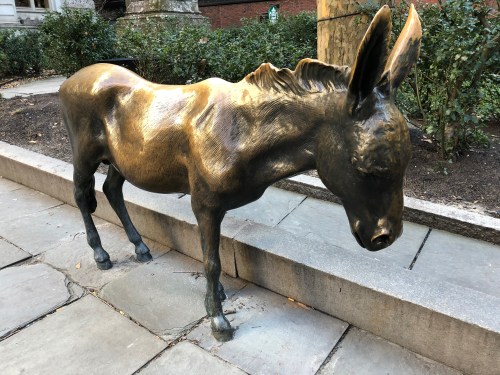
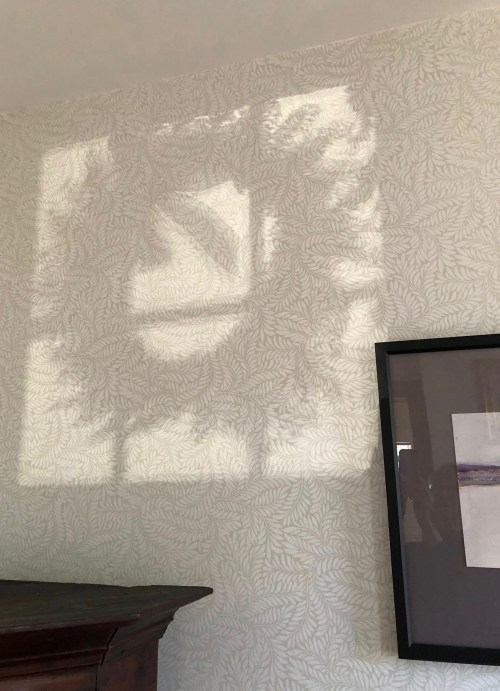
Next there’s one of my shadow pictures, followed by the random donkey that graces the yard at Boston’s old city hall.

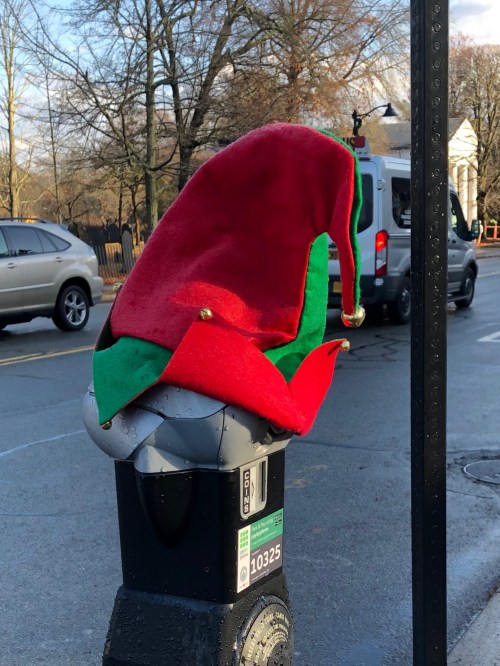
Background for the photo after that: About a week ago all four grandchildren were at a Christmas crafts workshop where grownups in elf hats made everything run smoothly. The next day I found elf hats on parking meters around town.

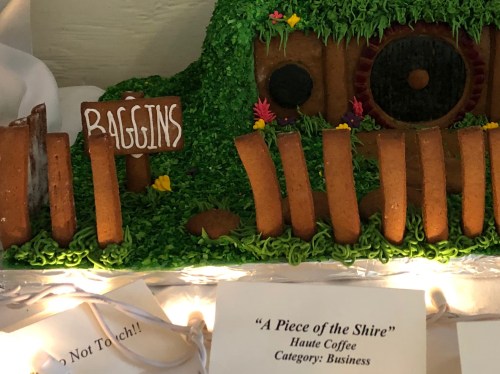
Next are several gingerbread creations at annual displays in town. The tree house, hobbit house, Victorian advertisement for the Gentleman Handyman, and the Acton Dental house with Santa inside in the dentist chair are all at the Colonial Inn. The last gingerbread house is in the library and is created every year by a local physician who starts to work weeks in advance.

Finally, what’s this? Another shadow picture. A Christmas-y one this time.

113018-lamp-shadow

120518-donkey-at-old-city-hall

120318-elf-hat-on-meter

120318-Colonial-Inn-gingerbread-treehouse


120318-Hobbit-Home-in-gingerbread

120318-Gentleman-Handyman-gingerbread

120318-Santa-at-the-dentist

120918-gingerbread-at-the-library

120718-shadow-of-Xmas-wreath

Read Full Post »

Photos: A Ride Home
When you get out of prison, you’re often on your own. That’s where A Ride Home comes in.

The other day, I was reiterating for a couple grandchildren the basics of the Christmas story. When you get down to essentials, the life of the grownup Baby Jesus, as told to us, was all about teaching kindness and going among the poor and outcast to comfort them.

I told the kids that “when Herod the King heard [about a new ‘Governor’], he was troubled” because he didn’t know the baby would not grow up to be the kind of leader that would take Herod’s throne and soldiers and money but instead would teach people about being good to one another.

Although we aren’t regular churchgoers, the kids like the annual Christmas pageant, and I wanted to go over the setting and roles a bit.

That’s a long intro to saying that Christmas is a particularly good time to consider how much the poor and outcast — and those who provide compassion to them — can benefit when we adhere to what is really the essence of all religions.

I recently learned about a great example of compassion for the outcast — a program for ex-offenders called “A Ride Home.” WNYC radio interviewed the people behind it.

“People released from prisons face all kinds of barriers as they transition back into the outside world, whether it’s finding jobs or housing.

“But beyond these large challenges, there are all kinds of small things the formerly incarcerated have to re-learn on the outside world — from opening doors, ordering from a menu, to choosing what kind of shampoo to buy.

“The Ride Home program helps people with those first few hours when they get out of prisons in California. …

“Carlos Cervantes is one of the program’s drivers, who is formerly incarcerated, and now picks people up, takes them for coffee and food, buys them new clothes and is with them in those first moments. He remembers the moments leading up to his own release back in 2011.

” ‘You feel nervous, asking, “What’s on the other side? How does the other side look like.” For me having spent 10 years 8 months, it’s kind of like this picture that like you can only imagine,’ he said.”

You can listen to WNYC’s podcast about the compassionate program via iTunesTuneInStitcher, or wherever you get your podcasts.

What I especially like is that former offenders want to help out by volunteering with the program. A Ride Home can make a person’s first post-prison emotion one of gratitude. And we all know what good things a feeling of gratitude can work in the world.

More at WNYC, here. Check out some really nice photos at the Ride Home website, here.

Read Full Post »

Photo: CBSLocal
New York City hopes that donating reusable water bottles to high school students will make some advocates for reducing waste. The campaign is part of the city’s ultimate goal of sending zero waste to landfills by the year 2030.

After reading an inspiring book called Climate Justice, I signed up at the website 1 Million Women to get ideas for reducing my carbon footprint. One thing the site suggests is to boycott fruits and vegetables that have unnecessary packaging. You know, like those Japanese pears in plastic foam holders. Such gestures are small, but they add up if a lot of people pursue them.

In New York, meanwhile, schools are trying to wean students from plastic water bottles by giving them nice reusable ones.

CBSLocal reports, “After a recent push to ban plastic bags, straws, and bottles in New York, some local leaders are working to get the city’s high school students involved. …

” ‘When you think about it, you’re not gonna be wasting all that plastic,’ [student] Daisy Palaguachi said.

“More than 320,000 bottles made by S’well were donated to all New York City high schools throughout all five boroughs [in September].

” ‘The goal is really to extend our mission to rid the world of plastic bottles and we couldn’t help but think the best way to do that is to tap into the city’s future leaders,’ S’well Vice President Kendra Peavy said.

“The company partnered with Mayor Bill de Blasio’s Office of Sustainability for the new ‘Bring It’ campaign. They’re asking students to ditch the plastic and spread the word to their families and friends.

“ ‘To empower them with actual tools that they can bring and take to make better and more informed decisions,’ Mark Chambers, Director of the Mayor’s Office of Sustainability, said.

“The city says its goal in doing this is to try and get rid of 54 million single-use plastic bottles.

“ ‘About 167 water bottles are used by the average American every year, and so it’s important to say by using a reusable water bottle we could displace that many from going into the waste stream every year,’ Chambers said. …

“ ‘Knowing that you’re making a small change can turn into something bigger in the future,’ student Alexandra Capistran said. ‘You don’t have to spend all your money buying water bottles every day.’

“Sunset Park High School now also has a newly installed water bottle filler for that very purpose. … The bottles donated [would have cost] $19 to $35, and the campaign is part of the city’s ultimate goal of sending zero waste to landfills by the year 2030.”

More at CBS, here.

Read Full Post »

Photo: William Raynard/Essex County Sheriff’s Department
From left, Sheriff Kevin Coppinger and department director of food services Kathy Lawrence meet with program director Kate Benashski, Carlos Zagada, and Josiel Cabrera from Haven From Hunger on the farm at the Essex County Pre-Release Center in Lawrence.

Most of my posts about people helping people must seem like a drop in the bucket to readers: the problems of this world are so enormous. But I like to think about what can be accomplished by, say, one person whose better nature is released by a program like the one for ex-offenders described here. And I like to think of the way many such efforts can accumulate to improve the world.

Morgan Hughes writes at the Boston Globe, “Drive around the back of the Essex County Pre-release and Re-Entry center in Lawrence, and you’ll find 6 acres of pumpkins, corn, tomatoes, peppers, and gourds.

“Inmates at the center run the farm, which yields about 50,000 pounds of produce each season to feed others who are incarcerated and the wider community. Located just behind Interstate 495, the farm is fertile ground for personal growth.

“ ‘We’re giving jobs to the inmates, we use the crops, but it’s also an opportunity to give back to the community,’ Sheriff Kevin F. Coppinger said.

“At the moment, the farm has about seven inmates who volunteer to plant, maintain, and harvest the produce. They feed not only the roughly 200 inmates at the pre-release center, but those at the Middleton House of Correction and Women in Transition, a women’s pre-release center in Salisbury.

“The facility purchases meals from a third-party food vendor, but the kitchen incorporates the fresh produce into the menu whenever possible.

“ ‘They live there, so they can really see the fruits of their labor,’ Coppinger said.

“About 30,000 pounds go to food pantries and homeless shelters in the Merrimack Valley and throughout the North Shore, said Kathy Lawrence, director of food services for the sheriff’s department. …

“She said, ‘What we can do sometimes is either incorporate [our produce] into the menu and serve it in addition to what’s being prepared, or we can substitute in ratatouille instead of giving them frozen green beans.’

“But even when the harvest is over and the ground begins to freeze, these hyperlocal vegetables are used throughout the year, Lawrence said. Bell and Italian peppers are frozen to use in casserole dishes. The butternut squash is also kept in the freezer and saved for special holiday meals.

“Heather Bonanno-Baker is manager of both Pleasant Valley Gardens in Methuen and the farm at the pre-release center. She took over duties from her father, who helped inmates run the farm for at least 15 years.

“She said she teaches inmates how to plant and water the crops, manage pests, and harvest at the end of the season. She shows them what a vegetable looks like when it’s ready to be picked, and how to wash it before it goes to a kitchen.

“ ‘I’m big into teaching the public about agriculture, growing your own food, and where it comes from,’ Bonanno-Baker said. …

“When Lawrence collected some feedback from the farm workers, she said some common themes were ‘a sense of pride in what they’ve grown’ and feeling rewarded to be able to give back to the community. One told her: ‘Hard work leads to positive results.’

“Lawrence teaches ServSafe to inmates working in the kitchen, a certification in food safety necessary for many jobs in the food industry. Coppinger said working on the farm provides another skill they could use to find a job when they are released.

“ ‘From the minute you arrive at intake in Middleton, to when you are about to be released at the pre-release center is trying to get them in better shape to get out of here and not come back,’ he said.

‘I always like to say, “Thanks for coming, but don’t come back.” ‘

More at the Boston Globe, here.

Read Full Post »

colour-e1536593120475

Photo: Reuters/Mohamed Abd El Ghany
The tomb of Mehu opened for the public near the Saqqara necropolis, in Giza, Egypt, on Sept. 8, 2018.

I have never been to Egypt, but members of my extended family grew up there. My experience of visiting an Egyptian tomb is pretty much limited to the Metropolitan Museum in New York.

But it seems new tombs keep being discovered, and after getting thoroughly studied, are being opened to the public. The tomb of Mehu, a top official under King Pepi I, was found in 1940 but was only opened to the general public in September of this year.

Josh K. Elliott writes at Canada’s GlobalNews, “Egypt has opened the doors of an ornate 4,000-year-old tomb to the public. … The Tomb of Mehu, in the Saqqara necropolis near Giza, features dozens of vibrant paintings from Egypt’s sixth dynasty, dating back approximately four millennia. …

” ‘Mehu, a top official under King Pepi I, … was a vizier, the chief of the judges and the director of the palace at the time of King Pepi, the first king of the sixth dynasty,’ archeologist and Egyptologist Zahi Hawass told [Reuters].

“The tomb includes two chambers with wall inscriptions that depict Mehu hunting, gathering a bountiful harvest and dancing acrobatically. It also lists Mehu’s 48 titles as pictures on the walls

“Hawass says the tomb contains several unique images from the sixth dynasty, including a portrait of two crocodiles getting married.

“The Tomb of Mehu was first discovered by Egyptologist Zaki Saad in 1940, but remained off-limits to the public until this month. …

“ ‘We opened this previously discovered tomb to invite ambassadors and show the media that Egypt is safe,’ he told Reuters in Arabic. …

“Egypt’s tourism industry has struggled in the wake of the Arab Spring uprising in 2011. … Tourism numbers rebounded in 2017, when they jumped up to 8.2 million foreign tourist arrivals, the UNTWO [UN World Tourism Organization] data shows. …

“Archeologists have found several high-profile sites in Egypt recently, including a massive, sealed sarcophagus, an ancient village and a giant statue of Ramses II.”

More at the GlobalNews, here.

Read Full Post »

091720nc20boats

Photo: Patrik Jonsson/Christian Science Monitor
At Swan Quarter, North Carolina, shrimp boats cluster on the shore ahead of hurricane Florence in September. The town’s protective dike represents cooperation among practical people, who put aside politics to solve a serious problem.

Even when people believe global warming is only a cyclical blip, they can find common cause with others to solve a problem that affects everyone. Residents of a small town in North Carolina did just that after years of dangerous floods.

From the Christian Science Monitor: “As staff writer Patrik Jonsson began traveling the Carolinas after hurricane Florence, he came across a town that put aside its differences over politics and global warming to find a solution to chronic flooding. …

“Neighbors J.W. Raburn and Henry Williams are political polar opposites. … But the two lifelong friends – along with about 300 or so other North Carolinians who call Swan Quarter home – stood united [in September] against hurricane Florence.

“Nearby Oriental, New Bern, and large parts of central North Carolina were devastated when up to 40 inches of rain fell. … Tens of thousands of residents were displaced, and at least 23 people died.

” ‘There is no doubt that dike has saved us. It gives us a little bit of hope,’ says Raburn. His friend nods.

“The dike, completed in 2010, is a piece of political pragmatism that has gained stature as it held up well against during hurricanes Irene and Matthew, superstorm Sandy. …

“There is also growing evidence that mounting property losses, declines in property values, and threatened historical landmarks are wearing away resistance to preparedness. That common purpose might sometimes be hard to see on the national stage. But locally, people are putting aside politics in favor of practical solutions.

” ‘Working in Swan Quarter, flooding is not an ideological issue there. It is a way of life. Same with sea level rise. People have watched it happen within that lived environment. If you watch forests turn to marshland and the roads flood, the politics fade away,’ says Jason Evans, an environmentalist from Stetson University in DeLand, Fla., who worked on the dike project.

“Raburn and Williams, former bandmates, show the human side of the debate. Raburn believes that finding solutions to manmade climate change is vital. Williams, a farmer and volunteer firefighter, does not believe that humans are altering the temperature of the planet, calling it ‘a phase we are going through.’ But he is the one who cares for and maintains the dike – a job he takes very seriously. …

“In Swan Quarter, local taxes are likely to go up. The county needs to purchase pumps to help clear water that seeps through the dike. Across the sound on Ocracoke Island, county leaders are working on bolstering dunes. …

“At the same time, the dike played a role in the county investing millions in a new courthouse and fire station. The state credit union has felt confident enough in the dike to build a new branch. A critical ferry service runs from the docks to the Ocracoke Island. Inside the local gas station, a line drawn at head level shows the height of Isabel’s surge. Thus far, Florence has left no mark at all.

“The size of the town and the lean budgets mean, ‘the kind of interventions that can be done there and how we think about it is much different than thinking about New York City or Miami,’ says Evans. ‘Hyde County is a hardscrabble place trying to build a dike. Nothing solves anything forever. … But it clearly has helped with certain floods. I wouldn’t want to be in Swan Quarter during a big hurricane event without that dike being there. …

‘Whatever legislators want to do, whatever presidents want to do, it’s in the end not relevant in terms of trying to work through the facts. We have scientific understanding that can apply to all these places,’ says Evans. ‘But I have also seen over and over again – whether in the Florida Keys or in Swan Quarter – that within areas facing substantial problems, all the political stuff that we all get drawn into fades away.’ ”

Speaking of political stuff fading away, I want to do a post sometime on the fact that the divisions among us may make lively and urgent headlines but aren’t always replicated on the ground. Don’t we all interact regularly with people whose politics we know differ from ours? Would love to hear your examples to add to my own.

More at the Christian Science Monitor, here.

Read Full Post »

2048

Photo: Gemeente Zwolle
The plastic bicycle path in Zwolle, the Netherlands, is a test for building roads from plastic waste in the future.

I don’t know if it’s because, historically, they’ve had to protect their land from the encroaching sea, but the Dutch seem to be repeat innovators. This blog has covered a lot of new ideas from the Netherlands. (3-D printed houses, anyone? Wind power for trains?) Today’s post is on a possible use for discarded plastic bottles.

Daniel Boffey writes at the Guardian, “The world’s first plastic bicycle path made of recycled bottles, cups and packaging has opened in the Netherlands, as part of a pilot that could see similar roads open up across the country.

“The 30-metre path, made of recycled plastic equivalent to more than 218,000 plastic cups, is expected to be three times as durable as an asphalt alternative. It also contains sensors to monitor the road’s performance, including its temperature, the number of bikes that pass over it and its ability to cope with the traffic.

“The prefabricated sections of cycle path are light and hollow making them easy to transport and 70% quicker to install. Cables and utility pipes are able to be easily fitted inside, and the path is designed to drain off rainwater. … It is believed that many of the benefits of the paths will apply to plastic roads.

“The path’s inventors, Anne Koudstaal and Simon Jorritsma, said: ‘This first pilot is a big step towards a sustainable and future-proof road made of recycled plastic waste. When we invented the concept, we didn’t know how to build a plastic road, now we know.’

“Asphalt concrete is responsible for 1.5m tonnes of CO2 emissions a year, equivalent to 2% of global road transport emissions. …

“Earlier this year the EU [European Union] launched an urgent plan to clean up Europe’s act on plastic waste and ensure that every piece of packaging on the continent is reusable or recyclable by 2030. … Each year, 25m tonnes of plastic waste is generated by Europeans, but less than 30% is collected for recycling.”

The idea has real possibilities, but the concerns of groups hoping to end the use of plastics altogether need to be addressed. “Plastic Soup has warned that small particles of the plastic could find their way into the living environment due to heat, wear and run-off.” More at the Guardian, here.

I’m just glad people are trying to find solutions to some of the damage that human activity has done to the planet. The issues are in the news right now as both great powers and small, climate-impacted countries are meeting in Katowice, Poland, to improve on the Paris Agreement.

By the way, if you are on twitter, do follow Sweden’s 15-year-old climate activist Greta Thunberg (@GretaThunberg), who is speaking truth to power in Poland: “I will not beg the world leaders to care for our future. I will instead let them know change is coming whether they like it or not.” I just read that Venice is likely to succumb of sea-level rise. Greta’s urgency is warranted. Young people give me hope.

And read a wonderful, inspiring book by former president of Ireland Mary Robinson called Climate Justice, which connects human rights and poverty to the effects of global warming and offers hope in the shape of brave, ordinary people.

Read Full Post »

ma-bb21-2018-beat-billboard-1548

Photo: Judith Jockel/laif/Redux
Cellist Yo-Yo Ma is a musician who knows the power of music to be a force for good. Concerned about our fractured society, he asked himself, “What can I do?”

Recently, my husband and I watched the lovely documentary Won’t You Be My Neighbor? — about children’s television visionary Fred Rogers.

Mister Rogers had a gift for speaking directly to the individual child through a mass medium, unlikely as that sounds, looking into the child’s eyes and letting the child know that she was seen.

Cellist Yo-Yo Ma, who ultimately became a friend of Mister Rogers, is seen in the documentary making his first appearance on the show. He tells the documentarian, who happens to be his son Nicholas, that he was scared to death when Mister Rogers put his face very close and looked into his eyes, until he realized that’s what children do.

It made me a bit sad and more conscious of the lack of eye contact today’s children get as we imagine we’re interacting if we talk to them while looking at our phones. No wonder they get stressed. Generally speaking, it’s through the eyes that children learn they are really seen. Mister Rogers understood their needs. He was a great healer.

Yo-Yo Ma is also a healer, but although he has appeared often on television like Mister Rogers, it is music that is his medium. Rebecca Milzof reports at Billboard about Ma’s current project to use his musical gift to help heal the fractured world.

“On Sept. 2, cellist Yo-Yo Ma played all six of Bach’s cello suites at the Nikolaikirche in Leipzig, Germany. It wasn’t out of the ordinary for the world’s most famous classical musician, who was playing at the church where the composer premiered many of his works. But the setting had a deeper meaning: In 1989, it’s where peaceful rebellions against communist rule — which led to the fall of the Berlin Wall — began.

“ ‘This is the very [place] where these [political] changes happen,’ says Ma, 62, over the phone from Leipzig. Today, he notes, Syrian refugees are coming to the city and facing demonstrations of a different sort — from right-wing nationalists. ‘It’s the right moment to explore the idea of home. What is home? It’s where you go to be sustained in difficult times. For me, Bach is home.’

“Over the next two years, Ma will visit 36 sites worldwide as part of his Bach Project, playing the cello suites in places like the Nikolaikirche — settings with sociopolitical meaning. It coincides with the recent release of his third and final recording of the suites, Six Evolutions.

“ ‘We live in more and more of a fractured society,’ the 18-time Grammy winner says. ‘As a cellist, I was thinking, “What can I do to help?” I’ve been toying with the idea of “citizen musicians” for a while.’ …

“So far, that has meant engaging with the Mexican-American community around Denver after playing Red Rocks in August and meeting community organizers spurring industrial revitalization outside Cleveland.

“ ‘One of the things culture does best is to make the “other” into “us,” ‘ he says. He’ll test that idea on six continents.” More at Billboard, here.

By the way, Nell Minnow has a really nice interview with the younger Ma about Won’t You Be My Neighbor? on Medium, here. He talks about performing with his dad as a child on Mister Rogers’ Neighborhood, and he still sounds amazed that Fred Rogers could get him to do that.

Read Full Post »

welling-court1

Photo: Welling Court Mural Project
New York City recently sought proposals from qualified nonprofit organizations to install artwork on an ugly sidewalk shed or fence.

There’s a lot of construction and renovation going on in New York City these days, and many otherwise interesting buildings are obscured by scaffolding and green plywood fences. Fortunately, the city is always looking for ways to bring culture to unlikely places and to engage artists.

Michelle Cohen writes at the website 6sqft, “On September 12, the New York City Department of Cultural Affairs announced a search for applicants for a new pilot program called City Canvas, Archpaper reports. The program was designed to beautify New York City’s visual landscape by installing large-scale–and temporary artwork on its endless construction fences and 270 miles of sidewalk sheds. The protective construction structures are an everyday eyesore for New Yorkers, but current building codes prohibit altering them. The City Canvas program circumvents that ban by allowing select artists and cultural institutions to add visual art to the visual affronts.

“There are two main objectives for the new initiative. First, to improve the experience of strolling through the city’s streets for residents and tourists alike by turning the ubiquitous fences into beautiful works of art, and second, to increase opportunities for artists and cultural institutions to get recognized for their work and to create art that represents the surrounding community. …

“During the pilot period, which will run for the next 24 months, the city is seeking proposals from at least one qualified nonprofit organization to install artwork on at least one ugly sidewalk shed/fence.” More.

The winning applications were announced November 28 at the New York City Department of Cultural Affairs (DCLA) website: “DCLA, in partnership with the NYC Department of Buildings and the NYC Mayor’s Office, is excited to announce two cultural organizations selected for the City Canvas pilot. ArtBridge and Studio Museum in Harlem will each work with local communities to transform protective construction structures into spaces for temporary art installations. First installations are anticipated in Spring 2019.”

Well, it’s a drop in the bucket, but I can’t wait to see what emerges.

Read Full Post »

120218-Luna-and-Stella-rings-Knausgaard-book

I’m reading Book Six of Karl Ove Knausgaard’s My Struggle. The rings with the birthstones of my grandchildren are from Luna & Stella.

It’s always nice to learn that something you do anyway is good for your health. For example, I love to read. Now an article in the San Diego Union-Tribune tells me that reading books may help older folks stave off dementia.

Doug Williams writes, “If you want to live a long, healthy life, be sure to exercise, eat your veggies, get plenty of sleep and surround yourself with family and friends.

“Oh, and read a few good books each year, too.

“Several studies in recent years indicate that reading — especially reading books — is beneficial to health, wellness and even longevity.

“In 2016, research done by a team at the Yale University School of Public Health found that of more than 3,600 men and women 50 and older in a long-term health and retirement study, book readers — reading at least 3½ hours per week — had a 20 percent lower risk of dying over the next 12 years than non-book readers.

“Books, even more than long magazine or newspaper articles, seem to enhance quality of life, the researchers said.

“ ‘You have to engage more, hold on to information longer,’ says Avni Bavishi, one of the researchers and authors of the study done while she was completing her master’s in chronic disease epidemiology at Yale. …

“Bavishi, now a medical student at Northwestern, says regular book readers can find relaxation in reading. That can be an oasis — an old-school refuge — in this era of constantly changing stimuli from the Internet and 24-hour news cycle. Lifelong readers, too, may develop better critical thinking skills, vocabulary and empathy that can improve quality of life.

“The researchers believe books promote ‘deep reading’ that is a slow, immersive process. That cognitive engagement may help a reader over his or her lifetime to develop better skills for reasoning and concentration that can improve quality of life (better schools, jobs, income, standard of living). Plus, reading books can ‘promote empathy, social perception and emotional intelligence’ that can help create what they call a ‘survival advantage.’ …

“A study published in the journal Neurology in 2013 also cited the benefits of a lifetime of reading as a barrier to ‘late-life cognitive decline.’ It found that although there is no cure for dementia, ‘reading, writing and playing games’ can slow the progress of that affliction. …

“In a 2009 study at the University of Sussex in the United Kingdom, researchers found reading reduced stress levels by 68 percent, better even than listening to music or taking a walk. Stress reduction was indicated by a lower heart rate and reduced muscle tension.

“Other studies show reading — especially before bedtime — promotes better sleep. It also can enhance social skills and can boost overall intelligence and academic success. …

“In 2012, Stanford researchers — using magnetic resonance imaging (MRI) — tracked blood flow to the brain of men and women critically reading excerpts of a Jane Austen novel. They found positive physical results, including increased blood flow to the brain in general, not just to the areas responsible for ‘executive function.’ ” More here.

FYI, I post mini reviews of all the books I read at GoodReads. You can email me at suzannesmom@lunaandstella.com about that.

Read Full Post »

« Newer Posts - Older Posts »