Feeds:
Posts
Comments

Posts Tagged ‘oakland’

Photo; Carlo Velasquez.
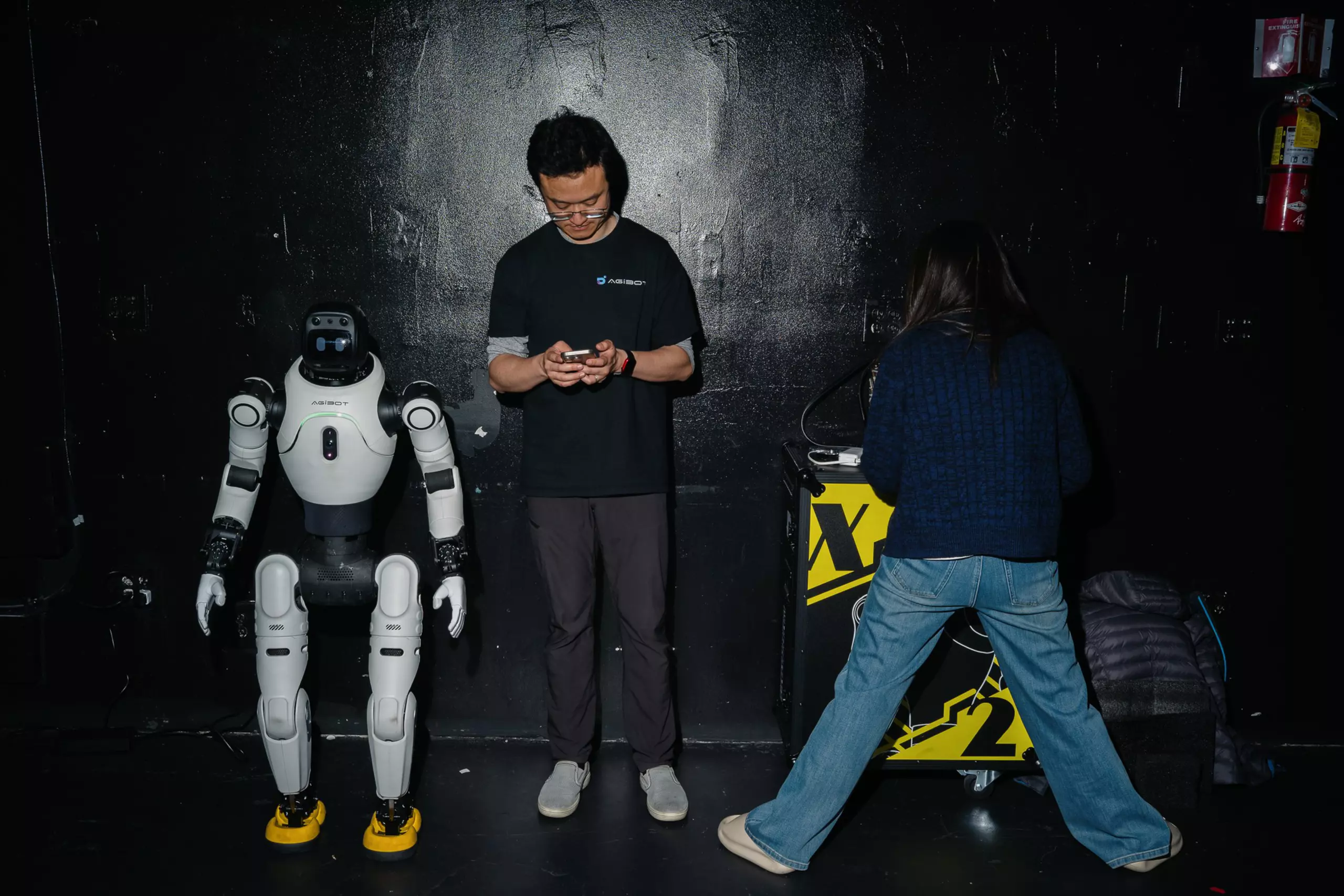
Some bots were brought out just to watch the dancing.

People lead such different lives! In San Francisco, there are people who test robots by making them fight. Now they have added dance competitions to the mix.

Zara Stone wrote about this recently at the San Francisco Standard: “Cricket just wants to dance.  The $40,000 humanoid robot walked to the center of an octagon cage inside SoMa’s Temple nightclub Thursday night wearing a neon pink wig and struck a pose. A moment later, A-ha’s ‘Take on Me’ filled the air, and Cricket started swiveling its hips, gyrating to the beat.

“Unfortunately for Cricket, it followed Johnny Anthony Lopez, who runs Oakland dance company TURFinc, and seven of his crew. They dropped, popped and locked, performing turf dancing, the Oakland street moves. One dancer, a contortionist, folded to the floor, arms moving like rubber.

“It was a heavy act to follow, and Cricket fully disappointed. It executed three preprogrammed dances. The first was skillful, but the second stalled halfway through. During the third, an engineer had to physically push the robot back into the ring.

“The demonstration was part of a ‘dance-off’ meant to highlight the latest improvements to the robot, a two-year old G1 model from Chinese company Unitree. Programming a humanoid robot to dance used to take engineers weeks, but now the moves can be generated from a video upload. The night was ostensibly both a debut of the robo-dancing and a showcase for the public launch of Studio, a robo-choreography tool. …

“Earlier in the night, two Unitree bots had been part of a fight demonstration, throwing punches in the ring. It wasn’t a one-off. Over the last year humanoid robot fight clubs have become a fixture at techie-oriented San Francisco parties and events.  The crowd was a mix of tech workers wearing hoodies and backpacks, tees with slogans like ‘internet person’ and ‘insert code here.’ …

“ ‘I didn’t even know that dancing was a part of this,’ said Pat Santiago, founder of Accelr8, a hacker house community, who had stuck around. He was initially skeptical of the dance premise. ‘They tend to have a limited repertoire, he said of robots but revised his opinion afterward. ‘I was actually really impressed. … Every time I see a robot dance, it’s 10x the last time.’ 

“The fights followed a predictable rhythm: three 90-second rounds filled with wild swings, body slams, and robots walking into walls while their amateur operators tried desperately to steer them. A human referee counted blows and reset the bots when they faceplanted.

“The seventh bout mixed things up. Vitaly Bulatov, cofounder of Ultimate Bots, faced Trey Roski, cofounder of BattleBots, controlling their respective machines. … Watching two skilled controllers battle demonstrated how important the humans’ roles are. The robots sprung up from the floor, dodged and weaved, and targeted each other with uncanny precision. …

“Tae Marsden, 35, a drag clown from Oakland’s Ruckus Revival, said the fighting entranced her. ‘I grew up with WWE and UFC, and I really appreciated the metal-on-metal action.’ Still, she found the second part of the evening mid. ‘I thought the robot dancing left a lot to be desired.’ 

“Ram Ravi, 35, a machine learning researcher from Oakland, was more forgiving. The dancing was OK, he said, though the fighting was better. He’s not sure he’d go to an event that was just robot dancing. ‘It depends on the progress that’s been made,’ he said.”

More at the Standard, here.

Read Full Post »

Photo: Colin Mandlin
Ubuntu Theater Project in Oakland, California, is using a pay-as-you-can model to expand their audience. Their production of
Othello, pictured above, was presented in a rug shop.

I have posted about finding unusual venues, like rug shops, for artistic performances (click here) and also about establishing pay-as-you-can models for a range of purposes (for example, the food business). Today’s post is about a California theater company that does both.

Ashley Lee reports at the American Theatre website, “Amid the dense arts scene of California’s Bay Area, Ubuntu Theater Project has proudly distinguished itself with a mission statement of being ‘radically inclusive.’

“Founded in 2012 as a handful of summer theatre festivals, Ubuntu — named after a Zulu proverb that means ‘I am because we are’ — now programs year-round shows at various venues throughout Oakland, Calif., one of America’s most diverse cities. They often stage American classics with predominantly casts of color, a majority of whom are Oakland natives. Though a seat at each performance costs between $15 and $45, the company has regularly drawn a percentage of patrons from low-income communities through pay-as-you-can tickets sold at the door, and has offset those costs with a bucket donation ask after the curtain call.

“But all that wasn’t inclusive — or radical — enough for Ubuntu. So last summer, the theatre adopted a pay-as-you-can subscription model, guaranteeing tickets to its seven shows for a single amount named by the ticketholder. …

“ ‘There was a financial risk — we had no idea what people were gonna pay,’ concedes Simone Finney, the organization’s marketing director. … ‘This is a way to invite someone into a continued conversation, rather than just an affordable experience of one show. It’s not just transactional; it’s saying, “I want to be part of this community.” ‘ …

“It was a huge gamble — and it’s paid off surprisingly well, both in terms of cash flow and feedback. Ubuntu’s subscriber base grew from just 25 devoted patrons to around 300 and counting. … Finney attributes the generosity of their higher-end subscribers to word of mouth, since her marketing budget didn’t suddenly multiply over the past season. ‘We’re trying to do a lot on not a lot,’ she admits.

“Leigh Rondon-Davis, Ubuntu’s executive associate, [says] ‘A lot of the feedback we’ve gotten is, “Thank you, I can finally afford to see theatre.” ‘ …

“As with any first-time initiative, the program had its share of hitches. … Their online ticketing platform, Vendini, doesn’t allow buyers to input their own prices; the current two-step work-around involves making a donation via the Square Cash app, waiting for a manually sent email from Rondon-Davis, and then booking tickets with a coupon code. …

“If their expanded subscriber base returns for next season, the organization hopes to offer shows that reflect their audience even more.

“ ‘Our bread and butter for a while was classics or established works, and humanitarian world premieres of new works,’ says Rondon-Davis. ‘Now, edgier works.’ …

“Adds Finney: ‘People don’t just come to things because they’re free. … You still want to earn people’s time, interest, and enthusiasm.’ …

“While other theatre companies might be hesitant to make this drastic leap, no one needs to jump into the deep end immediately. Instead Finney and Rondon-Davis suggest following in Ubuntu’s footsteps and experimenting with PAYC tickets at the door for each performance. Most important, they suggest, talk to your audiences to identify what their primary challenges are when it comes to seeing theatre. …

“ ‘It’s not always cost — it can be location, the type of work, not having people to go with, not feeling welcome in a theatre space,’ notes Finney. “These are conversations we will continue to have. … This hasn’t made us take a financial hit and has been, in fact, very beneficial to us. I hope that makes more companies consider accessible pricing, not just as a sacrifice you make, but something that could be a viable part in the life of a company.’ ” More.

Read Full Post »

Photo: Anna Mindess
One of Ba-Bite’s colorful salads: red cabbage with mung bean sprouts, dried figs, arugula and feta and the creamiest hummus. The restaurant is like a welcoming family for immigrant workers.

Lisa, who lives in Oakland, California, put this nice story about an Oakland restaurant on Facebook. If I ever go to Oakland, I’m going to visit Ba-Bite in person.

Anna Mindess writes at KQED Food, “They’ve won accolades for their silken hummus and rainbow of organic salads, but for the owners of Oakland’s Ba-Bite, the most precious thing the almost two-year old restaurant can display right now may be the Sanctuary Restaurant poster on their front door. …

“Ba-Bite is Hebrew for ‘at home.’ Even though most of Mica Talmor and Robert Gott’s employees don’t speak Hebrew, (besides English, they speak Spanish, Maya, and Arabic) they completely understand the concept. The majority of them — like most food service workers in the Bay Area — are immigrants. After walking across deserts at night, being shortchanged or abused in other restaurants where they could not complain, working at Ba-Bite feels like they have found a family.

“Russell Chable manages the kitchen at Ba-Bite and is responsible for set up, prepping, and cooking. He grew up in a tiny town in Mexico’s Yucatan. … He started as a dishwasher and worked his way up to his lead position in Ba-Bite.

“After eight years away from home, Russell missed his mom. Sure, he would talk to her on the phone every week, but he wanted to see her face. So this determined young man decided to build his parents a cell tower so that he could FaceTime with his mom. Six months ago, he made contact with a man back in Mexico who outlined what would be needed: laptops, cables and a cell tower. Russell had his uncle check out the man and then sent money. Now he uses FaceTime to talk to his mom every week, and his parents have a small business renting out computer and internet time. …

“Fatima Abudamos is from Jordan and works as cashier. She also holds the distinction as Ba-Bite’s best falafel shaper. As she stuffs the green balls with sheep’s milk feta, she says, ‘This is an amazing place, just like a family. I’ve worked here almost two years. Mica is not like a boss, she’s more like a friend. She doesn’t scream if you make a mistake; she explains things. I feel safe here; it’s my second family.’ …

““We pay all of our workers well,” says Gott. “Partly because we know how expensive it is to live here. My experience is that more often than not, immigrants are working multiple jobs or longer hours, and forgo taking time off at all costs, as they want to or need to make money. …

“[Food runner Kasandra Molina says,] ‘This space here doesn’t feel like a workplace, it feels like home. We all get along. They care about our opinions and feelings. They don’t treat us just as employees; it’s more like a family.’ ”

More at KQED, here.

Are you in Oakland? Check out Ba-Bite at 3905 Piedmont Ave. Phone: (510) 250-9526

Read Full Post »

Ideas for very cheap houses keep coming around and disappearing. I remember one some years ago that was basically a covered bed, promoted as preferable to a sheet of cardboard for a homeless person but not exactly a solution to underlying issues.

See what you think of these homes in unused shipping containers.

oung professionals are living in repurposed shipping containers while the homeless are lugging around coffinlike sleeping boxes on wheels.

“These two improvised housing arrangements have emerged in an industrial pocket of Oakland where the median rent has gone up by 20 percent over the past year. One, in a warehouse, is called Containertopia, a community of young people who have set up a village of 160-square-foot shipping containers like ones used in the Port of Oakland. Each resident pays $600 a month to live in a container, which can be modified with things like insulation, glass doors, electrical outlets, solar panels and a self-contained shower and toilet. …

Photo: Jim Wilson/The New York Times
Heather Stewart created Containertopia with Luke Iseman in Oakland, Calif.

Read Full Post »

Solving a problem by definition means making something better. But for many years, disciplinary action in schools made things worse. Now more communities are testing the potential of “restorative justice,” an approach focused on helping a perpetrator change for the better.

It was at a neighborhood picnic that I first heard from a couple neighbors that they were restorative-justice volunteers.

They told me that if a student spray paints someone’s garage, let’s say, the police get called in, and the kid may end up with a record.

Under restorative justice, however, police, perpetrator, victim, school personnel, and community volunteers hear the case and agree on suitable compensation — in this case, it might be repainting the garage. The youth sees face to face how the victim feels. Change is possible with the community involved.

Patricia Leigh Brown writes at the NY Times about a restorative justice program in Oakland, California, where a high school’s “zero tolerance” policies had ridden roughshod over underlying causes, leading to escalation of problems.

She writes about youth adviser Eric Butler, whose “mission is to help defuse grenades of conflict at Ralph J. Bunche High School, the end of the line for students with a history of getting into trouble. He is the school’s coordinator for restorative justice, a program increasingly offered in schools seeking an alternative to ‘zero tolerance’ policies like suspension and expulsion.

“The approach … encourages young people to come up with meaningful reparations for their wrongdoing while challenging them to develop empathy for one another through ‘talking circles’ led by facilitators like Mr. Butler.” More.

In one talking circle, participants discovered that a girl in trouble for uncontrolled aggression had just lost a brother to gun violence. She had not told anyone or sought support. She began to learn other ways to deal with her anger.

Photo: Jim Wilson/The New York Times
Mr. Butler with a student at Ralph J. Bunche High School in Oakland.

Read Full Post »