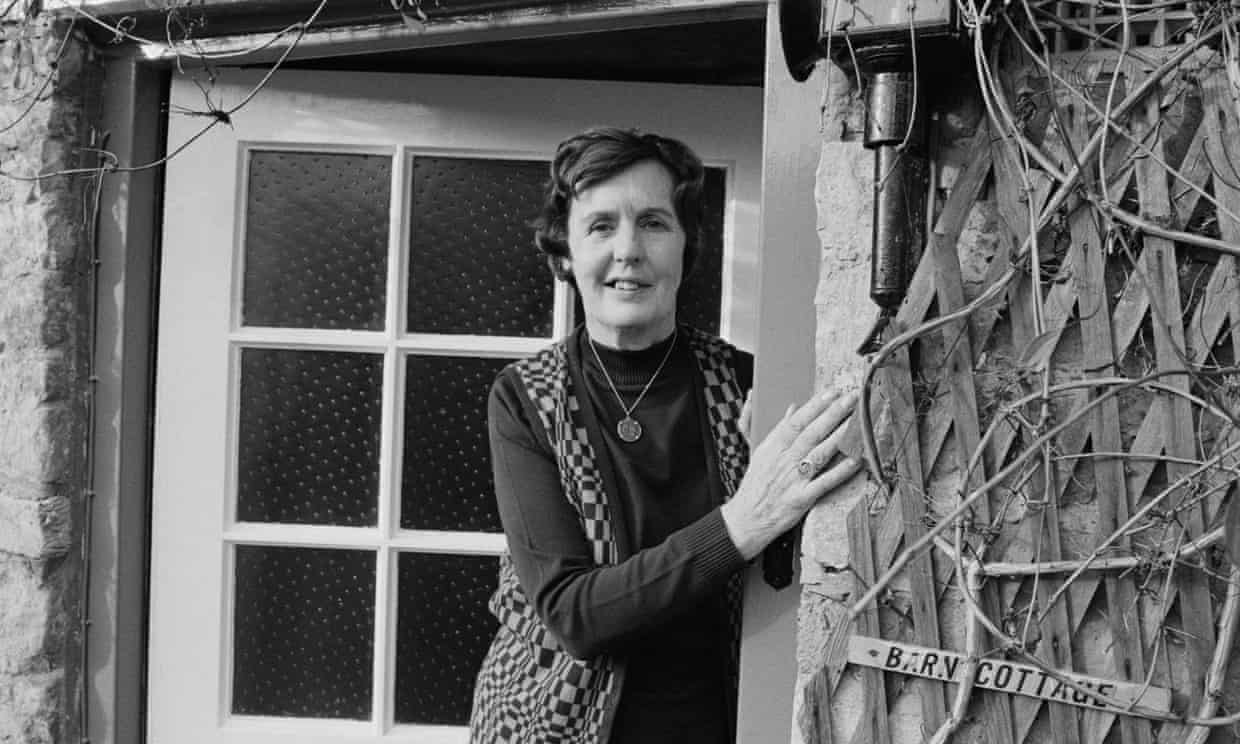
Photo: United News/Popperfoto/Getty Images.
British novelist Barbara Pym is said to have been trained as a spy.
Barbara Pym had a unique style of novel writing, very homey and at the same time, full of intrigue. I went through an intense Barbara Pym phase back in the day and am not surprised to learn that her powerful ability to observe and interpret small details might have made her a good candidate for a different field. Both wartime censorship (ugh!) and spying.
In today’s article, we learn that Pym received special training as an “examiner” to find coded messages and secret writing in normal-seeming letters. And there was probably more.
Nadia Khomami writes at the Guardian, “It is an irony that she herself would have reveled in: Barbara Pym, the author who punctured the social strictures of 20th-century Britain, worked as a censor during the second world war.
“But research suggests that rather than just poring over the private letters that must have helped hone her talent, she may have also been working for [British spy agency] MI5.
“New work by Claire Smith published {in May] proposes that Pym’s time as an ‘examiner’ for the government and in the navy could be more than a poacher-turned-gamekeeper tale about a future satirist. …
“Smith said: ‘In one of her novels, she said being an examiner was really rather dull. But when I began to look closely at her, I discovered many oddities.’
“She believes that Pym’s keen eye for detail was utilized for coded messages and secret writing in otherwise normal-seeming correspondence, becoming one of a group of female examiners who received special training.
“Smith, who worked in the Foreign and Commonwealth Office for 27 years and is the only female diplomat to have negotiated with the Taliban, said: ‘They were the ones looking for the micro dots, the secret writing, the messages concealed in ordinary letters. And because Pym was a writer, she would have noted odd ways of constructing sentences. She’d have been extremely valuable.’
“Dame Jilly Cooper described Pym as the author who ‘brought me more happiness and gentle laughter than any other writer.’ But before she became feted for works such as Excellent Women and A Glass of Blessings, Pym spent the prewar era looking for a job in publishing.
“Instead she became a censor in 1941, ostensibly charged with checking private correspondence between Irish families in Britain and Ireland.
“ ‘I thought it very odd that an Oxford graduate who speaks German and is already writing should really only be looking at letters between Irish families,’ Smith said.
“Pym made several trips to Germany in the 1930s, and even had a relationship with a young Nazi officer.
“The research, British Naval Censorship in World War II: A Neglected Intelligence Function, is being published with the support of the Barbara Pym Society. It coincides with the commemoration of Pym’s home in Pimlico, London, with a blue plaque by English Heritage.
“Within Pym’s notebooks and diaries, which are housed in the University of Oxford’s Bodleian Library, Smith discovered that she had written about learning code when she was an examiner and how she even made a submission to MI5.
“Smith said: ‘If you’re just reading everybody’s letters to strike out forbidden parts, why would you be learning code?’
“And Pym’s time as a postal censor in the Women’s Royal Naval Service (nicknamed the Wrens) also holds key clues to a hidden past.
“She was fast-tracked for promotion and became a naval censor in Southampton when the admiralty was preparing for D-day, before seeing out the rest of the war in Naples.
“It was during her time on the south coast that the biggest oddity occurred, according to Smith. ‘In the second world war, MI5 used PO Box 500 as their address, and in correspondence they were often referred to as ‘Box 500.’ That’s quite different from the box numbers that naval personnel used.
“ ‘But on the back of one of her letters that was going outside the UK, Pym – in her own handwriting – wrote her initials, [naval land base] HMS Mastodon, and Box 500.’ …
“One final piece of the puzzle Smith stumbled upon was that after Pym died, her literary executor was ‘at great pains to say one piece of work, the comic spy thriller So Very Secret, wasn’t successful because Pym didn’t know any spies.’
“ ‘I thought: why mention that at all?’ Smith said.”
So it’s still conjecture. Seems likely, though. We know from the story of Jane Austen’s sister that literary executors can be extremely cautious about revealing anything. And Pym would have been good at spying.
I think anyone who’s a little bit paranoid, a little touchy about double meanings in the words of others could be good at finding hidden messages. What do you think? Any Pym fans here?
More at the Guardian, here.

 Suzanne's Mom's Blog
I have not read her work… yet. Sounds like a intriguing life!
LikeLike
A more intriguing life than one would expect from the quietly bubbling novels, big on surface details like tea with the vicar.
LikeLike
Only female diplomat to negotiate with the Taliban, interesting 👀 thanks for the share.
LikeLiked by 1 person
Yes, the writer of the study sounds pretty interesting herself.
LikeLiked by 1 person
Go, Barbara, go! One of my favorite writers.
LikeLike
I need to read her again. Binged for a while but now I have forgotten all the plots.
LikeLiked by 1 person
She was not big on plot. Rather. Characters and their emotions were her concerns.
LikeLike
Yes.
LikeLike