Feeds:
Posts
Comments

Posts Tagged ‘censor’

Photo: Stas Levshin.
One Russian magazine called The Kholops the “rare instance where the public and the professional community converged,” declaring it the best in Russia.

I seem to be gravitating to theatrical stories at the moment, and I’m wondering if they are somehow comforting to other people, too. I noticed that blogger/historian Robin liked the post about Miss Piggy (“porcine Muppet diva”) and shared it on the site formerly known as twitter.

Today I’m pondering a theatrical conundrum from Russia: to wit, why a popular show that’s obviously critical of Putin has been hands-off to government censors.

Ivan Nechepurenko, reporting from St Petersburg for the New York Times, writes, “When an obscure play called The Kholops opened in St. Petersburg, Russia, in 2024, many Russians raced to see it, fearful that the authorities would quickly shut down the production. The play’s exploration of a censored and repressive society resonated deeply with those living in Vladimir V. Putin’s Russia, and the production seemed ripe for a crackdown.

“But nearly two years later, the doors remain wide open and the seats packed for The Kholops, written in 1907 by the Russian playwright Pyotr Gnedich.

“Critics have fallen in love with the play. One magazine said the production’s director, a leading light in contemporary Russian theater named Andrei Moguchiy, had transformed ‘a half-forgotten chamber play into a sweeping and tragic symphony.’ Another said The Kholops was a ‘rare instance where the public and the professional community converged.’ …

“On a recent evening, limousines lined the curb out front. Chauffeurs ushered out government officials, business leaders and other members of the country’s upper crust, all arriving to spend more than four hours taking in a production that attacks, slyly but patently, the system of which they are beneficiaries.

The Kholops (the title means The Serfs) is performed only a few times every other month, a standard timetable in Russia. … The typically zealous Russian authorities, who have forced the closure of many productions critical of modern Russia, have kept their hands off the play. The reasons are most likely manifold.

“The Kholops became a hit so immediately that officials seemed to recognize that closing it would incite a scandal, and they appear to have taken comfort in the fact that tickets are not only expensive but also scarce, so far limiting how many everyday citizens can actually see it. … At the same time, many critics and theatergoers in Russia have posited that The Kholops has avoided intense scrutiny because, as scathing as the play is toward Russian society under Putin, its judgments arrive largely indirectly.

The Kholops tells the story of a noble family living in the dark period of early-19th-century Russia, when the country was briefly ruled by the mercurial Czar Paul I, a paranoid tyrant who so bewildered his court that its members murdered him with the help of his own son. …

“Moguchiy worked as the Bolshoi Drama Theater’s artistic director until 2023, when the country’s Ministry of Culture apparently deemed him insufficiently loyal to the Kremlin and decided not to renew his contract.

“But he is still permitted to produce plays at the theater, and The Kholops highlights themes deeply familiar here: widespread tyranny, oppression and corruption; a perpetual longing to abandon the country for a freer, less provincial place (while knowing that its emotional hold is inexorable); a self-defeating loyalty to authority. …

“One of the play’s central tenets is what many Russians see as a nearly eternal feature of their society: Everyone, from the poor and powerless to the wealthy and connected, is owned by someone. When the czar banishes an influential prince for taking more than a few days to procure new army uniforms, the prince delivers a speech that certainly strikes a chord with Russia’s privileged class.

“ ‘Why do I, a rich and independent man, find myself in the position of the last serf?’ he asks. ‘Why have I been a lackey all my life?’ …

“The success of The Kholops is all the more notable because contemporary theater has become an especially perilous business since Moscow invaded Ukraine in 2022. In July 2024, the playwright Svetlana Petriychuk and the director Zhenya Berkovich were each sentenced to six years in prison for ‘justifying terrorism’ through Petriychuk’s play Finist the Brave Falcon, which interweaves a Russian fairy tale with the story of a woman falling in love with a radical extremist online.”

More at the Times, here.
Read Full Post »

Photo: United News/Popperfoto/Getty Images.
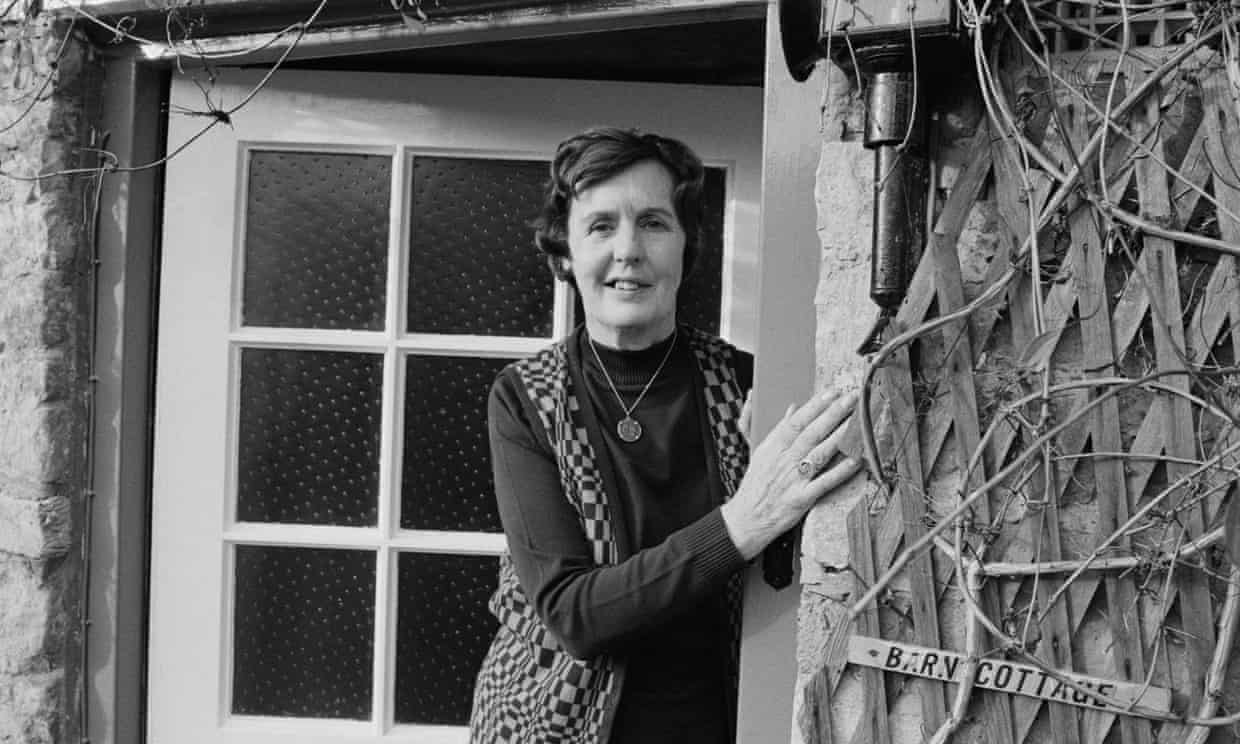
British novelist Barbara Pym is said to have been trained as a spy.

Barbara Pym had a unique style of novel writing, very homey and at the same time, full of intrigue. I went through an intense Barbara Pym phase back in the day and am not surprised to learn that her powerful ability to observe and interpret small details might have made her a good candidate for a different field. Both wartime censorship (ugh!) and spying.

In today’s article, we learn that Pym received special training as an “examiner” to find coded messages and secret writing in normal-seeming letters. And there was probably more.

Nadia Khomami writes at the Guardian, “It is an irony that she herself would have reveled in: Barbara Pym, the author who punctured the social strictures of 20th-century Britain, worked as a censor during the second world war.

“But research suggests that rather than just poring over the private letters that must have helped hone her talent, she may have also been working for [British spy agency] MI5.

“New work by Claire Smith published {in May] proposes that Pym’s time as an ‘examiner’ for the government and in the navy could be more than a poacher-turned-gamekeeper tale about a future satirist. …

“Smith said: ‘In one of her novels, she said being an examiner was really rather dull. But when I began to look closely at her, I discovered many oddities.’

“She believes that Pym’s keen eye for detail was utilized for coded messages and secret writing in otherwise normal-seeming correspondence, becoming one of a group of female examiners who received special training.

“Smith, who worked in the Foreign and Commonwealth Office for 27 years and is the only female diplomat to have negotiated with the Taliban, said: ‘They were the ones looking for the micro dots, the secret writing, the messages concealed in ordinary letters. And because Pym was a writer, she would have noted odd ways of constructing sentences. She’d have been extremely valuable.’

“Dame Jilly Cooper described Pym as the author who ‘brought me more happiness and gentle laughter than any other writer.’ But before she became feted for works such as Excellent Women and A Glass of Blessings, Pym spent the prewar era looking for a job in publishing.

“Instead she became a censor in 1941, ostensibly charged with checking private correspondence between Irish families in Britain and Ireland.

“ ‘I thought it very odd that an Oxford graduate who speaks German and is already writing should really only be looking at letters between Irish families,’ Smith said.

“Pym made several trips to Germany in the 1930s, and even had a relationship with a young Nazi officer.

“The research, British Naval Censorship in World War II: A Neglected Intelligence Function, is being published with the support of the Barbara Pym Society. It coincides with the commemoration of Pym’s home in Pimlico, London, with a blue plaque by English Heritage.

“Within Pym’s notebooks and diaries, which are housed in the University of Oxford’s Bodleian Library, Smith discovered that she had written about learning code when she was an examiner and how she even made a submission to MI5.

“Smith said: ‘If you’re just reading everybody’s letters to strike out forbidden parts, why would you be learning code?’

“And Pym’s time as a postal censor in the Women’s Royal Naval Service (nicknamed the Wrens) also holds key clues to a hidden past.

“She was fast-tracked for promotion and became a naval censor in Southampton when the admiralty was preparing for D-day, before seeing out the rest of the war in Naples.

“It was during her time on the south coast that the biggest oddity occurred, according to Smith. ‘In the second world war, MI5 used PO Box 500 as their address, and in correspondence they were often referred to as ‘Box 500.’ That’s quite different from the box numbers that naval personnel used.

“ ‘But on the back of one of her letters that was going outside the UK, Pym – in her own handwriting – wrote her initials, [naval land base] HMS Mastodon, and Box 500.’ …

“One final piece of the puzzle Smith stumbled upon was that after Pym died, her literary executor was ‘at great pains to say one piece of work, the comic spy thriller So Very Secret, wasn’t successful because Pym didn’t know any spies.’

“ ‘I thought: why mention that at all?’ Smith said.”

So it’s still conjecture. Seems likely, though. We know from the story of Jane Austen’s sister that literary executors can be extremely cautious about revealing anything. And Pym would have been good at spying.

I think anyone who’s a little bit paranoid, a little touchy about double meanings in the words of others could be good at finding hidden messages. What do you think? Any Pym fans here?

More at the Guardian, here.

Read Full Post »