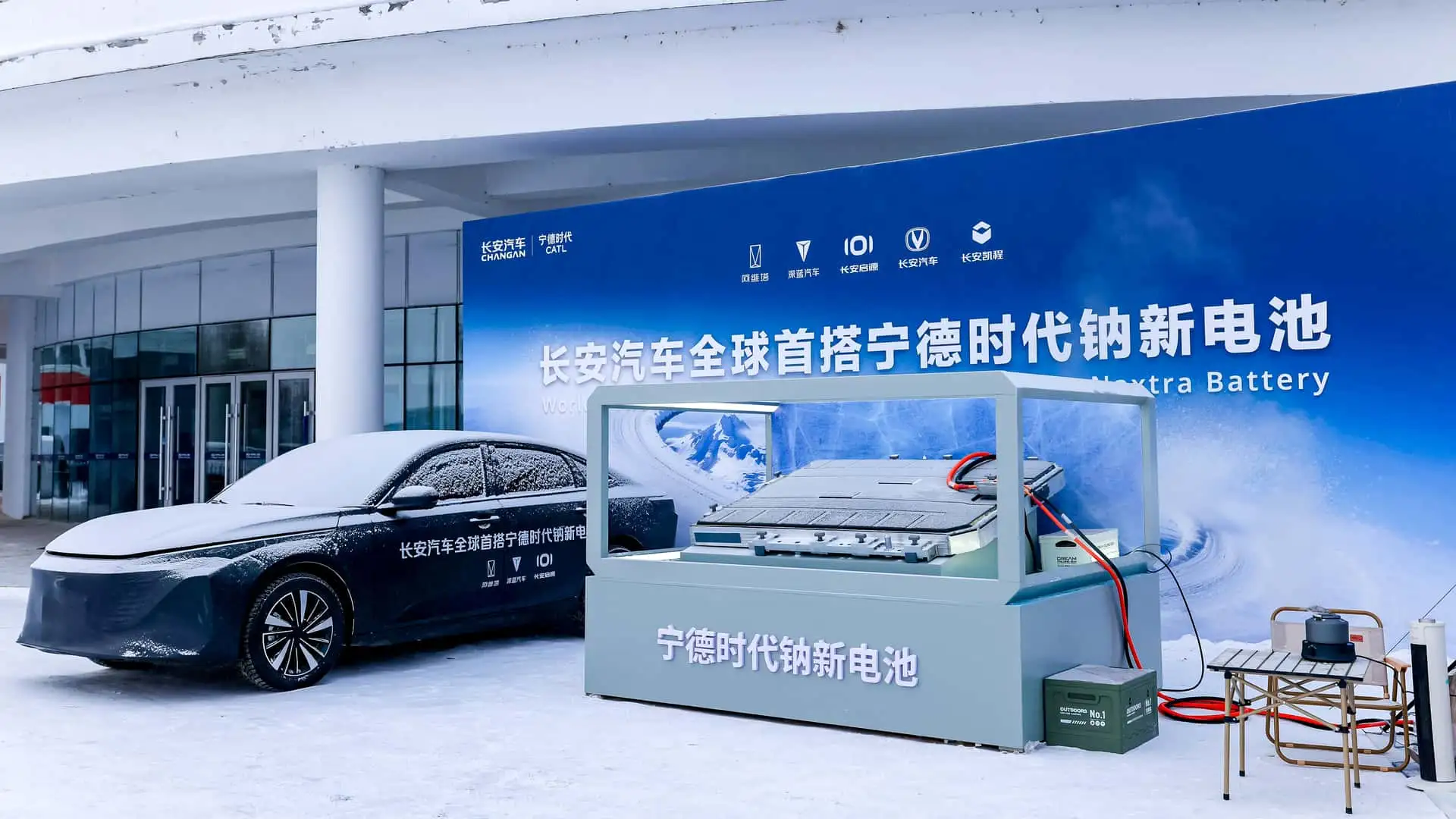
Photo: IAA Mobility.
China’s Changan Nevo A06 features a sodium-ion pack, delivering a range of about 250 miles. Researchers in China continue to hunt even greener solutions and have recently announced a sodium-metal battery that can fully charge in four minutes.
Like most of us, I’m dependent on my phone. But I know that makes me complicit in the damage that the mining of phone-necessary lithium is doing to communities and the environment. So although I don’t always read science articles, I really want to learn about possible substitutes for lithium.
Today I test just how much I can understand about scientific innovations. It helps when science reporters write for a general audience, as Rory Bathgate does in this Live Science article.
Bathgate notes, “Researchers in China have announced a radical sodium metal battery (SMB) design that can fully charge in just four minutes and will retain its capacity for years of use.
“SMBs are a form of ultrafast-charging, stable batteries that scientists say could one day be a cheap alternative to today’s lithium-ion (Li-ion) batteries, which rely on geographically concentrated metals and easily catch fire. SMBs also differ from sodium-ion (Na-ion) batteries in that they use a metallic sodium anode rather than a graphite or hard carbon anode.
“However, SMBs remain largely theoretical because they are prone to a type of degradation known as dendrite formation. This is when the sodium ions passing through the electrode deposit onto the highly reactive, pure-metal sodium anode in spiky, stalagmite-like structures. Over time, this forms a bridge between the cathode and the anode, short-circuiting the battery. …
“Now, researchers say they have solved this issue by using a tough, quasi-solid gel electrolyte … which strengthens the battery against punctures and provides a semisolid internal structure that prevents dendrites from forming. They outlined their findings in a study published May 21 in the journal Nano-Micro Letters.
“To confirm the longevity of this approach, the scientists charged and discharged the battery for over 6,000 hours without dendrites short-circuiting the battery. They also noted that when they charged the battery from zero to 100% capacity in just four minutes, it retained electrical charge. …
“When charged at a slightly slower rate of zero to 100% in 20 minutes, the battery retained 90% of its charge capacity over 2,000 cycles — matching the theoretical limits for Lithium-ion batteries, the scientists said in the study. This slower speed lowered the cost and improved the safety. …
“This is relevant because charging speed remains a sticking point for battery deployment in electric vehicles (EVs). …
“Indeed, most batteries used for modern technologies, such as smartphones and EVs, are Li-ion. However, Li-ion batteries are expensive to produce because they contain the hard-to-obtain metals lithium and cobalt, and they are prone to catching fire.
“Increasingly, battery manufacturers are looking to bring sodium-ion batteries to commercial scale because they are cheaper and safer. However, they are heavier and larger than Li-on batteries.
“SMBs are the focus of intense research because they theoretically combine the best of both types of batteries. “
More at Live Science, here.


Lots of progress has been made with electric cars, and that with the full weight of the fossil fuel industry against them. Shameful. And history won’t judge them and their enablers kindly.
LikeLike
I think you’re right.
LikeLiked by 1 person