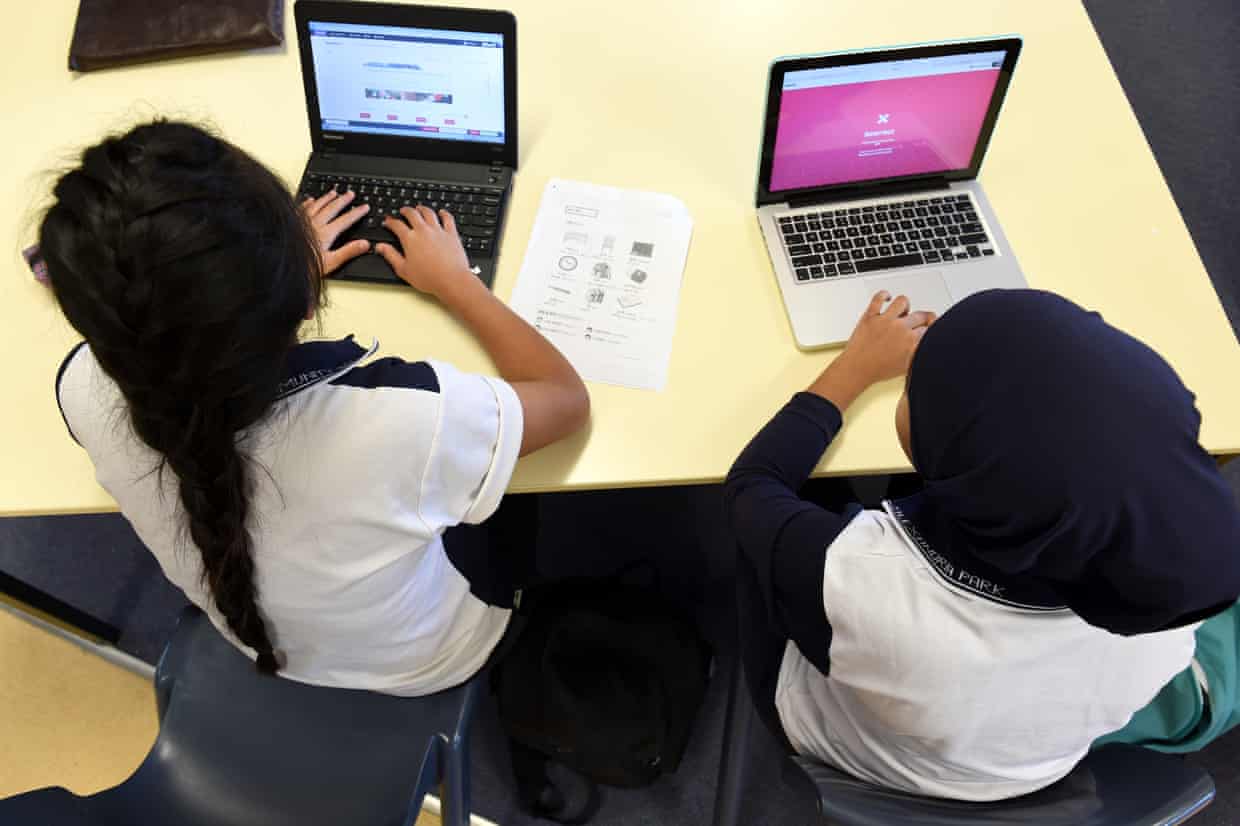
Photo: Paul Miller/AAP.
Researchers disagree on how much use of electronic devices is good for kids.
Computers in schools are here to stay. It’s hard to imagine how kids will get along in the world without knowing how to use use them and how to search online.
But where is the point that electronic devices begin to damage rather than boost learning?
Sally Weale writes at the Guardian, “Jared Cooney Horvath is on a mission. In the wake of global campaigns for smartphone bans in schools and social media restrictions for under-16s, the neuroscientist wants to raise the alarm about educational technology in classrooms.
“A former teacher, Horvath believes the use of screens and digital tools in schools is undermining how children learn and develop. ‘This might be one of the hardest truths our generation has to face,’ he writes in his book, The Digital Delusion.
“ ‘Our children are less cognitively capable than we were at their age,’ he says. ‘For nearly two centuries, the west experienced steady generational progress. Each new cohort of children grew up, on average, healthier, happier, and better educated than the last. Until now.’
“Starting around the year 2000, something changed. ‘Across the west, IQ scores began to fall – even as time spent in school kept rising,’ writes Horvath. Scores in international tests started to drop. Why? ‘The answer lies in the meteoric rise of educational technology.’
“According to a recent Department for Education report, the UK educational technology – or edtech – market generated an annual [profit] of about £6.5bn [~$8.7bn]. …
“ ‘We’ve been making some incredible strides on the screen-based childhood stuff which even two years ago, I did not think was going to happen as fast as it did,’ he said. ‘But it’s not just about getting rid of screens for entertainment. It’s about reducing them as much as possible for academic learning as well.’ …
“The uptake of laptops in schools – especially in the US where he lives – began in earnest in 2010-12, Horvath said, but it was when Covid hit a decade later that ‘every school had to pivot digital as a Band-Aid … rightly so. Better to have something than nothing.
“ ‘But when Covid finished you would assume they’d rip that Band-Aid off, but the vast majority of schools didn’t. They just stayed digital.’ …
“He cites recent scores from the program for international student assessment (Pisa) which takes place every three years and tracks the academic performance of 15-year-olds across dozens of countries.
“In 2012, 2015 and 2018, Pisa asked students how much time they spent using digital devices during a typical school day. ‘The more time students spent on screens at school, the further their scores fell,” Horvath said. ‘On average, those who used computers for more than six hours per day scored 66 points lower than their peers who didn’t use them at all.’ ” …
“Rose Luckin is an emerita professor of learner-centered design at the UCL Knowledge Lab in London and a recognized expert on AI in education [says, however] ‘In terms of that Pisa data, if you look at it on computer use and outcomes, actually moderate school device use is associated with better results than no school device use. It’s just that the heaviest daily use is the worst.’ ”
More at the Guardian, here.


Leave a comment. Website address isn't required.