Feeds:
Posts
Comments

Posts Tagged ‘build’

Photo: Asem Salama / Scientific Reports..
A diagram of the inside of the Great Pyramid of Giza in Egypt.

Today’s story about the brilliant design of the the Great Pyramid of Giza reminds me that people living in the 21st century should never assume they are more intelligent than people centuries ago. Many of our ethical stances show improvement. We have advanced gadgets and skills. But we have lost ancient skills needed to manipulate ancient gadgets.

And what about building construction? The high rise in New York City that threatens to collapse is surely an example of inferior design capability.

Compare that to the pyramids. Richard Widdington writes at Artnet, “Over the past 4,600 years, the Great Pyramid of Giza has weathered a dozen or so major earthquakes. … Cumulatively, seismic activity is one factor that explains why the structure has lost around 30 feet in height since it was completed at the peak of Egypt’s Old Kingdom.

“Otherwise, the wonder of the ancient world has endured relatively unscathed. Unlike the earlier Step Pyramid at Saqqara or the aptly named Bent Pyramid at Dahshur, the Great Pyramid of Giza is free from earthquake-induced structural damage. A new study led by seismologists at Egypt’s National Research Institute of Astronomy and Geophysics measured such resilience and concluded that it might be partly by design.

“[Researchers] used an accelerometer to measure natural vibrations at 37 locations inside and around the pyramid, including on its exterior stones, within its chambers, and in the surrounding soil. They found the majority of the vibrations inside the structure exhibited ‘exceptional homogeneity’ and ranged between 2.0 and 2.6 hertz. This means the stress of an earthquake is distributed evenly throughout the pyramid. Crucially, this differed from the surrounding soil, which averaged 0.6 hertz, effectively offering the ground as a natural shield that prevents seismic energy from amplifying as it passes into the monument. Building on top of a carefully leveled limestone bedrock, researchers noted, also helped to anchor the structure. The results were published in Scientific Reports in May.

“ ‘The Great Pyramid behaves as a single, cohesive unit that naturally vibrates at a fundamental frequency of approximately 2.3 Hz,’ one of the researchers, Asem Salama, said over email. ‘The frequency difference prevents the destructive phenomenon of resonance, the primary culprit behind the collapse of modern buildings, when a structure’s frequency matches the earthquakes vibrations.’

“Another factor preventing shockwaves from amplifying as they rise through the pyramid is a series of five rooms built directly above the King’s Chamber, which sits at the heart of the structure. Known as weight-relief chambers, they were designed to protect the hallowed space from the immense weight of the stone blocks above it. In the context of earthquakes, however, they act as a built-in ‘shock absorbers,’ diminishing the vibrations that reach them.

“Last, there’s the Great Pyramid of Giza’s most visibly obvious advantage: its bottom-heavy, symmetrical shape. This ensures weight and stress are distributed evenly throughout the structure.

“​ ‘The earthquake resilience of the Great Pyramid of Giza is not a historical fluke, but the pinnacle of an ancient engineering evolution,’ Salama said. ‘Much like modern engineering advances through iterative science and lessons learned from past structural failures, Egyptian architects refined their techniques over generations. Prior disasters, such as the collapse of the Meidum Pyramid, provided critical data. By the time the Great Pyramid’s architects broke ground, they had mastered the physics of permanence.’ ”

More at Artnet, here. No firewall.

Read Full Post »

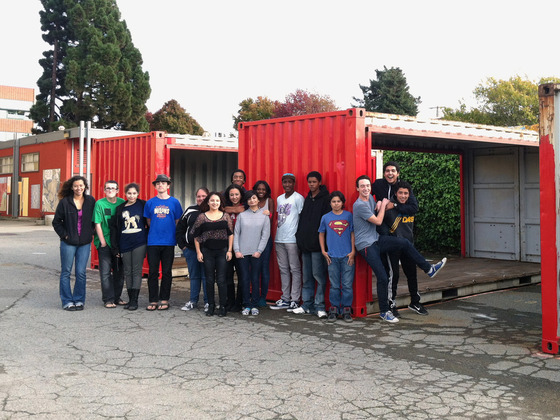
I’m not sure where I first read about Studio H, but I think you will be interested in this high school that engages students in hands-on construction from design to delivery.

The website explains: “Studio H is a public high school design/build curriculum that sparks community development through real-world, built projects. Originally launched in rural Bertie County, North Carolina, Studio H is now based at REALM Charter School in Berkeley, CA.

“By learning through a design sensibility, applied core subjects, and industry-relevant construction skills, students develop the creative capital, critical thinking, and citizenship necessary for their own success and for the future of their communities.

“Over the course of one semester, students earn high school credit and have the opportunity to design, prototype, and build a full-scale community project. Our students have designed and built some crazy chicken coops for families in need, and a 2,000-square-foot farmers market pavilion.”

More here.

Photographs: http://www.studio-h.org

Read Full Post »

I came across a nonprofit organization called BUILD on the website of the accelerator incubator MassChallenge (where Erik is among 26 finalists who will be honored at Tuesday’s awards). BUILD helps inspire students to graduate from high school by getting them engaged in an entrepreneurship project.

“MassChallenge Partner BUILD Greater Boston is gathering a select group of entrepreneurs to mentor student business teams in some of the city’s lowest performing high schools.

“BUILD is an exciting 4-year college success program that uses entrepreneurship to motivate disengaged students to excel academically, graduate from high school, and succeed in college. …

“To help students become college-eligible, BUILD also provides tutoring, test prep, mentoring, and college planning advice. Entrepreneurship is the hook — but college is the goal. Over the past 13 years, 95% of BUILD seniors nationally have been accepted to college, with 88% accepted to 4 year colleges and universities.

A student team calling itself “the Dream Team and their mentors, including MassChallenge Alumni Shonak Patel, won 1st place at the Youth Business Plan Competition at Northeastern University on June 2, 2012, receiving $1,500 to start their business.”

According to the Bay State Banner, the Dream Team’s product is an “inspirational iPhone case, made of bamboo and customizable to have the purchaser’s own dream etched into it.” More here.

See video highlights of the competition from the Boston Business Journal.

Being a BUILD mentor gave me the opportunity to use my passion for entrepreneurship to inspire greatness in others.— Shonak Patel, Charlestown Mentor and MassChallenge Alumni. 

Read Full Post »