Feeds:
Posts
Comments

Archive for the ‘Uncategorized’ Category

I love getting tips on blog-worthy topics. This week, Earle sent an article from the Stanford News about a truce between environmentalists and hydropower companies, a promising rapprochement. People on opposing sides of a critical issue working quietly together to find common ground.

Devon Ryan wrote, “A dialogue organized by Stanford that brought together environmental organizations, hydropower companies, investors, government agencies and universities has resulted in an important new agreement to help address climate change by advancing both the renewable energy and storage benefits of hydropower and the environmental and economic benefits of healthy rivers.”

The New York Times also covered the peacemaking. Here is Brad Plumer on the topic: “The industry that operates America’s hydroelectric dams and several environmental groups announced an unusual agreement Tuesday to work together to get more clean energy from hydropower while reducing the environmental harm from dams, in a sign that the threat of climate change is spurring both sides to rethink their decades-long battle over a large but contentious source of renewable power.

“The United States generated about 7 percent of its electricity last year from hydropower, mainly from large dams built decades ago, such as the Hoover Dam, which uses flowing water from the Colorado River to power turbines. But while these facilities don’t emit planet-warming carbon dioxide, the dams themselves have often proved ecologically devastating, choking off America’s once-wild rivers and killing fish populations.

“So, over the past 50 years, conservation groups have rallied to block any large new dams from being built, while proposals to upgrade older hydropower facilities or construct new water-powered energy-storage projects have often been bogged down in lengthy regulatory disputes over environmental safeguards. …

“In a joint statement, industry groups and environmentalists said they would collaborate on a set of specific policy measures that could help generate more renewable electricity from dams already in place, while retrofitting many of the nation’s 90,000 existing dams to be safer and less ecologically damaging.

“The two sides also said they would work together to accelerate the removal of older dams that are no longer needed, in order to improve the health of rivers. More than 1,000 dams nationwide have already been torn down in recent decades.

“The statement, the result of two years of quiet negotiations, was signed by the National Hydropower Association, an industry trade group, as well as environmental groups including American Rivers, the World Wildlife Fund and the Union of Concerned Scientists. Another influential organization, The Nature Conservancy, listed itself as a ‘participant,’ signaling that it was not prepared to sign the full statement but would stay engaged in the ongoing dialogue over hydropower policies.

“Bob Irvin, the president of American Rivers, which has long highlighted the harm that dams cause to the nation’s waterways, said that growing concern over global warming had caused some environmentalists to reassess their longstanding opposition to hydropower. …

Mr. Irvin emphasized that his group would still oppose any effort to build new dams on rivers. But that still left plenty of room for compromise.

“As an example, he pointed to the Penobscot River in Maine, where environmentalists, energy companies and the Penobscot Indian Nation reached a landmark agreement in 2004 to upgrade several dams in the river basin while raising money to remove two other dams that had blocked fish from migrating inland for more than a century. The result: The hydropower companies on the Penobscot ended up producing at least as much clean electricity as before, while endangered Atlantic salmon have returned to the rivers. (For more on that, read an article I acquired for my former magazine, here.) …

“Said Malcolm Woolf, president of the National Hydropower Association, ‘We’re now willing to talk about removing uneconomic dams, and environmentalists are no longer talking about all hydropower being bad.’

“Energy experts have said that adding more hydropower could provide a useful tool in the fight against climate change. While wind turbines and solar panels are becoming more widespread, they don’t run all the time, and hydroelectricity can offer a backstop as utilities clean up their electrical grids. …

“ ‘We’re not talking about the Hoover Dams of old,’ said Jose Zayas, a former Energy Department official who oversaw the study. ‘There have been some big technological advances that now let us produce more energy in a much more sustainable way.’ Some companies are designing new turbines that allow fish to pass safely through, while others are looking at ways to reduce oxygen depletion in the water caused by dams.

“One particularly promising approach is to build more facilities known as pumped hydro storage, an old technology that involves connecting two reservoirs of water, one at a higher altitude than the other. When there’s surplus electricity on the grid, these facilities use that power to pump water from the lower reservoir to the higher one. When electricity is needed, such as during lulls in wind or solar power, the water flows back downhill, spinning a turbine to generate electricity.”

More at the New York Times, here. And you can read Devon Ryan’s Stanford News interview with “Dan Reicher, a former U.S. assistant secretary of energy, and board member of the conservation group American Rivers, who launched and helped lead the meetings,” here.

Read Full Post »

Some years ago I asked a woman who headed an excellent Rhode Island nonprofit for housing whether she gave money to panhandlers. She said she did not, and I thought I shouldn’t either. But Mother Teresa had said to smile at people in need. I found I could manage that.

The belief that giving money leads panhandlers to buy drugs has long been the common wisdom. But a new study from Canada suggests it’s wrong.

Francesca Giuliani-Hoffman reports at CNN, “You’ve heard this refrain before — giving money to homeless people is not the best way to help them because it might be squandered, or spent on harmful habits.

“But a new Canadian study makes a powerful case to the contrary. The study, dubbed ‘The New Leaf Project,’ is an initiative of Foundations for Social Change, a charitable organization based in Vancouver, in partnership with the University of British Columbia.

“Researchers gave 50 recently homeless people a lump sum of 7,500 Canadian dollars (nearly $5,700). They followed the cash recipients’ life over 12-18 months and compared their outcomes to that of a control group who didn’t receive the payment. The preliminary findings, which will be peer-reviewed next year, show that those who received cash were able to find stable housing faster, on average. By comparison, those who didn’t receive cash lagged about 12 months behind in securing more permanent housing.

“People who received cash were able to access the food they needed to live faster. Nearly 70% [maintained] greater food security throughout the year.

The recipients spent more on food, clothing and rent, while there was a 39% decrease in spending on goods like alcohol, cigarettes or drugs. …

“Said Claire Williams, the CEO and co-founder of Foundations for Social Change, ‘We really think it’s important to start testing meaningful risk-taking in the name of social change.’ …

“The 115 participants in the randomized controlled trial were between the ages of 19 and 64, and they had been homeless for an average of 6 months. Participants were screened for a low risk of mental health challenges and substance abuse. Funding for the initiative came from a grant from the Canadian federal government, and from donors and foundations in the country.

” ‘One of the things that was most striking is that most people who received the cash knew immediately what they wanted to do with that money, and that just flies in the face of stereotypes,’ Williams told CNN.

“For example, she explained some cash recipients knew they wanted to use the money to move into housing, or invest in transportation — getting a bike, or taking their cars to the repair shop to be able to keep their jobs. Others wanted to purchase computers. A number of them wanted to start their own small businesses. …

“Direct cash transfers are not ‘a silver bullet for homelessness in general,’ and the program focused on ‘a higher functioning subset of the homeless population,’ Williams said, but she believes the research shows that providing meaningful support to folks who have recently become homeless decreases the likelihood they will become entrenched. …

“The study shows there are advantages for the taxpayer, too. According to the research, reducing the number of nights spent in shelters by the 50 study participants who received cash saved approximately 8,100 Canadian dollars per person per year, or about 405,000 Canadian dollars over one year for all 50 participants.”

More details at CNN, here.

Read Full Post »

I’ve been doing this blog daily for more than nine years, and sometimes in covering an activity that seems hopeful, I’ve overlooked a possible downside — or I learn later that things have changed. I try my best to add an update to a previous post so as not to have misleading information out there in the world.

The topic for today — turning unwanted plastic bags into sleeping mats for homeless people — was written up a year ago at the Detroit News and, according to Facebook, is still going strong. I’m drawn to the idea of doing something useful with the scourge of plastic bags, and I like the idea of giving people experiencing homelessness something they might want. For sure, it would be better to give them homes, so that’s an obvious downside. But I like that the self-named “Bag Ladies with a Cause” are really trying to help. Read about the initiative and let me know what you think.

Jocelynn Brown started her report at he Detroit News admitting, “Whenever I throw away a good, clean plastic bag, I’m always overcome with guilt, knowing there are groups like ‘Bag Ladies With a Cause’ that are putting them to good use as a way of making a difference in the lives of homeless individuals.

“Donna Harki of Lincoln Park and Jeannine Ayers of Wyandotte had worked with two groups … helping them turn plastic bags into what’s referred to as ‘plarn’ (plastic yarn), and then using it to crochet sleeping mats that would later be distributed to persons living on the streets of Detroit. …

“Word about the group got out. … ‘We just ask them for whatever free time they have,’ said Harki. … ‘It only costs your time, and we try to make the process fun, and keep them (the bags) out of the landfills.’ 

“Not everyone in the group is a crocheter, but everyone has a skill that will help with the assembly line-like production. …

“Each finished mat measures approximately 6 feet long by 3 feet wide, and it takes 700 bags to make just one. Additional plarn is used to crochet a strap that’s attached to the mat so it can be rolled up and carried as a backpack. …

“Harki has cranked out close to 100 mats in the past two years. She recently made one with a pocket attached at one end, which becomes a pillow when stuffed by its owner with maybe a shirt and pair of socks. If she already has the plarn, she said she can crochet a mat in a week, if she works on it every night. 

“How is plarn made? First, the plastic bag should be neatly flattened into its original shape with creases, folded twice length-wise, and then the handles and bottom are cut off. The remainder of the bag is cut into 3-inch wide strips/loops and then looped together, as you would rubber bands.

“A size Q crochet hook is used to crochet the mats, and in terms of bags used for making the plarn, Harki said, ‘We use any plastic bags, as long as they’re clean. … We (also) have an academy school in [Brownstown] that collects bags for us. … We had a fifth grader (from Summit) crochet her own mat! …

” ‘We deliver the mats. So far, we have given (to) ChristNet (in Taylor), a band of churches who alternate helping the homeless with (the) cold. We also have donated to FDDR (Feeding Detroit & Downriver) … an organization that feeds the homeless six days a week, year round. They know who sleeps outside, so they know who to give them to.’ ” More at the Detroit News, here.

Want a children’s book about women in Africa who’ve making good things out of plastic bags for years? Check out One Plastic Bag, by Miranda Paul, here.

Read Full Post »

Although coronavirus on surfaces still seems to be an issue (read about a lab study in Australia that says it can cling to phones and banknotes for 28 days), my current focus is on droplets suspended in the air. More ventilation, fewer ventilators!

So I’ve been following stories about people who have found ways to do things outside that would be too dangerous inside right now.

Bob Morris writes at the New York Times about singers feeling more like they are part of a real choir when they rehearse from their cars. (More or less how I hope to be with friends in winter.)

“I love singing four-part harmony,” Morris says. “It isn’t just about the precision, the ringing sound when voices blend together. It’s also about community, listening to one another and breathing together, creating a mood-lifter and balm in a fraught world.

“But like theater and hand shaking, choral singing has been canceled for now — and for good reason. Singing is the AK-47 of expression in the coronavirus era, shooting out so many aerosols that a church choir in Washington made the news in March when almost everyone present contracted the virus after a rehearsal; 53 singers became ill, and two died.

“When my men’s a cappella chorus on Long Island turned to Zoom rehearsals in the spring, I didn’t last long. The lag time over Zoom didn’t allow for live harmonizing or even the simplest singing in unison. ‘Performing’ meant recording ourselves alone at home so our conductor could edit us together.

“It felt like homework for hobbyists, without the emotional payoff. So when I first heard about choirs singing live in cars, it struck, well, a chord.

“It started with David Newman, a baritone on the voice faculty of James Madison University in Harrisonburg, Va. In May, after a widely discussed web conference on the dangers of singing, Mr. Newman set up a sound system with four wireless microphones, an old-school analog mixer and an amplifier. Several singers gathered in their cars on his street, and he conducted them from his driveway.

“It worked. Out of respect for the neighbors, Mr. Newman started using an FM transmitter, so the blended sound came through over car radios — as it does for drive-in movies — not over a loudspeaker. He found barely any audio delay. ‘The latency was near zero, which was really exciting,” he told the Chorus Connection. ...

“Word of Mr. Newman’s drive-in chorus gradually spread as he posted instructions to help other groups. Bryce and Kathryn Denney, in Marlborough, Mass., were inspired … and were soon showing up with a car full of equipment for dispirited local choirs to facilitate live singing for up to 30 participants.

“On a recent Sunday, I was one of them. … The steeple of the First Parish Church of Stow and Acton, towered over the verdant town of Stow, Mass., west of Boston. …

“ ‘This is one concert that can’t be canceled,’ Bryce. …

“Kathryn, who directs musical theater productions, added, ‘We figured out how to bring people together to sing without making them sick,’ as she checked a spreadsheet of arriving participants and, wearing black latex gloves, [then gave participants] color-coded … sanitized microphones. …

“[The choir’s boyish conductor, Mike Pfitzer] had us sing scales and arpeggios. Hearing others not just over my radio but also outside made my voice shaky with emotion, especially when we sang the chords I’d been missing for so long: sunny major ones, darker minor ones and a trickier major seventh, as well. …

“I struggled with ‘Bonse Aba,’ the cheerful Zambian call and response song. … A rough translation of the song — a hymn — suggests it means that all children who want to sing should be able to sing. And so I did in close, bright harmony; we all did, with bells from the steeple ringing 5 o’clock just as we were finishing with another hymn, ‘May I Be Still.’ …

“ ‘It wasn’t just wonderful,’ said Ruth Lull, a soprano. ‘It was like coming home.’ ”

More here.

Read Full Post »

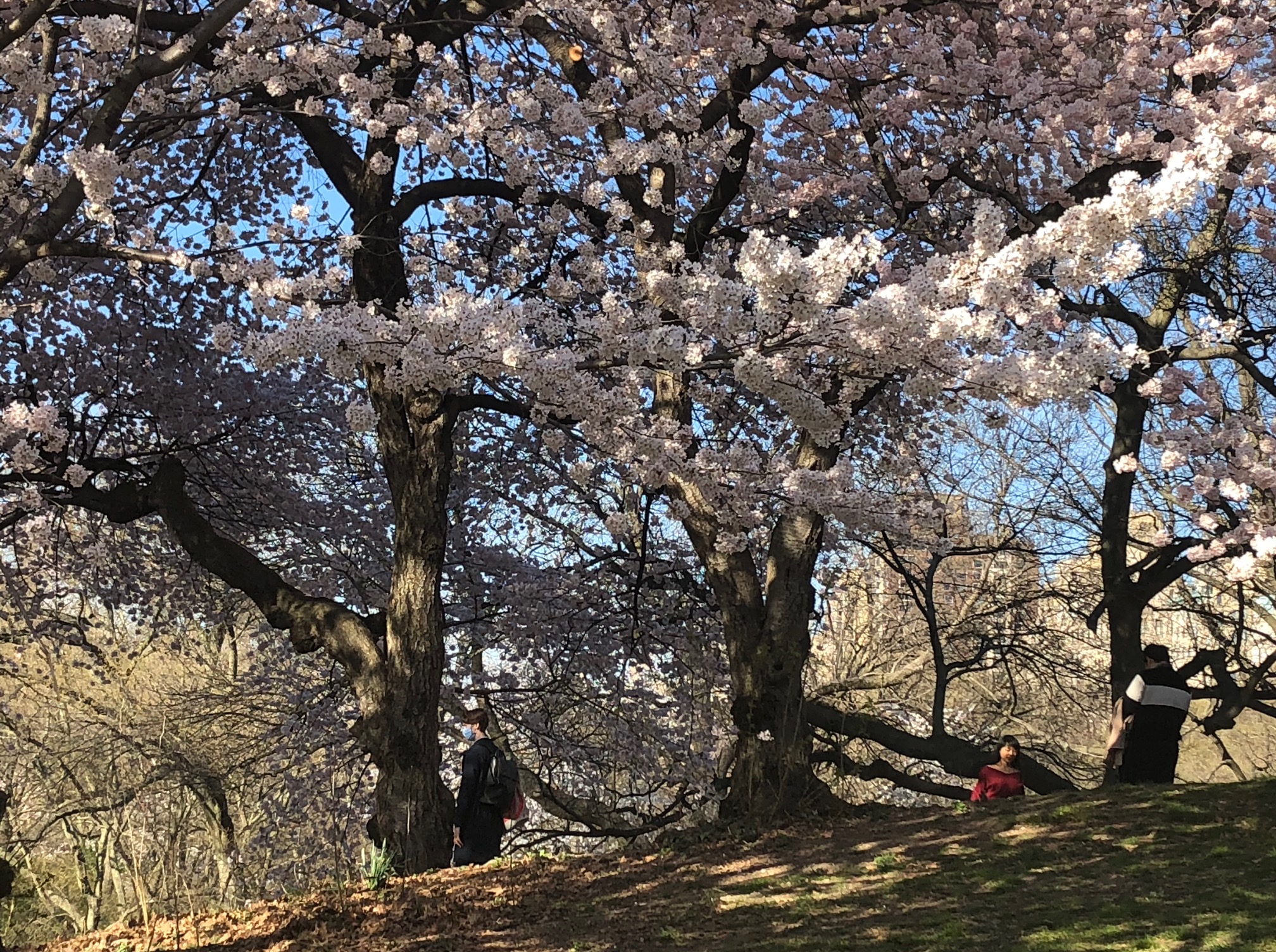
On this rainy, indoor day, I’m sharing photographs from recent walks. I have been so surprised lately by how much is blooming late in the season. Look at the color of those roses and the vitality of the daisies! I want to get some autumn daisies for my own yard.

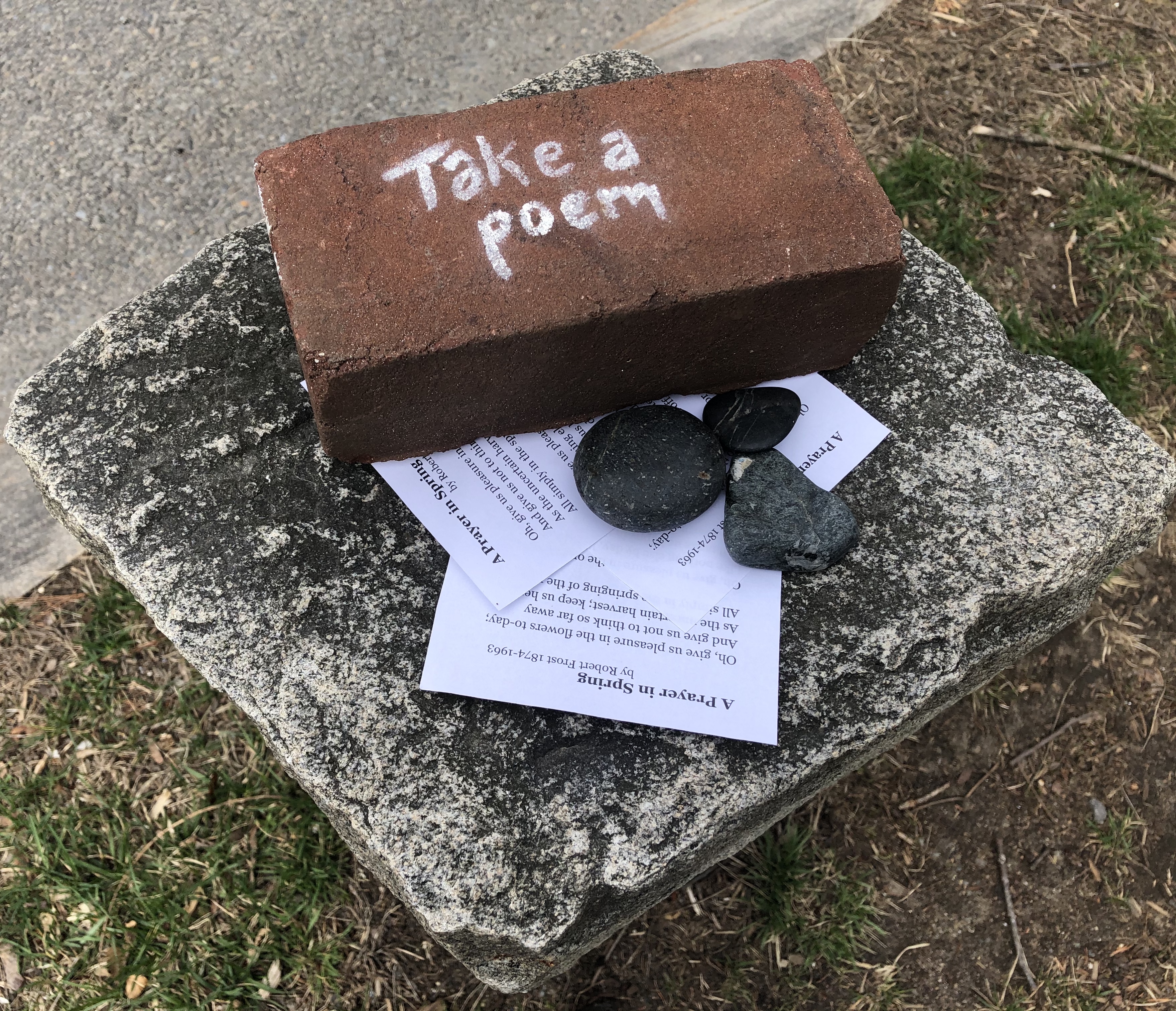
As you may have guessed, the flower basket at the street crossing memorializes a death on that spot. The woman who was hit was devoted to nature, so her friends have not been putting anything plastic up. Yesterday I noticed a small pile of smooth stones such as one sees in Japanese gardens.

The next shot, of an old tree stump, was taken on a trail that branches off from our local cemetery. I often walk in the cemetery because it is so beautifully landscaped, but I had never taken this path along the wetlands because it’s usually too swampy. I enjoyed trying to guess where the trail would emerge and I was almost right.

I was also drawn to a tree stump by a stone wall on the Codman House grounds in Lincoln, Massachusetts. Sometimes there is beauty in decay. Some might regard the old formal gardens with the ionic columns as representing a different kind of decay, although I must say, the statue looks pretty alert and energetic to me.

The farmstand and a homeowner’s gourd-and-pumpkin display speak for themselves. They remind me I should add a bag of candy to my delivery order on the off-chance we actually get a trick-or-treater this year. It’s been years. But a toddler just moved in next door, so I have hopes. Maybe his mother would prefer something other than candy though. What do you suggest?

Next I have two of the pieces of art from this year’s Umbrella Art Ramble in the town forest. I liked the hanging rowboats and the fishnet strung between trees. The theme this year was “Water Change: Where Spirit, Nature, and Civilization Meet.” Some works spoke to the different ways we use water. Some spoke to increasing shortages. In our own town, we have been suffering from a drought, so the pieces were especially relevant.

Finally, beautiful clouds. I don’t need to tell anyone here that some of the best art is not of human device.

Read Full Post »

What goes ’round, comes ’round, they say. In this story from the Washington Post “Optimist” newsletter, a drugstore cashier helped out a customer, and when the customer devised a way to acknowledge the favor, she learned that lots of people loved the cashier.

Cathy Free reports, “Real estate agent Rina Liou realized she had a problem as soon as she reached into her purse for her wallet at a Houston [Walgreens].

“She had stopped at the store to buy lightbulbs for an open house that would start in less than 30 minutes, but she had left her wallet at home. …

“ ‘I was pretty flustered,’ said Liou, 35. ‘I didn’t know what to do.’

“Liou, feeling a bit of panic, wondered how potential buyers would react when they couldn’t turn on the lights at the townhouse she was showing on that day, Sept. 7, she said. But then Walgreens checker Rita Jackson Burns spoke up:

‘I’m a little short on funds because I only have $20 in my checking account, but I’ll go ahead and pay for this for you,’ Liou recalled her saying.

“Then Burns pulled out her personal debit card. When she rang up the lightbulbs, Burns said she was relieved to see that they were on sale, costing $12.41.

“ ‘I was a little embarrassed that I only had $20 in the bank because I’d just paid my bills,’ Burns recalled. … ‘I wanted to help, because I know that if I were in a bind, I’d hope that somebody else would do the same,’ Burns said.

“Liou thanked Burns profusely and told her that she’d return later that afternoon to pay her back. She kept that promise. ‘She gave me $15, plus $30 extra, and told me to put it in my bank account,”’ said Burns, 58. …

“A few days later, Liou decided to take her gratitude one step further: She posted about her experience on her neighborhood’s Nextdoor page, and dozens of people chimed in, wondering how they could show their appreciation for Burns. Then Houston’s KHOU-11 television learned about Burns’s kind deed, and things really took off.

“Burns has worked at the Walgreens on Stella Link Road for 38 years and knows all of the regular customers, she said. Many of those people, including Michelle Suh, wanted to recognize her decades of service behind the cash register.

“Suh decided to organize a GoFundMe campaign called ‘Gratitude for Ms. Rita’ to reward Burns’s contributions as an essential worker during the coronavirus pandemic.

“ ‘Ms. Rita is a neighbor in the truest sense of the word,’ Suh wrote. ‘Until Walgreens and our country pays our essential workers more, let’s step up to make sure Ms. Rita has more than $20 in her account. … She has given us so much kindness, and we would love to show her how much she means to us,’ Suh added.

“The fundraiser has reached more than $11,000, and thankful customers have left dozens of comments.

“ ‘Ms. Rita, your smile and kind words greeted us every time we walked into the store,’ wrote Sandi Mercado, who donated $25. ‘On a bad day, you made us forget our troubles for a few minutes. On a good day, you shared in our laughter. … If you ever wondered if people notice your kindness … they do. We do.’ …

“ ‘The world needs more kind people like you,’ added Emilie Mavligit, who donated $10.

“Burns said she is stunned by the generosity. … She is the main provider for her husband, Robert Burns, a retired steel cutter, and their adult son, Jarrell.

“ ‘I’m going to save some of the money for a rainy day, but I’d like to donate a portion of it to help children in some way and show them what can happen if you help others,’ she said.”

More at the Washington Post, here.

Photo: Rina Liou via KHOU-11

Read Full Post »

Photo: Gavin Sheridan
Built in Midleton, County Cork, Ireland, this sculpture memorializes the aid given by the Chocktaw Nation during the Great Famine.

Whether you say Columbus Day or Indigenous Peoples Day, the Monday holiday is a good time to address our current problem with statues.

Are the ones getting removed all equally troubling? Take Columbus. Many Italians honor him as an explorer from their homeland. But to indigenous people, the history of his violence against their ancestors and of the diseases and exploitation that contact with Europeans brought is as painful to contemplate as Confederate statues are for the descendants of slaves.

That’s why in Boston, a frequently defaced Columbus statue is being moved to the private property of the fraternal order called Knights of Columbus.

Lately I’ve been wondering if our statue problem derives from honoring an individual. Individuals — and contemporaneous attitudes toward individuals — are more likely to be flawed than, say, a concept. Even Boston’s Abraham Lincoln statue is being removed because of the grovelling way the slave he’s freeing is depicted.

Conceptual monuments like the one to the seagulls that saved the Mormon crops from locusts could be better. Or how about the monument Ireland put up in gratitude to the Choctaw Nation for assistance in the potato famine?

But concepts can be offensive, too. Consider the Spirit of the Confederacy statue. The interesting thing about that one is that the Houston Museum of African American Culture, having decided to preserve it for teaching purposes, has actually given it a home, according to an article at Hyperallergic.

I guess my idea about avoiding monuments to individuals doesn’t really solve anything. As scientists say, “More study is needed.” Fortunately, there’s a group that’s on the case.

Philip Kennicott at the Washington Post reports, “The Mellon Foundation has announced that it will make rethinking this country’s landscape of monuments and memorials a major institutional priority, with a $250 million ‘Monuments Project’ over the next five years. …

“Says Elizabeth Alexander, president of the foundation … ‘This is not a Confederate monuments project; it is a monuments project.’ …

“That means addressing the larger issue of what values and ideas about identity are embedded in this country’s public architecture of history and memory. What is preserved, what is forgotten and what is suppressed?” So there’s that.

What do you think? Is the problem too many militaristic statues? Should public monuments focus on traits we want to encourage, like kindness, generosity, service to others? I invite you to ponder.

Photo: David McConeghy/ Flickr
The Seagull Monument located in front of the Salt Lake Assembly Hall on Temple Square, Salt Lake City, Utah.

Read Full Post »

One thing that’s been interesting in the pandemic has been reading about various wild animals that apparently feel safer exploring suburbs and streets now that they are quieter. Today’s story is about birds that have stopped feeling the need to shout.

Eva Botkin-Kowacki reports at the Christian Science Monitor, “When the pandemic began, Elizabeth Derryberry wasn’t thinking about her research. Her focus was on the basics: how to teach remotely as an associate professor at the University of Tennessee, Knoxville; how to manage the lockdown with her young family; and how to keep everyone safe and healthy.

“But as she scrolled through social media one evening, she saw a picture of a coyote at the empty Golden Gate Bridge in San Francisco. She recalls thinking, ‘Oh my goodness, there really are no cars.’ And as she stared at that image, Dr. Derryberry thought about how quiet it must be nearby without the normal hubbub of traffic – and about the birds she had been studying there.

“Along with her colleague David Luther of George Mason University, Dr. Derryberry had been recording the songs of white-crowned sparrows in both the urban setting of San Francisco and the more rural Marin County to study how the birds responded to the hum of human-made noise. They’d found that the city sparrows sang more loudly, but with a much more limited range, than their country cousins. And the shutdown presented an unprecedented opportunity for the researchers to see if those urban birds changed their tune.

“Indeed, the urban sparrows took full advantage of the relative silence. When the research team recorded birdsongs near the Golden Gate Bridge in April and May of this year, they sounded notably different – and of higher quality – from those recorded during previous springs. Their findings were published [in September] in the journal Science. …

“As people stayed home this spring, many noticed more wildlife around them. Some pondered whether there were actually more birds, for example, or if the quieter cities just made their songs (and presence) more obvious. …

“ ‘When we’re going about our daily lives, we get used to the patterns of the animals that we see,’ says Allison Injaian, a lecturer in the Odum School of Ecology at the University of Georgia, who was not involved in the study. ‘It’s pretty hard to know what we’re missing out on if that never is visible or audible.

“ ‘But when this really unprecedented shift in human behavior occurred,’ she says, it presented ‘a great opportunity for all of us to realize the impact that we ourselves are having on the wildlife around us.’ …

“For the birds themselves, their songs encode information crucial to their existence. White-crowned sparrows, for example, listen to each other’s songs to pick potential mates in spring, and as a way to assess the fitness of another male from afar when deciding whether or not to fight him to try to take over his territory.

“But in cities, they’re typically making a trade-off between the quality of their songs and simply being heard, says Ken Otter, a biologist at University of Northern British Columbia who was not involved in the new study. …

“Before the shutdown, Dr. Derryberry and Dr. Luther found that birds in San Francisco were competing with nearly three times as much noise as those in Marin County. But when the pandemic closed everything down, there was no difference in noise levels. They attribute that to less traffic, as the amount of cars passing through had reverted to levels not seen since the 1950s.

“As a result, birdsongs could travel much farther. The researchers found that the birds sang more softly because they didn’t have to be louder than the anthropogenic noise, and even still, their songs could travel twice the distance as before the shutdown. 

“The bandwidth of the trill at the end of the sparrows’ song is also key to communicating physical fitness to potential mates or rivals. Researchers found previously that the urban birds limit their trills to higher frequencies so they don’t have to compete with the low hum of traffic. But during the shutdown, the team found that the city sparrows utilized their full range – and when they compared the 2020 songs to historical recordings in the area, they found that some of the sparrows were singing in ways not heard in the city since the 1970s. 

“Whether this has a long-term effect remains to be seen, says Dr. Derryberry. But she plans to study the San Francisco sparrows’ sounds during the breeding season once again next year. ‘I’m really excited to see what happened with the nestlings that learned their songs this year,’ she says. …

Birds don’t just adjust their songs’ volume and range. Research has found that some urban birds will adjust the time of day that they sing to avoid rush hour. …

“Studies like this one, Dr. Otter says, can also help give us direction. ‘It’s really important for understanding how we can move forward with planning,’ he says, ‘so that we can create spaces that not only attract the birds, but allow them to be successful.’ ”

More here.

Read Full Post »

I remember a woman in my town who was fighting beavers that had decided to build a dam on her property. It was a big property with plenty of room, but When beavers start a project, the dead trees and grass smell awful. A year or so later, I ran into her and asked about the anti-beaver campaign. Oh, she said, I like them now. It smelled bad at first, but now there’s a beautiful lake.

Chalk one up for the lessons of Nature.

Recently the radio show Living on Earth had a segment on a similar learning process in England.

“HOST STEVE CURWOOD: The Eurasian beaver is native to the British Isles but was hunted to extinction some 400 years ago. But not long ago a beaver family mysteriously turned up on a river in Devon, England, prompting concerns about disease and flooding from beaver dams. Some scientists were able to persuade the UK government to allow the beavers to stay as part of a reintroduction pilot plan and recently confirmed that it’s working. Professor Richard Brazier is a hydrologist at the University of Exeter and spoke with Living on Earth’s Jenni Doering.

“JENNI DOERING: So it sounds like these beavers are here to stay. What made this trial a success?

“RICHARD BRAZIER: Yes, that’s correct. The government has allowed the animals to [not just remain] but also to expand. We learn a multitude of different things in this really intensively farmed lowland catchment setting. We learned that the beaver dams could reduce the impact of flooding downstream. We learned that the dams could filter pollutants out of the water. We learned, of course, that the animals in bringing water and creating wetlands to these otherwise dry and drained landscapes that they [bring] biodiversity back. …

“DOERING: What do you think the landscape has lost in all of those centuries of no beavers on rivers?

“BRAZIER: Well, it’s lost a very efficient water-resource manager in the beaver. And therefore, it’s lost a lot of water. And in fact, for the last few months, we have pretty dry weather conditions at this time of year. And during those times a lot of our small streams and tributaries, agricultural ditches, they just run dry. … When you lose that water, you tend to lose all the aquatic life, all the aquatic ecology, that depends upon it. So in bringing the beavers back, and now there’s [15] family groups of these animals in the River Otter, we’re seeing water coming back. … It’s an amazing thing to see because the landscape transforms even in just a few years into a wetland, wildlife rich water resourceful landscape again. …

“DOERING: How do [the rivers and streams] change?

“BRAZIER: [You know, for] hundreds of years, we’ve we’ve straightened our streams and rivers, we’ve deepened them, we’ve even dredged them. … [Beavers] start to push the water sideways back onto floodplains, they start to put meanders back into streams and rivers, they [bring back] the trees like willow, sallow, hazel. And so we get abundant vegetation flourishing again. …

DOERING: And how much have these beavers on the River Otter in the Devin area, how much have they cleaned up the water?

“BRAZIER: [Most] of the lowland streams and rivers in England [hold] a fine layer of sediment above the bed of the stream, which is soil that’s left on agricultural fields. When the beavers build dams, they capture that soil. And so immediately downstream for tens of meters, you see these beautiful clean gravels. And water flowing through those gravels is well oxygenated because it’s not full of fine sediment. Those clean gravels are so critical as spawning grounds for salmon and sea trout. …

“DOERING: So before we go, can you share your favorite fun fact about beavers?

“BRAZIER: Favorite fun fact. That’s a good one. Probably the way in which the [adult] female treats the kids [manipulating] these young sticks and shoots for the young beavers just like humans. [They] really are like a little family.”

More at Living on Earth, here.

Read Full Post »

I attended a high school that had us memorize Bible verses. In the story of the Prodigal Son — who “took his journey into a far country and there wasted his substance with riotous living” — a few simple words have always meant the most to me. “And when he came to himself, he said … .”

Those words are powerful because, in my view, it really takes a lot for a desperate person to say, “I can do something about this.”

So in the story of the homeless woman who had disabilities and had fought off addiction, I’m most impressed with the moment she got up the courage to ask about a job. True, the hiring manager at the market where she’d been sleeping outside for a year showed compassion, but the real turning point was the homeless woman’s fearful but brave decision to ask.

Cathy Free reports at the Washington Post, “LaShenda Williams woke up in a grocery store parking lot last year after another restless night in her car. On the window of the supermarket, she spotted a new flier.

“The East Nashville Kroger store where she had been living in her car for almost a year was advertising a job fair. Williams, 46, who has a learning disability and has difficulty reading or writing — and also had been addicted to drugs — saw meaning in the flier. …

“Williams went inside the store, as she did every day, to say hello to the employees. But this time, she gathered her courage and asked the hiring manager: ‘Maybe I could work here one day. You got room for me?’

“The manager, Jacqueline Vandal, said she’d help Williams fill out the application. Vandal sat with her patiently and helped her answer all of the questions on her application, then submit them on Williams’s laptop computer. When a prompt came up, informing Williams that she’d successfully applied, Vandal immediately gave her the good news: ‘You’re hired.’

‘I couldn’t believe it — I hugged her and cried,’ said Williams, who has been homeless off and on in Nashville for several years. ‘It was overwhelming. Somebody gave me a chance.’

“Vandal, 56, said Williams’s persistence in filling out the application tipped the scales in her favor.

“ ‘LaShenda had the right attitude, and I knew I needed to give her a shot,’ Vandal said. …

“In May, after working for five months as a self-checkout associate, Williams saved enough money to get a small place of her own. Co-workers and customers rallied to collect household items for her one-bedroom apartment, said Williams, and after her story was featured on Kroger’s website and in Nashville’s Tennessean last month, offers of help poured in. …

“Verlenteez Williams [no relation], who runs a food prep and catering company in Nashville, said he wasn’t surprised that people were eager to step up. ‘We were all feeling empty from the uncertainty of the times,’ he said. ‘All we really have are each other.’

“Until she put on her uniform and reported for work at Kroger, LaShenda Williams said, she felt for years that she had no one. …

“ ‘I walk with a limp because I have cerebral palsy, and I had a tough time getting hired anywhere, so I just did odd jobs like housecleaning,’ Williams said. ‘When I finally got treatment for my addiction, I couldn’t afford a place of my own. I’d live from place to place or stay in abandoned houses.’

“It was late 2018 when Williams decided to park her 2015 Kia Forte in the Kroger parking lot.

“ ‘It was open 24 hours and the lot was always lit up at night,’ she said. ‘I figured I’d be safe there.’ “

Read more at the Washington Post, here.

Read Full Post »

I don’t know about you, but I really enjoy the verbal style some indigenous people use when speaking of traditional ways or of ancestors. If it is not disrespectful to say so, it transports me to a place in the imagination where wizards and Hobbits reside — different from my own place in a way that feels both magical and close to Nature.

In Vancouver, Adrienne Matei writes for the Guardian, “On winter nights for the past six years, a group of 20 people have rustled through dark, coniferous woods to emerge on a Canadian beach at the lowest possible tide, illuminated by a correspondingly full moon.

“An elder offers a greeting to the place and a prayer, then the team of researchers, volunteers, and First Nations ‘knowledge holders’ lights a warming fire and begins its work. At sites outlined by stones placed hundreds or even thousands of years ago, some begin raking, or ‘fluffing,’ the top three inches of the beach, loosening rocks and mud — and a remarkable number of old clam shells.

“When the tide comes back in, it will flush out any rotting organic matter, changing ‘some places that are compact and smelly into a good clam beach again.’ says Skye Augustine, a member of the Stz’uminus First Nation.

“This spot was once a clam garden, an ancient indigenous form of mariculture that coastal First Nations people have used for millennia. It is estimated that they once numbered in the thousands along the Pacific north-western coast, though ruins are all that’s left of most. In collaboration with the W̱SÁNEĆ and Hul’q’umi’num nations, Augustine has spearheaded the first formal clam garden rehabilitations at two sites in the Gulf Islands, in British Columbia, with dozens more to follow.

‘My elders articulated to me that if we want to bring our beaches back to life again, we need to bring people back on to them to care for them as they have been cared for in the past.

” ‘That became my inspiration for my education and career,’ she says. ‘How do we make this clam garden thing happen?’

“For millennia pre-colonization, clam gardens epitomized sustainable food security for Pacific north-western coastal nations from northern Washington to south-eastern Alaska. Modern studies have found that clam gardens have historically been up to 300% more productive than unmodified beaches, that their clams grew larger and faster than average, and that the clams did not exhibit any signs of resource stress from over-harvesting.

“To create the beaches, indigenous people built rock walls parallel to a beach’s low tide line, which would trap sediment and flatten the slope of the shore. With continuing tending, such as tilling to improve aeration and the removal of predators like sea stars, these gardens increase or create habitat for butter, littleneck, and horse clams, as well as crabs, chitons, seaweeds, and other useful species.

“Recent carbon dating has revealed that the oldest clam garden known to science was built about 3,500 years ago. …

“ ‘It has always been our duty to be the stewards of the land,’ says group member Nicole Norris, a knowledge holder for the Hul’q’umi’num and an aquaculture specialist. ‘It is the exact same land my ancestors walked. … From the work that we’ve done, we’ve seen the greater ecosystem return – some of the people who live in the local communities have talked about the return of certain birds and plants, and that’s been heartwarming,’ she says.

“In addition to providing food, clam gardens have historically provided the opportunity for ‘grandparents, aunties, and uncles to spend time at the beach with their grandchildren and younger generations, not only teaching about how to tend the environment … but sharing stories, language, spiritual ties to the place,’ says Melissa Poe, who specializes in the social and cultural dimensions of ecosystems at the University of Washington.”

More at the Guardian, here.

Read Full Post »

In Massachusetts, the Covid-related eviction moratorium will expire October 17 with no plan to help tenants who have lost their jobs and can’t pay rent. The C.D.C. moratorium is in effect, but with many stipulations. Landlords need relief, too, but there has to be a better way than eviction court, where it will all end up. It’s especially worrisome given some new research showing many tenants lose in court because they haven’t received notice of their court date and therefore don’t go.

Clyde Haberman at the New York Times revisits the possibilities of a tenant-to-ownership program.

“Even before the coronavirus pandemic rang down the curtain on much of the U.S. economy, times could be tough for the roughly 110 million Americans living in rental housing. … Nearly four million eviction petitions were filed each year. On any given night as many as 200,000 people were without a home.

“In the pandemic, losing shelter is an ever-present threat on a far bigger scale, by some estimates potentially affecting upward of 30 million cash-strapped tenants. A calamity of that magnitude has been averted, for now, under a moratorium on evictions imposed through 2020 by the Centers for Disease Control and Prevention. But equitable and compassionate solutions to America’s chronic housing problems will clearly remain an elusive goal long after the coronavirus is conquered.

“One method with promise is explored in this video from Retro Report. … The underlying premise is a familiar one: giving people a genuine stake in their apartments and houses by turning renters into owners. The video focuses on two situations separated by half a century: in San Francisco, where the idea was not able to get off the ground, and in Minneapolis, where it has taken flight, albeit with an uncertain future.

“The San Francisco story dates to the late 1960s on Kearny Street, in a neighborhood known as Manilatown because of its many immigrants from the Philippines. There, the three-story International Hotel was home to 150 people, principally Filipino laborers who rented rooms for about $50 a month, about $380 in today’s dollars. In 1968 the hotel’s owners handed tenants eviction notices. …

“After nine years of turmoil and with the courts’ blessing, the owners evicted the hotel residents in 1977. … But the outcome could have been different. A year before the evictions, San Francisco’s mayor, George R. Moscone, suggested a new approach, proposing that the owners sell the hotel to the residents, who were to get the necessary money through a government loan. ..

“The mayor’s idea never really got rolling. … But the concept behind the Moscone plan had resilience, and in 1980 it became embodied in legislation passed in the District of Columbia: the Tenant Opportunity to Purchase Act, or Topa. It gave tenants or allied developers the right to be first in line to buy any building about to be sold by its landlord. Once tenants made clear they were interested, the landlord had to give them time to make an offer and raise the funds.

“Studies show that several thousand units of affordable housing in D.C. were preserved this way, for less than it would have cost to build new housing. …

“One place that has made the idea a reality is a low-rise complex in Minneapolis that houses 40 families. As recounted by Retro Report, the landlord sought to push out the tenants so that he could sell the buildings. But while lawyers duked it out, the residents took action, forming a collective to buy the complex, aided by city officials and an activist group called United Renters for Justice. The sale, for $7.1 million, was completed in May. A nonprofit group put up the money as a loan, and will manage the property for three years while the residents pay back the debt.

“Tenant leaders like Chloe Jackson expressed confidence in their ability to keep up the payments. Still, success is not assured, especially when millions across the country are out of work. If people who lose their jobs can’t cover the rent, why would they be in a better position to repay a loan?

“Some landlords have their own concerns. They are hardly real-estate giants. On the contrary, they are so-called ‘mom and pop’ owners with maybe a building or two. But they account for nearly half of all rental units in the United States. …

“What will happen once the C.D.C.’s eviction moratorium ends is anyone’s guess. Even before the pandemic, millions of Americans were crushed by their rent burden. … That is one reason Ms. Jackson embraces her new status, inherent risks notwithstanding. Yes, the loan must be repaid, she said. ‘But we are thinking as owners, our mind-set is as owners, and we’re ready to do it.’ ”

More here.

Read Full Post »

Swimming Camels

In India, camels that had to cross waterways frequently developed over generations an uncamel-like ability to swim. Now, with more threats to their environment, the future of the trait is in doubt.

Romita Saluja writes at the Guardian, “Ayub Amin Jat treats his camels like his children. But then his camels are no ordinary ungulates: they are a unique breed of camels that swim.

“Amin Jat’s semi-nomadic ancestors have kept these camels in the Indian state of Gujarat for hundreds of years. Known as kharai camels, their name is derived from the local word khara, meaning saline. During the rainy season, they swim along the Gulf of Kutch, an inlet of the Arabian Sea, to small forest islands and graze on mangroves and other saline-loving plants. …

“Immediately after grazing, they drink the rainwater collected in the depressions of the islands. When there isn’t enough water, the herders take them to neighbouring villages to feed them.

“But kharai camels are disappearing. Although exact numbers are hard to find – kharai camels were only recognised as a separate breed in 2015 – local nonprofit Sahjeevan estimates that there were more than 10,000 in Gujarat about a decade ago. Now there are fewer than 4,500. Rapid industrialisation in the mangrove swamps and erratic rainfall are destroying the habitat kharai camels rely on for food, and pushing this unique breed to extinction, warn conservationists.

“My ancestors gave me these camels,” says Amin Jat, 53. “They are like my kids. How can I see them die in front of my eyes?”

“Herders and local conservationists point to the activities of the many salt companies in the mangrove swamps. The companies create salt pans by restricting the entry of tidal water in the mangroves. This dries up the plants and eventually kills them. Power plants, ports and other industries are also responsible for the loss of the camels’ habitat, Sahjeevan says.

“ ‘These companies create mud walls, locally known as bunds, around a portion of land which blocks the tidal water. Without the water, the mangroves die a slow death, making it easier for the machines to uproot them,’ says Mahendra Bhanani, camel programme coordinator at Sahjeevan. ‘One company plundered over 4 sq km of mangrove cover for over a month like this in 2018.’

“The salt companies argue that they bring development and jobs to an area that is nothing more than wasteland. … G A Thivakaran, a scientist at Gujarat Institute of Desert Ecology who specialises in coastal and marine ecology, says that some companies have been going out of their way to get land declared wasteland.

” ‘Until about two decades ago, industries were rampantly destroying mangroves. In 2011, the government framed stricter laws and limited development in mangrove areas. But then the companies found a new workaround. They would block the tidal creek, leading the mangrove to die a natural death in about a year. The land would then be declared a wasteland and [could] easily be claimed by industries,’ he says.

“The Indian government has taken notice of the camels’ decline and in 2015 designated them endangered. … In September last year, herders also won a reprieve from India’s National Green Tribunal, which handles environmental disputes. It asked the Gujarat authorities to check any kind of obstruction in the flow of tidal creeks, and restore mangroves. It also warned against any kind of salt manufacturing activity in certain areas.

“But herders say their fight to protect the mangroves is ongoing. ‘It’s a constant struggle. We get one company removed, another one comes up within a week,’ says Bhanani. …

“Erratic rainfall in the region compounds the problem. Kutch has a variable rainfall and is hit by drought about every three years. ‘Because of the salt content in the mangroves, the camels immediately need to drink water after grazing. So low rainfall spells a crisis for us,’ says Amin Jat. ‘We don’t need big buildings. We just need food and clean water for our animals.’ …

“Amin Jat has never had a permanent home. His family typically moves three times a year in search of grazing grounds for their camels. He belongs to the pastoralist community of Fakirani Jats, whose primary occupation has traditionally been camel breeding. Wherever they settle, the women of the family build houses made of reed grass, jute ropes and wood called pakkhas. They mostly use camels to carry their belongings during their migratory tours but, occasionally, sell off a male camel to sustain them through several months.

“But Amin Jat is not optimistic about the future. ‘If they don’t stop the industries soon, I will send my camels to a slaughterhouse,’ he says.

“ ‘The camels’ extinction would not just be an ecological loss but also a cultural one,’ Bhanani laments. ‘It would fundamentally alter the pastoral lifestyle of the Fakirani Jats and other nomadic communities in the region. Younger male members in their families are migrating to cities and seeking jobs to sustain themselves. Interestingly, some are employed by the same companies that are destroying their camels’ habitat.’ ”

More at the Guardian, here.

Read Full Post »

Sometimes it’s good to be reminded that there are communities where everybody helps everybody, where one person’s emergency is a call to action. I imagine that the North Dakota farmers who gave up a day to help a neighbor feel as great as the family that benefited. What goes ’round comes ’round.

As Sydney Page reports at the Washington Post, “Lane Unhjem was driving his combine harvester across a field of durum wheat on his North Dakota farm [in September], when suddenly smoke began billowing from the machine. …

“Unhjem’s neighbors saw the fire and raced over, helping him extinguish the blaze and saving the field from ruin. But the shock of the moment, coupled with the thick plumes of smoke Unhjem inhaled, triggered the 57-year-old farmer to go into cardiac arrest.

“ ‘He flatlined three times in the emergency room,’ his daughter Tabitha Unhjem, 31, said.

“Lane Unhjem, who also had a heart attack several years ago, was airlifted about 100 miles from his farm near Crosby, N.D., to a trauma center in Minot, N.D., where he remains in critical condition.

“When other farmers in Divide County, N.D., heard what happened to Unhjem on Sept. 9, they immediately halted their own harvesting.

Nearly 60 of them showed up at Unhjem’s farm, equipped with a range of heavy-duty machinery, to finish his harvest for him.

“ ‘I made a couple phone calls and started getting equipment offered left and right, plus the help to go with it,’ said Jenna Binde, 28, a fellow farmer and family friend of the Unhjems. …

“Dozens of farmers and neighbors congregated at Unhjem’s farm on Sept. 12, bringing with them 11 combine harvesters, six grain carts and 15 semi-trucks. They spent almost eight hours harvesting 1,000 acres — an area comparable to 758 football fields — of durum wheat and canola. …

“What the group accomplished in one day would have taken Unhjem nearly two weeks to complete on his own, estimated Brad Sparks, a neighboring farmer.

“ ‘There were guys there who had their own harvest to do, and they just quit and came to help,’ said Sparks, who was there with his machinery that day. … ‘In this part of the country, any time anybody needs a helping hand, everybody will stop what they’re doing at the drop of a hat and come help.’ …

“ ‘If we hadn’t done it, I don’t know if he would have gotten the crop off in time,’ said Binde, adding that weather affects the quality of the crops. “It was crucial to get it off when we did. It’s one less thing for the family to worry about.’ …

“If the fellow farmers hadn’t stepped up to help, Tabitha Unhjem said, it would have been devastating for them. ‘This farm is our livelihood,’ she said.

“Lane Unhjem grew up on the farm, which has been in his family for more than six decades.

“ ‘This is the farm our dad was raised on and we were all raised on,’ [Unhjem daughter Toni White] said. ‘He has dedicated his whole life to this farm and to this community.’ …

“ ‘He has a long road ahead,’ White said. “We are looking at months of recovery. This is going to be a marathon. She called it a blessing that the other farmers were able to get to her father and the farm so quickly. ‘We were so thankful for that,’ White said.

“But for the farmers, ‘this is just something that comes naturally. This is the farming way of life,’ Binde said. …

“ ‘You can’t truly appreciate it unless you were there,’ [local photographer Don Anderson] said. ‘The ground was rumbling. It’s not only something you felt emotionally, but it was also a physical feeling. It was really something to be proud of.’ ” More at the Post, here.

Read Full Post »

I remembering reading years ago that, in a business meeting, sitting beside someone you normally disagree with makes you both feel more akin. I know that when I tried it, I felt friendlier toward the other person, less antagonistic.

That insight came to mind recently when I read an article at the Conversation by Liam Cross, a lecturer in psychology at Edge Hill University in the UK.

“It’s often said,” he writes, “we feel a connection to those we are on the same path as or in sync with. … Many metaphors for conflict and resolution seem to revolve around walking or moving together. But maybe we shouldn’t be so surprised by this – research shows that moving in time together with another person can result in positive social consequences.

One study, for example, found that people who walk in step with one another are more likely to cooperate – even if doing so comes at a financial cost to them. Studies have also shown how coordinating your movement with other people – such as tapping to the same rhythm – can lead to greater rapport and the desire to help each other.

“We are also more likely to conform to and obey requests when they come from someone we have coordinated with.

“Given then that we are living at a time in history when many people are marching for equality and an end to discrimination and prejudice, in our latest research project we wanted to find out if walking together could be used as a tool to foster better relationships between polarised groups. And it seems it can – in more ways than you might imagine.

“We tested whether walking in synchrony with a member of a disenfranchised minority group could improve people’s attitudes towards that group. We asked native Hungarians to walk with a Roma person. Roma people are a particularly disenfranchised group in Hungary. …

“One week before coming into the lab, we asked 70 Hungarians to fill in an attitudes assessment towards the Roma online. They were then introduced to a Roma person and spent five minutes walking laps of a large room with them. They did so either synchronously (landing their steps at the same time), or at different speeds.

The study found that following synchronous walking, people rated their Roma co-walker as more likeable, felt closer to them and had more empathy for them. They also showed increased empathy and a reduction in negative attitudes towards the Roma group as whole.

“We then wanted to see if just imagining walking in step could have the same effects. … Research has also shown that imagining having a positive conversation with members of different social groups can help bring groups together akin to actual positive interactions. Previous research has also shown how imagining walking in synchrony with a group of people can increase rapport in line with actually walking together.

“In a follow-up study, 60 Hungarian people came in to the lab and were asked to just imagine walking with a Roma man or woman after a video introduction. They were simply asked to imagine walking either in or out of sync with them. The study found that just imaging walking in synchrony improved intergroup relations akin to actual walking. …

“This kind of bodily synchrony is something we, as humans, have been doing for many thousands of years. From prehistoric cave paintings of our dancing ancestors to the remains of Palaeolithic pipes people have practised moving in time with each other throughout history.

“For coordination to have persisted across culture and time, it likely served some adaptive purpose in terms of evolution. Perhaps one of these purposes was to do with helping people get on the same path and move forward together. It seems then that there might just be something to the idea that we can empathise with others by walking in their shoes.”

More at the Conversation, here.

“Walk Together Children, Don’t You Get Weary,” sung by Mt. Olives Church Choir, Naalya, Uganda.

Read Full Post »

« Newer Posts - Older Posts »