Feeds:
Posts
Comments

Archive for the ‘Uncategorized’ Category

Photo: Boston Area Gleaners

In September, I posted pictures at a community garden where a sign said not to pick anything that wasn’t yours. I expressed the hope that when the gardeners were completely finished with their harvest, gleaners for food pantries would be allowed in. I don’t know if they were, but I did learn that my church contacted Boston Area Gleaners to help collect fresh surplus produce at local farms.

Kathy Shiels Tully provides background on Boston Area Gleaners at the Christian Science Monitor.

“As a volunteer for the past four years with Boston Area Gleaners (BAG), which collects excess fresh produce at local farms for those in need, I’ve watched the nonprofit grow into something of a gleaning giant. …

“[Laurie ‘Duck’] Caldwell, the executive director of BAG, is pretty much responsible for the group’s, shall we say, mushrooming growth. Though she deflects any praise, her story shows how one person can have a powerful effect on an organization. Caldwell, in fact, was BAG’s first paid employee.

“She believes deeply in BAG’s mission of ‘rescuing’ surplus produce (as the group puts it). Last year, BAG helped deliver 1.45 million four-ounce servings to those who might not otherwise enjoy the benefits of fresh fruits and vegetables. …

“I learn that she is a carpenter with more than 20 years of experience. Her entry into nonprofits came while living in Vermont, through a program she helped pioneer at Vermont Works for Women. There, she taught incarcerated women skilled trades like carpentry and plumbing, and they built a modular home that was then sold as affordable housing. The pilot program gained national attention.”

Having lost her job after the 2008 financial crisis, “she searched for volunteering opportunities to buoy her spirits while job hunting and discovered BAG. …

“Gleaning gave Caldwell an emotional boost and challenged her to develop new skills. She and [founder Oakes] Plimpton became the organization’s first ‘gleaning coordinators’ – arranging farm visits, picking pantries to deliver to, and rounding up volunteers. …

“On Jan. 2, 2010, with salary money secured, that she signed on as BAG’s first employee.

“Caldwell dug into her new work immediately. She made the gleaning process easier for the farmers, proactively calling them instead of waiting for the farmers to speak up. She grew the solid list of 30 volunteers by recruiting like-minded people at farm, alternative energy, and ecology events. And, knowing she couldn’t do it alone, she almost doubled the size of the board of directors. …

“Strawberries, zucchini, corn, beans, carrots, tomatoes, kale, radishes, turnips, beets, squash, apples – everything but bananas fills empty, cardboard banana boxes, which are driven into Boston to a distribution partner such as the Greater Boston Food Bank or Food for Free in Cambridge, Mass.

“ ‘BAG is the Cadillac of food distribution to food pantries,’ says farmer Carl Hills. … Last year, he let BAG glean more than 71,000 pounds of produce on the 200-acre family farm. The crops gleaned are high-quality, the kind sought out by top chefs at high-end restaurants. ..

“Sasha Purpura, executive director of Food for Free … says, [it’s] “beautiful food” – something that for many people is out of reach.”

Read more and learn how to take action at the Christian Science Monitor, here.

Read Full Post »


Photo: David Llada
Dorsa Derakhshani could read before the age of 2 and grew up to be a chess champion. She was banned from Iran’s chess association for not wearing a headscarf.

After you read this article on an Iranian chess prodigy, you are sure to be surprised by her current career goal. Not that there’s anything wrong with it; it’s just surprising.

Mika Klein interviewed Dorsa Derakhshani at WBUR radio’s Only a Game, first watching an old video of Dorsa to get some background.

“The year was 2000. Dorsa was 2, and appearing on a children’s television show. Dorsa wears a red velvet dress with puffy sleeves and dark tights. She’s tightly clutching a stuffed puppy, so the interviewer holds the microphone for her. Dorsa breaks into song, with the poise of seasoned performer, and the studio audience applauds.

“The camera cuts to the audience. Most of the girls are sitting in the back, many are wearing headscarves. Dorsa’s head is uncovered.

“Dorsa was born in Tehran in 1998. And this is just one of many times she appeared on Iranian TV. This time, she reads a story from a children’s book. …

” ‘Are you saying you could read at the age of 2?’

“ ‘No,’ Dorsa says. ‘I could read when I was 1 1/2. But I finished first grade when I was 2.’

“Dorsa’s television career as a child prodigy was never going to last forever, but it ended abruptly when she was 6.

“ ‘They made me wear a scarf against my will,’ says Dorsa … ‘I never went back for the TV.

“ ‘I finished fourth grade when I was 4 1/2. Math, science, everything. … My parents tried to fill my time with other things like music, swimming, ballet, gymnastics, painting.”

“Right next door to her painting class was a chess class. Dorsa decided to join. …

” ‘Chess was really different, because you are actually playing with a live human being,” Dorsa says. … ‘You can’t be 100 percent ready and sure that you play good when you go to a tournament.’

“Dorsa’s first big success came in the Iranian national youth under-8 tournament.

“ ‘It was a big surprise for everyone, because there were players who already had private coaches and they came to win,’ Dorsa says. ‘I came out of nowhere, and I won the tournament. I remember that everybody else was wearing a scarf, even under 8. But I wore a princess dress and a tiara. And it was really cute. …

“Dorsa went on to win three straight gold medals at the 2012, 2013 and 2014 Asian Junior Championships. In the numerical chess ratings lists, Dorsa was at the top for all girls in Asia. …

“I first met Dorsa at the Chess Olympiad in September 2016. She was attending as a journalist, not a player. The tournament was in Baku, the capital of Azerbaijan, a country that is 98 percent Muslim. She did not wear a headscarf at the tournament or on the street. I’ve never seen her wear one.”

Klein continues with a story of the time when Dorsa was traveling and saw that her Instagram account was going crazy. She went to bed and forgot about it. In the morning friends explained that ” ‘they saw on newspaper that my federation banned me — my brother and I, actually, both of us. It was just very out of the blue.’ ”

Dorsa’s brother, Borna, was banned for competing against someone from Israel, Dorsa for not wearing a headscarf.

“She believes the action against her and her brother was a tactic to divert from other news. The announcement came in the middle of the Women’s World Chess Championship, which was being held in Tehran. Several notable players, including the reigning U.S. women’s champion, boycotted the event because players were required to wear a headscarf. All three Iranian women competing had just been eliminated in the opening round. …

“This July, she moved to the U.S. after being accepted to the chess team at St. Louis University. She said there were no problems when she landed in New York and cleared immigration.

” ‘I’m hoping to become a dentist,’ Dorsa says. ‘I’m looking forward to finally having a stable trainer and a team, and I really wish to become grandmaster.’ ”

More at WBUR, here.

Read Full Post »

Vermont’s Farm Ballet

dsc07595_orig

Photo: Jonas Powell
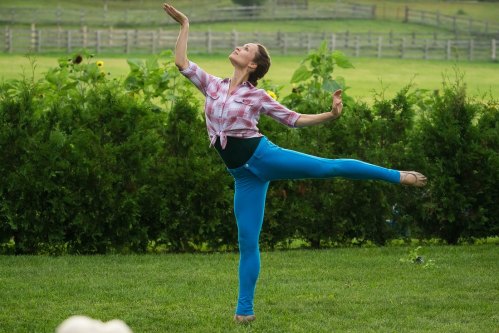
The Farm Ballet performing at Philo Ridge Farm in Charlotte, Vermont. The atmosphere is casual and allows small children to have fun, too.

Around the country, arts organizations are continually thinking up new ways to expand their audiences whether it’s New York City’s public schools adding Broadway shows to the curriculum with $10 tickets (here) or free admission for teens to the Art Institute of Chicago (here).

In today’s post, a ballet company makes professional dance performances available to people who prefer to be outdoors and dress casually.

Elizabeth M. Seyler writes at Seven Days, “Going to the ballet often conjures images of elegant theaters, dapperly dressed adults and thin young people dancing across a pristine stage. But what if ballet were more than that? What if parents in jeans and sandals brought their rambunctious children to a farm picnic to watch ballet lovers of all ages dance across a verdant, or muddy, field? Would it still be ballet?

“In Vermont, it sure would. Since 2015, the Farm to Ballet Project, founded and directed by Vermont-raised ballet professional Chatch Pregger, has given 24 full-length classical ballet performances for adults and children at 17 Vermont farms.

“Featuring six string musicians and 25 adult dancers, each performance conveys the work and life of a female farmer during the growing season and the natural forces she encounters. …

” ‘At our performances, I see all the adults with their picnic blankets and their dinners — eating, drinking, enjoying themselves,’ says company soloist Maria Mercieca. ‘And I see all the kids dancing along, running around. They’re watching, they’re enjoying it, they’re taking it in, but they’re not being made to be still. I love that about it. It’s a family- and kid-friendly event, and I mean little, little kids.’

” ‘It’s really a great event for our members and our community,’ says Tre McCarney, director of community programs at Shelburne Farms. She’s coordinated four Farm to Ballet events there, and each has drawn more than 600 spectators. …

“From two performances this year, McCarney expects to receive approximately $8,000 to support Vermont Food Education Every Day, a partnership of Shelburne Farms and the Northeast Organic Farming Association of Vermont. More specifically, funds help sustain Jr Iron Chef VT, a statewide culinary competition for teams of middle and high school students charged with creating healthy, locally sourced dishes to improve school meals. …

” ‘The company is very tight; we’re very close,’ says Mercieca, 41, a member of Farm to Ballet since 2016. “‘It’s not competitive; it’s really supportive and a good place to be. …

” ‘We aren’t 40-pound creatures who can wrap their legs around their heads,’ adds company soloist Avi Waring. “We’re human beings,.’ …

“For most of Farm to Ballet’s choreography, Pregger reinterpreted ballet classics such as ‘Swan Lake’ and ‘Giselle’ to allow dancers to perform on grass without turns or pointe shoes. But each year he also created original choreography for one of the concerti in Antonio Vivaldi’s The Four Seasons. ‘Bees & Friends’ combines those original works into a 45-minute performance set to the Vivaldi piece.” More here and here.

Read Full Post »

Sandcastle Artist

Photo: Calvin Seibert
Artist Calvin Seibert lives frugally in order to make his ephemeral art. He favors New York beaches for his sandcastles.

Here’s something a bit warmer to think about as winter’s cold brings out our heavy coats, boots, gloves, hats, and scarves: sandcastles at the beach.

Alexxa Gotthardt writes at Artsy, “It’s early September on New York’s Rockaway Beach, and the strong winds — aftershocks of Hurricane Harvey — keep most beachgoers away. But not sandcastle artist Calvin Seibert.

“He’s sitting on the shore, midway through sculpting the latest of the many whimsical castles he’s made over the course of the summer. This one — whose angled edges and shadowy nooks resemble a Brutalist temple by way of M.C. Escher — rises from a plot close to the crashing waves. …

“The artist, now 59 years old, has been making sandcastles most of his life. Over the last five years, he’s made the ephemeral structures the focus of his overall art practice, which has also included sculptures forged from cardboard salvaged from the street. ‘I’ve always made things outdoors from the materials I find around me, so this is sort of a long continuation of that,’ Seibert tells me …

“Seibert grew up in Vail, Colorado, in the 1960s, when the resort town was growing fast and mired in construction projects. ‘Everywhere you looked, there were construction and sand piles to play in, and scrap and garbage mounds to pull stuff from,’ he remembers. From these leavings, he built treehouses, fantasy worlds, and models of buildings that he’d glimpsed, like the TWA Flight Center at New York’s JFK Airport. …

“Like most other aspects of Seibert’s life, his process is economical. ‘I do this partly because the main materials I use, sand and water, are free — and there’s a lot of them,’ he explains, smiling. ‘I also live very frugally. No eating out. No movies. No air conditioning. No dog. No car. That’s how I can afford to do this.’ …

“This past winter, Seibert [exhibited] his sandcastles at Ramiken Crucible on New York’s Lower East Side. For several months, he made them on the gallery floor with construction-grade sand trucked in from a local lumberyard. The show marked a rare occasion that Seibert’s castles were for sale (one went to an unnamed private collector).

“Seibert has made money from his sand creations in other ways, too. … Hermès also tapped Seibert’s skills for one of the luxury brand’s photo shoots. The trip to took him first to Paris, where he gathered supplies. ‘On Facebook, I said, “I knocked that off my bucket list … I’m in Paris, shopping for buckets!” ‘ he laughs.”

More great pictures at Artsy, here.

Read Full Post »


Photo: Richard Anderson
After running Center Stage in Baltimore for seven years, Kwame Kwei-Armah returns to England to serve as the new artistic director of the Young Vic.

The London theater world learned recently that the Young Vic‘s new artistic director would be the man behind seven strong years at Baltimore’s Center Stage. He is not native to Baltimore but England, where he has been an actor, a director, and a playwright — a versatility that is expected to serve him well at the Young Vic.

In September, Georgia Snow wrote at The Stage, “Kwame Kwei-Armah is set to be announced as the new artistic director of the Young Vic. …

“Kwei-Armah is understood to have been linked to other artistic director jobs in the UK recently. His recent productions as a director have included One Night in Miami… at the Donmar Warehouse, and a musical about the life of Bob Marley, which he also wrote and which ran at Birmingham Repertory Theatre earlier this year.

“He is currently in rehearsals for an adaptation of Henrik Ibsen’s The Lady from the Sea, also at the Donmar Warehouse, which he directs. …

“His plays have included Bitter Herb, and Elmina’s Kitchen, which ran at the National Theatre in 2003 and was nominated for an Olivier Award. …

“In an interview with The Stage last year, Kwei-Armah also said he thought black representation in the UK has not come as far as the US, and that Brexit has resulted in Britain taking ‘a step backwards into a world of xenophobia.’ ”

Michael Billington at The Guardian adds, “It is significant that Kwei-Armah, born Ian Roberts in London, changed his name when he was 19 after tracing his family history through the slave trade back to its ancestral origins in Ghana. He became interested in the past through watching the TV series Roots and much of his work has been about the search for identity. It was certainly a theme in his first big hit as a playwright, Elmina’s Kitchen, which was seen at the National in 2003 and later became one of the first plays by a black British playwright to make it to the West End.”

More at The Stage, here, and at The Guardian, here.

Read Full Post »

Photo: Sustainergy
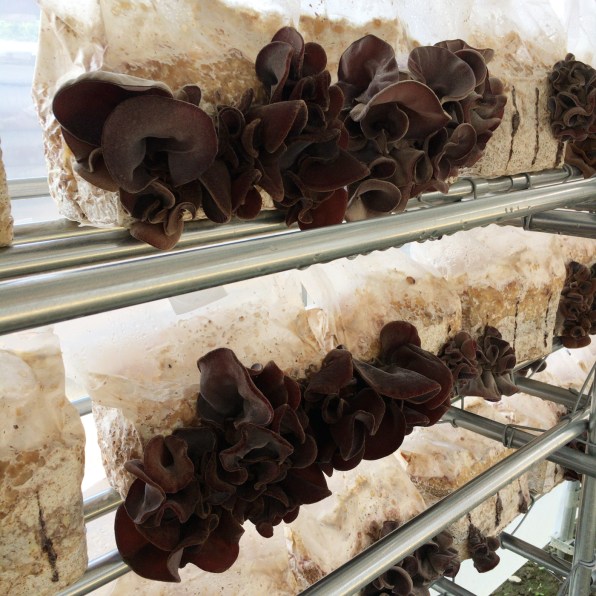
Solar arrays can reduce a farm’s carbon footprint while allowing room for crops and livestock. In Japan, Sustainergy has designed “solar farms at large scale so that farmers could obtain additional stable income.” Above, cloud ear mushrooms.

When a company solves two important problems with one project, I probably shouldn’t call it killing two birds with one stone. Send me a better metaphor, please.

Adele Peters writes at Fast Company about the dual benefits of a Japanese project that provides not only solar power but also a cozy place to grow mushrooms.

“Small farms in Japan are struggling to survive. Rural populations are shrinking, and the average farmer is 67 years old. But two new farms will test a different business model to try to reinvigorate the sector: solar panels with mushrooms growing underneath them.

“The farms, at two locations in northeastern Japan, will produce a combined 4,000 kilowatts of solar power that will be sold to a local utility, while the mushroom farms will yield an annual 40 tons of cloud-ear mushrooms, a crop that is typically imported from China.

“ ‘The environment needs to be dark and humid for mushrooms to spawn,’ says Minami Kikuchi, who leads the ‘solar sharing’ project that combines agriculture and solar power at Sustainergy, a renewable energy startup. ‘We simply created the suitable environment for them by making use of vacant space under the solar panels.’ ”

As Kikuchi explained to Fast Company in an email, ” ‘We designed the project of combination with solar farms at large scale so that farmers could obtain additional stable income. Of course, this renewable energy technology is contributing to the sustainable development of Japan too.’

“Today, an estimated 10% of Japanese farmland is not in use, despite the fact that the majority of food is imported. Government tariffs have discouraged companies from converting farmland to solar power generation, but a partial change in regulations in 2013 meant that solar power was more viable – provided that it was constructed in combination with agriculture. …

“Sustainergy believes that similar farms could potentially grow other crops that need little light, such as potatoes. In the U.S., researchers at the University of Massachusetts are exploring the possibility of growing a much wider range of crops; a farm in South Deerfield has spent the last two years growing plants like kale, broccoli, and Swiss chard under rows of nine-foot-high solar panels. …

“Farmers also have another option: Grazing sheep or cattle on grass grown under solar panels. Sheep can take the place of lawnmowers, and as the grass sucks up carbon dioxide from the atmosphere, the farm can have a negative carbon footprint.”

More at Fast Company, here.

Read Full Post »

Kurds in Ireland


Photo: Paulo Nunes dos Santos for The New York Times
Carrick-on-Shannon, a small town in the west of Ireland, where a group of Kurdish refugees were resettled from Iraq over a decade ago.

No one should claim that adjustment to life in a completely unfamiliar world is easy, but when refugees have no choice but to try and when communities have many kindhearted people, it can work.

Here is a story of how Kurdish refugees adapted to life in Ireland, of all places — and how their new home adapted to them.

Megan Specia writes at the New York Times, “A bold black-and-red sign announces Jamshid Ghafur’s business — ‘Kurdish Barber’ — up a narrow flight of stairs just off the main street of Carrick-on-Shannon in western Ireland. …

“ ‘I am happy with this small business,’ he said as he gestured around the shop with pride. ‘I feel like home here.’

“Mr. Ghafur, 37, is part of a thriving group of Kurds who adopted this small town as their own after a United Nations-supervised refugee resettlement program brought them here more than a decade ago.

“Kajal Allakarami, 29, was 17 when she arrived. … ‘Maybe it wasn’t our ways, maybe it wasn’t our traditions,’ she said, ‘but the way they respected us was huge.’

“In 2005 and 2006, around 100 Kurdish refugees, most Muslim, arrived in Carrick-on-Shannon, population 5,000, plucked from decades of displacement. …

“The government provided social welfare and language courses for the adults, while the children enrolled in the local schools. Volunteers brought food and clothes, [Fawzieh] Amiri said. Among them was Nora Burke, a Roman Catholic nun, who visited Mrs. Amiri weekly to help her practice English.

“Still, the adjustment was not easy. Sister Nora said some locals resented the state-funded support the Kurds received.

“ ‘Carrick-on-Shannon was not prepared,’ she said. ‘They just arrived and some in Carrick thought: “God, who are these people? Where did they come from? What are they here for?” ‘ …

“But bit by bit, the Kurds established themselves. …

“For members of the younger generation, resettlement has been a complex process of not just understanding Ireland but of coming to terms with their Kurdish and Irish identities. …

“Some found the adjustment more difficult. Jabar Azizi and his twin brother were 16 when their family arrived.

“ ‘My age group, it was really, really difficult for us,’ Mr. Azizi said. ‘Even though I was in Ireland, my mind was somewhere else.’

“Still, he made it through school, and credits the small town.

“ ‘They respected us and our religion,’ Mr. Azizi said. ‘They respected the way we wanted to live.’ …

“But it took tragedy for the Azizi family and the rest of the Kurdish community to know they had found a true home with their new Irish neighbors.

“In March 2012, Jalal Azizi, Jabar’s twin, was swimming with friends in the Shannon river during a rare warm snap when he got into difficulty and drowned. The whole town was shaken. Shops shut their doors and residents lined the road to pay their respects as the 21-year-old’s funeral cortege passed by.

“ ‘To be honest, we didn’t expect that with our brother,’ Mr. Azizi said. ‘His death really touched everyone.’ …

“ ‘When he passed away, we saw all the community from Carrick-on-Shannon gathering in my house,’ Mr. Azizi said. ‘It is something I will never forget in the years to come; it is something I will tell my son about.’ ”

More here.

Read Full Post »


Photo: Rupa Shenoy
Mayor Betty Roppe oversaw Prineville’s transformation after data centers injected new life. “We can keep the small-town feel. I’m sure of it,” Roppe says. “We don’t want to be a big city.”

I’m not always a fan of today’s tech giants, but I have to admit that when they provide jobs where there were no jobs, they are saviors.

This story tells how a dying town proved it was worthy of a tech company’s investment. Rupa Shenoy at Public Radio International reports this episode of PRI’s “50 States: America’s place in a shrinking world.”

“Everything people post on Facebook actually lives somewhere in real life — like a small town in central Oregon that was once decimated by the loss of manufacturing industries. …

“Steve Forrester’s grandparents got here in 1902. When he was growing up in the 1970s, Prineville was idyllic.

“ ‘It was a magical, magical place to grow up,’ he remembers. … ‘And everybody had a job, and everyone did well.’ …

“But when the federal government restricted logging and increased protections for animals … the city’s milling industry was decimated … Forrester took a job with one of the few remaining mills, because he wanted to live in Prineville.

“Eric Klann was driven by the same devotion. He’s the seventh generation of his family to live here. Out of college, he also took a job in Prineville that he knew wouldn’t last. …

“A few years later, the nationwide housing bubble burst and demand declined for housing parts made by the last mills. Lots of people lost jobs and left. It felt like Prineville couldn’t catch a break.

“Both Forrester and Klann felt lucky to land jobs at the city — Forrester as city manager, Klann as city engineer. Their chance to save Prineville came in 2009, arriving in the form of a mysterious email from a company called Vitesse.

“ ‘For the longest time, we had no idea what Vitesse meant,’ he says. …

“Vitesse wanted to build a big warehouse and fill it with rows and rows of servers — servers that tend to get hot. Central Oregon’s cold nights could cool them naturally. Klann remembers the first in-person meeting with Vitesse, and how it felt like Prineville’s last chance. …

“Klann and Forrester decided to outperform the other cities Vitesse was considering. They showed the company their small town could move at big-city speed, by responding to Vitesse’s questions day and night. …

“Their strategy worked, and in 2010, Prineville finally learned who Vitesse actually is. Mayor Betty Roppe was at the new data center’s groundbreaking.

“ ‘They had the big finger with a thumb-up Facebook sign, and we all pressed the button and it lit up, et cetera,’ she recounts. ‘That was the big announcement — it was Facebook.’ ”

More at PRI, here.

Read Full Post »

101817-Brush-Gallery-Vets-Ribbens-quilt

My former Minnesota boss, Ann Ribbens, has always quilted, even when her day job was something completely different. Her quilts have been in a number of shows and in a book published by Mary Ann’s company, Quarry: 1000 Quilt Inspirations, by Sandra Sider.

Recently, one of Ann’s quilts was accepted by the Brush Gallery in Lowell, Massachusetts, for an art exhibit honoring veterans. The show was diverse and included military artifacts, paintings, and photography. I thought Ann’s quilt was especially wonderful.

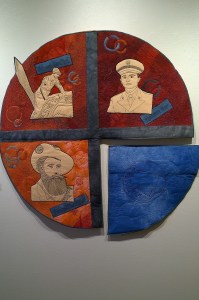
The quilt narrates the stories of three family members who served — one in the Boer War (lower left panel), one in World War II (upper left), and one in Vietnam (upper right). The fourth panel expresses her longing for peace and an end to all that veterans suffer in war and on their return from war.

I love the combination of gratitude and hope that these portraits represent, the war colors expressing the heat of battle and the cool blue expressing serenity.

The exhibit was presented in conjunction with Ironstone Farm of Andover, Massachusetts, which provides veterans who have experienced trauma and anxiety with a healing “equine encounter” one day a week for eight weeks. (“I never thought a horse could teach me so much about myself,” says one participant.)

101817-Lowell-MA-Ribbens-quilt

101817-Boer-War-Ribbens-quilt


Read Full Post »


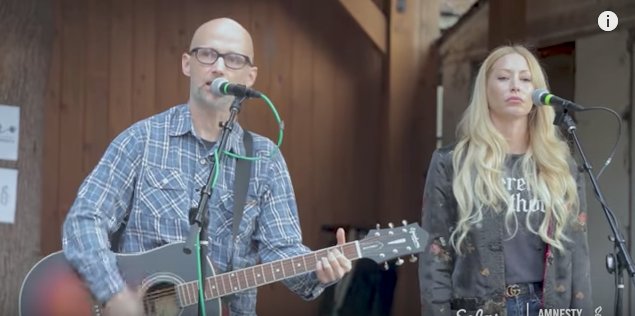
On September 20, Moby took part in #giveahome 2017 – a day of secret shows in homes around the world in solidarity with refugees. It was organized by Amnesty International and Sofar Sounds. Watch here, http://on.moby.com/2gUdSuL.

Many artistic people are sensitive to the struggles of the disenfranchised. That’s why as many as 1,000 musicians answered a call from Amnesty International to contribute their talents in support of refugees this past September.

Writes Amnesty, “Across more than 200 cities in 60 countries, musicians, artists, activists and local communities came together in a statement of support for the world’s refugees.

“Give a Home, a collaboration between Amnesty International and Sofar Sounds, saw living rooms across the globe play host to more than 300 special performances from some of the world’s leading musicians. …

“From the thousands of Rohingya currently fleeing Myanmar, to the desperate situation faced by those escaping conflicts in Syria and South Sudan, the world is in the grip of its worst refugee crisis since the Second World War. The global refugee population now stands at more than 22 million people.

“ ‘As the Secretary General I travel a lot and meet a lot of different people. But one person I have never met is a refugee who wanted to be a refugee. By definition, a refugee is a person fleeing a desperate situation of conflict or persecution. They are some of the most vulnerable people in the world,’ said Salil Shetty, Amnesty International’s Secretary General. …

“Of those 22.5 million, almost all are hosted outside the wealthiest nations, with just ten of the world’s 193 countries hosting more than half its refugees.

“ ‘While it’s a huge number, refugees represent only 0.3% of the world’s population. When we look at it that way, it seems crazy to me that we can’t find a home for all of them,’ said Salil Shetty. …

“Amnesty International’s research shows that four in five people around the world are open to welcoming refugees, while a recent attitudes survey by the World Economic Forum show that a huge 85% of young people in the US would welcome refugees.” More at Amnesty, here.

Read Full Post »

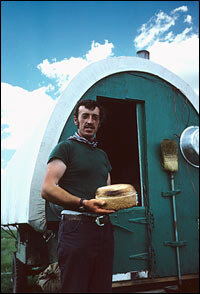
Photo: Richard Lane/Basque Library, University of Nevada, Reno
A herder holds freshly baked bread. His sheep wagon was a camp on wheels with beds, a table, and a wood stove. In the early days, a team of horses pulled the wagons.

I was driving to Providence and listening to the radio when I heard a story about Basque men who emigrated to the American West years ago because they needed jobs and because Idaho, Nevada, and other states needed shepherds.

Although the Basques actually knew nothing about being shepherds, they persisted, and today significant Basque communities remain.

Kimberlee Kruesi writes at the Associated Press, “Idaho is home to one of the biggest concentrations of Basques in the United States. … Basques began settling in southwestern Idaho as early as the late 1800s, with many coming from the Basque region on the border of Spain and France to work as sheepherders in Idaho. Nearly 8,000 residents of the Gem State identify as Basque today. …

“The Basque Museum and Cultural Center is packed with exhibits that explore the lives of the first Basque sheepherders, including a sheep wagon and full-size sheepherder’s tent. …

“The Basque Market … has become famous for preparing large portions of paella, served with homemade baked bread every Wednesday and Friday right on the patio. …

At National Public Radio, the Kitchen Sisters reported on the life of Basques in Nevada.

“Francisco and Joaquin Lasarte came to America in 1964 from Basque country in northern Spain. Francisco Franco, the Spanish dictator who repressively ruled the country for nearly 40 years, made life miserable for the Basque people, suppressing their language, culture and possibilities.

“The result was a massive exodus, and the only way to come to the United States for many Basque was to contract as sheepherders. There was a shortage of shepherds in the American West. …

“Neither Lasarte brother had any sheepherding experience when they arrived in America.

” ‘You lonely, you by yourself,’ Francisco Lasarte said. ‘My God, you with 2,000 sheep and two dogs and you don’t know what to do, where to go.’

“The brothers were contracted for five years to this life. It was a sentence.

“Each brother had his own flock, and they rarely saw each other or anyone else for months on end. Mostly they ate lamb and bread cooked in a Dutch oven in a hole they dug in the ground. You can still find these holes up in the mountains of Idaho, Montana, Nevada and California.

” ‘You say Basque to a Westerner and you think sheepherder,’ said Mark Kurlansky, author of The Basque History of the World. “In Basque country very few people were shepherds.’ …

“William Douglass, former director of the Center for Basque Studies at the University of Nevada, Reno, describes this solitary life.

” ‘Teenagers were ripped up out of their communities back home, brought to a foreign land, with a foreign language, put up on top of a mountain … crying themselves to sleep at night during the first year on the range.’

“The Basques have a family-oriented, communal culture, gathering around big tables to eat, drink and sing. This solitary life in remote mountains ran against the grain.” More at NPR, here.

Photo: Kimberlee Kruesi/The Associated Press
The Basque Center displays both the United States flag and Basque flag in Boise, Idaho.

Read Full Post »

Sundial

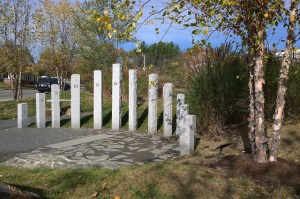
There is in a pocket park in Acton, Mass., a most unusual sundial. I discovered it quite by accident, tucked into a hill between a strip mall and a bank.

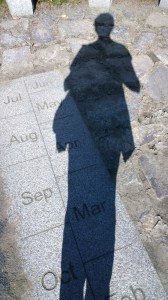
To tell the time on a sunny day, you must stand on a paving stone carved with the month of the year. Pillars, or columns, of varying heights indicate the hours. The first time I tried, in October, my shadow told me it was about 2 pm. In November, according to my shadow, I was there about noon.

I have Googled every phrase I can think of and have found nothing about either this park or the particular way of constructing a sundial. If anyone can enlighten me, I’d greatly appreciate it.

110417-pillar-sundial-ActonMA

110417-column-sundial-Acton


101917-sundial-says-2-pm

110417-before-noon-sundial


101917-sundial-Acton-MA


Read Full Post »


There’s a website called “The Conversation” that reported recently on scientific research into how the words for color are used in different languages.

Ted Gibson and Bevil R. Conway wrote, “People with standard vision can see millions of distinct colors. But human language categorizes these into a small set of words. In an industrialized culture, most people get by with 11 color words: black, white, red, green, yellow, blue, brown, orange, pink, purple and gray. …

“Maybe if you’re an artist or an interior designer, you know specific meanings for as many as 50 or 100 different words for colors – like turquoise, amber, indigo or taupe. But this is still a tiny fraction of the colors that we can distinguish.

“Interestingly, the ways that languages categorize color vary widely. Nonindustrialized cultures typically have far fewer words for colors than industrialized cultures. … The Papua-New Guinean language Berinmo has only five, and the Bolivian Amazonian language Tsimane’ has only three words that everyone knows, corresponding to black, white and red.

“The goal of our project was to understand why cultures vary so much in their color word usage. …

“In English, it turns out that people can convey the warm colors – reds, oranges and yellows – more efficiently (with fewer guesses) than the cool colors – blues and greens. …

“We found that this generalization is true in every language in the entire World Color Survey (110 languages) and in three more that we did detailed experiments on: English, Spanish and Tsimane’. …

“Our idea is that maybe we introduce words into a language when there is something that we want to talk about. So perhaps this effect arises because objects – the things we want to talk about – tend to be warm-colored. …

“We mapped the colors in the images [of objects] onto our set of 80 colors across the color space. It turned out that indeed objects are more likely to be warm-colored, while backgrounds are cool-colored. …

“When you think about it, this doesn’t seem so surprising after all. Backgrounds are sky, water, grass, trees: all cool-colored. The objects that we want to talk about are warm-colored: people, animals, berries, fruits and so on. …

“[This] communication hypothesis helped identify a true cross-linguistic universal – warm colors are easier to communicate than cool ones – and it easily explains the cross-cultural differences in color terms. It also explains why color words often come into a language not as color words but as object or substance labels. For instance, ‘orange’ comes from the fruit; ‘red’ comes from Sanskrit for blood. In short, we label things that we want to talk about.”

More here. The article gets pretty technical, but after struggling last Tuesday to find warm and cool colors in a jumbled box for ESL students, I appreciate having confirmation that warm colors (red, orange, yellow) have fewer competing names than cool ones (blue, blue-green, violet, purple, aquamarine, turquoise …).

Read Full Post »

Photo: Michael Desmond
Rumi Spice, which sells saffron from Afghanistan, makes a pitch on the TV show “Shark Tank.” It takes 150 Saffron Crocus flowers to make one gram of the coveted spice.

Most cooks know that the spice called saffron, essential for dishes like paella, is expensive. But much of what is available in the US is fake. That’s where some military veterans come in.

Catherine Clifford at CNBC has the story.

“Rumi Spice appeared on ‘Shark Tank’ seeking a $250,000 investment for five percent equity. The three co-founders — Emily Miller, Kim Jung and Keith Alaniz — all served in the military in Afghanistan. They learned that the war-torn country is covered with the purple flowers that make saffron, one of the most expensive spices in the world. They also learned that Afghan saffron is some of the best quality saffron in the world. …

“To bring more business and more money to the farmers in Afghanistan, Rumi Spice built an infrastructure to sell saffron harvested in Afghanistan to consumers in the United States.

“Rumi Spice sells one gram of saffron for $18, one ounce for $140. ‘It’s so expensive because there is no automation, it all has to be hand processed,’ says Jung, who, along with Miller, is both a West Point and Harvard Business School graduate. …

” ‘I don’t think there is a political risk because we are operating with the farmers, we are giving them incentive to produce and we are giving them an incentive to protect their investment,’ said Alaniz [in answer to a question]. …

“[Dallas-based tech entrepreneur Mark] Cuban offered the entrepreneurs a $250,000 investment for 15 percent equity, more than three times what the founders were hoping to give away of their company for the cash. However, he insisted there is no room for negotiation.

“Cuban gave two reasons for making the deal, despite the problems other sharks see in the young company: He respects their work to empower Afghani farmers and he likes to work with veterans.

“The entrepreneurs accepted the deal. …

” ‘Striking a deal with Mark Cuban is a game changer, for the women in Afghanistan who work for us, for the farmers in Afghanistan,’ Miller said.”

More here. The CNBC story has beautiful pictures from Rumi Spice’s twitter feed, @rumi_spice. And the company’s blog is fascinating.

Read Full Post »


Photo: Lemon42
Follow along at Vienna State Opera in any of six languages with the new subtitle system.

My husband and I use the subtitle feature for DVDs we get from Netflix, even when the movies are in English. We’re not hard of hearing, but it’s so easy to miss what people are saying — especially if the film is from England and the characters speak Mumblecore.

For the oddball plots of operas, subtitles can be even more important. Consider what the Vienna State Opera has done to keep patrons from too much confusion.

Elsabeth Parkinson reports at Limelight Magazine, “The Vienna State Opera has replaced its 16-year-old seat-back system with a new setup offering opera libretti in up to six languages …

“Since the opening of the company’s 2017/2018 earlier this month, subtitles are offered from suitably dimmed screens, in English, German, Italian, French, Russian and Japanese.

“A pre-performance information system provides such useful things to know as plot synopses, cast lists, and any general current news to do with the activities of the company. Audience members are able to view a list of frequently asked questions, or subscribe to the Vienna State Opera’s monthly newsletter. …

“Several other opera companies around the world have been diversifying their sub- and super-titling options in recent years. In New York, the Metropolitan Opera has been building on their custom-designed Met Titles system since 1995, and today it offers opera translations in English, Spanish, German and Italian. Opera Australia’s annual outdoor production Handa Opera on Sydney Harbour has allowed the audience to follow along in either English or Chinese since last year. …

“ ‘It’s extremely beneficial for [tourists] to be able to read the text in the language that they’re most comfortable with,’ [Opera Australia’s Artistic Director Lyndon Terracini] said. …

” ‘The trick is making it as unobtrusive as possible, so that you don’t detract from the performance and having it in the back of the seat is a fantastic solution to that.’ ”

Implementing such a system is more difficult when opera companies don’t own their home venues, of course.

“ ‘There are only a few companies in the world that have in-seat surtitles, and to the best of my knowledge they are only offered in venues which are controlled by those companies,’ [Victorian Opera’s Managing Director Andrew Snell] says.” More at Limelight, here.

Do you enjoy opera? I don’t go as often as I’d like. I do appreciate help with text. One of the reasons I thoroughly enjoyed Resurrection, which composer Tod Machover based on a story by Leo Tolstoy, was that it had supertitles. Of course, when you use words above the stage, you really can have only one language.

Read Full Post »

« Newer Posts - Older Posts »