Feeds:
Posts
Comments

Archive for the ‘Uncategorized’ Category

122617-dirndl-on-VT-hospitality-worker

Dressing in Austrian dirndl at Trapp Family Lodge, Stowe, Vermont.

Nearly five years ago, when I was an editor, I solicited an article on Latino dairy workers from Daniel Baker at the University of Vermont. Dairy farms are practically synonymous with Vermont, where cows dot the mountainous landscape. The article summarized Dr. Baker’s research showing how essential immigrants were to the Vermont dairy industry’s survival. (Read the piece here.)

Of late, however, Vermont dairy farmers are anxious about their industry’s viability as walls both figurative and solid threaten the labor supply.

Visiting the state this week, I did note that there seemed to be a good supply of immigrants or former immigrants working in the hospitality industry at least.

I try not to ask people where they are “from” since friends in my Race in America group at the Fed have convinced me it’s a question that can make people feel unwelcome. But I was interested when someone whose way of speaking suggested Africa came to fix the hotel shower and when I noted the dirndl-garbed young lady above working the breakfast shift.

According to 2015 data from Migration Policy, Vermont has 2,619 residents born in Africa (9.3 % of the state’s foreign-born population in 2015), 8,199 born in Asia (29%), 9,113 born in Europe (32.3%), 3,038 born in Latin America (10.8%), 4, 875 born in North America, with small places like Greenland added to that mix (17.3%), and 403 born in Oceana (1.4%). By far the largest group is from Canada, which borders Vermont on the north. Vermont would be a more empty state than it is and nearly devoid of workers without all the foreign born.

If you’re interested in more, take a look at American Migration Council’s Vermont data, too. It’s here.

Read Full Post »

treasurehunt

Photo: No Strings Marionette Company
In this production,
Treasure Hunt, a boy called Jim is lured out to sea, where he encounters a mermaid, “a giant clam, a fish that swallows him whole, an electric eel and an angry octopus guarding his treasure.”

Tuesday night at the Trapp Family Lodge, my husband and I watched a charming puppet show about a fox called Sharp Ears. The show was created and performed by the Vermont-based No Strings Marionette Company. Our four grandchildren were too tired for theater after a day of skiing, but we were charmed — especially by unusual marionettes like the frog, the chicken and chicks, the rooster, the grasshopper, the cow, and the numerous butterflies and flying bugs. And in case the theatrical company’s title threw you off, the puppets do have strings.

We very much enjoyed hanging around afterwards to listen to the questions that children asked the puppeteers: how do you make puppets? how do you make them move? how did you make the bench? did you paint your sets or buy them? do you have other shows?

Puppeteers Dan Baginski and Barbara Paulson have about 12 other shows, which they tour widely, keeping them so busy that the story of Sharp Ears took them two years to create at night — instead of the four months in which they could have finished if they’d been able to work nonstop.  “Sharp Ears” is still new, not even up on the website yet.

The show was based on the Czech story called “The Adventures of the Vixen Known as Sharp Ears,” on which the opera The Cunning Little Vixen is also based. In this version, a henpecked woodcutter who’d rather hang out in nature than do his chores brings home a fox as a pet for his grandson, with unfortunate consequences for the farm.

Dan and Barbara, says their website, “have toured America together for over sixteen years.  Their traveling stage transforms any space into an intimate theater, where the seamless blend of movement, music and masterful manipulation captivates young and old alike.

“With puppeteers in full view,  the audience sees how the puppets are brought to life. These Vermont artisans lovingly hand craft the marionettes, props and scenery, whether for an original tale or an adaptation of a classic.

“Shows begin with an interactive song featuring audience members, and finish with demonstrations sparked by the audiences’ curious questions.”

More here.

Photo: No Strings Marionette Company
Puppet characters from
The Hobbit.

hobbit


Read Full Post »


Photo: True Story Theater
An Arlington, Mass., theater troupe performs the stories of ordinary people.

Recently, John told me about an unusual improvisational theater group that will perform your story. Called True Story Theater, it is affiliated with the worldwide Playback Theatre movement, which seeks to right wrongs experienced by minorities and marginalized groups by putting their actual words into plays to build understanding.

From the website: “True Story Theater is a nonprofit theater company that offers 50-75 improvisational performances and workshops a year for community groups, businesses, and individuals mostly in the greater Boston area. We work with hospitals, universities, corporations, religious communities, with teen leaders, cancer survivors, activists, philanthropists, business leaders …

“Our mission is to build empathy and respect in community through honoring all of our true stories.

“In performances, volunteers from the audience are helped to share what’s important in their lives. On the spot, actors then portray the heart of what they heard using music, movement, and dialogue. From this simple interaction, people laugh, cry, share fresh insights, and bond. … True Story Theater offers audiences fresh perspectives, deeper connections, and a renewed appreciation for our common humanity.”

The troupe says it employs many dramatic styles but is especially indebted to the technique of Playback Theatre, which “was founded in 1975 by Jonathan Fox and Jo Salas in New Paltz, NY. …

“Globally, Playback is often used to reach disenfranchised people and to build understanding where conflict had driven people apart. A few examples:

“Southern India: Groups of Dalit people have used Playback Theatre to assert their rights. Western Australia: Playback has helped landowners and Aboriginal people find common ground. Burundi: Hutu and Tutsi actors work together in a Playback troupe in a country healing civil war.”

Watch samples from performances here.

True Story Theater is also available to draw people out at weddings and other such events.

Read Full Post »

otherwiseman4

Art: Robert T. Barrett
The “other” wise man, meeting the needs that cross his path, is too late to present gifts to the baby in the manger. But “Inasmuch as thou hast done it unto one of the least of these my brethren, thou hast done it unto me.” (Matthew 25:40)

I loved this story as a child. Just for you, I present a summary from Wikipedia, slightly edited.

“The Story of the Other Wise Man,” by Henry van Dyke, was initially published in 1895. The story is an expansion of the account of the Biblical Magi. It tells about a “fourth” wise man, a priest of the Magi named Artaban, one of the Medes from Persia. Like the other Magi, he sees signs in the heavens proclaiming that a King had been born among the Jews. Like them, he sets out to see the newborn ruler, carrying treasures to give as gifts to the child — a sapphire, a ruby, and a “pearl of great price.”

However, he stops along the way to help a dying man, which makes him late to meet with the caravan of the other three wise men. Because he missed the caravan, and he can’t cross the desert with only a horse, he is forced to sell one of his treasures in order to buy the camels and supplies necessary for the trip. He then commences his journey but arrives in Bethlehem too late to see the child, whose parents have fled to Egypt. He saves the life of a child at the price of another of his treasures.

He then travels to Egypt and to many other countries, searching for Jesus for many years and performing acts of charity along the way. After 33 years, Artaban arrives in Jerusalem just as Jesus as been condemned to death. He spends his last treasure, the pearl, to ransom a young woman from being sold into slavery. He is then badly injured in an accident and realizes he is dying. He has failed to meet Jesus because he has been busy meeting the needs that appear before him.

Then he hears a voice: “Verily I say unto thee, Inasmuch as thou hast done it unto one of the least of these my brethren, thou hast done it unto me.”(Matthew 25:40) His treasures have been accepted.

Read Full Post »

122117-candle-in-darkness

Among the many gifts our country has received from Mexico is the luminaria, which some of us put outside our homes on Christmas Eve. This gift originated back when Mexico was called New Spain and still included Texas.

I first learned about the custom in upstate New York years ago when, exhausted from wrapping presents, I took a walk around the neighborhood in the snowy darkness. “What’s that?” I wondered at one neighbor’s house. “How lovely!”

Since that year, I have put candles out every Christmas Eve in rain or snow, fair weather or foul. Sometimes the candles are in paper bags weighted with kitty litter. Sometimes they are in glass vases collected from florists.

This year my husband and I are cutting back a bit on the festivities at our house as we’re going to John’s church Christmas Eve and then to Vermont so that most of the family can ski (my husband, our kids, their spouses, our grandkids). I myself have three very fat library books that I hope to read in front of a nice fire.

Back to luminaria. I just looked it up on Wikipedia. Here is the entry, edited.

A luminaria is a small paper lantern (commonly a candle set in some sand inside a paper bag) which is of significance in the U.S. state of New Mexico at Christmas time, especially on Christmas Eve.

Traditional Christmas Eve luminarias are said to originate from Spaniard merchants impressed with Chinese paper lanterns. The paper bags are typically arranged in rows to create large and elaborate displays. The hope among Roman Catholics is that the lights will guide the spirit of the Christ child to one’s home.

More.

Whatever holidays you celebrate, I hope you take delight in the oldest customs you know.

Photo: camerafiend/English Wikipedia
Christmas Eve luminaria (sometimes called farolito) are on display in Albuquerque, New Mexico.

800px-luminarias

Read Full Post »

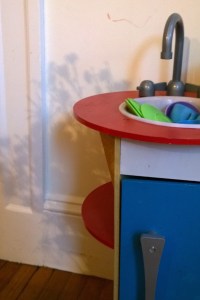
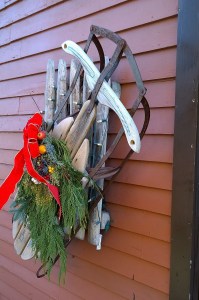
Before we head off for vacation (actually, I’m retired, so I’m always on vacation), I thought I’d post some more photos, especially as blogger KerryCan says she likes them. The general theme is winter, which began officially with the Winter Solstice on Thursday. I already imagine that I can perceive the increase in daylight. (Well, we believe what we want to believe.)

OK, what have we here? A shock of deciduous holly berries. We need to prune these bushes, but the shivering birds get to eat first.

Two shadow pictures and ESL students dancing at one Jewish Vocational Service holiday party. The dancers here are from Morocco, Ivory Coast, Puerto Rico and Haiti. The teacher is the woman in red. Everyone brought food. I especially loved the Chinese pot stickers and the Nepalese chicken curry. My chocolate chip cookies disappeared, too.

The Colonial Inn has an annual Gingerbread House display.

My 7-year-old grandson is a fierce hockey player whether on his team (Saturday 7 a.m. practice, Anyone?) or in this backyard rink created by John.

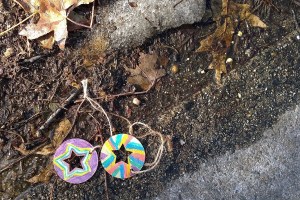
The last photos don’t really need commentary, but I thought the lost Christmas crafts were sweet and clearly wanted to be on some child’s tree. I hope they got a home.

122117-holly-berries

122117-shadows-at-Concord-Academy


121917-child-kitchen-and-shadows

122217-getting-down-at-ESL-party


122017-inn-since-1716

122017-annual-gingerbread-display


122017-annual-gingerbread-display

122117-icy-banks


122117-icy-banks

122117-Xmas-sled


122017-forgotten-ornament


Read Full Post »

singing

Photo: Teachingtimes.com
Could these faces lifted in song be any sweeter?

I was tired of “Deck the Halls,” “Jingle Bells,” and “I Saw Mommy Kissing Santa Claus” before I got through Thanksgiving this year. Maybe you felt the same. Why is it so rare to hear carols like “I Wonder as I Wander,” the haunting “Minuit, Chrétiens,” or authentic Gospel music at this season?

Today I decided to correct that loss a little with YouTube music that should not make anyone feel like running and hiding. I’d love it if you would share your favorite seasonal music with other readers in the Comments.

Above, the Choir of Kings College sings “In the Bleak Midwinter.” Next we have the Cambridge Singers with “I Wonder as I Wander.”

Finally, whatever one’s faith or feelings about religion, who can resist the voice of Harry Belafonte with his honeyed Jamaican diction? (Note where the person typing the lyrics wrote “the” instead of what he really said, which is so much more charming.)


Read Full Post »

Photo: Adam Grossberg/KQED

Ahmet Ustunel, who is blind, plans to kayak across the Bosphorus Strait in Turkey, like blind King Phineus of Greek mythology.

Never say studying Greek mythology fails to prepare a student for life. Laura Klivans’s story at Public Radio International will help you understand why it can be valuable.

“Ahmet Ustunel remembers his daily commute to high school well. He’d wake up at home, on the Asian side of Istanbul, Turkey, a city that straddles two continents. Then he would take a ferry across the Bosphorus Strait to the European side of the city. …

“Ustunel has been blind since he was three years old when he lost his sight because of eye cancer — but that never kept him away from the water. He spent afternoons fishing with his father and summers swimming in the Black Sea, where his grandmother had a house. …

“For the last 11 years, Ustunel has lived in the United States. … He plans to return to his homeland next summer to kayak solo across the Bosphorus Strait. …

“Ustunel first became inspired to captain his own boat in high school, while studying Greek mythology. …

” ‘There was this blind king called Phineus, and he used to live on the north side of the Bosphorus,’ he recalled. ‘His mission was guiding sailors in the dark safely to the Black Sea from the Mediterranean.’ …

“Earlier this year, Ustunel saw an opportunity … A nonprofit launched a new award to fund blind and visually impaired people undertaking adventures. The Holman Prize for Blind Ambition offers grants of up to $25,000 to accomplish a bold project. …

“LightHouse has been able to fund these creative projects after receiving an unexpected gift of $125 million from a Seattle businessman upon his death.

“For Ustunel, the money will help him buy the right kind of kayak and the instruments he will use to navigate. He’s documenting his training process on his website, where he calls himself ‘The Blind Captain.’

“So, how do you kayak if you can’t see? Ustunel says the first thing is to use your other senses, which can convey lots of information. …

“But to cross the Bosphorus, Ustunel will need more than just his senses. His journey will be just over 3 miles, but the strait is one of the busiest shipping channels in the world. The waters are dangerously crowded with huge freighters and tankers, alongside small ferries and fishing boats — and the currents are strong.”

At PRI, here, you can read about the many gadgets the kayaker is testing before he tackles the Bosphorous.

Read Full Post »

Photo: Flying Studio / Mary Corse, Kayne Griffin Corcoran
Mary Corse transformed the exterior of her studio into “Untitled (White Light Bands).” The art takes on an otherworldly glow at dusk.

Here is a story about art works that you have to see in person because the light shifts when you move.

Carolina A. Miranda reports at the Los Angeles Times,”If you stand outside of Mary Corse’s studio in Topanga Canyon at just the right hour, you might get to see one of her works come to life. The painter, who is known for playing with the properties of light, last year transformed the exterior of her studio into one of her largest pieces to date. Along the building’s exterior face, she painted a sequence of four simple columns employing one of the materials for which she is best known: white paint mixed with glass microbeads. The material is what gives street signs and lane markings their illuminative properties.

“ ‘They don’t reflect light, they prism,’ Corse says. ‘It makes a triangle between the surface, the viewer and light. So if the viewer moves, then it changes.’

“In broad daylight, the columns on Corse’s studio are barely perceptible. But at dusk, when the light dims, it is a different story. The moment the wall is hit by any stray beam of light, the columns take on an otherworldly glow.

The effect is that of a portal opening into a parallel universe. …

“Since the 1960s, the Los Angeles artist has produced a body of work that toys with light and the emotional states it can induce — using reflective and refractive materials to create pieces that can shift and change in surprising ways as you move before them. …

“As an artist, she has remained somewhat under the radar — known to a circle of art world insiders; less so to the general public.

“That is changing. [Corse had a November show at] Kayne Griffin Corcoran in Los Angeles, with works from various stages in her career — including an immersive environment she first conceived in the 1960s titled ‘The Cold Room,’ a free-standing structure kept at near-freezing temperatures, in which floats a spectral light box. …

“In May, Dia:Beacon, the temple to minimalism in New York’s Hudson Valley, will present a long-term installation of four recently acquired works covering the span of her career. And the following month, the Whitney Museum of American Art will open the doors on Corse’s first solo museum survey.

“ ‘It will be focusing on her critical moments,’ says the exhibition’s curator, Kim Conaty, ‘starting with her early experiments with shaped canvases, when she was beginning to think about how to find light within painting. …

” ‘She has not only used materials in innovative ways to literally capture light,’ Conaty says, “but to also capture the metaphysical qualities of light. And she has done a lot of it through painting.’ …

“Conaty says the work requires some commitment from the viewer.

“ ‘You pass it, you do the double take, you come back, you move along the side of it,’ she says. ‘You can’t just walk through.’ ”

Conaty is a close friend of Suzanne, so if you are in New York City in June, please go see the Mary Corse show she’s curating.

More on Corse at the Los Angeles Times, here.

Read Full Post »

Dec.19… Kiffles

This cookie recipe from Deb’s grandmother looked too delicious not to share. Here you go … today’s bonus!

sevencubs's Blog

I had mentioned about a year ago that I would explain more on how to do Kiffles, I think I procrastinated.

Not any more will I procrastinate, here goes on how to make kiffles , a real favorite in this household. It is an old recipe handed down from my Grammy.

In a large bowl put a pound of butter (2cups) if it is not room temperature than warm butter in microwave. Add 1 cup of sour cream ,3 egg yolks and one whole egg. ( Set egg whites aside for tomorrow) 2 teaspoons of salt, 1 heaping tablespoon of yeast or one pack, and 4 cups of white flour. I mix all the ingredients except for the flour and yeast, which I add to the flour, then work the flour in by hand. The dough will be sticky rather like cookie dough.

Refrigerate overnight to let it rise.

Next…

View original post 253 more words

Read Full Post »

Photo: Pekka Sipola/EPA
Finland is experimenting with a guaranteed income.

Recently I posted about a guaranteed-income pilot program in Kenya that MIT’s rigorously data-driven Abdul Latif Jameel Poverty Action Lab (J-PAL) will be evaluating over the next few years.

Now I see that Finland is testing the concept, too.

Aditya Chakrabortty wrote about Finland’s experiment last month at the Guardian. “In a speck of a village deep in the Finnish countryside, a man gets money for free. Each month, almost €560 [about $660] is dropped into his bank account, with no strings attached. The cash is his to use as he wants. Who is his benefactor? The Helsinki government.”

Juha Järvinen “is a human lab rat in an experiment that could help to shape the future of the west. Last Christmas, Järvinen was selected by the state as one of 2,000 unemployed people for a trial of universal basic income [UBI]. …

“Finland is the first European country to launch a major dry run. It is not the purists’ UBI – which would give everyone, even billionaires, a monthly sum. Nor will Finland publish any results until the two-year pilot is over at the end of 2018. …

“Ask Järvinen what difference money for nothing has made to his life, and you are marched over to his workshop. Inside is film-making equipment, a blackboard on which is scrawled plans for an artists’ version of Airbnb, and an entire little room where he makes shaman drums that sell for up to €900. All this while helping to bring up six children. All those free euros have driven him to work harder than ever.”

Even more than the money, the freedom from the country’s welfare bureaucracy is key.

“In Finland, €560 is less than a fifth of average private-sector income. … [Järvinen’s] liberation came in the lack of conditions attached to the money. If they so wish, Finns on UBI can bank the cash and do nothing else. But, in Järvinen’s case at least, the sum has removed the fear of utter destitution, freeing him to do work he finds meaningful. …

“Social affairs minister Pirkko Mattila … seems genuinely bemused that there could be any political resistance to handing poor people some money to sit at home. ‘I personally believe that in Finland citizens really want to work,’ she says.”

More at the Guardian, here.

Read Full Post »

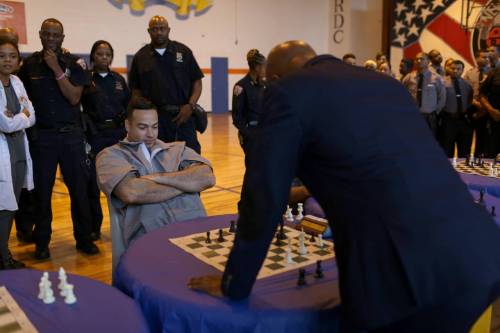
bn-vu227_nyches_m_20171025125530Photo: Bess Adler for The Wall Street Journal
Rikers Island inmate Camilo Arcelay faced off against chess grandmaster Maurice Ashley at the Rikers Island jail complex.

I like articles about better ways to prepare prison inmates for a return to society. In this 2015 post, for example, I wrote about a jailhouse debate club that beat Harvard, raising the spirits and aspirations of prisoners at the Eastern New York Correctional Facility.

Today’s story concerns a serious chess competition in a notorious New York City prison.

Zolan Kanno-Youngs at the Wall Street Journal writes, “On a rainy afternoon at the Rikers Island Jail Complex [in October] five men and one woman wearing tan uniforms sat in front of chess boards surrounded by an audience of correction officers and fellow inmates.

“Maurice Ashley, a 2003 U.S. Chess Federation grandmaster of the year walked from one board to the next, simultaneously playing six games. One by one, he eliminated the inmates — except for Camilo Arcelay, 37 years old, who used his king to take Mr. Ashley’s last pawn. That left Mr. Arcelay and Mr. Ashley with a king as their last piece.

“The result was a draw — enough for Mr. Ashley, who also judged the event, to name Mr. Arcelay the winner of the first chess tournament, which is slated to become an annual event at Rikers Island.

“ ‘To be in a situation that I’m in right now in jail, it leaves me speechless,’ Mr. Arcelay said, referring to his chess victory. ‘Because I’ve made so many bad decisions to be here.’

“The final round of the 2-month tournament is part of a series of programming designed to educate and reduce idleness funded by a $38.9 million New York City initiative.

” ‘It teaches them how to think, how to strategize, in an environment that is conducive to those things,’ said James Walsh, department of corrections deputy commissioner of adult programming & community partnerships.

“While this was the first official tournament at Rikers, chess has long been popular behind bars. Carl Portman, 53, the author of Chess Behind Bars, and the manager of prisons chess for the English Chess Federation, said the game’s history in prisons dates to World War II, when inmates would create chess pieces from scrap materials, and differentiate the two sides by using coffee powder to dye some pieces. …

“At Rikers, the seed for the tournament was planted two years ago when corrections officer Gregory Lamb bought a chess set so he could play with 16- and 17-year-old inmates. Prison officials soon asked him to organize sessions with adult inmates twice a week. That evolved into the tournament organized by the corrections’ Adult Programs Unit that began two months ago with 800 inmates participating.

“ ‘Inmates are probably the best chess players because they play all day,’ Mr. Lamb noted. …

“During the games, inmates stood on bleachers cheering, critiquing and moving their arms on imaginary boards as if they, too, were participating.

“ ‘Society wastes so much when we don’t channel the energy and capabilities of those who have been incarcerated,’ Mr. Ashley said.”

More at the WSJ, here.

Read Full Post »


Photo: Library of Congress/Wikimedia
Frances Densmore at the Smithsonian Institution in 1916 during a recording session with the Blackfoot tribal leader called Mountain Chief for the Bureau of American Ethnology.

I can understand that one might be able to resurrect a mastodon that was frozen in ice, but how do you resurrect an extinct language? Turns out the answer is lasers and wax recordings. (Takes me back to my father’s clunky wire recorder and what I had to say in my 6-year-old voice on the static-filled recording we call “The Birth of Willie.”)

Allison Meier writes at Hypoallergic, “Among the thousands of wax cylinders in the University of California (UC) Berkeley’s Phoebe A. Hearst Museum of Anthropology are songs and spoken-word recordings in 78 indigenous languages of California. Some of these languages, recorded between 1900 and 1938, no longer have living speakers. The history on the cylinders is difficult to hear. The objects have deteriorated over the decades, mold eating away at their forms, cracks breaking through the sound.

“A project underway at UC Berkeley is using innovative optical scan technology to transfer and digitally restore these recordings. … The initiative aims to preserve about 100 hours of audio. he collaborative restoration project involves linguist Andrew Garrett, digital librarian Erik Mitchell, and anthropologist Ira Jacknis, all at UC Berkeley, and utilizes a non-invasive scanning technique developed by Lawrence Berkeley National Laboratory physicists Carl Haber and Earl Cornell. …

“Anthropologist Alfred Kroeber began his field audio collecting in 1901, a month after becoming the curator of the then-new museum. Although the recordings are limited, each only a few minutes long, and were captured at a subjective start and stop by Kroeber, they are invaluable for understanding the diverse languages of indigenous life in California.”

According to Hypoallergic, the project website warns that “due to ‘the culturally sensitive material of the content on these cylinders, and out of respect for the contemporary descendants of many of the performers on the recordings, access to the majority of the audio being digitized is currently restricted.’ One of the publicly available recordings is that of Ishi, recognized as the last surviving member of his Yahi tribe, who lived out his final years at Hearst Museum. His voice, among many being recovered from the noise of the wax cylinders, leads the recently-shared video from [National Science Foundation] below.”

More at Hyperallergic, here.

Read Full Post »

Photo: David Brichford
This eight-panel folding screen, a late 1800s example of Korean “Chaekgeori,” makes one observer think of a kind of instagram photo popular today. The screen was displayed in a recent Cleveland Museum of Art exhibition.

Some people call instagram pictures of their beautifully appointed bookshelves “shelfies.” They might think the fad is a 21st C. idea, but in 18th C. Korea, something similar was going on.

Claire Voon writes about the Cleveland Museum of Art’s recent chaekgeori exhibit at the website Hyperallergic.

“You could call it a very early precursor to the ‘shelfie.’ Long before we were snapping pictures of our bookshelves to show off our literary troves on the ‘gram, there was chaekgeori, a style of Korean still-life painting that emerged in the late 18th century. Spread across the panels of folded screens, these images of near-life-size bookshelves were also meant to express an individual’s intellect, and often stood in a scholar’s room as a beautiful, dignifying backdrop.

“More broadly, they were markers of one’s social status, putting on full view the objects of refined taste and affluence. Chaekgeori (pronounced check-oh-ree) literally means ‘books and things.’ Aside from tomes stacked on tomes on tomes, these massive paintings also featured writing tools, luxury goods from abroad, and gourmet delicacies, all neatly arranged. …

“The interest in depicting bookshelves grew under the reign of King Jeongjo of the Joseon Dynasty, between 1776 and 1800, and flourished through the early 20th century. As Sooa McCormick, the museum’s assistant curator of Korean art explained, Jeongjo [began] commissioning chaekgeori as a royal emblem to display around his royal throne. …

“ ‘Books became a symbol of high social status and power,’ McCormick told Hyperallergic. … ‘Learned individuals made up a very, very small percent of the population.’ …

“In a few instances, screens also included Western objects: one of the paintings on view [in Cleveland] boasts a rare depiction of European mechanical clocks — a subtle yet significant record of the kinds of cultural exchanges that occurred during this period.

” ‘When historians look at ancient, premodern Korea, they often describe Korea as “a hermit kingdom” — as if Korea never really interacted with the bigger world,’ McCormick said. ‘But when you look at these works, you see that Koreans traveled to Beijing, and that European materials were also introduced to Korean audiences at the time.”

More at Hyperallergic, here. (This lead came from twitter.)

Read Full Post »

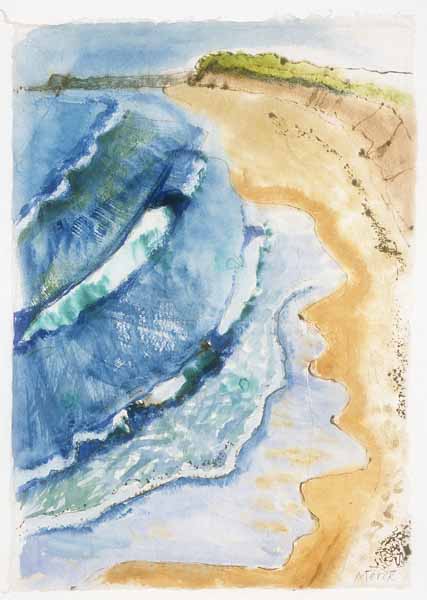
Art: Josie Merck
Mansion Beach, New Shoreham, Rhode Island

Oh, my poetry-loving readers, you are in for a treat! Praised by poets Lisa Starr and Naomi Shihab Nye and US Senator Sheldon Whitehouse, among others, a book of paintings and poems that captures a powerful love of a place just became available. It’s Present on Block Island, by poet Nancy Greenaway and painter Josie Merck.

I have written about Nancy Greenaway in several posts, including the time she asked for feedback on her owl poem. Her collaborator Josie Merck is both a fine painter and an extraordinary benefactor of environmental causes. Her love of nature, especially in Rhode Island, is palpable in the art illustrating the collection.

I welcomed like an old friend Nancy’s owl poem, but the other poems were new to me. They cover a variety of themes, especially the joy that the beauty of nature can inspire. But there are also poems about friendships; a poem about a big-shot visitor who failed to engage school children; a moving contribution about a brush with death (the plane’s fuel line froze; “we all now know/ just how we’d handle/ a situation like that”); a funny one about being trapped in brambles near home and calling out for help before deciding to crawl on her belly to safety; and a very touching poem about island great Fred Benson, who lived to 101 and hoped that the afterlife would be something like Block Island.

I enjoyed Nancy’s many intriguing turns of phrase, too — like a new meaning for “weather underground” and the reference to ice cream as George Washington’s “revolutionary dessert.”

You can find the book at http://www.lulu.com. Or you can call the Island Bound Bookstore at 1 401 466 8878, as I did to buy my copy with a credit card. It arrived in the mail soon after.

From “Astonished,” by Nancy Greenaway

“Each morning that I wake
“to sun painting black sky blue
“and inhale ocean-chilled air,
“I am astonished.

“First glance out my window
“grants me cloud migrations
“over Great Salt Pond,
“sails on Long Island Sound.

“I drive to work with crows,
“gulls, hawks, terns, herons
“following overhead,
“pass waddling ducks, walkers,

“check ocean choppiness
“in scene-slots between dunes,
“wave to fellow drivers
“who wave to me in turn. …

Read Full Post »

« Newer Posts - Older Posts »